This report highlights the discrimination, harassment, violence, and non-consensual medical interventions faced by intersex people across 30 European countries, based on responses from nearly 2,000 participants in FRA's 2023 EU LGBTIQ Survey III. It reveals that many intersex individuals also identify as trans, non-binary, gender-diverse and have varied sexual orientations, which further compounds their experiences of discrimination. The report aims to support the development of laws and policies that promote the inclusion and dignity of intersex people.
This publication is an excerpt from the Fundamental Rights Report 2025, the annual report of the European Union Agency for Fundamental Rights (FRA). It presents selected critical developments in fundamental rights in 2024, as well as the key findings and FRA opinions from the report’s chapters.
Cette publication est un extrait du rapport annuel de l’Agence des droits fondamentaux de l’Union européenne (FRA), le Fundamental Rights Report 2025 (Rapport sur les droits fondamentaux 2025). Elle présente une sélection de développements critiques en matière de droits fondamentaux en 2024, ainsi que les principales conclusions et avis de la FRA dans les
chapitres du rapport.
The Fundamental Rights Report 2025 is the annual report of the European Union Agency for Fundamental Rights (FRA). It provides an overview of the state of fundamental rights in the EU and highlights selected critical developments and trends in 2024. The report covers issues such as inclusive elections, gender-based violence, and the implementation of the EU Charter of Fundamental Rights. It presents FRA’s opinions on these developments, setting out the actions that the EU and Member States should take. This annual publication is a valuable resource for those seeking to stay informed about the EU’s shifting landscape of fundamental rights.
In recent years, the EU has taken steps to improve child protection, yet some Member States do not have an integrated approach. FRA first produced an overview of child protection systems in the EU in 2014, and an update in 2023. The data is published in FRA’s ‘Mapping of Child Protection Systems in the EU – Update 2023’. This report completements the 2023 update with comparative analysis and provides greater detail on children in vulnerable situations, care and the participation of children in matters affecting them. It also offers guidance on creating comprehensive frameworks that ensure that children’s rights are respected.
This technical report presents in detail the stages of the survey implementation and the relevant information needed to assess the quality and reliability of the data.
Racism towards Muslims is increasing in countries across the EU. Muslims face racial discrimination and racist harassment because of their religion, skin colour or ethnic background. This report shows a sharp rise since the last survey in 2016.
The third iteration of the EU LGBTIQ Survey of the European Union Agency for Fundamental Rights (FRA), was conducted in 2023. It presents the experiences of LGBTIQ people across the EU 27 Member States, and the candidate countries Albania, North Macedonia and Serbia, on the extent to which they enjoy fundamental rights. It provides policymakers with a solid empirical basis for evidence-based policies to ensure respect and protection for and fulfilment of the fundamental rights of LGBTIQ people. This interactive data explorer shows data from the survey for over 150 questions and contains multiple options for filtering, exporting and sharing the data.
FRA’s third LGBTIQ survey shows that people still experience hate-motivated violence and discrimination. Trans and intersex people face even greater victimisation. Yet, signs of progress show that the EU’s and Member States’ efforts can positively affect people’s lives. More LGBTIQ people are open about their sexual orientation, gender identity, gender expression and sex characteristics.
Children’s rights exist to ensure the safety and wellbeing of every child. Improved child protection systems ensure that these rights are met. In recent years, the EU has taken significant steps to improve child protection systems. This mapping of child protection systems gives an overview of the state of such systems at national level and developments since 2015. It promotes the improvement of integrated child protection systems. It is an update of FRA’s mapping of child protection systems in 2015, based on data collected in 2023 in the 27 EU Member States. By publishing this, FRA aims to support securing the sustainable well-being, safety and rights of all children living in the EU.
FRA's first Being Black in the EU report exposed widespread and entrenched racism against people of African descent in Europe. Now updated with new data, this report revisits the situation revealing persistent racial discrimination, harassment and violence. Overall, experiences of racial discrimination increased in the EU countries since 2016, reaching as high as 77%. The lack of progress is alarming despite binding anti-discrimination law in the EU since 2000 and significant EU policy developments since then.
FRA’s Fundamental Rights Report 2023 reviews major developments in the field in 2022, identifying both achievements and areas of concern. It also presents FRA’s opinions on these developments, including a synopsis of the evidence supporting these opinions.
Les organisations de la société civile sont confrontées à divers défis dans l’Union européenne. Le rapport de l’Agence des droits fondamentaux de l’Union européenne sur la protection de l’espace civique dans l’UE présente les conclusions de l’Agence sur ces défis. Il a été publié en septembre 2021. Ce résumé présente les principales conclusions et les avis de l’Agence exposés dans le rapport.
Civil society organisations play a vital role in promoting fundamental rights, but they face diverse challenges across the European Union. This report presents FRA’s findings on a range of such challenges. The findings are based on research, and on two online consultations with civil society organisations, carried out in 2020.
Les organisations de la société civile jouent un rôle essentiel dans la promotion des droits fondamentaux, mais sont confrontées à diverses problématiques dans l’Union européenne. Ce rapport présente les conclusions de la FRA concernant quelques-unes de ces problématiques, conclusions qui se fondent sur des recherches ainsi que sur deux consultations en ligne auprès d’organisations de la société civile, menées en 2020.
FRA’s Fundamental Rights Report 2021 reviews major developments in the field in 2020, identifying both achievements and areas of concern. It also presents FRA’s opinions on these developments, including a synopsis of the evidence supporting these opinions. This year’s focus chapter explores the impact of the COVID-19 pandemic on fundamental rights. The remaining chapters cover: the EU Charter of Fundamental Rights; equality and non-discrimination; racism, xenophobia and related intolerance; Roma equality and inclusion; asylum, borders and migration; information society, privacy and data protection; rights of the child; access to justice; and the implementation of the Convention on the Rights of Persons with Disabilities.
This opinion illustrates the extent and nature of lived experiences of inequality and discrimination across the EU. It does so with reference to the grounds of discrimination and areas of life covered by the racial and employment equality directives, as well as in relation to the grounds and areas covered by the proposed Equal Treatment Directive.
FRA’s second survey on LGBTI people in the EU, North Macedonia and Serbia surveyed almost 140,000 participants. This technical report presents a detailed overview of the survey methodology used by FRA when collecting the survey data.
This report reviews how asylum claims based on sexual
orientation and gender identity are assessed and analyses the existence of
specific reception measures for LGBTI persons.
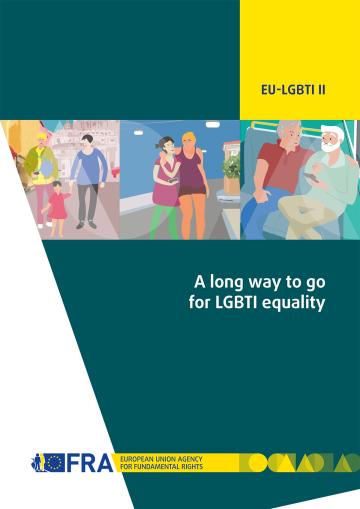
While awareness of the rights of lesbian, gay, bisexual, transgender and intersex (LGBTI) persons is on the rise across the European Union, hurdles to their full enjoyment of their fundamental rights remain. This report updates FRA’s 2010 report on homophobia, transphobia and discrimination on grounds of sexual orientation and gender identity.