Top Menu

  • Om FRA
  • Samarbejde
  • Newsroom
  • Cookies
  • Contact

Select site language

  • Български
  • Čeština
  • Dansk
  • Deutsch
  • Ελληνικά
  • English
  • Español
  • Eesti
  • Suomi
  • Français
  • Gaeilge
  • Hrvatski
  • Magyar
  • Italiano
  • Lietuvių
  • Latviešu
  • Malti
  • Nederlands
  • Polski
  • Português
  • Română
  • Slovenčina
  • Slovenščina
  • Svenska

Custom Topbar

Home

Search the FRA website

      • Work on rights
        • Retfærdighed, ofres rettigheder og retligt samarbejde
          • Ofrenes rettigheder
          • Forsvarets rettigheder
          • Civilret
          • Retligt samarbejde og retssamfund
          • Sikkerhed
          • Erhvervslivet og menneskerettigheder
        • Ligestilling, ikkeforskelsbehandling og racisme
          • Børn, unge og ældre
          • Mennesker med handicap
          • Hadforbrydelser
          • Racemæssig eller etnisk baggrund
          • Religion og tro
          • Roma
          • Sex, seksuel orientering og kønsidentitet
        • Asyl, migration og grænser
          • Adgang til asyl
          • Grænser og informationssystemer
          • Beskyttelse af børn
          • Irregulær migration, tilbagesendelse og tilbageholdelse i forbindelse med immigration
          • Regulær migration og integration
          • Ulovlig handel og udnyttelse af arbejdskraften
        • Databeskyttelse, privatlivets fred og ny teknologi
          • Kunstig intelligens og big data
          • Grænser og informationssystemer
          • Databeskyttelse
          • Ulovlig profilering
        • Støtte til menneskerettighedssystemer og -forkæmpere
          • EU's charter om grundlæggende rettigheder
          • Mellemstatslige menneskerettighedssystemer
          • Nationale menneskerettighedssystemer og -organer
          • Civilsamfundet
        • Environmental and social sustainability
          • Climate change and environmental protection
          • Just and green transition
          • Business and human rights
          • Human rights due diligence
          • Consumer protection
      • EU's charter om grundlæggende rettigheder
        • Hvad er grundlæggende rettigheder?
        • What is the EU Charter of Fundamental Rights?
        • Præambel
        • Afsnit I: Værdighed
          • 1 - Den menneskelige værdighed
          • 2 - Ret til livet
          • 3 - Ret til respekt for menneskets integritet
          • 4 - Forbud mod tortur og umenneskelig eller nedværdigende behandling eller straf
          • 5 - Forbud mod slaveri og tvangsarbejde
        • Afsnit II: Friheder
          • 6 - Ret til frihed og sikkerhed
          • 7 - Respekt for privatliv og familieliv
          • 8 - Beskyttelse af personoplysninger
          • 9 - Ret til at indgå ægteskab og ret til at stifte familie
          • 10 - Ret til at tænke frit og til samvittigheds
          • 11 - Ytrings
          • 12 - Forsamlings
          • 13 - Frihed for kunst og videnskab
          • 14 - Ret til uddannelse
          • 15 - Erhvervsfrihed og ret til at arbejde
          • 16 - Frihed til at oprette og drive egen virksomhed
          • 17 - Ejendomsret
          • 18 - Asylret
          • 19 - Beskyttelse i tilfælde af udsendelse, udvisning og udlevering
        • Afsnit III: Ligestilling
          • 20 - Lighed for loven
          • 21 - Ikke-forskelsbehandling
          • 22 - Kulturel, religiøs og sproglig mangfoldighed
          • 23 - Ligestilling mellem kvinder og mænd
          • 24 - Børns rettigheder
          • 25 - Ældres rettigheder
          • 26 - Integration af mennesker med handicap
        • Afsnit IV: Solidaritet
          • 27 - Ret til information og høring af arbejdstagerne i virksomheden
          • 28 - Forhandlingsret og ret til kollektive skridt
          • 29 - Ret til arbejdsformidling
          • 30 - Beskyttelse i tilfælde af ubegrundet opsigelse
          • 31 - Retfærdige og rimelige arbejdsforhold
          • 32 - Forbud mod børnearbejde og beskyttelse af unge på arbejdspladsen
          • 33 - Familieliv og arbejdsliv
          • 34 - Social sikring og social bistand
          • 35 - Sundhedsbeskyttelse
          • 36 - Adgang til tjenesteydelser af almen økonomisk interesse
          • 37 - Miljøbeskyttelse
          • 38 - Forbrugerbeskyttelse
        • Afsnit V: Borgerrettigheder
          • 39 - Stemmeret og valgbarhed til Europa-Parlamentet
          • 40 - Stemmeret og valgbarhed til kommunale valg
          • 41 - Ret til god forvaltning
          • 42 - Ret til aktindsigt
          • 43 - Den Europæiske Ombudsmand
          • 44 - Ret til at indgive andragender
          • 45 - Fri bevægelighed og opholdsret
          • 46 - Diplomatisk og konsulær beskyttelse
        • Afsnit VI: Retfærdighed i retssystemet
          • 47 - Adgang til effektive retsmidler og til en upartisk domstol
          • 48 - Uskyldsformodning og ret til et forsvar
          • 49 - Legalitetsprincippet og princippet om proportionalitet mellem lovovertrædelse og straf
          • 50 - Ret til ikke at blive retsforfulgt eller straffet to gange for samme lovovertrædelse
        • Afsnit VII: Almindelige bestemmelser
          • 51 - Anvendelsesområde
          • 52 - Rækkevidde og fortolkning af rettigheder og principper
          • 53 - Beskyttelsesniveau
          • 54 - Forbud mod misbrug af rettigheder
      • Tools
        • EU Fundamental Rights Information System - EFRIS
        • Criminal detention database
        • Anti-Muslim hatred database
        • National human rights structures navigator
        • Case-law database
        • Charterpedia
        • FRA e-learning platform
        • Data visualisation
        • Equality data collection: promising practices
        • Fighting hate crime: promising practices
      • Produkter
    • About FRA
      • Who we are
        • Structure of FRA
        • Management Board
          • Management Board members
          • Management Board meeting documents
        • Executive Board
        • Scientific Committee
          • Scientific Committee members
        • Director
        • Management team
      • What we do
        • Research and data
        • Capacity-building
        • Advising
        • Convening people
        • FRA for children
          • What are my rights?
          • Where do my rights come from?
        • Areas of work
          • Multi-annual Framework 2007-2022
        • Work Programme
          • Archive
        • Annual Activity report
          • Archive
        • Projects
      • Working at FRA
        • Vacancies and selections
          • Previous vacancies
        • What we offer
        • Work-life balance
        • Application instructions
        • Seconded National Experts
        • Traineeship
        • Study visits at FRA
      • Procurement
        • Ongoing procedures
        • Closed procedures
        • Contracts awarded
      • Finance and budget
        • Financial Rules
        • Financial documents
      • Aktindsigt
        • Access to documents
        • Anmodningen om aktindsigt
      • Data protection within FRA
        • Records registry
    • Cooperation
      • EU-institutionerne og andre -organer
        • European Parliament
        • Council of the European Union
        • European Commission
        • EU agencies
          • Justice and Home Affairs Agencies Network
        • European Committee of the Regions
        • European Economic and Social Committee
        • European Ombudsman
        • EU CRPD Framework
          • Promotion
          • Protection
          • Monitoring
          • Review process
          • Resources
      • EU’s medlemsstater
        • National Liaison Officers
        • National Parliaments
      • Europarådet
      • Civilsamfundet og platformen for grundlæggende rettigheder
        • Activities
        • Civic space
        • Platform library
        • How to register
      • Nationale menneskerettighedsinstitutioner, ligestillingsorganer samt ombudsmandsinstitutioner
      • FN, OSCE og andre internationale organisationer
        • EEA and Norway Grants
      • FRANET
    • Newsroom
      • Media contacts
      • News
      • Press releases
      • Stories
      • Events
        • Past Events
      • FRA products 2026
        • FRA products 2025
        • FRA products 2024
        • FRA products 2023
        • FRA products 2022
        • FRA products 2021
        • FRA Products 2020
        • FRA Products 2019
      • Multimedia
        • Videos
        • Infographics
        • Podcasts
      • Speeches
      • Press packs
        • EU LGBTIQ survey - Press pack
        • Fundamental Rights Survey
        • EU LGBTI survey II
        • From institutions to community living for persons with disabilities: perspectives from the ground
        • Second European Union Minorities and Discrimination Survey – Main results
        • Second European Union Minorities and Discrimination Survey (EU-MIDIS II) Muslims
        • Together in the EU: Promoting the participation of migrants and their descendants
        • Second European Union Minorities and Discrimination Survey (EU-MIDIS II) Roma
        • Severe labour exploitation in the EU
        • Child-friendly justice – perspectives and experiences of professionals: Press pack
        • Fundamental rights at EU borders
        • Violence against women press pack
        • Jewish people’s experiences and perceptions of hate crime, discrimination and antisemitism
        • EU LGBT Press pack
        • Child-friendly justice – perspectives and experiences of children
      • Newsletter
    • Account
      • Log in

Main menu

Home
  • Work on rights
    Work on rights
    • Retfærdighed, ofres rettigheder og retligt samarbejde
      • Ofrenes rettigheder
      • Forsvarets rettigheder
      • Civilret
      • Retligt samarbejde og retssamfund
      • Sikkerhed
      • Erhvervslivet og menneskerettigheder
    • Ligestilling, ikkeforskelsbehandling og racisme
      • Børn, unge og ældre
      • Mennesker med handicap
      • Hadforbrydelser
      • Racemæssig eller etnisk baggrund
      • Religion og tro
      • Roma
      • Sex, seksuel orientering og kønsidentitet
    • Asyl, migration og grænser
      • Adgang til asyl
      • Grænser og informationssystemer
      • Beskyttelse af børn
      • Irregulær migration, tilbagesendelse og tilbageholdelse i forbindelse med immigration
      • Regulær migration og integration
      • Ulovlig handel og udnyttelse af arbejdskraften
    • Databeskyttelse, privatlivets fred og ny teknologi
      • Kunstig intelligens og big data
      • Grænser og informationssystemer
      • Databeskyttelse
      • Ulovlig profilering
    • Støtte til menneskerettighedssystemer og -forkæmpere
      • EU's charter om grundlæggende rettigheder
      • Mellemstatslige menneskerettighedssystemer
      • Nationale menneskerettighedssystemer og -organer
      • Civilsamfundet
    • Environmental and social sustainability
      • Climate change and environmental protection
      • Just and green transition
      • Business and human rights
      • Human rights due diligence
      • Consumer protection
  • EU's charter om grundlæggende rettigheder
    EU's charter om grundlæggende rettigheder
    • Hvad er grundlæggende rettigheder?
    • What is the EU Charter of Fundamental Rights?
    • Præambel
    • Afsnit I: Værdighed
      • 1 - Den menneskelige værdighed
      • 2 - Ret til livet
      • 3 - Ret til respekt for menneskets integritet
      • 4 - Forbud mod tortur og umenneskelig eller nedværdigende behandling eller straf
      • 5 - Forbud mod slaveri og tvangsarbejde
    • Afsnit II: Friheder
      • 6 - Ret til frihed og sikkerhed
      • 7 - Respekt for privatliv og familieliv
      • 8 - Beskyttelse af personoplysninger
      • 9 - Ret til at indgå ægteskab og ret til at stifte familie
      • 10 - Ret til at tænke frit og til samvittigheds
      • 11 - Ytrings
      • 12 - Forsamlings
      • 13 - Frihed for kunst og videnskab
      • 14 - Ret til uddannelse
      • 15 - Erhvervsfrihed og ret til at arbejde
      • 16 - Frihed til at oprette og drive egen virksomhed
      • 17 - Ejendomsret
      • 18 - Asylret
      • 19 - Beskyttelse i tilfælde af udsendelse, udvisning og udlevering
    • Afsnit III: Ligestilling
      • 20 - Lighed for loven
      • 21 - Ikke-forskelsbehandling
      • 22 - Kulturel, religiøs og sproglig mangfoldighed
      • 23 - Ligestilling mellem kvinder og mænd
      • 24 - Børns rettigheder
      • 25 - Ældres rettigheder
      • 26 - Integration af mennesker med handicap
    • Afsnit IV: Solidaritet
      • 27 - Ret til information og høring af arbejdstagerne i virksomheden
      • 28 - Forhandlingsret og ret til kollektive skridt
      • 29 - Ret til arbejdsformidling
      • 30 - Beskyttelse i tilfælde af ubegrundet opsigelse
      • 31 - Retfærdige og rimelige arbejdsforhold
      • 32 - Forbud mod børnearbejde og beskyttelse af unge på arbejdspladsen
      • 33 - Familieliv og arbejdsliv
      • 34 - Social sikring og social bistand
      • 35 - Sundhedsbeskyttelse
      • 36 - Adgang til tjenesteydelser af almen økonomisk interesse
      • 37 - Miljøbeskyttelse
      • 38 - Forbrugerbeskyttelse
    • Afsnit V: Borgerrettigheder
      • 39 - Stemmeret og valgbarhed til Europa-Parlamentet
      • 40 - Stemmeret og valgbarhed til kommunale valg
      • 41 - Ret til god forvaltning
      • 42 - Ret til aktindsigt
      • 43 - Den Europæiske Ombudsmand
      • 44 - Ret til at indgive andragender
      • 45 - Fri bevægelighed og opholdsret
      • 46 - Diplomatisk og konsulær beskyttelse
    • Afsnit VI: Retfærdighed i retssystemet
      • 47 - Adgang til effektive retsmidler og til en upartisk domstol
      • 48 - Uskyldsformodning og ret til et forsvar
      • 49 - Legalitetsprincippet og princippet om proportionalitet mellem lovovertrædelse og straf
      • 50 - Ret til ikke at blive retsforfulgt eller straffet to gange for samme lovovertrædelse
    • Afsnit VII: Almindelige bestemmelser
      • 51 - Anvendelsesområde
      • 52 - Rækkevidde og fortolkning af rettigheder og principper
      • 53 - Beskyttelsesniveau
      • 54 - Forbud mod misbrug af rettigheder
  • Tools
    Tools
    • EU Fundamental Rights Information System - EFRIS
    • Criminal detention database
    • Anti-Muslim hatred database
    • National human rights structures navigator
    • Case-law database
    • Charterpedia
    • FRA e-learning platform
    • Data visualisation
    • Equality data collection: promising practices
    • Fighting hate crime: promising practices
  • Produkter

You are here

  • Home
  • Work On Rights
  • Environmental and social sustainability
  • Just and green transition
  • Fundamental rights and housing in the EU’s climate and energy transition
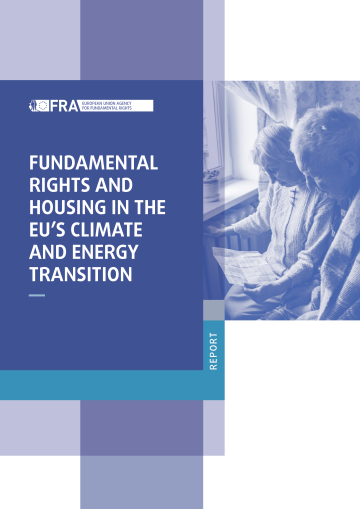
Cover with title and image showing elderly couple with blankets around their shoulders sitting in front of  radiator and holding a energy bill in their hand.
AdobeStock@Solarisys
29
January
2026

Fundamental rights and housing in the EU’s climate and energy transition

Just and green transition
Environmental and social sustainability
Making homes energy efficient and equipping them with clean energy can help the EU to reach its climate and energy goals. These measures improve living conditions and support fighting energy poverty, but they can also compromise affordability and displace low-income families. This report looks at housing renovation and clean energy installation programmes and wider EU climate and energy transition policies. It analyses their impact on fundamental rights. It finds that measures often inadvertently exclude people or risk exacerbating existing inequalities. Climate and social policies must comply with fundamental rights obligations. This report builds on FRA’s 2025 publication: Towards a fundamental rights-compliant European Green Deal.
Read Press Release
  • Read Online
  • Related
Export to PDF
Search inside this publication
  • Key findings and FRA opinions
    • Integrating fundamental rights into the climate and energy transition
      • FRA opinion 1
    • Strengthening fundamental rights safeguards in designing and implementing energy renovation policies
      • FRA opinion 2
      • FRA opinion 3
    • The lack of equal access to renovation measures impacts the right to housing
      • FRA opinion 4
    • Protecting the rights of tenants in energy renovations
      • FRA opinion 5
    • People confronted with housing deprivation are at risk of being left behind in the climate and energy transition
      • FRA opinion 6
    • Participation and stakeholder engagement in the energy transition is often a one-off exercise and is not inclusive
      • FRA opinion 7
    • Lack of transparency and information for complaint mechanisms hinder access to justice
      • FRA opinion 8
    • Need for integrated and systematic monitoring and data collection for a just climate and energy transition
      • FRA opinion 9
  • Introduction
  • 1. Access to energy and the right to housing in the climate and energy transition
    • 1.1 International framework on access to affordable and sustainable energy
    • 1.2 The link between the right to housing and sustainability
    • 1.3 Energy as an essential service in the European Union’s framework
      • 1.3.1 Addressing energy poverty to ensure health and an adequate standard of living
      • 1.3.2 Right of access to energy – including renewable energy – and users’ rights
    • 1.4 Energy renovations for achieving affordable and sustainable housing in the European Union
    • 1.5 Conclusion
  • 2. Fundamental rights in the European Union climate and energy governance
    • 2.1 Fundamental rights in the National Energy and Climate Plans
      • 2.1.1 Equality and non-discrimination in national energy and climate plans
      • 2.1.2 Gender equality
      • 2.1.3 Vulnerability and equal access to energy
      • 2.1.4 Access to affordable housing
    • 2.2 National Energy and Climate Progress Reports
    • 2.3 Conclusion
  • 3. Non-discrimination and leaving no one behind in the energy transition
    • 3.1 Equal access to renovation and energy transition measures
      • 3.1.1 Target groups and access criteria
      • 3.1.2 Tenure status and renovations: exclusion of tenants
      • 3.1.3 Support measures essential for ensuring equal access to the programmes in practice
      • 3.1.4 Funding is necessary to ensure access for people with lower incomes
    • 3.2 Energy poverty and attention to people in situations of vulnerability
      • 3.2.1 Risks and prevalence of energy poverty in the European Union
      • 3.2.2 Tackling energy poverty among people in vulnerable situations
    • 3.3 Conclusion
  • 4. Participation and stakeholder engagement in the energy transition
    • 4.1 Ensuring the right to information: transparency and awareness
    • 4.2 Participation and stakeholder engagement
    • 4.3 Conclusion
  • 5. Accountability: effective structures for fundamental-rights-compliant energy policy implementation
    • 5.1 Fundamental-rights-compliant funding and finances
    • 5.2 Monitoring and data collection
    • 5.3 Access to justice and complaints mechanisms
      • 5.3.1 Complaint and review mechanisms in energy renovation programmes lack consistency and transparency
      • 5.3.2 The role of ombudsperson institutions, equality bodies, national human rights institutions and other stakeholders
    • 5.4 Conclusion
  • Conclusions
  • Annex 1 – Methodology
  • Acronyms and abbreviations
  • About this publication


1. Access to energy and the right to housing in the climate and energy transition

Access to energy is recognised as a prerequisite for the fulfilment of human rights such as the right to health and education, and also as an element of the right to an adequate standard of living, including the right to housing, in the decisions and commentaries of international human rights mechanisms.

Energy renovations – modernisation and retrofitting of buildings and dwellings aimed at improving their energy efficiency or equipping them with access to modern and clean energy installations – are not widely considered a fundamental rights issue, yet they may impact fundamental rights in a variety of ways. Such measures enable access to clean and affordable energy and adequate housing, on which the enjoyment of many fundamental rights depends. A climate-resilient house is key to protecting its inhabitants from the negative impacts of climate change.

The Charter enshrines a number of rights and principles that should be considered in the context of energy renovations (See Legal corner – The EU Charter of Fundamental Rights protecting equal access to energy and housing).

Legal corner – The EU Charter of Fundamental Rights protecting equal access to energy and housing 

The Charter protects equal access to energy and housing through several provisions and principles, namely access to services of general economic interest (Article 36) and the right to social and housing assistance to combat social exclusion and poverty (Article 34). It also prohibits any form of discrimination (Article 21). 

Other relevant Charter provisions include:

  • the right to human dignity (Article 1);
  • respect for private and family life (Article 7);
  • equality between men and women (Article 23);
  • the rights of the child (Article 24), elderly (Article 25)andpersonswith disabilities (Article 26).

This chapter outlines considerations on access to energy and the right to housing in the current EU and international human rights law context, in particular how access to energy is linked to fundamental rights, and how the right to housing may be impacted by energy renovations.


1.1 International framework on access to affordable and sustainable energy

In international human rights law, access to energy is considered primarily in the context of housing. The right to housing under international human rights law is an explicit element of the right to an adequate standard of living (Article 11 of the ICESCR, general comments No 4 (1991) and No 7 (1997) of the Committee on Economic, Social and Cultural Rights, along with Article 28 of the CRPD and Article 27 of the Convention on the Rights of the Child). While the ICESCR does not explicitly include energy as a component of this right, the United Nations (UN) Committee for Economic, Social, and Cultural Rights has confirmed that access to energy and electricity is required in the context of the right to adequate housing under Article 11 (General Comments No 4 (1991) and No 7 (1997)). Moreover, the International Court of Justice has opined that:

[T]here is a close connection between the environment and the right to an adequate standard of living, which, for its part, encompasses access to food, water and housing, as set out in Article 11 of the ICESCR and Article 25 of the Universal Declaration of Human Rights.

International Court of Justice, Advisory Opinion on obligations of states in respect of climate change of 23 July 2025, paragraph 380.

Goal 7 of the UN Sustainable Development Goals (SDGs) calls for universal access to affordable, reliable, sustainable and modern energy. Access to energy is also necessary for the realisation of rights enshrined in the ESC (see Legal corner – Human rights and access to energy under the revised ESC: the Cañada Real Galiana decision).

Legal corner – Human rights and access to energy under the revised ESC: the Cañada Real Galiana decision

In its decision on Complaint No 206/2022, published in February 2025, the European Committee of Social Rights decided on a complaint regarding the impact of the lack of access to electricity on the fundamental social rights of residents of Cañada Real Galiana. It is a large shanty town in Madrid, Spain, where around 4 500 people, including 1 800 children, have been affected by power outages, negatively impacting different aspects of their lives and health.

The Committee has found the violation of a number of rights under the ESC, including:

  • the right to housing (Article 31), as stable, consistent and safe access to adequate energy is necessary in ‘adequate housing’;
  • the right of the family to social, legal and economic protection (Article 16),as regards the right to adequate housing and the right of families concerned and their associations to be involved in decision-making on policies and measures that concern them;
  • the right to protection of health (Article11), including prevention of ill-health (Article11§1) and protection from epidemics, diseases and domestic accidents (Article11§3);
  • the right of children and young people to social, legal and economic protection (Article17, including Article17§1 and Article17§2 as regards the right of children to education);
  • the right to protection against poverty and social exclusion (Article30);
  • the right of elderly people to social protection (Article23); and
  • the right of people with disabilities to independence, social integration and participation in the life of the community (Article15§3).

Source: European Committee of Social Rights, Decision on merits – Defence for Children International (DCI), European Federation of National Organisations working with the Homeless (FEANTSA), et al. v. Spain, Complaint No 206/2022, 11 September 2024.

The United Nations Convention on the Elimination of All Forms of Discrimination against Women, ratified by all EU Member States, is the only international human rights law that explicitly enshrines a human right to energy (electricity). Article 14(2)(h) includes electricity as an element of rural women’s right to adequate living conditions. In its General Recommendation No 34 (2016), the Committee on the Elimination of Discrimination against Women highlights the gender dimension of ‘poor access to modern energy supplies and services’.

Policy context – Conceptualisations of a self-standing right to energy in policy and academic literature

While international human rights law so far does not establish a self-standing right to energy (Hesselman (2022)), some scholars and civil society representatives have argued for acknowledgment of such a right based on the importance of energy access to fulfil basic human needs – analogous to the recognition of the right to water (e.g. Tully (2008), Walker (2016)). In this context authors point out the need to consider certain aspects of access to energy and energy services, such as the rights to use energy and energy affordability (Walker(2016)), along with the rights to information, choice and participation (Shyu (2021)). There is no consensus as to what elements a self-standing right to energy should comprise. The need for a human-rights-based approach to energy is seen as a way to operationalise and implement ‘energy justice’ concepts (Huhta (2023), Wewerinke-Singh (2021)) and to address energy poverty (the Right to Energy Coalition, see also Hesselman et al. (2019)).


1.2 The link between the right to housing and sustainability

Energy renovations impact the right to housing, beyond ensuring access to clean energy. They are an opportunity to ensure adequacy, affordability, accessibility and habitability, along with the sustainability and climate resilience of homes. At the same time, they may negatively affect housing affordability and limit access to adequate housing for people in vulnerable situations and tenants. Ensuring equal access to energy renovation measures and effective safeguards to mitigate unintended harm are key to prevent negative impacts.

While housing policy lies within the competence of the Member States, the EU has direct or shared competence in relevant areas such as state aid and competition policy and energy policy. It can also have a supporting role, for example by providing guidance and funding, in line with the principle of subsidiarity. Ensuring the sustainability of housing is essential to address climate change and environmental pollution. Sustainable housing can be defined as ‘low or zero emissions housing, that is built with regenerative [and] sustainable materials, and that adequately protects against climate-related disasters and weather’.

The right to housing is interdependent on other human rights in the context of climate change. In its landmark advisory opinion on obligations of states in respect of climate change, the International Court of Justice recognised the right to a clean, healthy and sustainable environment as a precondition of enjoyment of many human rights, including housing. The UN Special Rapporteur on adequate housing in the report on climate crisis advises that the right to housing should also encompass sustainability, in keeping with the right to a clean, healthy and sustainable environment.


1.3 Energy as an essential service in the European Union’s framework

EU law and policy consider energy an essential service. While there is no explicitly recognised self-standing right to energy in EU primary law (Cuyvers et al., 2024), the Charter enshrines and recognises a number of relevant rights and principles (see Legal corner – The EU Charter of Fundamental Rights protecting equal access to energy and housing).

Article 36 of the Charter enshrines the principle of respect by the EU for the access to services of general economic interest, in line with Article 14 of the Treaty on the Functioning of the European Union (TFEU). Protocol 26 of the Treaty on European Union (TEU) outlines the shared values that direct the EU’s activities in this area: the essential role and wide discretion of the Member States’ authorities; the diversity between services and differences of user preferences or needs; and ensuring a high level of quality, safety and affordability, equal treatment and the promotion of universal access and of user rights. Articles 122 and 194 TFEU outline the basis and objectives for EU energy policy. Article 194 TFEU also expressly links the EU’s energy policy to the aims of guaranteeing a high level of environmental protection enshrined in Article 191 TFEU. These principles are incorporated into EU energy sector laws, which also reflect the principle of energy efficiency first.

Legal corner – Equality and non-discrimination in accessing energy services –services – CHEZ Razpredelenie Bulgaria judgment of the Court of Justice of the European Union (C-83/14)

In the CHEZ Razpredelenie Bulgaria case, the Court of Justice of the European Union (CJEU) has issued a preliminary ruling concerning the interpretation of Articles 1, 2, 3 and 8(1) of the Racial Equality Directive and of Article 21 of the Charter which prohibits discrimination based on racial or ethnic origin in the context of electricity services.

The CJEU considered questions relating to the placement of electricity meters which were positioned at a height of between six and seven metres in Roma districts of the town, whereas in other districts not densely populated by Roma they were usually positioned lower than two metres above ground.

The CJEU found that preventing consumers living in that district from being able to check their electricity meters for the purpose of monitoring their consumption was ‘an offensive and stigmatising practice’, which, if it was introduced or maintained because of the ethnic origin of most of the district residents, would constitute direct discrimination. The CJEU further specified that for a measure to amount to indirect discrimination, the measure does not need to be introduced because of any reasons relating to race or ethnic origin. It is sufficient that the measure, while using neutral criteria, ‘has the effect of placing particularly persons possessing that characteristic at a disadvantage’.

Source: Judgment of the Court of Justice of 16 July 2015, CHEZ Razpredelenie Bulgaria, C-83/14, ECLI:EU:C:2015:480.

Principle 20 of the EPSR, adopted as a Commission Recommendation (EU) 2017/761 includes energy among the essential services to which everyone in the EU is entitled, and explicitly reiterates the services of general economic interest value of universal access.

Policy context – Principle 20 EPSR – Access to essential services

Everyone has the right to access essential services of good quality, including water, sanitation, energy, transport, financial services and digital communications. Support for access to such services shall be available for those in need.

The EPSR action plan highlights the link between essential services and social inclusion, requiring the adoption of legislation or measures for effective access to services and implementation of the sectoral laws and policies both at the EU level and by Member States.

EU secondary energy sector legislation increasingly incorporates and operationalises Principle 20 of the EPSR. For example, the EED, SCFR, the Just Transition Fund Regulation and the recast Gas Directive all explicitly refer to the EPSR and recognise energy as an essential service in line with its Principle 20.

Key EU climate and energy laws incorporate certain fundamental rights aspects, albeit not systematically (Table 1 and below).

Table 1 – Mapping of selected fundamental rights aspects in key EU climate and energy laws

EU law

Fundamental/ human rights

Social rights

Equality and non-discrimination

Gender equality

Vulnerable persons/groups

Access to energy

Affordable housing

European Climate Law

✔

✘

✘

✔

✔ In the context of adaptation – ‘most vulnerable populations and sectors’ (Article 5).

✘

✘

Energy Union and Climate Action Governance Regulation


–> National energy and climate plans

✔

✔

✘

✔

✔ Refers to households in energy poverty, vulnerable consumers, energy poor consumers.

✔

✘

Effort Sharing Regulation

✘

✘

✘

✘

✘

✔

✘

Energy Efficiency Directive

✘

✔

✔

✘

✔ Prioritises measures among people affected by energy poverty, vulnerable customers, low-income households, and social housing (Article 24.4, Recitals 76, 78, 125).

✔ Defines energy poverty and emphasises access to essential energy services.

✘

Electricity Directive (recast)

✔

✔

✘

✘

✔ Defines ‘vulnerable customers’ and protects them from disconnections (Articles 27, 27a, 28).

✔ Establishes right to universal service and strengthens consumer rights.

✘

Gas Directive (recast)

✔

✔

✘

✘

✔ Provides safeguards for gas consumers, including vulnerable customers.

✔

✘

Renewable Energy Directive

✘

✘

✔

✘

✔Ensures accessibility of renewables self-consumption for low-income or vulnerable households (Articles 21.6, 22.4).

✔

✘

Energy Performance of Buildings Directive


–> National building renovation plans

✘

✘

✘

✘

✔ Requires protecting vulnerable households from negative social impacts of renovation costs (Articles 9.4, 17.18).

✘

✔ Requires addressing housing affordability in NBRPs.

Social Climate Fund Regulation


–> Social climate plans

✘

✔

✔

✔

✔Requires addressing social impacts of ETS-2 on vulnerable households, transport users and micro-enterprises.

✔

✔ Eligible measures include building renovation support for tenants and people living in social housing (Recital 24, Article 6.1(q)).

Alternative text: The table summarises how various EU climate and energy laws address selected fundamental rights aspects. For each law, the table shows whether specific aspects—such as human rights, social rights, equality and non-discrimination, gender equality, protection for vulnerable groups, access to energy, and affordable housing—are included. A checkmark means the law covers that aspect, while a cross means it does not.

Source: FRA.


1.3.1 Addressing energy poverty to ensure health and an adequate standard of living

The affordability of energy is a common theme in EU energy legislation and policy, primarily via its focus on energy poverty. The recent legislation and policy explicitly acknowledge the link between access to affordable energy and the standards of living and health. The recast EED introduces a minimum EU-wide definition of energy poverty.

Legal corner – Energy poverty definition

‘Energy poverty’ means a household’s lack of access to essential energy services, where such services provide basic levels and decent standards of living and health, including adequate heating, hot water, cooling, lighting, and energy to power appliances, in the relevant national context, existing national social policy and other relevant national policies, caused by a combination of factors, including at least non-affordability, insufficient disposable income, high energy expenditure and poor energy efficiency of homes’.

Source: Article 2 of the Energy Efficiency Directive.


1.3.2 Right of access to energy – including renewable energy – and users’ rights

Some EU laws introduce specific safeguards for ensuring access to energy. For example, the recast Electricity Directive establishes a right to universal service (Article 27) and strengthens the rights of electricity consumers. It obliges Member States to define ‘vulnerable customers’ in this context and take appropriate measures to protect them, which may include social security benefits and energy efficiency support to tackle energy poverty (Article 28). The definition explicitly includes affordability considerations, along with specific energy needs, for example those linked to health or age (see also Chapter 3 2). The directive also requires that vulnerable consumers be protected from disconnections (Article 28a) and indicates that Member States may appoint a supplier of last resort (Article 27). The recast Gas Directive provides for related safeguards for gas consumers (Articles 26 and 28), also specifically in the context of gas phase-out (Article 13). The Commission will provide guidance on the protection of vulnerable customers and customers affected by energy poverty in this context (Article 27). Both these directives also explicitly refer to the Charter in their respective preambles, acknowledging the link between access to energy and fundamental rights.

In the context of energy decarbonisation, EU law also contains certain rules and safeguards for equal access specifically to clean and sustainable energy. The recast Renewable Energy Directive sets out, among other things, EU rules for renewable energy self-consumption and renewable energy communities. It requires that Member States put in place an enabling framework addressing the accessibility of renewables self-consumption and related barriers, including for low-income or vulnerable households and tenants (Article 21). Participation in renewable energy communities should be accessible to all consumers including for low-income or vulnerable households, and consumers participating in such communities should be treated in an equal and non-discriminatory way (Article 22). The amendments introduced by Directive (EU) 2023/2413 as regards the promotion of energy from renewable sources also strengthen consumer rights of district heating and cooling users, for example by providing for the right to disconnect from non-efficient district heating and cooling systems (Article 23).

 Legal corner – Right to energy in national legislation

Catalan Law 24/2015 on the housing and energy poverty crisis enshrines a right to basic energy supply, such as electricity and gas. It prohibits energy disconnections of households that are unable to pay their energy bills, unless the suppliers obtain proof from the local social services confirming households are not in vulnerable situations.

In France, since 2015, the objectives of the Energy Code (Law No 2015-992) include ‘the right of access to energy for all households without excessive cost in relation to their resources’ (Article L100-1), and a number of safeguards via regulation of energy companies.


1.4 Energy renovations for achieving affordable and sustainable housing in the European Union

The key European Green Deal initiative for achieving energy efficiency in the buildings sector through renovations – the Renovation Wave – should be implemented in a way that ‘protects the right of everyone to have affordable, liveable, accessible and healthy housing’ (p. 26). The Commission communication also highlights renovations ‘as a lever to address energy poverty and access to healthy housing for all households’ and stresses the need to address the energy efficiency of buildings together with their accessibility in line with the CRPD obligations of the EU and its Member States. Although the EU has adopted legislation to establish a framework for decarbonisation and energy renovations of buildings to achieve energy-efficient, sustainable and quality housing via renovations, and has acknowledged the need to safeguard access and affordability of housing in this context, no concrete guidelines and measures have been put in place to ensure such equal access to energy renovations.

The EED calls on Member States to implement energy efficiency obligations and measures as a priority among people affected by energy poverty, vulnerable customers, people in low-income households and, where applicable, people living in social housing. They must also ensure that the measures implemented have no adverse effects on those persons (Article 8(3)). However, some provisions run the risk of excluding people from access to energy renovations. The EED allows Member States to exempt social housing from the minimum energy performance obligations where renovations would not be cost-neutral or would lead to rent increases (Article 6(1)). Although the intention was to protect low-income households, there is a risk that this provision may result in depriving people living in social housing from access to energy renovations. It is therefore important that these rules are implemented in a way that enables access to energy efficiency renovations for vulnerable customers and people living in social housing and protects them from disproportionate cost increases.

The need to implement renovations in line with the principles of leaving no one behind and a fair transition to climate neutrality is addressed in the EPBD. For example, Recital 64 highlights the need to target vulnerable households and protect them from the negative social impacts of renovation costs and to take measures to prevent evictions. Member States are also required to establish draft NBRPs, which were due by 31 December 2025, and to include indicators on empowering and protecting vulnerable customers and addressing energy poverty, including housing affordability (Article 9(4)).

Additionally, the Social Climate Fund Regulation establishes a legal and funding framework to ensure a socially fair transition specifically in the context of addressing the social impacts of the ETS-2 within the scope of the EU emissions trading system on vulnerable households, transport users and micro-enterprises. Member States had to submit draft SCPs by June 2025, with the first fund disbursements planned in 2026. The measures include investments intended to increase the energy efficiency of buildings, decarbonising the heating and cooling of buildings and direct income support (Article 3), in particular for vulnerable households and microenterprises, including for tenants and people living in social housing (Article 8(1)).


1.5 Conclusion

Fundamental rights are key to ensuring that the EU climate and energy transition is just. Access to affordable and sustainable energy and adequate housing are essential to the enjoyment of other rights, as recognised in both EU and international law. However, while energy renovations offer opportunities to improve living standards and address energy poverty, current policies often lack robust safeguards for vulnerable groups, risking further exclusion. A more systematic, rights-based approach is needed to ensure that energy transition measures do not inadvertently result in negative impacts on fundamental rights or deeper inequalities.

Introduction2. Fundamental rights in the European Union climate and energy governance
Related
Planting a seedling
lovelyday12 / Adobestock
Report / Paper / Summary
Climate change and environmental protection
Business and human rights
Environmental and social sustainability
15
January
2025

Towards a fundamental rights-compliant European Green Deal

Climate change affects the daily lives of everyone in the EU and has significant environmental, economic, social and health impacts. To tackle this, the European Green Deal was adopted in 2019. This report examines the Green Deal from a fundamental rights perspective, with the aim of protecting the right to a safe, clean, healthy and sustainable environment for all. It highlights the lack of fundamental rights in EU climate policy and the need to incorporate these rights into future legislation. It also considers how applying a human-rights-based approach to climate policy could support a fair and inclusive transition.
Read news item
Om FRA

Læs mere om agenturet og dets arbejde her.

  • Om FRA
  • EU’s Charter om Grundlæggende Rettigheder
  • Hvor du kan få hjælp
  • Nyt
  • Abonnér på opdateringer
Kontakt
Address
European Union Agency for Fundamental Rights
Schwarzenbergplatz 11
A-1040 Vienna, Austria
E-mail
Kontakt os
Newsletter
Abonnér på opdateringer
  • Facebook
  • Twitter
  • LinkedIn
  • YouTube
  • Newsletter
  • E-mail
  • RSS

© European Union Agency for Fundamental Rights, 2007-2026

  • About this website
  • Legal notice
  • Cookies
  • Data Protection
  • Accessibility