Europos žmogaus teisių konvencija ir Europos Sąjungos teisė – tai vis svarbesnė užsieniečių teisių apsaugos sistema. Europos Sąjungos teisės aktai, susiję su prieglobsčiu, sienomis ir imigracija, sparčiai tobulėja. Europos Žmogaus Teisių Teismas yra suformavęs įspūdingą teismų praktiką, visų pirma susijusią su EŽTK 3, 5, 8 ir 13 straipsniais. Europos Sąjungos Teisingumo Teismo vis dažniau prašoma pasisakyti dėl Europos Sąjungos teisės nuostatų aiškinimo šioje srityje. Trečiame šio vadovo leidime, atnaujintame iki 2020 m. liepos mėn., prieinamai pristatomi šie Europos Sąjungos teisės aktai ir dviejų Europos Sąjungos teismų praktikos visuma.
Europejska konwencja praw człowieka i prawo UE stanowią coraz ważniejsze ramy ochrony praw cudzoziemców. Prawodawstwo Unii Europejskiej w dziedzinie azylu, granic i imigracji szybko się rozwija. Europejski Trybunał Praw Człowieka posiada imponujący dorobek orzeczniczy odnoszący się w szczególności do art. 3, 5, 8 i 13 EKPC. Trybunał Sprawiedliwości Unii Europejskiej coraz częściej otrzymuje wnioski o wypowiedzenie się w sprawie wykładni przepisów prawa Unii Europejskiej w tej dziedzinie. Trzecie wydanie niniejszego podręcznika, uaktualnione do lipca 2020 r., w przystępny sposób przedstawia prawodawstwo Unii Europejskiej oraz dorobek orzeczniczy obu trybunałów europejskich. Jest on przeznaczony dla prawników praktyków, sędziów, prokuratorów, urzędników imigracyjnych i organizacji pozarządowych w państwach członkowskich UE i Rady Europy.
A Convenção Europeia dos Direitos Humanos e o direito da União Europeia proporcionam um enquadramento cada vez mais importante para a proteção dos direitos dos estrangeiros. A legislação da União Europeia em matéria de asilo, fronteiras e imigração está a evoluir rapidamente. O Tribunal Europeu dos Direitos Humanos já possui uma jurisprudência abundante relativa, designadamente, aos artigos 3.º, 5.º, 8.º e 13.º da CEDH. O Tribunal de Justiça da União Europeia é crescentemente solicitado a pronunciar-se sobre a interpretação das disposições do direito da União Europeia neste domínio. Esta terceira edição do manual, que foi atualizada até ao final de julho de 2020, apresenta de forma acessível a legislação da União Europeia e a jurisprudência dos dois tribunais europeus. Tem como destinatários os profissionais da justiça, juízes, procuradores, funcionários dos serviços de imigração e organizações não governamentais dos Estados-Membros da União Europeia e do Conselho da Europa.
Convenția Europeană a Drepturilor Omului și dreptul Uniunii Europene oferă un cadru din ce în ce mai important pentru protecția drepturilor străinilor. Legislația Uniunii Europene în materie de azil, frontiere și imigrație se dezvoltă rapid. Există o jurisprudență
impresionantă a Curții Europene a Drepturilor Omului referitoare în special la articolele 3, 5, 8 și 13 din Convenție. Curtea de Justiție a Uniunii Europene este din ce în ce mai solicitată să se pronunțe cu privire la interpretarea dispozițiilor dreptului
Uniunii Europene în acest domeniu. Cea de a treia ediție a acestui manual, actualizată până în iulie 2020, prezintă într-un mod accesibil această legislație a Uniunii Europene și corpusul de jurisprudență a celor două instanțe europene.
Den europeiska konventionen om skydd för de mänskliga rättigheterna och de grundläggande friheterna och EU-rätten utgör en allt viktigare ram för skyddet av utlänningars rättigheter. EU-lagstiftningen om asyl, gränser och invandring utvecklas snabbt. Det finns en imponerande rättspraxis från Europeiska domstolen för de mänskliga rättigheterna, särskilt när det gäller artiklarna 3, 5, 8 och 13 i Europakonventionen. Europeiska unionens domstol ombeds i allt högre grad att uttala sig om tolkningen av unionsrättsliga bestämmelser på detta område. I den tredje utgåvan av denna handbok, som uppdaterats fram till juli 2020,
presenteras denna EU-lagstiftning och rättspraxis från de två europeiska domstolarna på ett lättillgängligt sätt. Den är avsedd för rättstillämpare, domare, åklagare, immigrationstjänstemän och icke-statliga organisationer i EU och Europarådets medlemsstater.
This report looks at fundamental rights compliance at the European Union (EU)’s external land borders, including rivers and lakes. On 30 January 2020, the European Parliament requested the EU Agency for Fundamental Rights (FRA) to prepare a report on these borders. It noted that the report should focus on the correct application of the safeguards in the European asylum acquis and the provisions of the Schengen Borders Code (Regulation (EU) 2016/399).
The EU Agency for Fundamental Rights has been regularly collecting data on asylum and migration since September 2015. This report focuses on the fundamental rights situation of people arriving in Member States and EU candidate countries particularly affected by migration. It addresses fundamental rights concerns between 1 July and 30 September 2020.
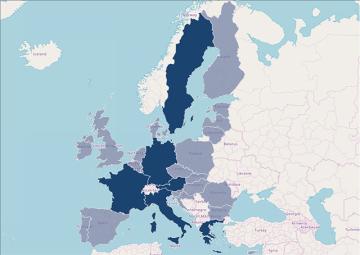
The EU Fundamental Rights Agency published in 2019 its report on the ‘Integration of young refugees in the EU’. The report explored the challenges of young people who fled armed conflict or persecution and arrived in the EU in 2015 and 2016. The report is based on 426 interviews with experts working in the area of asylum and integration, as well as 163 interviews with young people, aged 16 to 24, conducted between October 2017 and June 2018 in 15 regions and cities located in six Member States: Austria, France, Germany, Greece, Italy and Sweden. The links on this page provide a summary of the information collected during this period for each country about unaccompanied children turning 18 and the change in people’s legal status once international protection is granted. These two issues had at the time been identified as moments requiring sufficient, consistent and systematic support, particularly from lawyers, social workers and guardians, to ensure successful integration.
Business activity affects not just customers, employees, and contractors along supply chains, but often entire communities and the environment. This makes it vital that every business complies with human rights. This comparative report looks at the realities victims face when they seek redress for business-related human rights abuses. It presents the findings of fieldwork research on the views of professionals regarding the different ways people can pursue complaints. The findings highlight that obstacles to achieving justice are often multi-layered.
Often living in substandard and overcrowded housing conditions, Roma and Travellers face an increased risk of contracting COVID-19. They are also disproportionately affected by measures taken to contain the virus. This FRA Bulletin takes a closer look at this reality in 15 EU Member States, focusing on education; employment; poverty; healthcare; housing; and anti-Gypsyism. It also outlines civil society efforts to tackle the diverse challenges triggered by the Coronavirus pandemic.
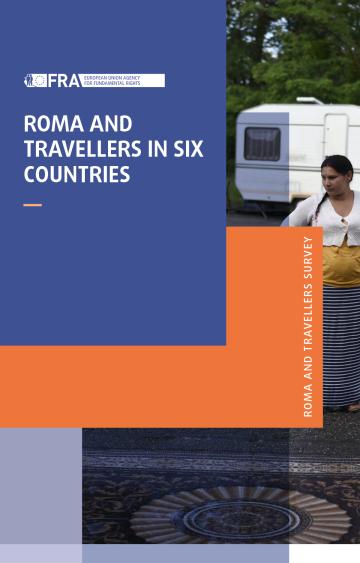
This report presents findings from FRA’s 2019 survey on Roma and Travellers in Belgium, France, Ireland, the Netherlands, Sweden and the United Kingdom. The survey included interviews with almost 4,700 Roma and Travellers, collecting information on more than 8,200 individuals living in their households.
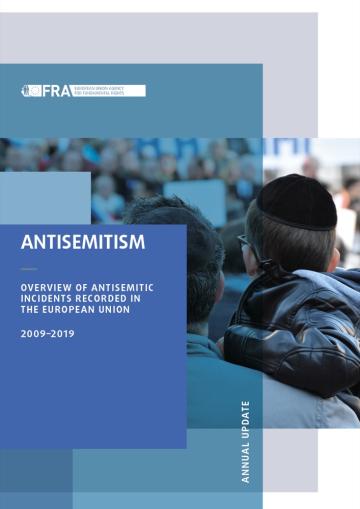
Antisemitism can be expressed in the form of verbal and physical attacks, threats, harassment, discrimination and unequal treatment, property damage and graffiti or other forms of speech or text, including on the internet. Antisemitic incidents and hate crimes violate fundamental rights, especially the right to human dignity, the right to equality of treatment and the freedom of thought, conscience and religion.
National Human Rights Institutions (NHRIs) are a vital part of the country-level human rights protection system. This report, published 10 years after FRA’s first in-depth study on NHRIs, looks at such bodies in the EU, as well as the Republic of North Macedonia, the Republic of Serbia, and the United Kingdom of Great Britain and Northern Ireland. It explores relevant developments, challenges to their effectiveness and ways to maximise their impact.
FRA’s second survey on LGBTI people in the EU, North Macedonia and Serbia surveyed almost 140,000 participants. This technical report presents a detailed overview of the survey methodology used by FRA when collecting the survey data.
This paper presents key findings from FRA’s second consultation of its Fundamental Rights Platform, focusing on the experiences of civil society organisations (CSOs) working on human rights. FRA started an annual consultation with organisations participating in its platform in 2018.
The EU Agency for Fundamental Rights has been regularly collecting data on asylum and migration since September 2015. This report focuses on the fundamental rights situation of people arriving in Member States and EU candidate countries particularly affected by migration. It addresses fundamental rights concerns between 1 April and 30 June 2020.
Настоящото ръководство е предназначено за служителите по управление на границите в държавите — членки на Европейския съюз, които работят на оперативно ниво. То има за цел да подпомогне ежедневната им работа по прилагането на гаранциите за основните права, предвидени в Кодекса на шенгенските граници (Регламент (ЕС) № 2016/399), и свързаните с него законодателни актове.
Denne vejledning er til grænseforvaltningsmedarbejdere i EU’s medlemsstater, der arbejder på det operationelle plan. Den er beregnet som en hjælp i det daglige arbejde i forbindelse med at gennemføre beskyttelsen af grundlæggende rettigheder i Schengengrænsekodeksen (forordning (EU) 2016/399) og tilhørende EU-lovgivning.
Η παρούσα καθοδήγηση απευθύνεται στο προσωπικό διαχείρισης των συνόρων των κρατών μελών της Ευρωπαϊκής Ένωσης (ΕΕ) που εργάζεται στο επιχειρησιακό επίπεδο. Αποσκοπεί στο να τους βοηθήσει να εφαρμόζουν, στο πλαίσιο της καθημερινής άσκησης των καθηκόντων τους, τις εγγυήσεις των θεμελιωδών δικαιωμάτων του κώδικα συνόρων του Σένγκεν [κανονισμός (ΕΕ) αριθ. 2016/399] και του συναφούς δικαίου της ΕΕ.
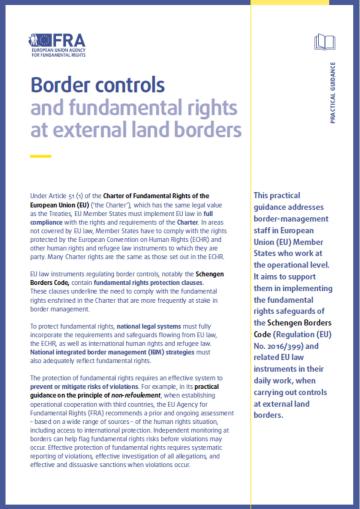
This practical guidance addresses border-management staff in European Union (EU) Member States who work at the operational level. It aims to support them in implementing the fundamental rights safeguards of the Schengen Borders Code (Regulation (EU) No. 2016/399) and related EU law instruments in their daily work, when carrying out controls at external land borders.