This Opinion by FRA aims to inform the European Parliament’s position on the legislative proposal for a recast Directive on common standards and procedures in Member States for returning illegally staying third country nationals (Return Directive), presented by the European Commission on 12 September 2018.
This paper discusses the evolution of European Court of Human Rights case law relating
to hate crime, providing an update on the most recent rulings. Approaching hate crime
from a fundamental rights perspective, it shows how Member State authorities’ duty to
effectively investigate the bias motivation of crimes flows from key human rights
instruments, such as the European Convention on Human Rights.
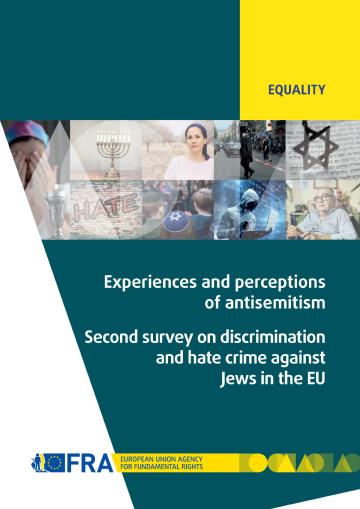
This report outlines the main findings of FRA’s second survey on Jewish people’s experiences with hate crime, discrimination and antisemitism in the European Union – the biggest survey of Jewish people ever conducted worldwide. Covering 12 EU Member States, the survey reached almost 16,500 individuals who identify as being Jewish. It follows up on the agency’s first survey, conducted in seven countries in 2012.
This Opinion by the European Union Agency for Fundamental Rights (FRA) aims to inform
the European Parliament’s position on the legislative proposal on the European Border and
Coast Guard (EBCG) presented by the European Commission on 12 September 2018.
В настоящото ръководство се обяснява какво представлява профилирането, правните рамки, които го регулират и защо правомерното извършване на профилиране е необходимо за спазването на основните права и е от решаващо значение за ефективната дейност на полицейските и граничните органи. В ръководството също така са предоставени практически насоки за това как да се избегне неправомерно профилиране при операции на полицейските и граничните органи.
I denne vejledning forklares, hvad der forstås ved profilering, de retlige rammer, der regulerer profilering, og hvorfor det er både nødvendigt at foretage profilering lovligt for at overholde de grundlæggende rettigheder og afgørende for et effektivt politiarbejde og en effektiv grænseforvaltning. Vejledningen indeholder også praktiske retningslinjer om, hvordan ulovlig profilering kan undgås i forbindelse med politi- og grænseforvaltningsoperationer.
Ο παρών οδηγός εξηγεί τι είναι η κατάρτιση προφίλ, τα νομικά πλαίσια που τη διέπουν και τον λόγο για τον οποίο η νόμιμη κατάρτιση προφίλ δεν είναι μόνο απαραίτητη για τη συμμόρφωση με τα θεμελιώδη δικαιώματα, αλλά και καίριας σημασίας για την αποτελεσματική αστυνόμευση και διαχείριση των συνόρων. Ο οδηγός παρέχει επίσης πρακτικές οδηγίες σχετικά με τρόπους αποφυγής της παράνομης κατάρτισης προφίλ στο πλαίσιο αστυνομικών επιχειρήσεων και επι-χειρήσεων διαχείρισης των συνόρων.
This guide explains what profiling is, the legal frameworks that regulate it, and why conducting profiling lawfully is both necessary to comply with fundamental rights and crucial for effective policing and border management. The guide also provides practical guidance on how to avoid unlawful profiling in police and border management operations.
En esta guía se explica qué es la elaboración de perfiles, los marcos jurídicos que la regulan, y por qué llevarla a cabo de manera lícita no solo es necesario para respetar los derechos fundamentales, sino también crucial para la eficacia de la actuación policial y la gestión de fronteras. Esta guía contiene también orientaciones prácticas sobre cómo evitar la utilización ilícita de perfiles en las operaciones de vigilancia policial y gestión de fronteras.
Käesolevas juhendis selgitatakse, mida profiilide koostamine endast kujutab, milliste õigusaktidega seda reguleeritakse ning miks on nii profiilide koostamise seaduslikkus põhiõiguste tagamiseks kui ka politseitegevuse ja piirihalduse tõhus toimimine olulised. Juhendis antakse ka praktilisi soovitusi selle kohta, kuidas vältida politsei- ja piirivalvetoimingutes ebaseaduslikku profiilide koostamist.