This publication is an excerpt from the Fundamental Rights Report 2025, the annual report of the European Union Agency for Fundamental Rights (FRA). It presents selected critical developments in fundamental rights in 2024, as well as the key findings and FRA opinions from the report’s chapters.
The Fundamental Rights Report 2025 is the annual report of the European Union Agency for Fundamental Rights (FRA). It provides an overview of the state of fundamental rights in the EU and highlights selected critical developments and trends in 2024. The report covers issues such as inclusive elections, gender-based violence, and the implementation of the EU Charter of Fundamental Rights. It presents FRA’s opinions on these developments, setting out the actions that the EU and Member States should take. This annual publication is a valuable resource for those seeking to stay informed about the EU’s shifting landscape of fundamental rights.
FRA’s Fundamental Rights Report 2024 analyses the year’s developments in fundamental rights. It focuses on the most pressing fundamental rights concerns facing Europe in 2023: the cost-of-living crisis, rights concerns at the EU’s external borders and migration, and threats to democracy. Re-structured, this year’s new approach is a shorter and sharper analysis. It also presents FRA’s opinions on these developments, including a summary of the evidence supporting these opinions.
The year 2023 brought both progress and setbacks in terms of fundamental rights protection. FRA’s Fundamental Rights Report 2023 reviews developments in the field, identifying both achievements and remaining areas of concern. This publication presents FRA’s opinions on the main developments in the thematic areas covered and a synopsis of the evidence supporting these opinions. In so doing, it provides a compact but informative overview of the main fundamental rights challenges confronting the EU and its Member States.
Racism in the police can include discriminatory racial profiling practices through to excessive use of force. Incidents like these highlight deeper systemic issues that need addressing. Many in society are affected by racism in policing, not only the individuals or communities targeted. Lack of trust in policing can fuel social exclusion and damages the foundations of a fair and equal society, however promising practices are developing to address these issues. This is the first EU-wide report on racism in policing. FRA’s findings identify gaps in regulatory frameworks and propose concrete steps for action.
Children’s rights exist to ensure the safety and wellbeing of every child. Improved child protection systems ensure that these rights are met. In recent years, the EU has taken significant steps to improve child protection systems. This mapping of child protection systems gives an overview of the state of such systems at national level and developments since 2015. It promotes the improvement of integrated child protection systems. It is an update of FRA’s mapping of child protection systems in 2015, based on data collected in 2023 in the 27 EU Member States. By publishing this, FRA aims to support securing the sustainable well-being, safety and rights of all children living in the EU.
Russia’s invasion of Ukraine posed new challenges for the EU. Millions were forced to flee the war. As a result of the scale of people’s displacement, the EU activated for the first time the Temporary Protection Directive (TPD). More than 1.3 million children sought international protection in the EU. This bulletin explores the respect, protection and fulfilment of the fundamental rights of displaced children and ways to safeguard their rights. The third in a series, this bulletin builds on the evidence in FRA’s Bulletin #1 and #2 on the experiences of displaced people seeking safety in the EU.
Russia’s unprovoked war of aggression against Ukraine has resulted in massive internal and external population displacement. The European Union (EU) rapidly activated its Temporary Protection Directive for the first time since it was adopted in 2001. This entitled nearly 4 million people to legal residence and access to work, housing and legal assistance, education and healthcare.
FRA’s Fundamental Rights Report 2023 reviews major developments in the field in 2022, identifying both achievements and areas of concern. It also presents FRA’s opinions on these developments, including a synopsis of the evidence supporting these opinions.
The year 2022 brought both progress and setbacks in terms of fundamental rights protection. FRA’s Fundamental Rights Report 2023 reviews major developments in the field, identifying both achievements and remaining areas of concern. This publication presents FRA’s opinions on the main developments in the thematic areas covered, and a synopsis of the evidence supporting these opinions.
Directive 2012/29/EU represents a milestone in the development of victims’ rights. It establishes minimum standards for the rights, support and protection of victims of crime. It defines the scope of support services, guarantees the right to effective protection against secondary victimisation and comprehensively regulates the measures required for this purpose. This report covers three core components underpinning victims’ rights: support services, crime reporting, and protection from secondary and repeat victimisation. Examples highlight the relevant legal provisions in Member States and how specific rights under the Victims’ Rights Directive work in practice.
Artificial intelligence is everywhere and affects everyone – from deciding what content people see on their social media feeds to determining who will receive state benefits. AI technologies are typically based on algorithms that make predictions to support or even fully automate decision-making.
Antisemitic incidents and hate crimes violate fundamental rights, especially the right to human dignity, the right to equality of treatment and the freedom of thought, conscience and religion. This report provides an overview of available data on antisemitism as recorded by official and unofficial sources in the EU Member States and in Albania, North Macedonia and Serbia. The data provided by the countries are supplemented with information from international organisations.
** As of 19 September 2024 a new version of this guidance has been issued. Please see the link below. **
Fundamental rights monitoring at EU external borders should be systematically and regularly carried out for a range of border management activities. These include border surveillance, apprehensions at land, sea and air borders, and the operation of referral mechanisms, including in the event of mass arrivals. This general guidance provides assistance to EU Member States in setting up national independent mechanisms to monitor fundamental rights compliance at EU external borders, in line with the proposed screening regulation of 23 September 2020 by the European Commission. The EU Agency for Fundamental Rights prepared this guidance at the request of the Commission.
Civil society organisations face diverse challenges across the European Union. FRA’s report on Protecting civic space in the EU presents the agency’s findings on these challenges. It was issued in September of 2021. This summary presents the Key findings and FRA opinions outlined in the report.
Civil society is a key component of Europe’s fundamental rights architecture. From supporting people affected by the pandemic to helping those fleeing the war in Ukraine, civil society plays a crucial role in upholding people’s rights. In so doing, it contributes to a healthy rule of law culture. FRA’s civic space report provides an overview of the many ways in which civil society contributes to the checks and balances that underpin the rule of law.
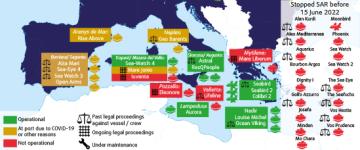
The EU Agency for Fundamental Rights (FRA) regularly collects data on the operations of NGO vessels involved in search and rescue in the Mediterranean. This includes any legal proceedings against them, as well as on any difficulties in disembarking migrants in safe ports. The International Organization for Migration estimates that from January to 15 June 2022 about 842 people died or went missing while crossing the Mediterranean Sea to reach Europe to escape war or persecution, or to pursue a better life. This is an average of five people per day.
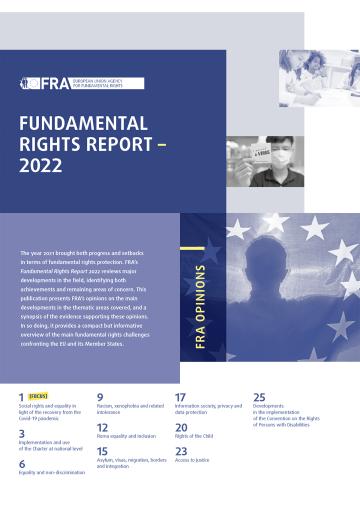
FRA’s Fundamental Rights Report 2022 reviews major developments in the field in 2021, identifying both achievements and areas of concern. It also presents FRA’s opinions on these developments, including a synopsis of the evidence supporting these opinions.
The year 2021 brought both progress and setbacks in terms of fundamental rights protection. FRA’s Fundamental Rights Report 2022 reviews major developments in the field, identifying both achievements and remaining areas of concern. This publication presents FRA’s opinions on the main developments in the thematic areas covered, and a synopsis of the evidence supporting these opinions.
Children are full-fledged holders of rights. They are beneficiaries of all human and fundamental rights and subjects of special regulations, given their specific characteristics. This handbook aims to illustrate how European law and case law accommodate the specific interests and needs of children. It also considers the importance of parents and guardians or other legal representatives and makes reference, where appropriate, to situations in which rights and responsibilities are most prominently vested in children’s carers. It is a point of reference on both European Union (EU) and Council of Europe (CoE) law related to these subjects, explaining how each issue is regulated under EU law, including the Charter of Fundamental Rights of the European Union, as well as under the European Convention on Human Rights, the European Social Charter and other CoE instruments.