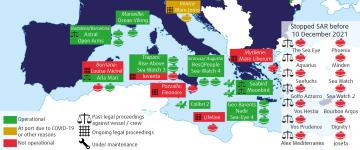
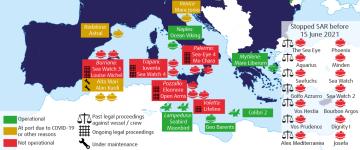
The EU Agency for Fundamental Rights (FRA) regularly collects data on NGO vessels involved in search and rescue in the Mediterranean. This includes any legal proceedings against them, as well as any difficulties disembarking migrants in safe ports. The International Organization for Migration estimates that from January to 10 December 2021 about 1,654 people have died or gone missing while crossing the Mediterranean Sea to reach Europe to escape war or persecution or to pursue a better life. This is an average of more than four people per day. Deadly incidents have also occurred recently in the Channel (La Manche).
The EU Agency for Fundamental Rights has been regularly collecting data on asylum and migration since September 2015. This report focuses on the fundamental rights situation of people arriving in Member States and EU candidate countries particularly affected by migration. It addresses fundamental rights concerns between 1 July and 30 September 2021.
Since 2014, FRA has been publishing an annual update of the forced return monitoring systems EU Member States have set up under Article 8 (6) of the EU’s Return Directive. This overview describes different indicators for an effective forced return monitoring system. It includes the organisation responsible for monitoring forced return, the number of operations monitored in 2020, the phases of monitored return operations, the number of staff trained and working as monitors, and whether the monitoring body issued public reports about their monitoring.
FRA Opinion 1/21 illustrates the extent and nature of lived experiences of inequality and discrimination across the EU. It does so with reference to the grounds of discrimination and areas of life covered by the racial and employment equality directives, as well as by the proposed Equal Treatment Directive. It was issued on 30 April 2021. This summary presents the main recommendations (‘Key findings and opinions’) outlined in FRA Opinion 1/21.
Antisemitic incidents and hate crimes violate fundamental rights, especially the right to human dignity, the right to equality of treatment, and the freedom of thought, conscience and religion. This report provides an overview of available data on antisemitism as recorded by official and unofficial sources in the EU Member States as well as Albania, North Macedonia and Serbia. The data provided by the countries are supplemented with information from international organisations.
This report outlines to what extent legal aid is available to those held in pre-removal detention in the 27 EU Member States, and in North Macedonia and Serbia, during procedures related to their return. These involve decisions on return, on detention pending removal, the removal itself and on bans on entry. The report also examines when people are entitled to free legal aid and how this aid is funded, as well as who provides representation and various factors that limit the scope of legal aid.
This report proposes a framework for becoming, and functioning as, a ‘human rights city’ in the EU. It includes ‘foundations’, ‘structures’ and ‘tools’ for mayors, local administrations and grassroots organisations to reinforce fundamental rights locally. It is based on existing good practice and expert input by representatives of human rights cities in the EU, academic experts, international organisations and city networks.
Since September 2020, three National Human Rights Institutions (NHRIs) had a change in their accreditation status, two new institutions were created and nine have had a change in tasks covered by their mandates. Following up on the September 2020 report “Strong and effective national human rights institutions – challenges, promising practices and opportunities”, this update provides an overview of developments in the accreditation status and mandates of NHRIS in the past 12 months. The update covers the 27 EU Member States as well as three additional states within FRA’s mandate (Albania, North Macedonia and Serbia).
The EU Agency for Fundamental Rights has been regularly collecting data on asylum and migration since September 2015. This report focuses on the fundamental rights situation of people arriving in Member States and EU candidate countries particularly affected by migration. It addresses fundamental rights concerns between 1 January and 30 June 2021.
Civil society organisations play a vital role in promoting fundamental rights, but they face diverse challenges across the European Union. This report presents FRA’s findings on a range of such challenges. The findings are based on research, and on two online consultations with civil society organisations, carried out in 2020.
This report examines why victims do not report bias-motivated incidents and the barriers that they face when reporting incidents through national crime reporting systems. By mapping existing practices that have a bearing on the victim’s experiences when reporting bias-motivated violence and harassment, it aims to provide evidence to support national efforts to encourage and facilitate reporting – and ultimately assist Member States in delivering on their duties with regard to combating hate crime.
The Employers Sanctions Directive was primarily enacted to dissuade employers from recruiting migrants in an irregular situation, but it also contains provisions to protect workers. It facilitates access to justice for exploited workers and sets out workers’ rights to claim back payment of outstanding wages. The directive also contains provisions to enhance the effectiveness of labour inspections. This report describes how the 25 Member States bound by the directive have been implementing its protective provisions, focusing on the impact these provisions have on migrant workers in an irregular situation who are victims of exploitation and other labour
law violations.
The International Organization for Migration estimates that about 813 people died or went missing crossing the Mediterranean Sea to reach Europe to escape war, persecution or to pursue a better life in 2021, up to 15 June. This is an average of almost five people per day. The EU Agency for Fundamental Rights (FRA) collects data on NGO ships involved in search and rescue in the Mediterranean, legal proceedings against them, as well as difficulties in disembarking migrants in safe ports.
This Coronavirus Bulletin focuses on equitable access to vaccines. It outlines the situation in the 27 EU Member States from 1 March to 30 April 2021. The bulletin looks at two main areas: planning and prioritisation in deploying Covid-19 vaccinations and their rollout in the countries. It covers information and communication campaigns, as well as (pre)registration channels for and the administration of vaccinations.
The year 2020 brought both progress and setbacks in terms of fundamental rights protection. FRA’s Fundamental Rights Report 2021 reviews major developments in the field, identifying both achievements and remaining areas of concern. This publication presents FRA’s opinions on the main developments in the thematic areas covered, and a synopsis of the evidence supporting these opinions.
FRA’s Fundamental Rights Report 2021 reviews major developments in the field in 2020, identifying both achievements and areas of concern. It also presents FRA’s opinions on these developments, including a synopsis of the evidence supporting these opinions. This year’s focus chapter explores the impact of the COVID-19 pandemic on fundamental rights. The remaining chapters cover: the EU Charter of Fundamental Rights; equality and non-discrimination; racism, xenophobia and related intolerance; Roma equality and inclusion; asylum, borders and migration; information society, privacy and data protection; rights of the child; access to justice; and the implementation of the Convention on the Rights of Persons with Disabilities.
This focus looks at COVID-19’s impact on fundamental rights. It underscores that a human rights-based approach to tackling the pandemic requires balanced measures that are based on law, necessary, temporary and proportional. It also requires addressing the pandemic’s socio-economic impact, protecting the vulnerable and fighting racism.
This paper presents statistical survey data for the EU on how often people are stopped by the police, in what kind of situations they are stopped, the action taken by the police during stops, and views on whether or not the police acted respectfully.
This opinion illustrates the extent and nature of lived experiences of inequality and discrimination across the EU. It does so with reference to the grounds of discrimination and areas of life covered by the racial and employment equality directives, as well as in relation to the grounds and areas covered by the proposed Equal Treatment Directive.
This is the second main report from FRA’s Fundamental Rights Survey, which collected data from 35,000 people on a range of issues. This report focuses on respondents’ experiences as victims of selected types of crime, including violence, harassment, and property crime. The report also examines how often these crimes are reported to the police, and presents further details relating to harassment and violence, such as the perpetrators and where the incidents took place.