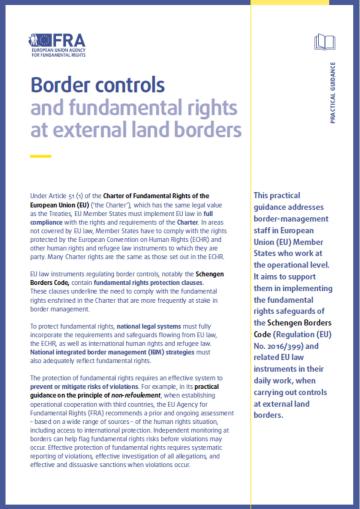
This practical guidance addresses border-management staff in European Union (EU) Member States who work at the operational level. It aims to support them in implementing the fundamental rights safeguards of the Schengen Borders Code (Regulation (EU) No. 2016/399) and related EU law instruments in their daily work, when carrying out controls at external land borders.
I presenti orientamenti sono destinati al personale addetto alla gestione delle frontiere negli Stati membri dell’Unione europea (UE) che lavora a livello operativo e mirano ad assisterli nell’attuare nel loro lavoro quotidiano, le tutele in materia di diritti fondamentali previste dal codice frontiere Schengen [regolamento (UE) 2016/399] e dal relativo diritto dell’UE.
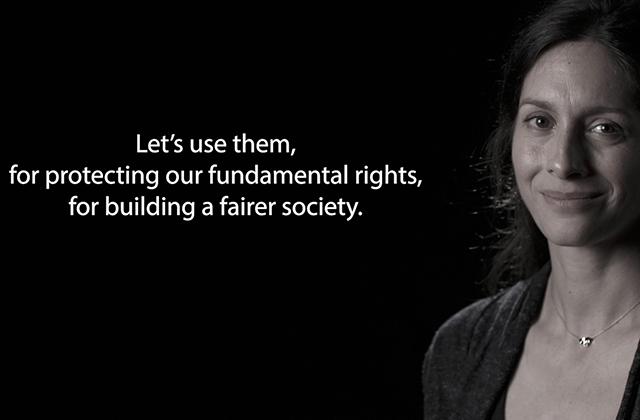
Michael O'Flaherty introduces the July edition of FRA's bulletin on the impact for fundamental rights of Covid-19. In this vlog he talks about the important role that people play who are engaged with the promotion and the protection of human rights in these times.
The July edition of the COVID-19 bulletin will be available from 30 July.
The EU Return Directive (2008/115/EC) in Article 8 (6) introduced an important fundamental rights safeguard for third-country nationals ordered to leave the EU because they do not or no longer fulfil the conditions for entry and/or stay. According to the directive, Member States must provide for an effective forced-return monitoring system.
The Coronavirus pandemic continues to interrupt everyday life in the EU in unprecedented ways. But the way it affects our societies is shifting. As governments gradually lift some of the measures put in place to contain the spread of COVID-19, new fundamental rights concerns arise: how to ensure that the rights to life and health are upheld as daily life transitions to a ‘new normal’. This Bulletin looks at declarations of states of emergency, or equivalent, and how they came under scrutiny. It considers
the impact on fundamental rights in important areas of daily life, and includes a thematic focus on the pandemic's impact on older people.
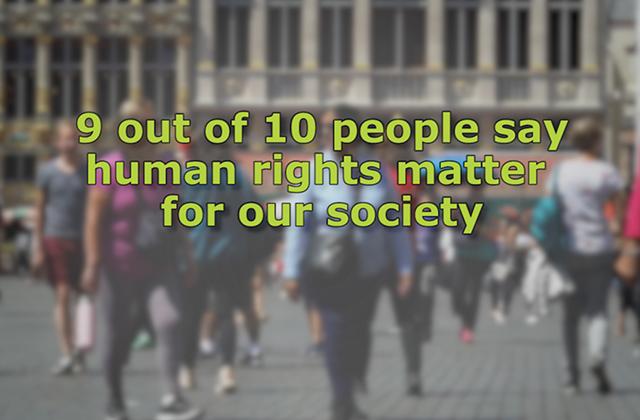
FRA’s Fundamental Rights Survey collected data from 35,000 people about their experiences, perceptions and opinions on a range of issues that are variously encompassed by human rights. This report presents a small selection of the survey results. It focuses on findings with respect to respondents’ opinions about human – or fundamental rights; their views and perceptions on the functioning of democratic societies – as a pillar on which human rights can flourish; and on their thoughts on and engagement with public services that have a duty to enforce human rights law and to protect people’s rights.
In 2019, the International Organization for Migration estimated that 1,866 people have died or gone missing while crossing the Mediterranean Sea to reach Europe to escape war or persecution or to pursue a better life. This is an average of five people per day. In recent years, a significant proportion of migrants in distress at sea have been rescued by civil society vessels deployed with a humanitarian mandate to reduce fatalities and bring rescued migrants to safety. Since 2018, however, authorities in some EU Member States started viewing civil society-deployed rescue vessels with hostility. As a reaction, national authorities initiated about 40 administrative and criminal proceedings against crew members or vessels, including seizing the latter. In some cases, rescue vessels were blocked in harbours due to flag issues or the inability to meet technical requirements.
This document presents data from the FRA Fundamental Rights Survey. It includes data on opinions and experiences of people in the European Union (EU) linked to data protection and technology.
This focus takes a closer look at the application of the Charter of Fundamental Rights of the European Union, which has been legally binding for 10 years. At EU level, it has gained visibility and sparked a new fundamental rights culture. At national level, awareness and use of the Charter are limited. Courts increasingly use the Charter, showing the impact of this modern instrument. But its use by governments and parliaments remains low. For instance, there is little indication of anyone regularly scrutinising national legislation that transposes EU law for compatibility with the Charter.
The year 2019 brought both progress and setbacks in terms of fundamental rights protection. FRA’s Fundamental Rights Report 2020 reviews major developments in the field, identifying both achievements and remaining areas of concern. This publication presents FRA’s opinions on the main developments in the thematic areas covered, and a synopsis of the evidence supporting these opinions. In so doing, it provides a compact but informative overview of the main fundamental rights challenges confronting the EU and its Member States.
FRA’s Fundamental Rights Report 2020 reviews major developments in the field in 2019, identifying both achievements and areas of concern. It also presents FRA’s opinions on these developments, including a synopsis of the evidence supporting these opinions. This year’s focus chapter explores how to unlock the full potential of the EU Charter of Fundamental Rights.
The Coronavirus pandemic continues to interrupt everyday life in the EU in unprecedented ways. But the way it affects our societies is shifting. As governments gradually lift some of the measures put in place to contain the spread of COVID-19, new fundamental rights concerns arise: how to ensure that the rights to life and health are upheld as daily life transitions to a ‘new normal’. This Bulletin looks at declarations of states of emergency, or equivalent, and how they came under scrutiny. It considers the impact on fundamental rights in important areas of daily life, and includes a thematic focus on the processing of users’ data to help contain COVID-19, particularly by contact-tracing apps. It covers the period 21 March – 30 April 2020.
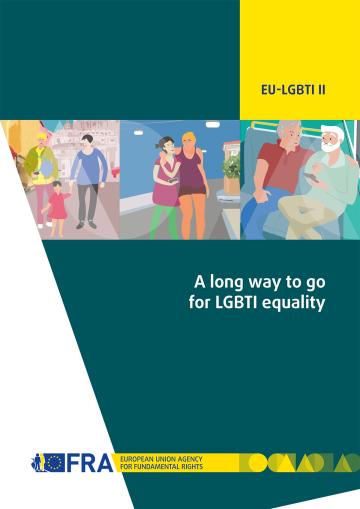
This report presents select findings from FRA’s 2019 survey on LGBTI people in the EU and North Macedonia and Serbia. With almost 140,000 participants, it is the largest survey of its kind. It follows the agency’s first survey on LGBT people in the EU, conducted in 2012. The new survey results show little progress over the past seven years.
The outbreak of COVID-19 affects people’s daily life in the 27 EU Member States. As the number of infected people in the EU territory began to mount rapidly in February and March, governments put in place a raft of measures – often introduced in a period of only a few days – in an effort to contain the spread of the virus. Many of these measures reflect how, in exceptional emergency situations, the urgent need to save lives justifies restrictions on other rights, such as the freedom of movement and of assembly. This report outlines some of the measures EU Member States have put in place to protect public health during the COVID-19 pandemic. It covers the period 1 February – 20 March 2020.
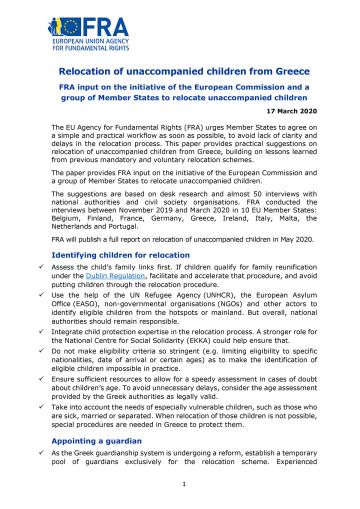
The EU Agency for Fundamental Rights (FRA) urges Member States to agree on a simple and practical workflow as soon as possible, to avoid lack of clarity and delays in the relocation process. This paper provides practical suggestions on relocation of unaccompanied children from Greece, building on lessons learned from previous mandatory and voluntary relocation schemes. The paper provides FRA input on the initiative of the European Commission and a group of Member States to relocate unaccompanied children.
In the latest edition of his video blog, FRA Director Michael O'Flaherty speaks about the importance and power of hope accompanying the work of FRA in 2020. Particularly after a troubled start of the year.