eu-charter

Listina Evropske unije o temeljnih pravicah

Člen 8 - Varstvo osebnih podatkov

Člen 8 - Varstvo osebnih podatkov

1. Vsakdo ima pravico do varstva osebnih podatkov, ki se nanj nanašajo.

2. Osebni podatki se morajo obdelovati pošteno, za določene namene in na podlagi privolitve prizadete osebe ali na drugi legitimni podlagi, določeni z zakonom. Vsakdo ima pravico dostopa do podatkov, zbranih o njem, in pravico zahtevati, da se ti podatki popravijo.

3. Spoštovanje teh pravil nadzira neodvisen organ.

Pojasnila

  • Text:

    Ta člen temelji na členu 286 Pogodbe o ustanovitvi Evropske skupnosti in Direktivi 95/46/ES Evropskega parlamenta in Sveta o varstvu posameznikov pri obdelavi osebnih podatkov in o prostem pretoku takih podatkov (UL L 281, 23.11.1995, str. 31), kot tudi na 8. členu EKČP in Konvenciji Sveta Evrope z dne 28. januarja 1981 o varstvu posameznikov glede na avtomatsko obdelavo osebnih podatkov, ki so jo ratificirale vse države članice. Člen 286 Pogodbe ES je sedaj nadomeščen s členom 16 Pogodbe o delovanju Evropske unije in členom 39 Pogodbe o Evropski uniji. Prav tako je treba omeniti Uredbo ES št. 45/2001 Evropskega parlamenta in Sveta o varstvu posameznikov pri obdelavi osebnih podatkov v institucijah in organih Skupnosti in o prostem pretoku takih podatkov (UL L 8, 12.1.2001, str. 1). Zgoraj omenjeni direktiva in uredba vsebujeta pogoje in omejitve pri izvajanju pravice do varovanja osebnih podatkov.

    Source:
    Uradni list Evropske unije C 303/17 - 14.12.2007
    Preamble - Explanations relating to the Charter of Fundamental Rights:
    V nadaljevanju navedena pojasnila so bila prvotno pripravljena pod vodstvom predsedstva Konvencije, ki je sestavilo Listino Evropske unije o temeljnih pravicah. Ta pojasnila so bila posodobljena pod vodstvom predsedstva Evropske konvencije zaradi prilagoditve besedila Listine s strani omenjene konvencije (zlasti členov 51 in 52) in nadaljnjega razvoja prava Unije. Čeprav sama nimajo pravne veljave, so dragocena pomoč pri razlagi in pojasnjevanju določb Listine.

Sodna praksa

Nacionalnem ustavnem pravu

68 results found

  • European Convention on Human Rights - Article 8
    Država:
    Austria

    Article 8

    1 Everyone has the right to respect for his private and family life, his home and his correspondence.

    2 There shall be no interference by a public authority with the exercise of this right except such as is in accordance with the law and is necessary in a democratic society in the interests of national security, public safety or the economic well-being of the country, for the prevention of disorder or crime, for the protection of health or morals, or for the protection of the rights and freedoms of others.

  • Federal Data Protection Act
    Država:
    Germany

    Section 1 Purpose and scope (1) The purpose of this Act is to protect the individual against his right to privacy being impaired through the handling of his personal data. (2) This Act shall apply to the collection, processing and use of personal data by 1. public bodies of the Federation, 2. public bodies of the Länder in so far as data protection is not governed by Land legislation and in so far as they a) execute federal law or, b) act as bodies of the judicature and are not dealing with administrative matters, 3.private bodies in so far as they process or use data by means of data processing systems or collect data for such systems, process or use data in or from non-automated filing systems or collect data for such systems, except where the collection, processing or use of such data is effected solely for personal or family activities. (3) In so far as other legal provisions of the Federation are applicable to personal data, including their publication, such provisions shall take precedence over the provisions of this Act. This shall not affect the duty to observe the legal obligation of maintaining secrecy or professional or special official confidentiality not based on legal provisions. (4) The provisions of this Act shall take precedence over those of the Administrative Procedures Act in so far as personal data are processed in ascertaining the facts. (5) This Act shall not apply in so far as a controller located in another member state of the European Union or in another state party to the Agreement on the European Economic Area collects, processes or uses personal data, except where such collection, processing or use is carried out by a branch in Germany. This Act shall apply in so far as a controller which is not located in a member state of the European Union or in another state party to the Agreement on the European Economic Area collects, processes or uses personal data in Germany. In so far as the controller is to be named under this Act, information is also to be furnished on representatives established in Germany. Sentences 2 and 3 shall not apply in so far as data storage media are employed solely for the purposes of transit through Germany. The first sentence of Section 38 (1) shall remain unaffected.

  • Fizisko personu datu aizsardzības likums
    Država:
    Latvia

    1.pants.Šā likuma mērķis ir aizsargāt fizisko personu pamattiesības un brīvības, it īpaši privātās dzīves neaizskaramību, attiecībā uz fiziskās personas datu (turpmāk — personas dati) apstrādi.

  • Henkilötietolaki 22.4.1999/523
    Država:
    Finland

    1 § Tämän lain tarkoituksena on toteuttaa yksityiselämän suojaa ja muita yksityisyyden suojaa turvaavia perusoikeuksia henkilötietoja käsiteltäessä sekä edistää hyvän tietojenkäsittelytavan kehittämistä ja noudattamista.

  • Konstytucja Rzeczypospolitej Polskiej
    Država:
    Poland

    Art. 47 Każdy ma prawo do ochrony prawnej życia prywatnego, rodzinnego, czci i dobrego imienia oraz do decydowania o swoim życiu osobistym. Art. 51.1. Nikt nie może być obowiązany inaczej niż na podstawie ustawy do ujawniania informacji dotyczących jego osoby. 2. Władze publiczne nie mogą pozyskiwać, gromadzić i udostępniać innych informacji o obywatelach niż niezbędne w demokratycznym państwie prawnym. 3. Każdy ma prawo dostępu do dotyczących go urzędowych dokumentów i zbiorów danych. Ograniczenie tego prawa może określić ustawa. 4. Każdy ma prawo do żądania sprostowania oraz usunięcia informacji nieprawdziwych, niepełnych lub zebranych w sposób sprzeczny z ustawą. 5. Zasady i tryb gromadzenia oraz udostępniania informacji określa ustawa. 

  • Konvention zum Schutze der Menschenrechte und Grundfreiheiten
    Država:
    Austria

    Artikel 8 (1) Jedermann hat Anspruch auf Achtung seines Privat- und Familienlebens, seiner Wohnung und seines Briefverkehrs.

  • Law 2472/1997 on the Protection of Individuals with regard to the Processing of Personal Data
    Država:
    Greece
  • Law No. 677/2001 on the Protection of Individuals with Regard to the Processing of Personal Data and the Free Movement of Such Data, amended and completed
    Država:
    Romania

    Article 1: Purpose (1) The purpose of this law is to guarantee and protect the individual’s fundamental rights and freedoms, especially the right to personal, family and private life, with regard to the processing of personal data.

  • Law no.506/2004 on the processing of personal data and the protection of privacy in the electronic communications sector
    Država:
    Romania

    Article 4: (1) The confidentiality of communications and the related traffic data by means of public electronic communications networks and publicly available electronic communications services is guaranteed. (2) Listening, tapping, storage or other kinds of interception or surveillance of communications and the related traffic data are prohibited, except for the following cases: a) these operations are carried out by the users who participate in that communication; b) the users who participate in that communication have previously given their written consent; c) these operations are carried out by the competent authorities, under the conditions set out by the legal provisions in force.

  • Law of 2 August 2002 on the Protection of Persons with regard to the Processing of Personal Data
    URL:
    Država:
    Luxembourg

    The GDPR will replace the Luxembourg Law of 2 August 2002 on the protection of persons with regard to the processing of personal data (the “2002 Law”) and will be directly effective in Luxembourg as from 25 May 2018.

  • Lege nr. 506 din 17 noiembrie 2004 privind prelucrarea datelor cu caracter personal şi protecţia vieţii private în sectorul comunicaţiilor electronice
    Država:
    Romania

    Articolul 4: (1) Confidenţialitatea comunicărilor transmise prin intermediul reţelelor publice de comunicaţii electronice şi a serviciilor de comunicaţii electronice destinate publicului, precum şi confidenţialitatea datelor de trafic aferente sunt garantate.(2) Ascultarea, înregistrarea, stocarea şi orice altă formă de interceptare ori supraveghere a comunicărilor şi a datelor de trafic aferente sunt interzise, cu excepţia cazurilor următoare:a) se realizează de utilizatorii care participă la comunicarea respectivă;b) utilizatorii care participă la comunicarea respectivă şi-au dat, în prealabil, consimţământul scris cu privire la efectuarea acestor operaţiuni;c) se realizează de autorităţile competente, în condiţiile legii.

  • Lege nr. 677 din 21 noiembrie 2001 pentru protecţia persoanelor cu privire la prelucrarea datelor cu caracter personal şi libera circulaţie a acestor date
    Država:
    Romania

    Articolul 1: (1) Prezenta lege are ca scop garantarea şi protejarea drepturilor şi libertăţilor fundamentale ale persoanelor fizice, în special a dreptului la viaţa intima, familială şi privată, cu privire la prelucrarea datelor cu caracter personal.

  • Lei da protecçao de dados pessoais (Lei 67/98)
    Država:
    Portugal
  • LEY ORGÁNICA 15/1999, de 13 de diciembre, de Protección de Datos de Carácter Personal
    Država:
    Spain

    Artículo 1La presente Ley Orgánica tiene por objeto garantizar y proteger, en lo que concierne al tratamiento de los datos personales, las libertades públicas y los derechos fundamentales de las personas físicas, y especialmente de su honor e intimidad personal y familiar.

  • Lietuvos Respublikos Konstitucija
    Država:
    Lithuania

    22 straipsnis. Žmogaus privatus gyvenimas neliečiamas. Asmens susirašinėjimas, pokalbiai telefonu, telegrafo pranešimai ir kitoks susižinojimas neliečiami. Informacija apie privatų asmens gyvenimą gali būti renkama tik motyvuotu teismo sprendimu ir tik pagal įstatymą. Įstatymas ir teismas saugo, kad niekas nepatirtų savavališko ar neteisėto kišimosi į jo asmeninį ir šeimyninį gyvenimą, kėsinimosi į jo garbę ir orumą.

  • Loi du 2 août 2002 relative à la protection des personnes à l'égard du traitement des données à caractère personnel.
    Država:
    Luxembourg
  • Loi du 8 décembre 1992 relative à la protection de la vie privée à l'égard des traitements de données à caractère personnel
    Država:
    Belgium


  • Loi n°78-17 du 6 janvier 1978 relative à l'informatique, aux fichiers et aux libertés
    Država:
    France

    Article 1L'informatique doit être au service de chaque citoyen. Son développement doit s'opérer dans le cadre de la coopération internationale. Elle ne doit porter atteinte ni à l'identité humaine, ni aux droits de l'homme, ni à la vie privée, ni aux libertés individuelles ou publiques. Article 2 La présente loi s'applique aux traitements automatisés de données à caractère personnel, ainsi qu'aux traitements non automatisés de données à caractère personnel contenues ou appelées à figurer dans des fichiers, à l'exception des traitements mis en oeuvre pour l'exercice d'activités exclusivement personnelles, lorsque leur responsable remplit les conditions prévues à l'article 5. (...)

  • Luxembourg / Constitution of the Grand Ducal of Luxembourg
    Država:
    Luxembourg

    Art. 31. Toute personne a droit à l’autodétermination informationnelle et à la protection des données à caractère personnel la concernant. Ces données ne peuvent être traitées qu’à des fins et dans les conditions déterminées par la loi.

  • Magyarország Alaptörvénye
    Država:
    Hungary

     VI. cikk (SZABADSÁG ÉS FELELŐSSÉG) [...] (2) Mindenkinek joga van személyes adatai védelméhez, valamint a közérdekű adatok megismeréséhez és terjesztéséhez.(3) A személyes adatok védelméhez és a közérdekű adatok megismeréséhez való jog érvényesülését sarkalatos törvénnyel létrehozott, független hatóság ellenőrzi. 

Pravo EU

37 results found

  • Regulation (EU) 2021/692 of the European Parliament and of the Council of 28 April 2021 establishing the Citizens, Equality, Rights and Values Programme and repealing Regulation (EU) No 1381/2013

    Article 4

    Equality, rights and gender equality strand

    Within the general objective set out in Article 2(1) and within the specific objective set out in point (b) of Article 2(2), the Programme shall focus on:

    (1) promoting equality and preventing and combating inequalities and discrimination based on sex, racial or ethnic origin, religion or belief, disability, age or sexual orientation, and respecting the principle of non-discrimination on the grounds provided for in Article 21 of the Charter;

    [...]

  • Regulation (EU) 2018/1725 of the European Parliament and of the Council of 23 October 2018 on the protection of natural persons with regard to the processing of personal data, repealing Regulation (EC) No 45/2001 and Decision No 1247/2002/EC

    Preamble

    (1) The protection of natural persons in relation to the processing of personal data is a fundamental right. Article 8(1) of the Charter of Fundamental Rights of the European Union (the ‘Charter’) and Article 16(1) of the Treaty on the Functioning of the European Union (TFEU) provide that everyone has the right to the protection of personal data concerning him or her. This right is also guaranteed under Article 8 of the European Convention for the Protection of Human Rights and Fundamental Freedoms.

    [...]

    (74) The supervisory competence of the European Data Protection Supervisor should not cover the processing of personal data by the Court of Justice when acting in its judicial capacity, in order to safeguard the independence of the Court in the performance of its judicial tasks, including decision-making. For such processing operations, the Court should establish independent supervision, in accordance with Article 8(3) of the Charter, for example through an internal mechanism.

    Article 1 Subject matter and objectives

    1. This Regulation lays down rules relating to the protection of natural persons with regard to the processing of personal data by the Union institutions and bodies and rules relating to the free movement of personal data between them or to other recipients established in the Union.

    2. This Regulation protects fundamental rights and freedoms of natural persons and in particular their right to the protection of personal data.

    3. The European Data Protection Supervisor shall monitor the application of the provisions of this Regulation to all processing operations carried out by a Union institution or body.

  • Regulation (EU) 2022/2065 of the European Parliament and of the Council of 19 October 2022 on a Single Market For Digital Services and amending Directive 2000/31/EC (Digital Services Act)

    Article 34: Risk assessment

    1. Providers of very large online platforms and of very large online search engines shall diligently identify, analyse and assess any systemic risks in the Union stemming from the design or functioning of their service and its related systems, including algorithmic systems, or from the use made of their services.

    They shall carry out the risk assessments by the date of application referred to in Article 33(6), second subparagraph, and at least once every year thereafter, and in any event prior to deploying functionalities that are likely to have a critical impact on the risks identified pursuant to this Article. This risk assessment shall be specific to their services and proportionate to the systemic risks, taking into consideration their severity and probability, and shall include the following systemic risks:

    [...]

    (b) any actual or foreseeable negative effects for the exercise of fundamental rights, in particular the fundamental rights to human dignity enshrined in Article 1 of the Charter, to respect for private and family life enshrined in Article 7 of the Charter, to the protection of personal data enshrined in Article 8 of the Charter, to freedom of expression and information, including the freedom and pluralism of the media, enshrined in Article 11 of the Charter, to non-discrimination enshrined in Article 21 of the Charter, to respect for the rights of the child enshrined in Article 24 of the Charter and to a high-level of consumer protection enshrined in Article 38 of the Charter;

  • Treaty on European Union - Article 39

    Article 39

    In accordance with Article 16 of the Treaty on the Functioning of the European Union and by way of derogation from paragraph 2 thereof, the Council shall adopt a decision laying down the rules relating to the protection of individuals with regard to the processing of personal data by the Member States when carrying out activities which fall within the scope of this Chapter, and the rules relating to the free movement of such data. Compliance with these rules shall be subject to the control of independent authorities.

  • Treaty on the Functioning of the European Union - Article 16 (ex Article 286 TEC)

    Article 16 (ex Article 286 TEC)

    1. Everyone has the right to the protection of personal data concerning them.

    2. The European Parliament and the Council, acting in accordance with the ordinary legislative procedure, shall lay down the rules relating to the protection of individuals with regard to the processing of personal data by Union institutions, bodies, offices and agencies, and by the Member States when carrying out activities which fall within the scope of Union law, and the rules relating to the free movement of such data. Compliance with these rules shall be subject to the control of independent authorities. The rules adopted on the basis of this Article shall be without prejudice to the specific rules laid down in Article 39 of the Treaty on European Union.


  • Directive (EU) 2019/1153 of the European Parliament and of the Council of 20 June 2019 laying down rules facilitating the use of financial and other information for the prevention, detection, investigation or prosecution of certain criminal offences ...

    Article 1 Subject matter

    1. This Directive lays down measures to facilitate access to and the use of financial information and bank account information by competent authorities for the prevention, detection, investigation or prosecution of serious criminal offences. It also lays down measures to facilitate access to law enforcement information by Financial Intelligence Units (‘FIUs’) for the prevention and combating of money laundering, associate predicate offences and terrorist financing and measures to facilitate cooperation between FIUs.

    2. This Directive is without prejudice to:

    (a) Directive (EU) 2015/849 and the related provisions of national law, including the organisational status conferred on FIUs under national law as well as their operational independence and autonomy;

    (b) channels for the exchange of information between competent authorities or the powers of competent authorities under Union or national law to obtain information from obliged entities;

    (c) Regulation (EU) 2016/794; (d) the obligations resulting from Union instruments on mutual legal assistance or on mutual recognition of decisions regarding criminal matters and from Framework Decision 2006/960/JHA.

    ...

  • Directive (EU) 2019/1024 of the European Parliament and of the Council of 20 June 2019 on open data and the re-use of public sector information

    Article 1 Subject matter and scope

    1. In order to promote the use of open data and stimulate innovation in products and services, this Directive establishes a set of minimum rules governing the re-use and the practical arrangements for facilitating the re-use of:

    (a) existing documents held by public sector bodies of the Member States;

    (b) existing documents held by public undertakings that are:

    (i) active in the areas defined in Directive 2014/25/EU;

    (ii) acting as public service operators pursuant to Article 2 of Regulation (EC) No 1370/2007;

    (iii) acting as air carriers fulfilling public service obligations pursuant to Article 16 of Regulation (EC) No 1008/2008; or

    (iv) acting as Community shipowners fulfilling public service obligations pursuant to Article 4 of Regulation (EEC) No 3577/92;

    (c) research data pursuant to the conditions set out in Article 10.

    2. This Directive does not apply to:

    (a) documents the supply of which is an activity falling outside the scope of the public task of the public sector bodies concerned as defined by law or by other binding rules in the Member State, or, in the absence of such rules, as defined in accordance with common administrative practice in the Member State in question, provided that the scope of the public tasks is transparent and subject to review;

    (b) documents held by public undertakings:

    (i) produced outside the scope of the provision of services in the general interest as defined by law or other binding rules in the Member State;

    (ii) related to activities directly exposed to competition and therefore, pursuant to Article 34 of Directive 2014/25/EU, not subject to procurement rules;

    (c) documents for which third parties hold intellectual property rights;

    (d) documents, such as sensitive data, which are excluded from access by virtue of the access regimes in the Member State, including on grounds of:

    (i) the protection of national security (namely, State security), defence, or public security;

    (ii) statistical confidentiality;

    (iii) commercial confidentiality (including business, professional or company secrets);

    (e) documents access to which is excluded or restricted on grounds of sensitive critical infrastructure protection related information as defined in point (d) of Article 2 of Directive 2008/114/EC;

    (f) documents access to which is restricted by virtue of the access regimes in the Member States, including cases whereby citizens or legal entities have to prove a particular interest to obtain access to documents;

    (g) logos, crests and insignia;

    (h) documents, access to which is excluded or restricted by virtue of the access regimes on grounds of protection of personal data, and parts of documents accessible by virtue of those regimes which contain personal data the re-use of which has been defined by law as being incompatible with the law concerning the protection of individuals with regard to the processing of personal data or as undermining the protection of privacy and the integrity of the individual, in particular in accordance with Union or national law regarding the protection of personal data;

    (i) documents held by public service broadcasters and their subsidiaries, and by other bodies or their subsidiaries for the fulfilment of a public service broadcasting remit;

    (j) documents held by cultural establishments other than libraries, including university libraries, museums and archives;

    (k) documents held by educational establishments of secondary level and below, and, in the case of all other educational establishments, documents other than those referred to in point (c) of paragraph 1;

    (l) documents other than those referred to in point (c) of paragraph 1 held by research performing organisations and research funding organisations, including organisations established for the transfer of research results.

    3. This Directive builds on, and is without prejudice to, Union and national access regimes.

    4. This Directive is without prejudice to Union and national law on the protection of personal data, in particular Regulation (EU) 2016/679 and Directive 2002/58/EC and the corresponding provisions of national law.

    5. The obligations imposed in accordance with this Directive shall apply only insofar as they are compatible with the provisions of international agreements on the protection of intellectual property rights, in particular the Berne Convention, the TRIPS Agreement and the WCT.

    6. The right for the maker of a database provided for in Article 7(1) of Directive 96/9/EC shall not be exercised by public sector bodies in order to prevent the re-use of documents or to restrict re-use beyond the limits set by this Directive.

    7. This Directive governs the re-use of existing documents held by public sector bodies and public undertakings of the Member States, including documents to which Directive 2007/2/EC applies.

    ...

  • Regulation (EU) 2019/818 of the European Parliament and of the Council of 20 May 2019 on establishing a framework for interoperability between EU information systems in the field of police and judicial cooperation, asylum and migration and amending Regula

    Article 1 Subject matter and scope

    1. In order to promote the use of open data and stimulate innovation in products and services, this Directive establishes a set of minimum rules governing the re-use and the practical arrangements for facilitating the re-use of:

    (a) existing documents held by public sector bodies of the Member States;

    (b) existing documents held by public undertakings that are:

    (i) active in the areas defined in Directive 2014/25/EU;

    (ii) acting as public service operators pursuant to Article 2 of Regulation (EC) No 1370/2007;

    (iii) acting as air carriers fulfilling public service obligations pursuant to Article 16 of Regulation (EC) No 1008/2008; or

    (iv) acting as Community shipowners fulfilling public service obligations pursuant to Article 4 of Regulation (EEC) No 3577/92; (c) research data pursuant to the conditions set out in Article 10.


    2. This Directive does not apply to:

    (a) documents the supply of which is an activity falling outside the scope of the public task of the public sector bodies concerned as defined by law or by other binding rules in the Member State, or, in the absence of such rules, as defined in accordance with common administrative practice in the Member State in question, provided that the scope of the public tasks is transparent and subject to review;

    (b) documents held by public undertakings:

    (i) produced outside the scope of the provision of services in the general interest as defined by law or other binding rules in the Member State;

    (ii) related to activities directly exposed to competition and therefore, pursuant to Article 34 of Directive 2014/25/EU, not subject to procurement rules;

    (c) documents for which third parties hold intellectual property rights;

    (d) documents, such as sensitive data, which are excluded from access by virtue of the access regimes in the Member State, including on grounds of:

    (i) the protection of national security (namely, State security), defence, or public security;

    (ii) statistical confidentiality;

    (iii) commercial confidentiality (including business, professional or company secrets);

    (e) documents access to which is excluded or restricted on grounds of sensitive critical infrastructure protection related information as defined in point (d) of Article 2 of Directive 2008/114/EC;

    (f) documents access to which is restricted by virtue of the access regimes in the Member States, including cases whereby citizens or legal entities have to prove a particular interest to obtain access to documents;

    (g) logos, crests and insignia;

    (h) documents, access to which is excluded or restricted by virtue of the access regimes on grounds of protection of personal data, and parts of documents accessible by virtue of those regimes which contain personal data the re-use of which has been defined by law as being incompatible with the law concerning the protection of individuals with regard to the processing of personal data or as undermining the protection of privacy and the integrity of the individual, in particular in accordance with Union or national law regarding the protection of personal data;

    (i) documents held by public service broadcasters and their subsidiaries, and by other bodies or their subsidiaries for the fulfilment of a public service broadcasting remit;

    (j) documents held by cultural establishments other than libraries, including university libraries, museums and archives;

    (k) documents held by educational establishments of secondary level and below, and, in the case of all other educational establishments, documents other than those referred to in point (c) of paragraph 1;

    (l) documents other than those referred to in point (c) of paragraph 1 held by research performing organisations and research funding organisations, including organisations established for the transfer of research results.

    3. This Directive builds on, and is without prejudice to, Union and national access regimes.

    4. This Directive is without prejudice to Union and national law on the protection of personal data, in particular Regulation (EU) 2016/679 and Directive 2002/58/EC and the corresponding provisions of national law.

    5. The obligations imposed in accordance with this Directive shall apply only insofar as they are compatible with the provisions of international agreements on the protection of intellectual property rights, in particular the Berne Convention, the TRIPS Agreement and the WCT.

    6. The right for the maker of a database provided for in Article 7(1) of Directive 96/9/EC shall not be exercised by public sector bodies in order to prevent the re-use of documents or to restrict re-use beyond the limits set by this Directive.

    7. This Directive governs the re-use of existing documents held by public sector bodies and public undertakings of the Member States, including documents to which Directive 2007/2/EC applies.

    ...

  • Regulation (EU) 2019/816 of the European Parliament and of the Council of 17 April 2019 establishing a centralised system for the identification of Member States holding conviction information on third-country nationals and stateless persons (ECRIS-TCN) t

    Article 1 Subject matter

    This Regulation establishes: (a) a system to identify the Member States holding information on previous convictions of third-country nationals (‘ECRIS-TCN’); (b) the conditions under which ECRIS-TCN shall be used by the central authorities in order to obtain information on such previous convictions through the European Criminal Records Information System (ECRIS) established by Decision 2009/316/JHA, as well as the conditions under which Eurojust, Europol and the EPPO shall use ECRIS-TCN.

    ...

  • Regulation (EU) 2019/1896 of the European Parliament and of the Council of 13 November 2019 on the European Border and Coast Guard and repealing Regulations (EU) No 1052/2013 and (EU) 2016/1624

    Preamble

    (103) This Regulation respects the fundamental rights and observes the principles recognised by Articles 2 and 6 TEU and by the Charter of Fundamental Rights of the European Union (‘the Charter’), in particular respect for human dignity, the right to life, the prohibition of torture and inhuman or degrading treatment or punishment, the prohibition of trafficking in human beings, the right to liberty and security, the right to the protection of personal data, the right of access to documents, the right to asylum and to protection against removal and expulsion, non-refoulement, non-discrimination and the rights of the child.

    Article 1: Subject matter

    This Regulation establishes a European Border and Coast Guard to ensure European integrated border management at the external borders with a view to managing those borders efficiently in full compliance with fundamental rights and to increasing the efficiency of the Union return policy.

    This Regulation addresses migratory challenges and potential future challenges and threats at the external borders. It ensures a high level of internal security within the Union in full respect of fundamental rights, while safeguarding the free movement of persons within the Union. It contributes to the detection, prevention and combating of cross-border crime at the external borders.

    Article 43: Instructions to the teams

    4.   Members of the teams shall, in the performance of their tasks and in the exercise of their powers, fully respect fundamental rights, including access to asylum procedures and human dignity, and shall pay particular attention to vulnerable persons. Any measures taken in the performance of their tasks and in the exercise of their powers shall be proportionate to the objectives pursued by such measures. While performing their tasks and exercising their powers, they shall not discriminate against persons on the basis of any grounds such as sex, race, colour, ethnic or social origin, genetic features, language, religion or belief, political or any other opinion, membership of a national minority, property, birth, disability, age or sexual orientation in line with Article 21 of the Charter.

Mednarodno pravo

3 results found

  • European Convention on Human Rights - Article 8

    Article 8 – Right to respect for private and family life

    1. Everyone has the right to respect for his private and family life, his home and his correspondence.

    2. There shall be no interference by a public authority with the exercise of this right except such as is in accordance with the law and is necessary in a democratic society in the interests of national security, public safety or the economic well-being of the country, for the prevention of disorder or crime, for the protection of health or morals, or for the protection of the rights and freedoms of others.

  • Council of Europe, Guidelines on the protection of individuals with regard to the processing of personal data in a world of big data

    ‘The present Guidelines recommend measures that Parties, controllers and processors should take to prevent the potential negative impact of the use of Big Data on human dignity, human rights, and fundamental individual and collective freedoms, in particular with regard to personal data protection.
    Given the nature of Big Data and its uses, the application of some of the traditional principles of data processing (e.g. the principle of data minimisation, purpose limitation, fairness and transparency, and free, specific and informed consent) may be challenging in this technological scenario. These Guidelines therefore suggest a specific application of the principles of Convention 108, to make them more effective in practice in the Big Data context.‘

  • OECD, Guidelines governing the Protection of Privacy and Transborder Flows of Personal Data

    ‘2. These Guidelines apply to personal data, whether in the public or private sectors, which, because of the manner in which they are processed, or because of their nature or the context in which they are used, pose a risk to privacy and individual liberties.‘
    ‘3. The principles in these Guidelines are complementary and should be read as a whole. They should not be interpreted:
    a) as preventing the application of different protective measures to different categories of personal data, depending upon their nature and the context in which they are collected, stored, processed or disseminated; or
    b) in a manner which unduly limits the freedom of expression‘
    ‘7. There should be limits to the collection of personal data and any such data should be obtained by lawful and fair means and, where appropriate, with the knowledge or consent of the data subject.‘
    ‘9. The purposes for which personal data are collected should be specified not later than at the time of data collection and the subsequent use limited to the fulfilment of those purposes or such others as are not incompatible with those purposes and as are specified on each occasion of change of purpose.‘

Gradivo

  • Handbook / Guide / Manual
    19
    August
    2022
    CS, DE, ES, FR, HU, IT, NL, PL, RO versions now available
    16 November 2022
    Listina Evropske unije o temeljnih pravicah (Listina) je listina pravic EU. Za institucije EU in države članice je zavezujoča vedno, ko delujejo na področju uporabe prava EU. Vendar pa še zdaleč ni preprosto ugotoviti, ali konkretna zadeva spada na področje uporabe prava EU. Delavcem v pravni stroki je zato treba zagotavljati usposabljanje in gradivo za usposabljanje, da se jim omogoči razumevanje področja uporabe Listine, kot je določeno v njenem členu 51. Cilj tega priročnika za izvajalca usposabljanja je zagotoviti smernice tako o organizaciji kot o izvajanju takih usposabljanj na podlagi niza študij primerov, ki se bo v prihodnosti razširil.
  • Handbook / Guide / Manual
    25
    May
    2018
    New language versions - Danish, Lithuanian, Slovenian
    10 November 2021
    Hiter razvoj informacijske tehnologije stopnjuje potrebo po trdnem varstvu osebnih podatkov, kar je pravica,
    ki je zaščitena z instrumenti Evropske unije (EU) in Sveta Evrope. Varovanje te pomembne pravice prinaša
    nove in pomembne izzive, saj se s tehnološkim napredkom širijo meje področij, kot so nadzor, prestrezanje
    komunikacij in shranjevanje podatkov. Ta priročnik je bil oblikovan, da bi delavce v pravni stroki, ki niso
    specializirani za varstvo osebnih podatkov, seznanil s tem nastajajočim področjem prava.
  • Fundamental Rights Report
    8
    June
    2022
    Leta 2021 je bil na področju varstva temeljnih pravic dosežen napredek, a je bilo hkrati opazno tudi nazadovanje. Poročilo o temeljnih pravicah za leto 2022, ki ga je pripravila Agencija Evropske unije za temeljne pravice (FRA), povzema razvoj glavnih dogodkov na tem področju ter izpostavlja dosežke in področja, ki še vedno vzbujajo skrb. Predstavlja mnenja agencije FRA o glavnem razvoju dogodkov na obravnavanih tematskih področjih in podaja utemeljitve za ta mnenja.
  • Leaflet / Flyer
    16
    January
    2020
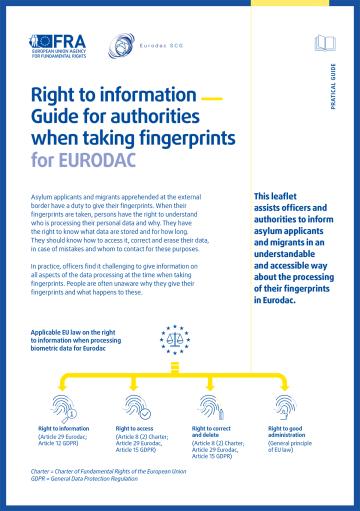
    Ta brošura pomaga uradnim osebam in organom pri obveščanju prosilcev za azil in migrantov o obdelavi njihovih prstnih odtisov v sistemu Eurodac v razumljivi in dostopni obliki.
  • Report / Paper / Summary
    21
    January
    2021
    German language version now available
    26 January 2021
    Nacionalne institucije za človekove pravice (NHRI) so ključnega pomena za varstvo človekovih pravic na državni ravni. Z ozaveščanjem, svetovanjem, spremljanjem in zagotavljanjem odgovornosti oblasti imajo osrednjo vlogo pri premagovanju velikih sodobnih izzivov na področju človekovih pravic, saj rešujejo zakoreninjene probleme, kot sta diskriminacija in neenakost, ter novejše težave, kot so posledice umetne inteligence ter pandemije covida-19 za človekove pravice.
  • Handbook / Guide / Manual
    5
    December
    2018
    Last versions available are EL and NL
    11 March 2021
    V tem priročniku je pojasnjeno, kaj je profiliranje, kateri pravni okviri ga urejajo ter zakaj je zakonitost profiliranja potrebna zaradi spoštovanja temeljnih pravic ter ključna za učinkovito policijsko delo in upravljanje meja. Priročnik vsebuje tudi praktične smernice o tem, kako se izogniti nezakonitemu profiliranju pri policijskih operacijah in operacijah upravljanja meja.
  • Report / Paper / Summary
    3
    September
    2020
    Summary version now available
    21 January 2021
    National Human Rights Institutions (NHRIs) are a vital part of the country-level human rights protection system. This report, published 10 years after FRA’s first in-depth study on NHRIs, looks at such bodies in the EU, as well as the Republic of North Macedonia, the Republic of Serbia, and the United Kingdom of Great Britain and Northern Ireland. It explores relevant developments, challenges to their effectiveness and ways to maximise their impact.
  • Fundamental Rights Report
    11
    June
    2026
    The Fundamental Rights Report: Challenges and Achievements in 2025 is FRA’s flagship annual publication. It provides an overview of the state of fundamental rights in the EU and highlights selected critical developments from 2025. This year, it focuses on four areas: rights protection in a rapidly changing digital environment; the housing crisis and rising homelessness rates; employment challenges for people from non-EU countries; and the implementation of the EU Charter of Fundamental Rights. The publication is a valuable resource for those seeking to stay informed about the EU’s shifting landscape of fundamental rights.
  • In brief / Factsheet
    22
    May
    2026
    This factsheet examines the "right to be forgotten" within the context of EU law and the European Convention on Human Rights. It emphasizes the intersections of these legal frameworks, with particular attention to case law from the Court of Justice of the European Union (CJEU) and the European Court of Human Rights (ECtHR).
  • Report / Paper / Summary
    11
    May
    2026
    The ability to communicate freely and privately online is protected under Article 7 of the EU Charter; it is a crucial enabler of other fundamental rights, particularly as the world becomes increasingly digital. This paper presents results from an EU-wide survey about people’s views on encryption of their private online communication. It looks, for example, at concern regarding access by outside actors to information shared when using private messaging applications. The results indicate that people highly value encryption and at the same time have concerns about online communications being accessed without their knowledge or permission. It provides a timely evidence base to shape policy discussions on internal security and digital privacy.
    FRA, 2026