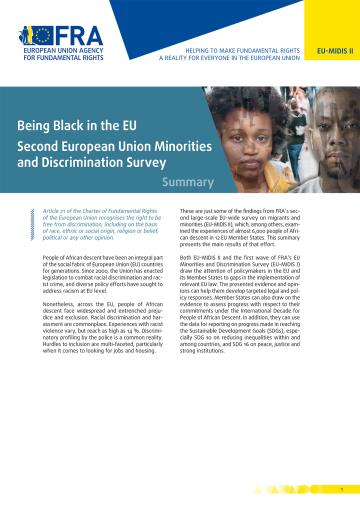
Across the EU, people of African descent face widespread and entrenched prejudice and exclusion. Racial discrimination and harassment are commonplace. Experiences with racist violence vary, but reach as high as 14 %. Discriminatory profiling by the police is a common reality. Hurdles to inclusion are multi-faceted, particularly when it comes to looking for jobs and housing.
This annual overview provides an update of the most recent figures on antisemitic incidents, covering the period 1 January 2008 – 31 December 2018, across the EU Member States, where data are available. It includes a section that presents evidence from international organisations. In addition, for the first time, it provides an overview of how Member States that have adopted or endorsed the non-legally binding working definition of antisemitism adopted by the International Holocaust Remembrance Alliance (IHRA) (2016) use or intend to use it.
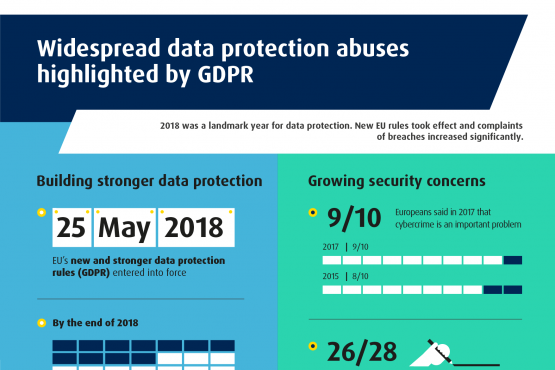
Fundamental Rights Report 2019: 2018 was a landmark year for data protection. New EU rules took effect and complaints of breaches increased significantly.
The General Data Protection Regulation (GDPR) has applied across the European Union (EU) since 25 May 2018. One year on, this paper looks at how the new regulation has affected the daily work of civil society organisations (CSOs).
Algorithms used in machine learning systems and artificial intelligence (AI) can only be as good as the data used for their development. High quality data are essential for high quality algorithms. Yet, the call for high quality data in discussions around AI often remains without any further specifications and guidance as to what this actually means.
How much progress can we expect in a decade? Various rights-related instruments had been in place for 10 years in 2018, prompting both sobering and encouraging reflection on this question.
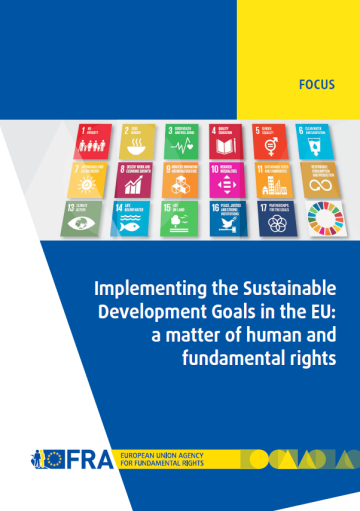
This year’s focus explores the interrelationship between the human and fundamental rights framework and the Sustainable
Development Goals (SDGs) of the global Agenda 2030 in the context of Member States’ and the EU’s internal policies.
It takes a closer look at the SDGs related to reducing inequality (SDG 10) and promoting peace, justice and strong
institutions (SDG 16).
The year 2018 brought both progress and setbacks in terms of fundamental rights protection. FRA’s Fundamental Rights Report 2019 reviews major developments in the field, identifying both achievements and remaining areas of concern. This publication presents FRA’s opinions on the main developments in the thematic areas covered, and a synopsis of the evidence supporting these
opinions.
Sa bhliain 2018, tógadh céimeanna chun tosaigh agus céimeanna siar araon i ndáil le cearta bunúsacha a chosaint. Déantar athbhreithniú sa Tuarascáil um Chearta Bunúsacha, 2019 ó FRA (Gníomhaireacht um Chearta Bunúsacha) ar na mórfhorbairtí san earnáil, agus sainaithnítear inti freisin na héachtaí a baineadh amach agus na rudaí ar ábhair imní iad go fóill. San fhoilseachán seo, cuirtear i láthair tuairimí ó FRA faoi na príomhfhorbairtí sna réimsí téamacha a chumhdaítear agus déantar achoimre ar an bhfianaise a thacaíonn leis na tuairimí sin.
Het jaar 2018 kende zowel vooruitgang als teleurstellingen bij de bescherming van grondrechten. Het Verslag over de grondrechten 2019 van het FRA evalueert de belangrijkste ontwikkelingen op het gebied van de grondrechten, waarbij niet alleen wordt ingegaan op de behaalde successen maar ook wordt gewezen op de resterende punten van zorg. Deze publicatie geeft een overzicht van FRA-adviezen voor de belangrijkste ontwikkelingen op de besproken thematische gebieden en van de feitelijke gegevens waarop deze adviezen berusten.
Victims of violent crime have various rights, including to protection and to access justice. But how are these rights playing out in practice? Are victims of violent crime properly seen, informed, empowered and heard? Do they tend to feel that justice has been done? Our four-part report series takes a closer look at these questions, based on interviews with victims, people working for victim support organisations, police officers, attorneys, prosecutors and judges.
Victims of violent crime have various rights, including to protection and to access justice. But how are these rights playing out in practice? Are victims of violent crime properly seen, informed, empowered and heard? Do they tend to feel that justice has been done? Our four-part report series takes a closer look at these questions, based on interviews with victims, people working for victim support organisations, police officers, attorneys, prosecutors and judges.
Member States have an explicit duty to promote the Charter’s application. These country-sheets support that effort by giving examples of the Charter’s use and highlighting how it adds value.
This summary outlines the main findings of FRA’s second survey on Jewish people’s experiences with hate crime, discrimination and antisemitism in the European Union – the biggest survey of Jewish people ever conducted worldwide.
This Opinion aims to inform the European Parliament’s position on the legislative proposal for a Regulation on preventing the dissemination of terrorist content online, presented by the European Commission on 12 September 2018.
This paper discusses the evolution of European Court of Human Rights case law relating
to hate crime, providing an update on the most recent rulings. Approaching hate crime
from a fundamental rights perspective, it shows how Member State authorities’ duty to
effectively investigate the bias motivation of crimes flows from key human rights
instruments, such as the European Convention on Human Rights.
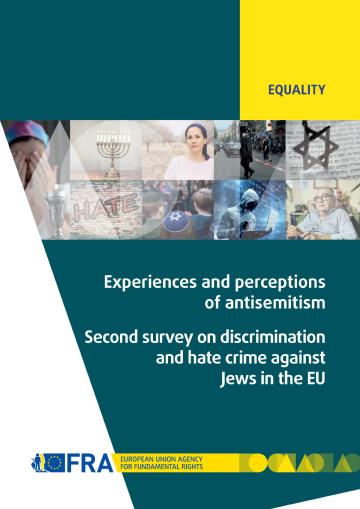
This report outlines the main findings of FRA’s second survey on Jewish people’s experiences with hate crime, discrimination and antisemitism in the European Union – the biggest survey of Jewish people ever conducted worldwide. Covering 12 EU Member States, the survey reached almost 16,500 individuals who identify as being Jewish. It follows up on the agency’s first survey, conducted in seven countries in 2012.
This Opinion by the European Union Agency for Fundamental Rights (FRA) aims to inform
the European Parliament’s position on the legislative proposal on the European Border and
Coast Guard (EBCG) presented by the European Commission on 12 September 2018.
В настоящото ръководство се обяснява какво представлява профилирането, правните рамки, които го регулират и защо правомерното извършване на профилиране е необходимо за спазването на основните права и е от решаващо значение за ефективната дейност на полицейските и граничните органи. В ръководството също така са предоставени практически насоки за това как да се избегне неправомерно профилиране при операции на полицейските и граничните органи.
I denne vejledning forklares, hvad der forstås ved profilering, de retlige rammer, der regulerer profilering, og hvorfor det er både nødvendigt at foretage profilering lovligt for at overholde de grundlæggende rettigheder og afgørende for et effektivt politiarbejde og en effektiv grænseforvaltning. Vejledningen indeholder også praktiske retningslinjer om, hvordan ulovlig profilering kan undgås i forbindelse med politi- og grænseforvaltningsoperationer.