Equality

Kön, sexuell läggning och könsidentitet

Highlights

  • Report / Paper / Summary
    3
    March
    2026
    Violence against women remains widespread in the European Union (EU). This joint report by the EU Agency for Fundamental Rights (FRA) and the European Institute for Gender Equality (EIGE) presents detailed findings from the EU gender-based violence survey. It offers in-depth analysis of the scale, nature and drivers of violence and exposes the structural gender inequality. Building on the 2024 publication, EU gender-based violence survey - Key results, and following up on FRA’s 2014 report, Violence against women: an EU-wide survey, this report tracks trends over the last decade across the EU. Eurostat, FRA, and EIGE jointly conducted the survey. It is based on over 100,000 interviews covering all 27 EU Member States.

  • Report / Paper / Summary
    24
    February
    2026
    The start of Russia’s war of aggression against Ukraine on 24 February 2022 shocked the global community and gave rise to a
    series of urgent fundamental rights challenges across Europe. While much attention has focused on the scale of devastation and its wider impact on all Ukrainians, the war has also inflicted profound personal harm. This report sheds light on the violence, sexual harassment and exploitation experienced by women displaced from Ukraine. Drawing on a survey and in-depth interviews with women from Ukraine, the report documents the prevalence, forms and patterns of gender-based violence and sets out practical measures to improve safety, access to justice and support.
  • Video
    There are no truly safe spaces for women. At home, at work, in public or online, 1 in 3 women and girls have experienced some form of gender-based violence. This ranges from hate, harassment, abuse, to physical and sexual violence. Women are being silenced and harmed - online and offline - every day, as the EU gender-based survey findings show. But we have the tools to fight it. By preventing violence before it starts, by strengthen legal protection, by funding support services for victims and by training police and healthcare professionals.
  • Report / Paper / Summary
    17
    September
    2025
    This report highlights the discrimination, harassment, violence, and non-consensual medical interventions faced by intersex people across 30 European countries, based on responses from nearly 2,000 participants in FRA's 2023 EU LGBTIQ Survey III. It reveals that many intersex individuals also identify as trans, non-binary, gender-diverse and have varied sexual orientations, which further compounds their experiences of discrimination. The report aims to support the development of laws and policies that promote the inclusion and dignity of intersex people.
    Produkter
    12
    September
    2019
    FRA’s second EU Minorities and Discrimination survey (EU-MIDIS II) collected information from over 25,000 respondents with different ethnic minority and immigrant backgrounds across all 28 EU Member States. The main findings from the survey, published in 2017, pointed to a number of differences in the way women and men with immigrant backgrounds across the European Union (EU) experience how their rights are respected. This report summarises some of the most relevant survey findings in this regard, which show the need for targeted, gender-sensitive measures that promote the integration of – specifically – women who are immigrants or descendants of immigrants.
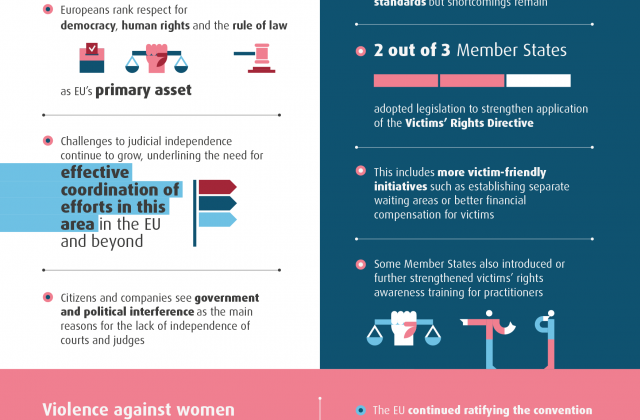
    Fundamental Rights Report 2019: In some Member States access to justice faces challenges. Judicial independence continues to cause
    concerns. Victims’ procedural rights need more effective implementation. Gaps in preventing
    violence against women and domestic violence remain.
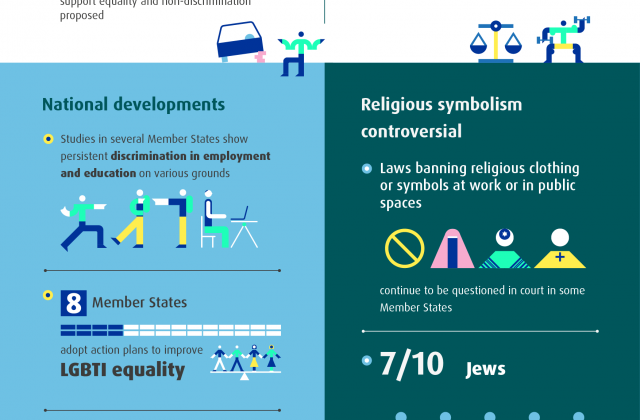
    Fundamental Rights Report 2019: Efforts to advance equality moved ahead in some areas but remain stalled in others.
    In this video blog Michael O'Flaherty focuses on EuroPride and the need to stand up for the fundamental rights of the LGBTIQ community.
    6
    June
    2019
    How much progress can we expect in a decade? Various rights-related instruments had been in place for 10 years in 2018, prompting both sobering and encouraging reflection on this question.
    25
    April
    2019
    Victims of violent crime have various rights, including to protection and to access justice. But how are these rights playing out in practice? Are victims of violent crime properly seen, informed, empowered and heard? Do they tend to feel that justice has been done? Our four-part report series takes a closer look at these questions, based on interviews with victims, people working for victim support organisations, police officers, attorneys, prosecutors and judges.
    5
    April
    2019
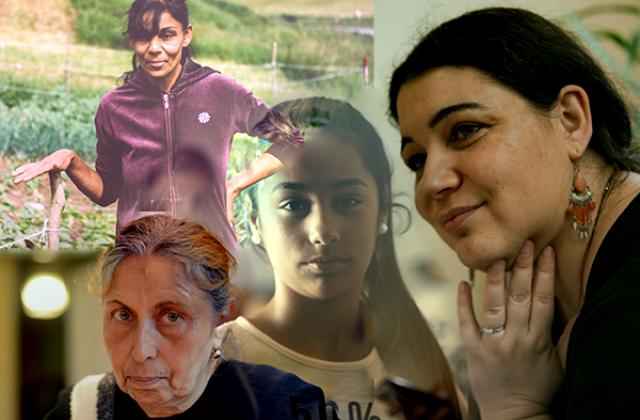
    Despite efforts by the European Union (EU) and its Member States to reduce gender inequalities among citizens of Roma origin, important gender differences persist. Drawing on FRA’s own EU-MIDIS II survey research in nine EU Member States this report highlights the position of Roma women in education, employment and health, as well as the extent to which they experience hate-motivated discrimination, harassment and physical violence.
    15
    June
    2018
    The stories of the domestic workers FRA interviewed for this paper reveal appalling working conditions and fundamental rights abuses in private homes across the EU. These stories indicate that, seven years on from FRA’s first report on domestic workers in 2011, little has changed in terms of the risks and experiences of severe labour exploitation domestic workers in the EU face.
    6
    June
    2018
    The year 2017 brought both progress and setbacks in terms of rights protection. The European Pillar of Social Rights marked an important move towards a more ‘social Europe’. But, as experiences with the EU Charter of Fundamental Rights underscore, agreement on a text is merely a first step. Even in its eighth year as the EU's binding bill of rights, the Charter's potential was not fully exploited, highlighting the need to more actively promote its use.
    17
    May
    2018
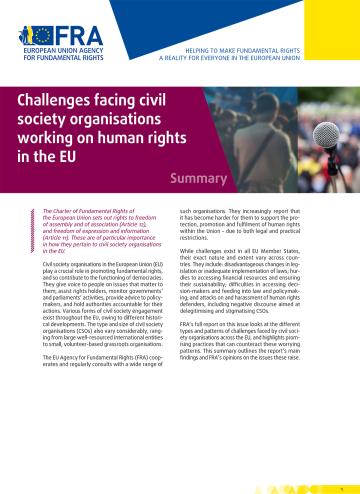
    Civilsamhällesorganisationerna i EU är avgörande för främjandet av grundläggande rättigheter, men deras arbete har försvårats – på grund av både rättsliga och praktiska begränsningar. Det finns utmaningar i alla EU-medlemsstater, men deras exakta natur och omfattning varierar. I allmänhet saknas data och forskning i frågan – däribland jämförande forskning.
    FRA:s rapport är därför inriktad på olika typer av och mönster för de utmaningar som det civila samhällets människorättsorganisationer står inför i EU. I rapporten framhävs också
    lovande praxis som kan motverka dessa oroande mönster.
    21
    March
    2018
    New language versions: Lithuanian, Portuguese and Slovak
    28 October 2021
    Den europeiska icke-diskrimineringslagstiftningen, som i huvudsak består av EU:s ickediskrimineringsdirektiv och artikel 14 i och protokoll nr 12 till Europakonventionen om de mänskliga rättigheterna, förbjuder diskriminering på en rad olika grunder och i olika sammanhang. Den här handboken innehåller en genomgång av den europeiska icke-diskrimineringslagstiftning som härrör från dessa två källor. De ses som två kompletterande system som delvis överlappar varandra. I de fall de skiljer sig åt påpekas detta.
    8
    December
    2017
    In this book you will read about laws against hurting women, what is wrong and what to do about it.
    6
    December
    2017
    Seventeen years after adoption of EU laws that forbid discrimination, immigrants, descendants of immigrants, and minority ethnic groups continue to face widespread discrimination across the EU and in all areas of life – most often when seeking employment. For many, discrimination is a recurring experience. This is just one of the findings of FRA’s second European Union Minorities and Discrimination Survey (EU-MIDIS II), which collected information from over 25,500 respondents with different ethnic minority and immigrant backgrounds across all 28 EU Member States.
    13
    November
    2017
    Women and girls in the European Union (EU) experience persistent gender discrimination and gender-based violence, as evidence collected by FRA confirms. This severely limits the ability of women and girls to enjoy their rights and to participate on an equal footing in society. This FRA contribution to the third Annual Colloquium on Fundamental Rights ‘Women's rights in turbulent times’ looks at core human rights commitments. It balances these against selected evidence on gender discrimination, sexist hate speech and gender-based violence against women and girls in the EU.
    30
    May
    2017
    Diverse efforts at both EU and national levels sought to bolster fundamental rights protection in 2016, while some measures threatened to undermine such protection.
    30
    May
    2017
    Diverse efforts at both EU and national levels sought to bolster fundamental rights protection in 2016, while some measures threatened to undermine such protection.
    29
    May
    2017
    This year marks the 10th anniversary of the EU Agency for Fundamental Rights. Such a milestone offers an opportunity for reflection – both on the progress that provides cause for celebration and on the lingering shortcomings that must be addressed.
    24
    March
    2017
    This report reviews how asylum claims based on sexual
    orientation and gender identity are assessed and analyses the existence of
    specific reception measures for LGBTI persons.
    16
    November
    2016
    A free and pluralist media is vital to the democratic functioning of the European
    Union (EU) and its Member States. However, journalists and other media actors
    in the EU face various challenges, including violence, threats and other forms of
    pressure, both direct and indirect.