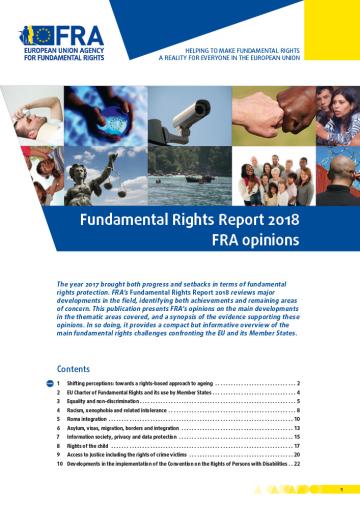
2017 m. pagrindinių teisių apsaugos srityje padaryta pažanga, tačiau neišvengta ir nesėkmių. Europos Sąjungos pagrindinių teisių agentūros (angl. FRA) 2018 m. ataskaitoje apie pagrindinių teisių būklę apžvelgiami svarbiausi šios srities pokyčiai, taip pat aptariami laimėjimai ir neišspręsti susirūpinimą keliantys klausimai.
Pamattiesību aizsardzības jomā 2017. gadā bija vērojami gan sasniegumi, gan neveiksmes. FRA 2018. gada ziņojumā par pamattiesībām ir aplūkoti galvenie jaunumi pamattiesību jomā, nosakot gan sasniegumus, gan jomas, kas vēl joprojām rada bažas.
Is-sena 2017 ġabet magħha kemm progress kif ukoll ostakoli f’termini ta’ protezzjoni tad-drittijiet fundamentali. Ir-Rapport dwar id-Drittijiet Fundamentali 2018 tal-FRA jirrevedi żviluppi ewlenin f’dan il-qasam, filwaqt li jidentifika kemm il-kisbiet kif ukoll l-oqsma ta’ tħassib li jifdal.
Het jaar 2017 kende zowel voor- als achteruitgang in de bescherming van grondrechten. Het Verslag over de grondrechten 2018 van het FRA evalueert de belangrijkste ontwikkelingen op het gebied van de grondrechten, waarbij niet alleen wordt ingegaan op de successen die zijn behaald, maar ook wordt gewezen op de resterende punten van zorg.
2017 r. przyniósł zarówno postęp, jak i regres pod względem ochrony praw podstawowych. Sprawozdanie FRA na temat praw podstawowych z 2018 r. zawiera przegląd najważniejszych zmian, jakie miały miejsce w tym obszarze,
wskazując zarówno na osiągnięcia, jak i kwestie, które nadal wymagają stosownych działań.
O ano de 2017 trouxe avanços e retrocessos no âmbito da proteção dos direitos fundamentais. O Relatório sobre os Direitos Fundamentais 2018 da FRA analisa os principais desenvolvimentos neste domínio, identificando tanto as realizações quanto os problemas que persistem.
Anul 2017 a adus atât progrese, cât și regrese în ceea ce privește protecția drepturilor fundamentale. Raportul privind drepturile fundamentale 2018 al FRA analizează evoluțiile majore din domeniu, identificând atât realizările, cât și domeniile de interes nesoluționate.
Rok 2017 priniesol z hľadiska ochrany základných práv pokrok i nezdary. V publikácii agentúry FRA Správa ozákladných právach 2018 je uvedený prehľad hlavného vývoja v tejto oblasti, poukazuje sa na úspechy, ale aj
oblasti, ktoré ešte stále vyvolávajú obavy.
V letu 2017 je bil na področju varstva temeljnih pravic dosežen napredek, opazno pa je bilo tudi nazadovanje. Poročilo agencije FRA o temeljnih pravicah 2018 zajema pregled razvoja glavnih dogodkov na tem področju ter
opredeljuje dosežke in področja, ki so še vedno zaskrbljujoča.
År 2017 innebar både framgångar och motgångar för skyddet av de grundläggande rättigheterna. FRA:s Rapport om grundläggande rättigheter 2018 innehåller en granskning av de viktigaste händelserna på området och pekar ut både framsteg och återstående problemområden
We live in a world of big data, where technological developments in the area of machine learning and artificial intelligence have changed the way we live. Decisions and processes concerning everyday life are increasingly automated, based on data. This affects fundamental rights in various ways. This focus paper specifically deals with discrimination, a fundamental rights area particularly affected by technological developments.
In view of the increasing numbers of refugees, asylum seekers and migrants entering the EU, the EU Agency for Fundamental Rights has been collecting relevant data since September 2015. This report focuses on the fundamental rights situation of people arriving in Member States particularly affected by large migration movements. This report addresses fundamental rights concerns between 1 March-30 April 2018.
The rapid development of information technology has exacerbated the need for robust personal data protection, the right to which is safeguarded by both European Union (EU) and Council of Europe (CoE) instruments. Safeguarding this important right entails new and significant challenges as technological advances expand the frontiers of areas such as surveillance, communication interception and data storage. This handbook is designed to familiarise legal practitioners not specialised in data protection with this emerging area of the law.
Straujā informācijas tehnoloģiju attīstība ir saasinājusi nepieciešamību pēc stabila personas datu aizsardzības
regulējuma, tiesībām, kuras aizsargā gan Eiropas Savienības (ES), gan Eiropas Padomes (EP) instrumenti.
Šo svarīgo tiesību aizsardzība rada jaunas un būtiskas problēmas, jo tehnoloģiju attīstība paplašina tādu
jomu robežas kā novērošana, sakaru pārtveršana un datu glabāšana. Šī rokasgrāmata ir paredzēta, lai
iepazīstinātu ar šo jauno tiesību jomu praktizējošus juristus, kuri nespecializējas datu aizsardzībā.
A rápida evolução das tecnologias da informação exacerbou a necessidade de uma proteção sólida dos dados pessoais, cujo direito é garantido por instrumentos da União Europeia (UE) e do Conselho da Europa (CdE). A salvaguarda deste importante direito implica importantes novos desafios porque os avanços tecnológicos expandem as fronteiras de áreas como a vigilância, a interceção das comunicações e o armazenamento dos dados. O presente manual destina-se a familiarizar os profissionais do Direito que não são especializados em proteção de dados com esta área emergente do Direito.
Civil society organisations in the European Union play a crucial role in promoting fundamental
rights, but it has become harder for them do so – due to both legal and practical restrictions.
This summary outlines the main
findings and FRA’s opinions on the different
types and patterns of challenges faced by civil society
organisations across the EU,
With terrorism, cyber-attacks and sophisticated cross-border criminal networks posing growing threats, the work of intelligence services has become more urgent, complex and international. Such work can strongly interfere with fundamental rights, especially privacy and data protection. While continuous technological advances potentially exacerbate the threat of such interference, effective oversight and remedies can curb the potential for abuse.
The methods used to determine the age of
an applicant may include “invasive” medical tests which interfere with the rights of the child, including their right to dignity,
integrity and privacy. It is often a challenge to find the right balance between protecting children from harm and promoting
their participation in these procedures. This report provides important insights and identifies the implications of collecting
children’s biometric data and conducting age assessments.
This report outlines Member States’ approaches to age requirements and limits
regarding child participation in judicial proceedings; procedural safeguards for, and rights of, children involved in criminal
proceedings; as well as issues related to depriving children of their liberty.
W niniejszym sprawozdaniu określa się podejścia państw członkowskich do wymogów dotyczących wieku i ograniczeń w zakresie uczestnictwa dzieci w postępowaniach sądowych; gwarancje proceduralne oraz prawa dzieci biorących udział w postępowaniu karnym; a także kwestie dotyczące pozbawiania dzieci wolności.