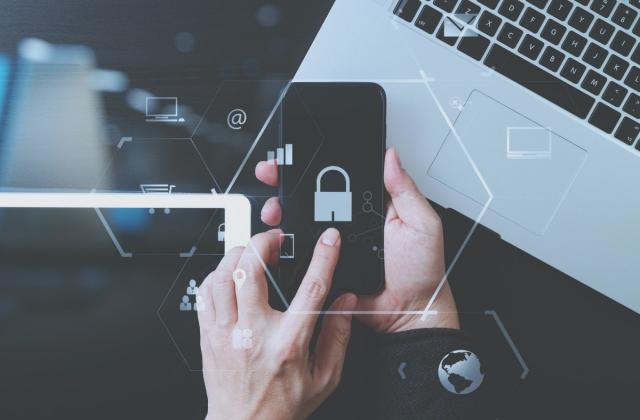
Encryption and concerns about access to private online communication – people’s views across the EU
In the survey, respondents were asked to indicate how concerned they are about the possibility of various actors having access to information they communicate privately online. The question asked in the survey was as follows:
- ‘How concerned are you that some of the information you share in private online communication (such as when using WhatsApp, Signal, iMessage or other private messaging applications/direct messaging) might be accessed by any of the following without your knowledge or permission?’
The respondents were asked to consider in turn each of the six actors listed in Figure 1 and indicate their answers on a scale from 1 to 7, where 1 means ‘not at all concerned’ to 7 means ‘extremely concerned’ (for details on the scale and its use see the note under (Figure 1).
FRA’s separate Fundamental Rights Survey – which collected data in 2019 from 34,948 respondents – examined the degree to which people in the EU are concerned about various actors accessing information they have shared on the internet, including on social media, when this access takes place without people’s knowledge or permission. The results – which have been analysed in FRA’s Fundamental Rights Report 2020 [4] FRA, Fundamental Rights Report 2020, Publications Office of the European Union, Luxembourg, 2020.
and in the 2020 paper, Your rights matter: Data protection and privacy [5] FRA, Your rights matter: Data Protection and privacy – Fundamental Rights Survey, Publications Office of the European Union, Luxembourg, 2020.
– show that most internet users (55 %) are concerned about their information being used without their knowledge or permission by one or more actors listed in the survey (such as criminals, businesses and advertisers, law enforcement agencies or intelligence services, (prospective) employers, and foreign governments).
Compared with the question asked in the Fundamental Rights Survey, the current survey focuses specifically on information shared via private online communication, and the list of potential actors involved is partly different (for the actors listed in the current survey, see Figure 1). However, while not directly comparable, both surveys indicate heightened concern when it comes to access – by certain groups – to people’s online communication.
The majority of people in the EU, 62 %, are concerned about information from their private online communication being accessed by criminals (Figure 1). Almost half of people in the EU are concerned about access to their private online communication by foreign governments (49 %) and businesses (47 %). Some two in five people are concerned about access to their private online communication by national secret or intelligence services (42 %), national governments (42 %), and law enforcement (37 %). Overall, three in four people (75 %) are concerned about access to their private online communication by at least one of the six actors listed in Figure 1. In the the survey, respondents were asked to indicate for each of the six actors in Figure 1 the degree of concern they had about each actor accessing one’s private online communications without a respondent’s knowledge or permission.
Figure 1 – Concerns over selected actors accessing one’s private online communications without their knowledge or permission (EU-27, %)
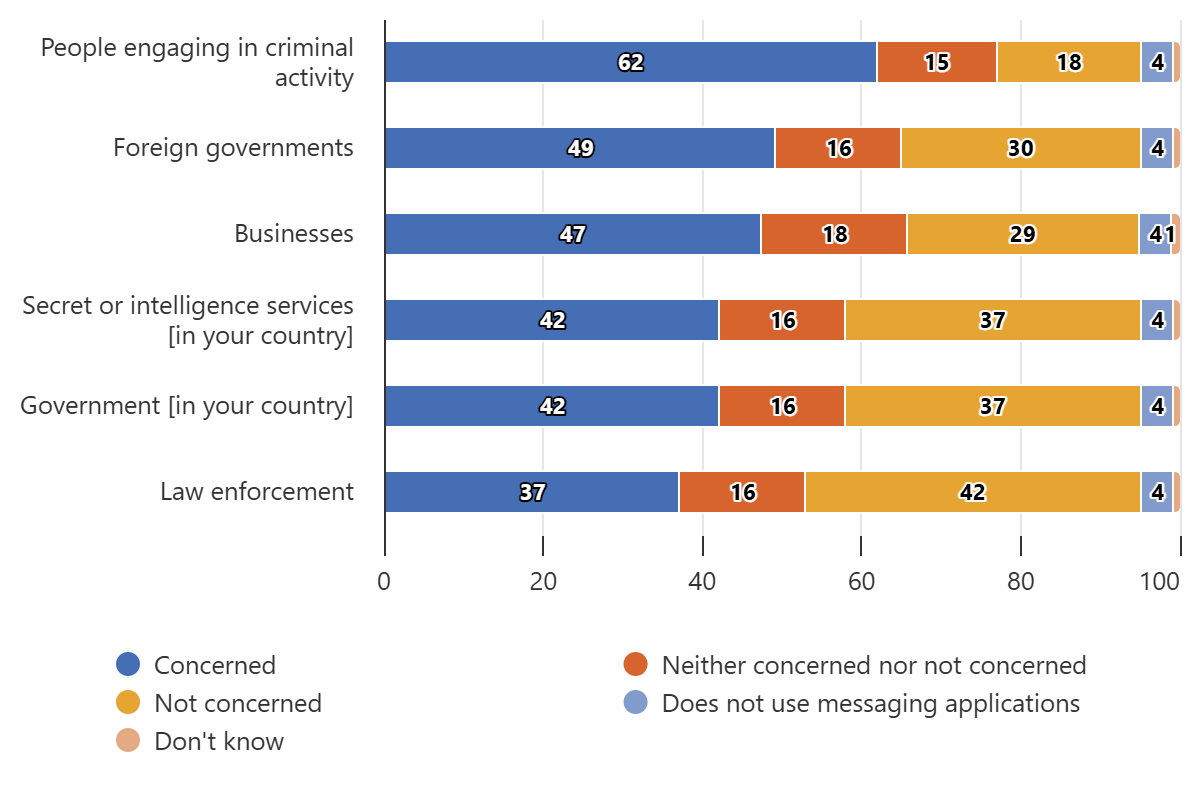
The stacked bar chart shows the levels of concern of respondents regarding access without their knowledge or permission to their private online communication, by different actors. 62 % are concerned about access by people engaging in criminal activity, followed by 49 % about access by foreign governments, 47 % by businesses, 42 % by the respondent’s national secret or intelligence services, 42 % by the respondent’s national government, and 37 % by law enforcement.
NB: n = 26,453
Question: ‘How concerned are you that some of the information you share in private online communication (such as when using WhatsApp, Signal, iMessage or other private messaging applications/direct messaging) might be accessed by any of the following without your knowledge or permission?’. Respondents were asked to provide an answer with respect to each of the actors listed in the figure above. They were asked to respond using a scale ranging from 1 to 7, where 1 means ‘not at all concerned’ and 7 means ‘extremely concerned’ – or that they don’t use messaging applications, or to select the answer category ‘Don’t know’. Above, respondents who answered with a value 1–3 are included in the category ‘Not concerned’, value 4 is labelled ‘Neither concerned nor not concerned’, and values 5–7 are shown in the category ‘Concerned’.
Source: FRA, 2026
People who use the internet every day/almost every day and those who use it less often express similar rates of concern as each other, ranging from 59 – 65 % of them concerned about access by criminals, to 38 % of them – across both groups – concerned about access by law enforcement.
Concern over access by different actors does not differ notably between women and men, with 63 and 62 % of women and men, respectively, being concerned about access by criminals, and 36 to 50 % concerned about other actors, with no more than 2 % points of difference in concern for each actor. In relation to age, people over 55 years old have lower concern regarding all actors. However, the age group 55+ also includes a higher number of people who do not use messaging apps compared to other age groups. When people who do not use messaging apps are removed from the analysis across all age groups, the levels of concern are broadly similar across all age groups.
Similarly, differences between people according to their level of education largely reflect differences in the use of online messaging. When focusing only on respondents who are users of online messaging, levels of concern are closer across educational categories. People in the intermediate category in terms of education (those with upper secondary education or post-secondary but non-tertiary education) express the highest concern, meaning there is no clear pattern of increasing or decreasing concern by people’s level of education. For example, regarding access to online communication by foreign governments, 42 % of people in the lowest of the three education categories analysed express concern, compared to 54 % of those in the intermediate education category, and 48 % of those in the highest education category (tertiary education).
Rates of concern about different actors accessing online data differ greatly across EU Member States. In some countries, such as Italy, Malta, Poland, Portugal and Spain, rates of concern are generally high (Table 1), ranging from 63 to 80 % for access by criminals (Figure 2). Regarding other actors, concern in these countries ranges from 44 to 67 %. On the other hand, Denmark, Finland, Lithuania, the Netherlands and Sweden score the lowest, ranging from 41 to 50 % respondents concerned about access by criminals, and 11 to 31 % about access by other actors.
While access by law enforcement is generally associated with lower concern, in 18 Member States, at least one third (33 %) of people express concern about it, with the highest rates in countries such as Cyprus, Italy, Malta, Poland, Romania and Spain (Figure 3).
Figure 2 – Concern over people engaging in criminal activities accessing one’s private online communications without user’s knowledge or permission, by EU Member State (%)
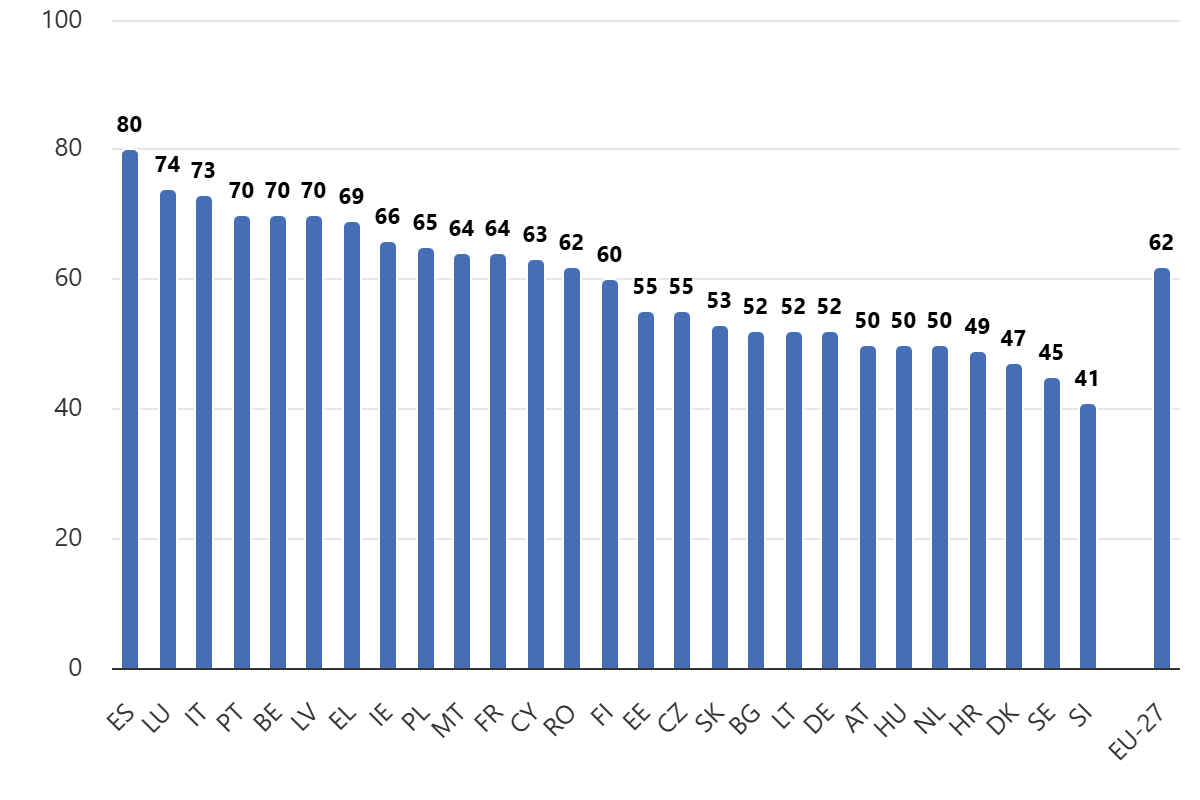
The chart shows the levels of concern of respondents in each EU Member State regarding access without their knowledge or permission to their private online communication, by people engaging in criminal activities. Results range from 80 % of respondents concerned in Spain, to 41 % concerned in Slovenia. The EU average is 62 %.
NB: n = 26,453
Question: For details on the question asked, see notes under Figure 1.
Source: FRA, 2026
Figure 3 – Concern over law enforcement accessing one’s private online communications without user’s knowledge or permission, by EU Member State (%)
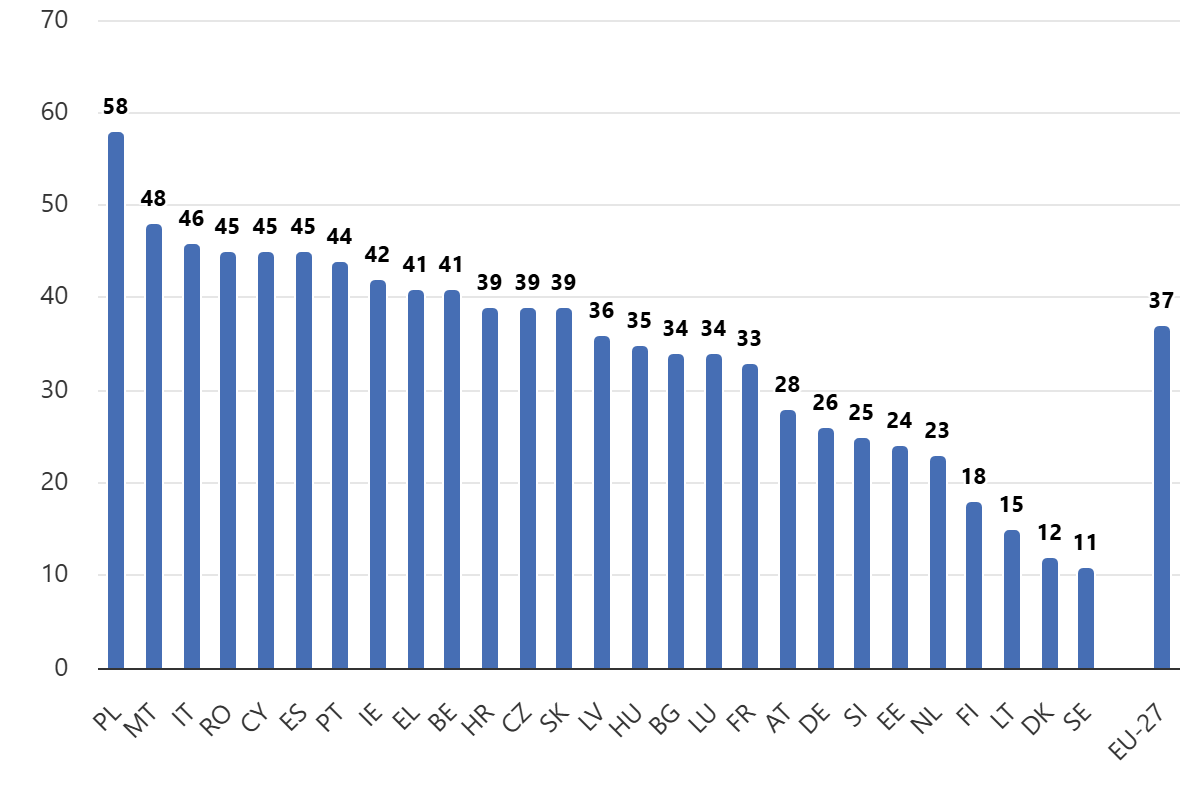
The chart shows the levels of concern of respondents in each EU Member State regarding access without their knowledge or permission to their private online communication, by law enforcement. Results range from 58 % of respondents concerned in Poland, to 11 % concerned in Sweden. The EU average is 37 %.
NB: n = 26,453
Question: For details on the question asked, see notes under Figure 1.
Source: FRA, 2026
Table 1 – Concern over selected actors accessing one’s private online communications without their knowledge or permission, by EU Member State (%)
|
Member States |
People engaging in criminal activity |
Foreign governments |
Businesses |
Secret or intelligence services [in your country] |
Government [in your country] |
Law enforcement |
|
BE |
70 |
56 |
51 |
44 |
46 |
41 |
|
BG |
52 |
30 |
34 |
33 |
31 |
34 |
|
CZ |
55 |
40 |
34 |
40 |
35 |
39 |
|
DK |
47 |
31 |
30 |
16 |
15 |
12 |
|
DE |
52 |
36 |
33 |
28 |
27 |
26 |
|
EE |
55 |
32 |
31 |
31 |
27 |
24 |
|
IE |
66 |
53 |
52 |
46 |
45 |
42 |
|
IT |
73 |
61 |
55 |
60 |
55 |
46 |
|
EL |
69 |
39 |
48 |
43 |
45 |
41 |
|
ES |
80 |
66 |
67 |
55 |
59 |
45 |
|
FR |
64 |
49 |
50 |
37 |
41 |
33 |
|
HR |
49 |
43 |
43 |
41 |
39 |
39 |
|
CY |
63 |
48 |
50 |
45 |
42 |
45 |
|
LV |
70 |
48 |
48 |
41 |
41 |
36 |
|
LT |
52 |
27 |
24 |
23 |
20 |
15 |
|
LU |
74 |
62 |
64 |
43 |
39 |
34 |
|
HU |
50 |
41 |
35 |
40 |
41 |
35 |
|
MT |
64 |
49 |
44 |
49 |
48 |
48 |
|
NL |
50 |
41 |
41 |
30 |
28 |
23 |
|
AT |
50 |
39 |
34 |
33 |
33 |
28 |
|
PL |
65 |
64 |
60 |
60 |
62 |
58 |
|
PT |
70 |
60 |
57 |
48 |
49 |
44 |
|
RO |
62 |
56 |
53 |
51 |
46 |
45 |
|
SI |
41 |
25 |
27 |
27 |
25 |
25 |
|
SK |
53 |
37 |
31 |
41 |
37 |
39 |
|
FI |
60 |
38 |
40 |
19 |
23 |
18 |
|
SE |
45 |
27 |
32 |
11 |
10 |
11 |
|
EU-27 |
62 |
49 |
47 |
42 |
42 |
37 |
NB: n = 26,453
Question: For details on the question asked, see notes under Figure 1.
Source: FRA, 2026