eu-charter

Povelja o temeljnim pravima Europske unije

Članak 8 - Zaštita osobnih podataka

Članak 8 - Zaštita osobnih podataka

1. Svatko ima pravo na zaštitu svojih osobnih podataka.
2. Takvi podaci moraju se obrañivati pošteno u za to utvrñene svrhe, na temelju pristanka osobe o kojoj je riječ ili na nekoj drugoj legitimnoj osnovi, utvrñenoj zakonom. Svatko ima pravo na pristup prikupljenim podacima koji se na njega ili nju odnose i pravo na njihovo ispravljanje.
3. Poštovanje tih pravila podliježe nadzoru neovisnog tijela.

Objašnjenja

  • Text:
    Source:
    Preamble - Explanations relating to the Charter of Fundamental Rights:

Sudska praksa

  • La Quadrature du Net, Fédération des fournisseurs d’accès à Internet associatifs, Franciliens.net, French Data Network v Premier ministre, Ministre de la Culture
    Decision date:
  • Federal Ministry of Finances
    Decision date:
  • Jens Hermans, Karin Verelst and C.U.; and others Association without lucrative purpose «Association de Promotion des Droits Humains et des Minorités» Versus The Flemish Government; The United College oCommon Community Commissionf the
    Decision date:
  • Ordre des barreaux francophones et germanophone ; “Académie Fiscale” and Jean Pierre Riquet; “Liga voor Mensenrechten”; “Ligue des Droits de l’Homme”; Patrick Van Assche and others.
    Decision date:
  • Belgian French and German-speaking bar associations and two Belgian League of Human Rights associations (‘Liga voor Mensenrechten/Ligue des Droits de l’Homme’) v Belgian State
    Decision date:
  • Order of Flemish Bars and Alain Claes and the de facto association “Belgian Association of Tax Lawyers” and others v. The Government of the Brussels-Capital Region and the Flemish Government
    Decision date:
  • VZW Kinderrechtencoalitie Vlaanderen (Children’s rights coalition Flanders) and VZW Liga voor Mensenrechten (League for Human Rights) v. the Kingdom of Belgium
    Decision date:
  • Ombudsman of the Republic of Bulgaria (Омбудсман на Република България)
    Decision date:
  • Mr A vs the National Revenue Agency (NRA) (Национална агенция за приходите, НАП)
    Decision date:
  • Patrick Kelly v National University of Ireland
    Decision date:

Nacionalnom ustavnom pravu

68 results found

  • Netherlands / Constitution of the Kingdom of the Netherlands
    Zemlja:
    Netherlands

    Article 10 (...) 2. Rules to protect privacy shall be laid down by Act of Parliament in connection with the recording and dissemination of personal data. 3. Rules concerning the rights of persons to be informed of data recorded concerning them and of the use that is made thereof, and to have such data corrected shall be laid down by Act of Parliament.

  • Organic Law 15/1999 of 13 December on the Protection of Personal Data
    Zemlja:
    Spain

    Article 1This Organic Law is intended to guarantee and protect the public liberties and fundamental rights of natural persons, and in particular their personal and family privacy, with regard to the processing of personal data

  • Personal Data Act (1998:204)
    Zemlja:
    Sweden

    Article 1 The purpose of this Act is to protect people against the violation of their personal integrity by processing of personal data.

  • Personal Data Act (523/1999)
    Zemlja:
    Finland

    Section 1The objectives of this Act are to implement, in the processing of personal data, the protection of private life and the other basic rights which safeguard the right to privacy, as well as to promote the development of and compliance with good processing practice.

  • Personal Data Protection Act 
    Zemlja:
    Estonia

    § 1. Scope of application and purpose of Act.
    (1) The aim of this Act is to protect the fundamental rights and freedoms of natural persons upon processing of personal data, above all the right to inviolability of private life. (…)

  • Personal Data Protection Act 2001
    Zemlja:
    Bulgaria

    Art. 1. (1) This Law shall govern the protection of rights of individuals with regard to the processing of their personal data.(2) The purpose of this law is to guarantee the inviolability of personality and privacy by ensuring protection of individuals in case of unauthorised personal data processing referred to them, in the process of free movement of data. (3) (new - SG 91/06) This Law shall apply to personal data processing:1. by automatic means; 2. by non-automatic means, where such data are, or are designed to become, part of a register.(...)

  • Personal Data Protection Act 2007
    Zemlja:
    Slovenia
  • Personal Data Protection Law
    Zemlja:
    Latvia

    Section 1. The purpose of this Law is to protect the fundamental human rights and freedoms of natural persons, in particular the inviolability of private life, regarding the processing of natural person data.

  • Personuppgiftslag (1998:204)
    Zemlja:
    Sweden

    1 § Syftet med denna lag är att skydda människor mot att deras personliga integritet kränks genom behandling av personuppgifter.

  • Portugal / Constitution of the Portuguese Republic
    Zemlja:
    Portugal

    Article 35 (Use of information technology) (1) All citizens have the right of access to any computerised data relating to them and the right to be informed of the use for which the data is intended, under the law; they are entitled to require that the contents of the files and records be corrected and brought up to date.(2) The law shall determine what is personal data as well as the conditions applicable to automatic processing, connection, transmission and use thereof, and shall guarantee its protection by means of an independent administrative body. (3) Computerised storage shall not be used for information concerning a person's ideological or political convictions, party or trade union affiliations, religious beliefs, private life or ethnic origin, except where there is express consent from the data subject, authorisation provided for under the law with guarantees of non-discrimination or, in the case of data, for statistical purposes, that does not identify individuals. (4) Access to personal data of third parties is prohibited, except in exceptional cases as prescribed by law. (5) Citizens shall not be given an all-purpose national identity number. (6) Everyone shall be guaranteed free access to public information networks and the law shall define the regulations applicable to the transnational data flows and the adequate norms of protection for personal data and for data that should be safeguarded in the national interest. (7) Personal data kept on manual files shall benefit from protection identical to that provided for in the above Articles, in accordance with the law.  

  • Sammenskrevet udgave af persondataloven
    Zemlja:
    Denmark

    Lovens område § 1. Loven gælder for behandling af personoplysninger, som helt eller delvis foretages ved hjælp af elektronisk databehandling, og for ikke-elektronisk behandling af personoplysninger, der er eller vil blive indeholdt i et register. Stk. 2. Loven gælder tillige for anden ikke-elektronisk systematisk behandling, som udføres for private, og som omfatter oplysninger om personers private eller økonomiske forhold eller i øvrigt oplysninger om personlige forhold, som med rimelighed kan forlanges unddraget offentligheden. Dette gælder dog ikke reglerne i lovens kapitel 8 og 9. Stk. 3. Lovens § 5, stk. 1-3, §§ 6-8, § 10, § 11, stk. 1, § 38 og § 40 gælder også for manuel videregivelse af personoplysninger til en anden forvaltningsmyndighed. Datatilsynet fører i overensstemmelse med lovens kapitel 16 tilsyn med videregivelse som nævnt i 1. pkt. Stk. 4. Loven gælder endvidere for behandling af oplysninger om virksomheder m.v., jf. stk. 1 og 2, hvis denne behandling udføres for kreditoplysningsbureauer. Tilsvarende gælder for så vidt angår behandlinger, som er omfattet af § 50, stk. 1, nr. 2. Stk. 5. Kapitel 5 gælder også for behandling af oplysninger om virksomheder m.v. , jf. stk. 1. Stk. 6. Uden for de i stk. 4 nævnte tilfælde kan justitsministeren bestemme, at lovens regler helt eller delvis skal finde anvendelse på behandling af oplysninger om virksomheder m.v., som udføres for private. Stk. 7. Uden for de i stk. 5 nævnte tilfælde kan vedkommende minister bestemme, at lovens regler helt eller delvis skal finde anvendelse på behandling af oplysninger om virksomheder m.v., som udføres for den offentlige forvaltning.

  • Slovakia / Constitution of the Slovak Republic
    Zemlja:
    Slovakia

    Article 19 (...) (3) Everyone has the right to protection against unauthorized collection, publication, or other misuse of personal data.

  • Slovenia / Constitution of the Republic of Slovenia
    Zemlja:
    Slovenia

    Article 38 The protection of personal data shall be guaranteed. The use of personal data contrary to the purpose for which it was collected is prohibited. The collection, processing, designated use, supervision and protection of the confidentiality of personal data shall be provided by law. Everyone has the right of access to the collected personal data that relates to him and the right to judicial protection in the event of any abuse of such data.

  • Spain / Constitution of the Kingdom of Spain
    Zemlja:
    Spain

    Article 18(...) 4. The law shall restrict the use of data processing in order to guarantee the honour and personal and family privacy of citizens and the full exercise of their rights.

  • Suomen perustuslaki
    Zemlja:
    Finland

    10 § Yksityiselämän suoja Jokaisen yksityiselämä, kunnia ja kotirauha on turvattu. Henkilötietojen suojasta säädetään tarkemmin lailla. (...) 

  • The Act on Processing of Personal
    Zemlja:
    Denmark

    Scope of the Act 1. - (1) This Act shall apply to the processing of personal data wholly or partly by automatic means, and to the processing otherwise than by automatic means of personal data which form part of a filing system or are intended to form part of a filing system. (2) This Act shall further apply to other non-automatic systematic processing of data which is performed for private persons or bodies and which includes data on individual persons' private or financial matters or other data on personal matters which can reasonably be claimed to be withheld from the public. However, this shall not apply to Chapters 8 and 9 of this Act. (3) This Act shall further apply to the processing of data concerning companies, etc., cf. subsections (1) and (2), if the processing is carried out for credit information agencies. The same shall apply in the case of processing of data covered by section 50 (1) 2. (4) Chapter 5 of the Act shall also apply to the processing of data concerning companies, etc., cf. subsection (1). (5) In other cases than those mentioned in subsection (3), the Minister of Justice may decide that the provisions of this Act shall apply, in full or in part, to the processing of data concerning companies, etc. which is performed for private persons or bodies. (6) In other cases than those mentioned in subsection(4), the competent Minister may decide that the provisions of this Act shall apply, in full or in part, to the processing of data concerning companies, etc., which is performed on behalf of public administrations. (7) This Act shall apply to any processing of personal data in connection with video surveillance. (...)

  • The Federal Act Concerning the Protection of Personal Data
    Zemlja:
    Austria

    Sect. 1.(1) Everybody shall have the right to secrecy for the personal data concerning him, especially with regard to his private and family life, insofar as he has an interest deserving such protection. Such an interest is precluded when data cannot be subject to the right to secrecy due to their general availability or because they cannot be traced back to the data subject [Betroffener]. (2) Insofar personal data is not used in the vital interest of the data subject or with his consent, restrictions to the right to secrecy are only permitted to safeguard overriding legitimate interests of another, namely in case of an intervention by a public authority the restriction shall only be permitted based on laws [footnote 1] necessary for the reasons stated in Art. 8, para. 2 of the European Convention on Human Rights (Federal Law Gazette No. 210/1958). Such laws may provide for the use of data [Verwendung von Daten] that deserve special protection only in order to safeguard substantial public interests and shall provide suitable safeguards for the protection of the data subjects' interest in secrecy. Even in the case of permitted restrictions the intervention with the fundamental right shall be carried out using only the least intrusive of all effective methods. (3) Everybody shall have, insofar as personal data concerning him are destined for automated processing or manual processing, i.e. in filing systems [Dateien] without automated processing, as provided for by law, 1.the right to obtain information as to who processes what data concerning him, where the data originated, for which purpose they are used, as well as to whom the data are transmitted; 2.the right to rectification of incorrect data and the right to erasure of illegally processed data. (4) Restrictions of the rights according to para. 3 are only permitted under the conditions laid out in para. 2. (5) The fundamental right to data protection, except the right to information [Auskunftsrecht], shall be asserted before the civil courts against organisations that are established according to private law, as long as they do not act in execution of laws. In all other cases the Data Protection Commission [Datenschutzkommission] shall be competent to render the decision, unless an act of Parliament or a judicial decision is concerned.

  • The Fundamental Law of Hungary
    Zemlja:
    Hungary

    Article VI (Freedom and Responsibility) [...] (2) Everyone shall have the right to the protection of his or her personal data, as well as to access
    and disseminate data of public interest.
    (3) The application of the right to the protection of personal data and to access data of public
    interest shall be supervised by an independent authority established by a cardinal Act.

  • The Processing of Personal Data (Protection of the Individual) Law
    Zemlja:
    Cyprus

    Scope of the law 3.(1) The provisions of this Law shall apply to the processing of personal data wholly or partly by automatic means, and to the processing otherwise than by automatic means of personal data which form part of a filing system or are intended to form part of a filing system.(…)

  • The Protection of Personal Data Act
    Zemlja:
    Czechia

Pravo EU-a

37 results found

  • Directive 2010/13/EU of the European Parliament and of the Council of 10 March 2010 on the coordination of certain provisions laid down by law, regulation or administrative action in Member States concerning the provision of audiovisual media services

    Preamble 
    (16) This Directive enhances compliance with fundamental rights and is fully in line with the principles recognised by the Charter of Fundamental Rights of the European Union (12), in particular Article 11 thereof. In this regard, this Directive should not in any way prevent Member States from applying their constitutional rules relating to freedom of the press and freedom of expression in the media.


    (48) Television broadcasting rights for events of high interest to the public may be acquired by broadcasters on an exclusive basis. However, it is essential to promote pluralism through the diversity of news production and programming across the Union and to respect the principles recognised by Article 11 of the Charter of Fundamental Rights of the European Union.


    (60) Measures taken to protect the physical, mental and moral development of minors and human dignity should be carefully balanced with the fundamental right to freedom of expression as laid down in the Charter on Fundamental Rights of the European Union. The aim of those measures, such as the use of personal identification numbers (PIN codes), filtering systems or labelling, should thus be to ensure an adequate level of protection of the physical, mental and moral development of minors and human dignity, especially with regard to on-demand audiovisual media services. The Recommendation on the protection of minors and human dignity and on the right of reply already recognised the importance of filtering systems and labelling and included a number of possible measures for the benefit of minors, such as systematically supplying users with an effective, updatable and easy-to-use filtering system when they subscribe to an access provider or equipping the access to services specifically intended for children with automatic filtering systems.

  • Regulation (EU) 2022/991 of the European Parliament and of the Council of 8 June 2022 amending Regulation (EU) 2016/794, as regards Europol’s cooperation with private parties, the processing of personal data by Europol in support of criminal investigation

    (57) This Regulation fully respects the fundamental rights and safeguards, and observes the principles recognised in particular by the Charter of Fundamental Rights of the European Union (‘the Charter’), in particular the right to respect for private and family life and the right to the protection of personal data as provided for by Articles 7 and 8 of the Charter, as well as by Article 16 TFEU. Given the importance of the processing of personal data for the work of law enforcement in general, and for the support provided by Europol in particular, this Regulation should include enhanced safeguards, democratic oversight and accountability mechanisms, to ensure that the activities and tasks of Europol are carried out in full compliance with fundamental rights as enshrined in the Charter, in particular the rights to equality before the law, to non-discrimination, and to an effective remedy before the competent national court against any of the measures taken pursuant to this Regulation. Any processing of personal data under this Regulation should be limited to that which is strictly necessary and proportionate, and subject to clear conditions, strict requirements and effective supervision by the EDPS.

  • Regulation (EU) 2017/746 of the European Parliament and of the Council of 5 April 2017 on in vitro diagnostic medical devices and repealing Directive 98/79/EC and Commission Decision 2010/227/EU

    (68) An electronic system should be set up at Union level to ensure that every interventional clinical performance study and other performance study involving risks for the subjects of the studies is recorded and reported in a publicly accessible database. To protect the right to protection of personal data, recognised by Article 8 of the Charter of Fundamental Rights of the European Union (‘the Charter’), no personal data of subjects participating in a performance study should be recorded in the electronic system. To ensure synergies with the area of clinical trials on medicinal products, the electronic system on performance studies should be interoperable with the EU database to be set up for clinical trials on medicinal products for human use.

    [...]

    Article 1

    Subject matter and scope

    10. Nothing in this Regulation shall restrict the freedom of the press or the freedom of expression in the media in so far as those freedoms are guaranteed in the Union and in the Member States, in particular under Article 11 of the Charter of Fundamental Rights of the European Union.

  • Regulation (EU) No 603/2013 of the European Parliament and of the Council of 26 June 2013 on the establishment of 'Eurodac' for the comparison of fingerprints for the effective application of Regulation (EU) No 604/2013

    Preamble

    (50) This Regulation respects the fundamental rights and observes the principles recognised in particular by the Charter. In particular, this Regulation seeks to ensure full respect for the protection of personal data and for the right to seek international protection, and to promote the application of Articles 8 and 18 of the Charter. This Regulation should therefore be applied accordingly.

    Article 1- Purpose of "Eurodac" 
    [...]
    ‘2. This Regulation also lays down the conditions under which Member States' designated authorities and the European Police Office (Europol) may request the comparison of fingerprint data with those stored in the Central System for law enforcement purposes. 
    3.   Without prejudice to the processing of data intended for Eurodac by the Member State of origin in databases set up under the latter's national law, fingerprint data and other personal data may be processed in Eurodac only for the purposes set out in this Regulation and Article 34(1) of Regulation (EU) No 604/2013.‘ 
    Article 23 - Responsibility for data processing
    [...]
    ‘2. In accordance with Article 34, the Member State of origin shall ensure the security of the data referred to in paragraph 1 before and during transmission to the Central System as well as the security of the data it receives from the Central System.‘
    Article 27 - Access to, and correction or erasure of, data recorded in Eurodac
    [...]
    ‘4.   If a Member State or the Agency has evidence to suggest that data recorded in the Central System are factually inaccurate, it shall advise the Member State of origin as soon as possible.
    If a Member State has evidence to suggest that data were recorded in the Central System in breach of this Regulation, it shall advise the Agency, the Commission and the Member State of origin as soon as possible. The Member State of origin shall check the data concerned and, if necessary, amend or erase them without delay.‘
    Article 33 - Protection of personal data for law enforcement purposes
    [...]
    ‘3.   The processing of personal data by Europol pursuant to this Regulation shall be in accordance with Decision 2009/371/JHA and shall be supervised by an independent external data protection supervisor. Articles 30, 31 and 32 of that Decision shall be applicable to the processing of personal data by Europol pursuant to this Regulation. The independent external data protection supervisor shall ensure that the rights of the individual are not violated.‘ 

  • Regulation (EU) 2017/1128 of the European Parliament and of the Council of 14 June 2017 on cross-border portability of online content services in the internal market

    [...]

    (30) This Regulation respects fundamental rights and observes the principles recognised in the Charter of Fundamental Rights of the European Union (‘Charter’). Accordingly, this Regulation should be interpreted and applied in accordance with those rights and principles, in particular the right to respect for private and family life, the right to protection of personal data, the right to freedom of expression, the freedom to conduct a business and the right to property, including intellectual property. Any processing of personal data under this Regulation should respect fundamental rights, including the right to respect for private and family life and the right to protection of personal data under Articles 7 and 8 of the Charter, and it is essential that such processing be in compliance with Directives 95/46/EC and 2002/58/EC. In particular, providers of online content services should ensure that any processing of personal data under this Regulation is necessary, reasonable and proportionate in order to achieve the relevant purpose. Where authentication of a subscriber is sufficient in order to provide the service, identification of the subscriber should not be required. Data collected pursuant to this Regulation for the purposes of verification of the Member State of residence should not be stored by the provider longer than necessary to complete such verification. Such data should be immediately and irreversibly destroyed after the verification is completed. However, this is without prejudice to the storage of data which was collected for another legitimate purpose, subject to applicable data protection rules, including rules concerning the storage of that data.

    [...]

  • Regulation (EU) 2021/784 of the European Parliament and of the Council of 29 April 2021 on addressing the dissemination of terrorist content online

    Preamble 


    (20) It should be possible for the competent authority of the Member State where the hosting service provider has its main establishment or where its legal representative resides or is established to scrutinise the removal order issued by competent authorities of another Member State to determine whether it seriously or manifestly infringes this Regulation or the fundamental rights enshrined in the Charter. Both the content provider and the hosting service provider should have the right to request such scrutiny by the competent authority in the Member State where the hosting service provider has its main establishment or where its legal representative resides or is established. Where such a request is made, that competent authority should adopt a decision on whether the removal order comprises such an infringement. Where that decision finds such an infringement, the removal order should cease to have legal effects. The scrutiny should be carried out swiftly so as to ensure that erroneously removed or disabled content is reinstated as soon as possible.


    (23) When putting in place specific measures, hosting service providers should ensure that users’ right to freedom of expression and information as well as the freedom and pluralism of the media as protected under the Charter are preserved. In addition to any requirement laid down in the law, including legislation on the protection of personal data, hosting service providers should act with due diligence and implement safeguards, where appropriate, including human oversight and verifications, to avoid any unintended or erroneous decision leading to the removal of or disabling of access to content that is not terrorist content.

    Article 1: Subject matter and scope

    1. This Regulation lays down uniform rules to address the misuse of hosting services for the dissemination to the public of terrorist content online, in particular on:

    (a) reasonable and proportionate duties of care to be applied by hosting service providers in order to address the dissemination to the public of terrorist content through their services and ensure, where necessary, the expeditious removal of or disabling of access to such content;

    (b) the measures to be put in place by Member States, in accordance with Union law and subject to suitable safeguards to protect fundamental rights, in particular the freedom of expression and information in an open and democratic society, in order to:

    (i) identify and ensure the expeditious removal of terrorist content by hosting service providers; and

    (ii) facilitate cooperation among the competent authorities of Member States, hosting service providers and, where appropriate, Europol.

    2. This Regulation applies to hosting service providers offering services in the Union, irrespective of their place of main establishment, insofar as they disseminate information to the public.

    3. Material disseminated to the public for educational, journalistic, artistic or research purposes or for the purposes of preventing or countering terrorism, including material which represents an expression of polemic or controversial views in the course of public debate, shall not be considered to be terrorist content. An assessment shall determine the true purpose of that dissemination and whether material is disseminated to the public for those purposes.

    4. This Regulation shall not have the effect of modifying the obligation to respect the rights, freedoms and principles referred to in Article 6 TEU and shall apply without prejudice to fundamental principles relating to freedom of expression and information, including freedom and pluralism of the media.

    5. This Regulation shall be without prejudice to Directives 2000/31/EC and 2010/13/EU. For audiovisual media services as defined in point (a) of Article 1(1) of Directive 2010/13/EU, Directive 2010/13/EU shall prevail.

    Article 4: Procedure for cross-borders removal orders 

    3.   The competent authority of the Member State where the hosting service provider has its main establishment or where its legal representative resides or is established may, on its own initiative, within 72 hours of receiving the copy of the removal order in accordance with paragraph 1, scrutinise the removal order to determine whether it seriously or manifestly infringes this Regulation or the fundamental rights and freedoms guaranteed by the Charter.

    Where it finds an infringement, it shall, within the same period, adopt a reasoned decision to that effect. 

  • Regulation (EU) 2023/1543 of the European Parliament and of the Council of 12 July 2023 on European Production Orders and European Preservation Orders for electronic evidence in criminal proceedings and for the execution of custodial sentences

    Preamble 


    (13) The respect for private and family life and the protection of natural persons regarding the processing of personal data are fundamental rights. In accordance with Article 7 and Article 8(1) of the Charter, everyone has the right to respect for their private and family life, home and communications and to the protection of personal data concerning them.

    (46) The principle of ne bis in idem is a fundamental principle of law in the Union, as recognised by the Charter and developed by the case law of the Court of Justice of the European Union. Where the issuing authority has grounds to believe that parallel criminal proceedings could be ongoing in another Member State, it should consult the authorities of that Member State in accordance with Council Framework Decision 2009/948/JHA . In any case, a European Production Order or a European Preservation Order is not to be issued where the issuing authority has grounds to believe that this would be contrary to the ne bis in idem principle.

    Article 1: Subject matter

    1. This Regulation lays down the rules under which an authority of a Member State, in criminal proceedings, may issue a European Production Order or a European Preservation Order and thereby order a service provider offering services in the Union and established in another Member State, or, if not established, represented by a legal representative in another Member State, to produce or to preserve electronic evidence regardless of the location of the data. This Regulation is without prejudice to the powers of national authorities to address service providers established or represented on their territory for the purpose of ensuring that they comply with national measures similar to those referred to in the first subparagraph.

    2. The issuing of a European Production Order or of a European Preservation Order may also be requested by a suspect or an accused person, or by a lawyer on that person’s behalf within the framework of applicable defence rights in accordance with national criminal procedural law.

    3. This Regulation shall not have the effect of modifying the obligation to respect the fundamental rights and legal principles as enshrined in the Charter and in Article 6 TEU, and any obligations applicable to law enforcement authorities or judicial authorities in this respect shall remain unaffected. This Regulation applies without prejudice to fundamental principles, in particular the freedom of expression and information, including the freedom and pluralism of the media, respect for private and family life, the protection of personal data, as well as the right to effective judicial protection.

  • Regulation (EU) 2021/1232 of the European Parliament and of the Council of 14 July 2021 on a temporary derogation from certain provisions of Directive 2002/58/EC as regards the use of technologies by providers

    Article 1

    Subject matter and scope

    1. This Regulation lays down temporary and strictly limited rules derogating from certain obligations laid down in Directive 2002/58/EC, with the sole objective of enabling providers of certain number-independent interpersonal communications services (‘providers’) to use, without prejudice to Regulation (EU) 2016/679, specific technologies for the processing of personal and other data to the extent strictly necessary to detect online child sexual abuse on their services and report it and to remove online child sexual abuse material from their services.

    2. This Regulation does not apply to the scanning of audio communications.

  • Directive (EU) 2022/2381 of the European Parliament and of the Council of 23 November 2022 on improving the gender balance among directors of listed companies and related measures

    Article 1

    Purpose

    This Directive aims to achieve a more balanced representation of women and men among the directors of listed companies by establishing effective measures that aim to accelerate progress towards gender balance, while allowing listed companies sufficient time to make the necessary arrangements for that purpose.

  • Directive (EU) 2019/1937 of the European Parliament and of the Council of 23 October 2019 on the protection of persons who report breaches of Union law

    Article 1

    Purpose

    The purpose of this Directive is to enhance the enforcement of Union law and policies in specific areas by laying down common minimum standards providing for a high level of protection of persons reporting breaches of Union law.

Međunarodno pravo

3 results found

  • European Convention on Human Rights - Article 8

    Article 8 – Right to respect for private and family life

    1. Everyone has the right to respect for his private and family life, his home and his correspondence.

    2. There shall be no interference by a public authority with the exercise of this right except such as is in accordance with the law and is necessary in a democratic society in the interests of national security, public safety or the economic well-being of the country, for the prevention of disorder or crime, for the protection of health or morals, or for the protection of the rights and freedoms of others.

  • Council of Europe, Guidelines on the protection of individuals with regard to the processing of personal data in a world of big data

    ‘The present Guidelines recommend measures that Parties, controllers and processors should take to prevent the potential negative impact of the use of Big Data on human dignity, human rights, and fundamental individual and collective freedoms, in particular with regard to personal data protection.
    Given the nature of Big Data and its uses, the application of some of the traditional principles of data processing (e.g. the principle of data minimisation, purpose limitation, fairness and transparency, and free, specific and informed consent) may be challenging in this technological scenario. These Guidelines therefore suggest a specific application of the principles of Convention 108, to make them more effective in practice in the Big Data context.‘

  • OECD, Guidelines governing the Protection of Privacy and Transborder Flows of Personal Data

    ‘2. These Guidelines apply to personal data, whether in the public or private sectors, which, because of the manner in which they are processed, or because of their nature or the context in which they are used, pose a risk to privacy and individual liberties.‘
    ‘3. The principles in these Guidelines are complementary and should be read as a whole. They should not be interpreted:
    a) as preventing the application of different protective measures to different categories of personal data, depending upon their nature and the context in which they are collected, stored, processed or disseminated; or
    b) in a manner which unduly limits the freedom of expression‘
    ‘7. There should be limits to the collection of personal data and any such data should be obtained by lawful and fair means and, where appropriate, with the knowledge or consent of the data subject.‘
    ‘9. The purposes for which personal data are collected should be specified not later than at the time of data collection and the subsequent use limited to the fulfilment of those purposes or such others as are not incompatible with those purposes and as are specified on each occasion of change of purpose.‘

Proizvodi

  • Handbook / Guide / Manual
    19
    August
    2022
    CS, DE, ES, FR, HU, IT, NL, PL, RO versions now available
    16 November 2022
    Povelja Europske unije o temeljnim pravima predstavlja zbirku najvažnijih prava EU-a. Uvijek obvezuje institucije Europske unije i države članice kada djeluju unutar područja primjene prava EU-a. Međutim, nije lako procijeniti je li konkretan slučaj obuhvaćen područjem primjene prava EU-a. Stoga je pravnim stručnjacima potrebno omogućiti osposobljavanje i materijale za osposobljavanje kako bi razumjeli područje primjene Povelje kako je navedeno u njezinu članku 51. Cilj je ovog priručnika za instruktore pružiti smjernice i za organizaciju i provedbu takvog osposobljavanja na temelju niza studija slučajeva, koji će se u budućnosti proširiti.
  • Handbook / Guide / Manual
    25
    May
    2018
    New language version - Polish
    30 April 2020
    Brz razvoj informacijske tehnologije povećao je potrebu za snažnom zaštitom osobnih podataka. To je pravo
    zaštićeno instrumentima i Europske unije (EU) i Vijeća Europe. Zaštita tog važnog prava podrazumijeva nove
    i značajne izazove dok tehnološki napredak dovodi do pomicanja granica područja poput nadzora, presretanja
    komunikacija i pohrane podataka. Ovaj je priručnik namijenjen pravnicima koji nisu specijalizirani u području
    zaštite podataka kako bi se upoznali s ovim novim područjem prava.
  • Fundamental Rights Report
    8
    June
    2022
    Godina 2021. donijela je i napredak i prepreke u pogledu zaštite temeljnih prava. U FRA-inu Izvješću o temeljnim pravima 2022. daje se pregled važnih promjena i postignuća u tom području te se ističu područja koja još izazivaju zabrinutost. U ovoj publikaciji navode se mišljenja FRA-e o glavnim promjenama u obuhvaćenim tematskim područjima te se ukratko iznose dokazi kojima se potkrjepljuju ta mišljenja. Na taj se način pruža sažet i informativan pregled glavnih pitanja povezanih s temeljnim pravima s kojima se suočavaju EU i njegove države članice.
  • Leaflet / Flyer
    16
    January
    2020
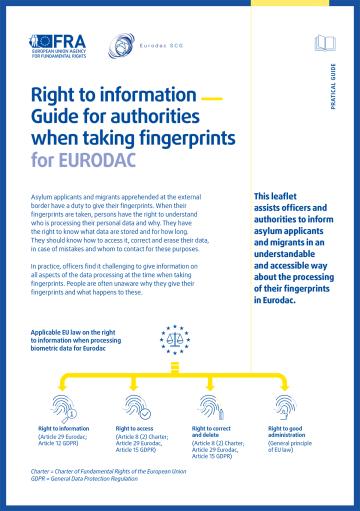
    Ovaj letak pomaže službenicima i nadležnim tijelima da na razumljiv i pristupačan način obavijeste podnositelje zahtjeva za azil i migrante o obradi njihovih otisaka prstiju u Eurodacu.
  • Report / Paper / Summary
    21
    January
    2021
    German language version now available
    26 January 2021
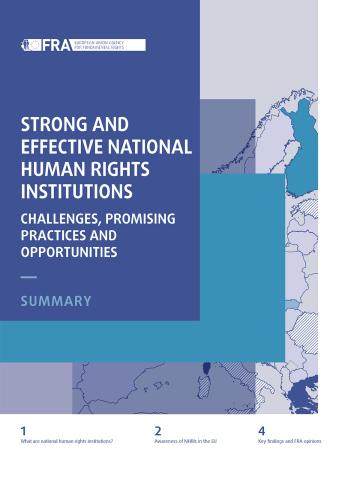
    Nacionalne institucije za ljudska prava ključan su dio sustava za zaštitu ljudskih prava na razini pojedine zemlje. Time što osvještavaju, pružaju savjete, nadziru tijela i pozivaju ih na odgovornost, te institucije imaju središnju ulogu u hvatanju u koštac s velikim poteškoćama u području ljudskih prava u današnje doba, nastojeći pronaći rješenje za trajne probleme kao što su diskriminacija i nejednakost, ali i baveći se novim pitanjima kao što je utjecaj umjetne inteligencije i pandemije bolesti COVID-19 na ljudska prava.
  • Handbook / Guide / Manual
    5
    December
    2018
    Last versions available are EL and NL
    11 March 2021
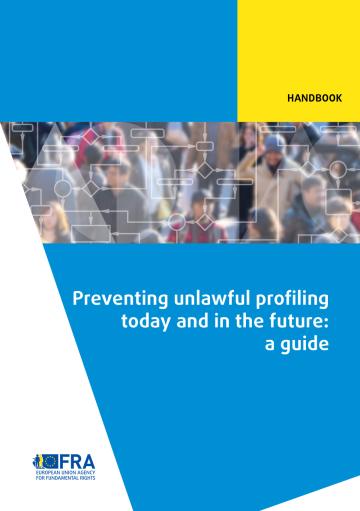
    U ovom se vodiču objašnjava što je izrada profila, opisuju pravni okviri kojima se ona uređuje i objašnjava zašto je zakonita izrada profila nužna da bi se poštovala temeljna prava, ali i ključna za djelotvoran rad policije i upravljanje granicama. Vodič sadržava i praktične smjernice o tome kako izbjeći nezakonitu izradu profila u policijskim operacijama i operacijama upravljanja granicama.
  • Report / Paper / Summary
    3
    September
    2020
    Summary version now available
    21 January 2021
    National Human Rights Institutions (NHRIs) are a vital part of the country-level human rights protection system. This report, published 10 years after FRA’s first in-depth study on NHRIs, looks at such bodies in the EU, as well as the Republic of North Macedonia, the Republic of Serbia, and the United Kingdom of Great Britain and Northern Ireland. It explores relevant developments, challenges to their effectiveness and ways to maximise their impact.
  • Fundamental Rights Report
    11
    June
    2026
    The Fundamental Rights Report: Challenges and Achievements in 2025 is FRA’s flagship annual publication. It provides an overview of the state of fundamental rights in the EU and highlights selected critical developments from 2025. This year, it focuses on four areas: rights protection in a rapidly changing digital environment; the housing crisis and rising homelessness rates; employment challenges for people from non-EU countries; and the implementation of the EU Charter of Fundamental Rights. The publication is a valuable resource for those seeking to stay informed about the EU’s shifting landscape of fundamental rights.
  • In brief / Factsheet
    22
    May
    2026
    This factsheet examines the "right to be forgotten" within the context of EU law and the European Convention on Human Rights. It emphasizes the intersections of these legal frameworks, with particular attention to case law from the Court of Justice of the European Union (CJEU) and the European Court of Human Rights (ECtHR).
  • Report / Paper / Summary
    11
    May
    2026
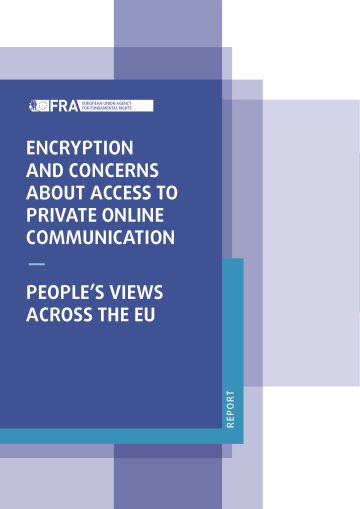
    The ability to communicate freely and privately online is protected under Article 7 of the EU Charter; it is a crucial enabler of other fundamental rights, particularly as the world becomes increasingly digital. This paper presents results from an EU-wide survey about people’s views on encryption of their private online communication. It looks, for example, at concern regarding access by outside actors to information shared when using private messaging applications. The results indicate that people highly value encryption and at the same time have concerns about online communications being accessed without their knowledge or permission. It provides a timely evidence base to shape policy discussions on internal security and digital privacy.
    FRA, 2026