Cilj je vodiča Djeca bez roditeljske skrbi pronađena u drugoj državi članici EU-a povećati mogućnosti
reakcije svih relevantnih strana u pogledu zaštite djece. Zaštita tih djevojčica i dječaka presudna
je i predstavlja obvezu država članica EU-a koja proizlazi iz međunarodnog i europskog pravnog
okvira. U središtu su pozornosti vodiča djeca žrtve trgovanja ljudima i djeca koja su izložena riziku
te provedba mjera opisanih u Komunikaciji iz 2017. o jačanju mjera EU-a protiv trgovanja ljudima.
Pritom se u obzir uzimaju utvrđeni obrasci, uključujući one povezane sa spolnom dimenzijom
kaznenih djela.
Algorithms used in machine learning systems and artificial intelligence (AI) can only be as good as the data used for their development. High quality data are essential for high quality algorithms. Yet, the call for high quality data in discussions around AI often remains without any further specifications and guidance as to what this actually means.
Godina 2018. sa sobom je donijela i napredovanja i nazadovanja u pogledu zaštite temeljnih prava. U Izvješću FRA-e o temeljnim pravima 2019. daje se pregled važnih novih događaja i postignuća u tom području te se ističu područja koja još izazivaju zabrinutost. U ovoj publikaciji navode se mišljenja FRA-e o glavnim kretanjima u obuhvaćenim tematskim područjima te se iznose dokazi kojima se potkrjepljuju ta mišljenja.
Despite efforts by the European Union (EU) and its Member States to reduce gender inequalities among citizens of Roma origin, important gender differences persist. Drawing on FRA’s own EU-MIDIS II survey research in nine EU Member States this report highlights the position of Roma women in education, employment and health, as well as the extent to which they experience hate-motivated discrimination, harassment and physical violence.
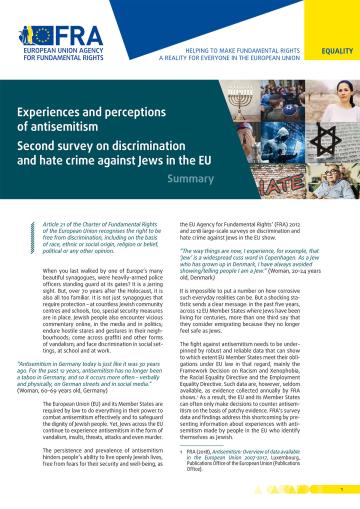
U ovom su sažetku predstavljeni glavni rezultati drugog istraživanja FRA-e o iskustvu Židova sa zločinima iz mržnje, diskriminacijom i antisemitizmom u Europskoj uniji, najvećeg istraživanja ikad provedenog u svijetu u kojem su sudjelovali Židovi.
This paper discusses the evolution of European Court of Human Rights case law relating
to hate crime, providing an update on the most recent rulings. Approaching hate crime
from a fundamental rights perspective, it shows how Member State authorities’ duty to
effectively investigate the bias motivation of crimes flows from key human rights
instruments, such as the European Convention on Human Rights.
This report outlines the main findings of FRA’s second survey on Jewish people’s experiences with hate crime, discrimination and antisemitism in the European Union – the biggest survey of Jewish people ever conducted worldwide. Covering 12 EU Member States, the survey reached almost 16,500 individuals who identify as being Jewish. It follows up on the agency’s first survey, conducted in seven countries in 2012.
U ovom se vodiču objašnjava što je izrada profila, opisuju pravni okviri kojima se ona uređuje i objašnjava zašto je zakonita izrada profila nužna da bi se poštovala temeljna prava, ali i ključna za djelotvoran rad policije i upravljanje granicama. Vodič sadržava i praktične smjernice o tome kako izbjeći nezakonitu izradu profila u policijskim operacijama i operacijama upravljanja granicama.
The Convention on the Rights of Persons with Disabilities commits both the EU and all of its Member States to realising the right of persons with disabilities to live independently in the community – which includes achieving deinstitutionalisation for those residing in institutional settings. But much remains to be done to make this a reality in practice. This report presents the main insights gained during fieldwork on the drivers of and barriers to deinstitutionalisation. Focusing on the local level, it gives voice to a diverse set of actors – most importantly, to people with disabilities themselves.


 Report / Paper / Summary3March2026
 Report / Paper / Summary27January2026
 Report / Paper / Summary27November2025