Almost 25 million children under 18 are at risk of poverty or social exclusion in the EU. Poverty deprives children of educational
opportunities, childcare, access to health care, adequate food and housing, family support and even protection from violence.
This report outlines data and survey findings that highlight the magnitude of child poverty in the EU, but also presents tools
available to counter this phenomenon and keep track of progress made.
The methods used to determine the age of
an applicant may include “invasive” medical tests which interfere with the rights of the child, including their right to dignity,
integrity and privacy. It is often a challenge to find the right balance between protecting children from harm and promoting
their participation in these procedures. This report provides important insights and identifies the implications of collecting
children’s biometric data and conducting age assessments.
This report outlines Member States’ approaches to age requirements and limits
regarding child participation in judicial proceedings; procedural safeguards for, and rights of, children involved in criminal
proceedings; as well as issues related to depriving children of their liberty.
The right to access justice and all other relevant procedural rights are not just rights in themselves; they also protect against violations of every other right. Respect for children’s rights in the area of justice is therefore essential. International treaties, the Charter of Fundamental Rights of the European Union, European Union (EU) secondary law, and national legislation provide a number of relevant rights.
This report outlines the fundamental rights implications of collecting, storing and using
biometric and other data in EU IT systems in the area of asylum and migration.
European non-discrimination law, as constituted in particular by the EU non-discrimination directives, and Article 14 of and Protocol 12 to the European Convention on Human Rights, prohibits discrimination across a range of contexts and grounds. This handbook examines European non-discrimination law stemming from these two sources as complementary systems, drawing on them interchangeably to the extent that they overlap, while highlighting differences where these exist.
EU Member States’ legal and practical responses to migrants and refugees implicate several of their fundamental rights, as enshrined in the Charter of Fundamental Rights of the European Union (EU). The EU Agency for Fundamental Rights (FRA) has regularly reported on these issues since September 2015. This report highlights key trends and persistent concerns between October 2016 and December 2017. It focuses on five areas: access to territory, reception conditions, asylum procedures, unaccompanied children and immigration detention.
Guardians are a key element of a protection system for children who are temporarily or
permanently deprived of their family environment and cannot have their interests represented
by their parents. Great disparities exist between the types of guardianship provided
to children in and within European Union (EU) Member States. This report explores the key
features of guardianship systems put in place to cater for the needs of all children in need
of protection, including child victims and those at risk of becoming victims of trafficking in
human beings or of other forms of exploitation.
Up to one third of migrants arriving in the European Union since the summer of 2015 have been children. The current emphasis on speedier asylum processing and making returns more effective may trigger increased use of immigration detention, possibly also affecting children. The detention of children implicates various fundamental rights and will only be in line with EU law if limited to exceptional cases. This report aims to support practitioners in implementing relevant polices in line with applicable law by outlining available safeguards against unlawful and arbitrary detention and highlighting promising practices.
This report assesses asylum seekers’ and refugees’ opportunities to access early
childhood education and primary, secondary and tertiary education and training.
It identifies measures available for their support, as well as possible areas for
improvement.
Integrating migrants, refugees and their descendants is of critical importance for the future of the European Union. This report examines Member States’ integration policies and action plans for promoting their participation in society, focusing on non-discrimination, education, employment, language learning and political engagement.
Around 2.5 million children participate in judicial proceedings across the European Union (EU) every year, affected by parental divorce or as victims of, or witnesses to, crime. Although their effective participation in such proceedings is vital for improving the operation of justice, the treatment of children in justice systems remains a concern. FRA investigated to what extent children’s rights to be heard, to be informed, to be protected, and to non-discrimination are fulfilled in practice.
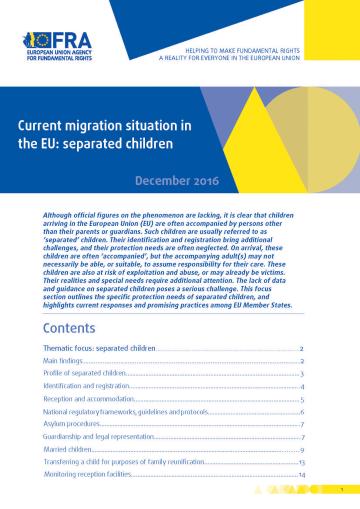
This focus section outlines the specific protection needs of separated children, and highlights current responses and promising practices among EU Member States.
The European Union Agency for Fundamental Rights (FRA), at the request of the European Commission, conducted research on national child protection systems in the 28 European Union (EU) Member States. It seeks to understand how national child protection systems work and to identify common challenges and promising practices.
Access to justice is an important element of the rule of law. It enables individuals to protect themselves against infringements of their rights, to remedy civil wrongs, to hold executive power accountable and to defend themselves in criminal proceedings. This handbook summarises the key European legal principles in the area of access to justice, focusing on civil and criminal law.
Children with disabilities face significant barriers to enjoying their fundamental rights. They are often excluded from society, sometimes living in facilities far from their families. They are also denied access to basic services, such as health care and education, and endure stigma and discrimination, as well as sexual, physical and psychological violence. FRA scrutinised the important but underreported issue of violence against children with disabilities, carrying out desk research and conducting interviews with knowledgeable stakeholders. This report presents the results of that research.
** Please note than an updated 2022 edition of this handbook is now available.** Children are full-fledged holders of rights. They are beneficiaries of all human and fundamental rights and subjects of special regulations, given their specific characteristics. This handbook aims to illustrate how European law and case law accommodate the specific interests and needs of children.
This report explores the key features of guardianship systems put in place to cater for the needs of all children in need of protection, including child victims and those at risk of becoming victims of trafficking in human beings or of other forms of exploitation. The research covers four specific areas, namely the type of guardianship systems in place, the profile of appointed guardians, the appointment procedures, and the tasks of the guardians.
Worker exploitation is not an isolated or marginal phenomenon. But despite its pervasiveness in everyday life, severe labour exploitation and its adverse effects on third-country nationals and EU citizens - as workers, but also as consumers - have to date not received much attention from researchers.
Each year thousands of children take part in criminal and civil judicial proceedings, affected by parental divorce
or as victims or witnesses to crime. Such proceedings can be stressful for anyone. The European Union Agency
for Fundamental Rights (FRA) investigated whether children’s rights are respected in these proceedings.