eu-charter

Europos Sąjungos pagrindinių teisių chartija

7 straipsnis - Teisė į privatų ir šeimos gyvenimą

7 straipsnis - Teisė į privatų ir šeimos gyvenimą

Kiekvienas asmuo turi teisę į tai, kad būtų gerbiamas jo privatus ir šeimos gyvenimas, būsto neliečiamybė ir komunikacijos slaptumas.

Paaiškinimai

  • Text:

    7 straipsnyje garantuotos teisės atitinka EŽTK 8 straipsnyje garantuotas teises. Atsižvelgiant į technologijų vystymąsi žodis `susirašinėjimas` buvo pakeistas žodžiu `komunikacija`.
    Remiantis 52 straipsnio 3 dalimi, šios teisės esmė ir taikymo apimtis yra tokia pati kaip atitinkamo EŽTK straipsnio. Todėl apribojimai, kurie gali būti teisėtai nustatyti šiai teisei, yra tokie patys kaip EŽTK 8 straipsnyje leidžiami apribojimai:
    `1. Kiekvienas turi teisę į tai, kad būtų gerbiamas jo privatus ir šeimos gyvenimas, būsto neliečiamybė ir susirašinėjimo slaptumas.
    2. Valstybės institucijos neturi teisės apriboti naudojimosi šiomis teisėmis, išskyrus įstatymų nustatytus atvejus ir kai tai būtina demokratinėje visuomenėje valstybės saugumo, visuomenės apsaugos ar šalies ekonominės gerovės interesams siekiant užkirsti kelią viešosios tvarkos pažeidimams ar nusikaltimams, taip pat būtina žmonių sveikatai ar moralei arba kitų asmenų teisėms ir laisvėms apsaugoti.`

    Source:
    Europos Sąjungos oficialusis leidinys C 303/17 - 14.12.2007
    Preamble - Explanations relating to the Charter of Fundamental Rights:
    Šie išaiškinimai buvo pirmą kartą parengti prižiūrint Europos Sąjungos pagrindinių teisių chartiją rengusio Konvento prezidiumui. Jie buvo atnaujinti Europos konvento prezidiumo atsakomybe, atsižvelgiant į Konvento įvestas Chartijos teksto projekto pataisas (ypač 51 ir 52 straipsnių) ir kitus Sąjungos teisės pakeitimus. Nors išaiškinimai neturi teisinės galios, jie yra svarbi Chartijos nuostatoms išaiškinti skirta aiškinimo priemonė.

Teismų praktika

  • La Quadrature du Net, Fédération des fournisseurs d’accès à Internet associatifs, Franciliens.net, French Data Network v Premier ministre, Ministre de la Culture
    Decision date:
  • Order of Francophone and Germanophone Bars, Order of Flemish Bars and the Institute of Accountants and Tax Consultants and others
    Decision date:
  • The Institute for the equality for women and a private individual (anonymous) v Council of Ministers
    Decision date:
  • Jens Hermans, Karin Verelst and C.U.; and others Association without lucrative purpose «Association de Promotion des Droits Humains et des Minorités» Versus The Flemish Government; The United College oCommon Community Commissionf the
    Decision date:
  • Ordre des barreaux francophones et germanophone ; “Académie Fiscale” and Jean Pierre Riquet; “Liga voor Mensenrechten”; “Ligue des Droits de l’Homme”; Patrick Van Assche and others.
    Decision date:
  • Belgian French and German-speaking bar associations and two Belgian League of Human Rights associations (‘Liga voor Mensenrechten/Ligue des Droits de l’Homme’) v Belgian State
    Decision date:
  • Order of Flemish Bars and Alain Claes and the de facto association “Belgian Association of Tax Lawyers” and others v. The Government of the Brussels-Capital Region and the Flemish Government
    Decision date:
  • VZW Kinderrechtencoalitie Vlaanderen (Children’s rights coalition Flanders) and VZW Liga voor Mensenrechten (League for Human Rights) v. the Kingdom of Belgium
    Decision date:
  • Liga voor Mensenrechten, Ligue des Droits de l’Homme, Ordre des barreaux francophones et germanophone, Association pour le droit des Etrangers, and others
    Decision date:
  • N.Z.G. vs the Director of the Metropolitan Home for Joyful Rites of Sofia Municipality (Столичен дом за радостни обреди към Столична община)
    Decision date:

Nacionalinės konstitucinės teisės

41 results found

  • КОНСТИТУЦИЯ на Република България
    Šalis:
    Bulgaria

    Чл. 32.(1) Личният живот на гражданите е неприкосновен. Всеки има право на защита срещу незаконна намеса в личния и семейния му живот и срещу посегателство върху неговата чест, достойнство и добро име. [...] Чл. 33. (1) Жилището е неприкосновено. Без съгласието на обитателя му никой не може да влиза или да остава в него освен в случаите, изрично посочени в закона. (2) Влизане или оставане в жилището без съгласие на неговия обитател или без разрешение на съдебната власт се допуска само за предотвратяване на непосредствено предстоящо или започнало престъпление, за залавяне на извършителя му, както и в случаите на крайна необходимост.Чл. 34. (1) Свободата и тайната на кореспонденцията и на другите съобщения са неприкосновени. (2) Изключения от това правило се допускат само с разрешение на съдебната власт, когато това се налага за разкриване или предотвратяване на тежки престъпления.

ES teisė

26 results found

  • Regulation (EU) 2024/1689 of the European Parliament and of the Council of 13 June 2024 laying down harmonised rules on artificial intelligence

    Preamble 


    (28) Aside from the many beneficial uses of AI, it can also be misused and provide novel and powerful tools for manipulative, exploitative and social control practices. Such practices are particularly harmful and abusive and should be prohibited because they contradict Union values of respect for human dignity, freedom, equality, democracy and the rule of law and fundamental rights enshrined in the Charter, including the right to non-discrimination, to data protection and to privacy and the rights of the child.


    (48) The extent of the adverse impact caused by the AI system on the fundamental rights protected by the Charter is of particular relevance when classifying an AI system as high risk. Those rights include the right to human dignity, respect for private and family life, protection of personal data, freedom of expression and information, freedom of assembly and of association, the right to non-discrimination, the right to education, consumer protection, workers’ rights, the rights of persons with disabilities, gender equality, intellectual property rights, the right to an effective remedy and to a fair trial, the right of defence and the presumption of innocence, and the right to good administration. In addition to those rights, it is important to highlight the fact that children have specific rights as enshrined in Article 24 of the Charter and in the United Nations Convention on the Rights of the Child, further developed in the UNCRC General Comment No 25 as regards the digital environment, both of which require consideration of the children’s vulnerabilities and provision of such protection and care as necessary for their well-being. The fundamental right to a high level of environmental protection enshrined in the Charter and implemented in Union policies should also be considered when assessing the severity of the harm that an AI system can cause, including in relation to the health and safety of persons.

    Article 1: Subject matter

    1.   The purpose of this Regulation is to improve the functioning of the internal market and promote the uptake of human-centric and trustworthy artificial intelligence (AI), while ensuring a high level of protection of health, safety, fundamental rights enshrined in the Charter, including democracy, the rule of law and environmental protection, against the harmful effects of AI systems in the Union and supporting innovation.

  • Regulation (EU) 2024/1083 of the European Parliament and of the Council of 11 April 2024 establishing a common framework for media services in the internal market and amending Directive 2010/13/EU

    Preamble 


    (15) This Regulation does not affect the freedom of expression and information guaranteed to individuals under the Charter. The European Court of Human Rights has observed that in such a sensitive sector as the audiovisual media sector, in addition to its negative duty of non-interference, the public powers have a positive obligation to put in place an appropriate legislative and administrative framework to guarantee effective media pluralism


    (20) In order to avoid circumvention of the protection of journalistic sources and confidential communications and guarantee adequate respect for one’s private and family life, home and communications in accordance with the Charter, safeguards should also apply to persons who, because of their regular private or professional relationship with media service providers or members of their editorial staff, are likely to have information that could identify journalistic sources or confidential communications. That should include persons living in a close relationship in a joint household and on a stable and continuous basis and persons who are or have been professionally involved in the preparation, production or dissemination of programmes or press publications and who are only targeted due to their close links with media service providers, journalists or other members of the editorial staff. The protection of journalistic sources and confidential communications should also benefit the staff of media service providers, such as the technical staff, including cybersecurity experts, who could be targeted given the important support role they provide to journalists in their daily work, which requires solutions to ensure the confidentiality of journalists’ work, and the resulting likelihood that they have access to information concerning journalistic sources or confidential communications.

    (21) Protecting journalistic sources and confidential communications is consistent with and contributes to the protection of the fundamental right enshrined in Article 11 of the Charter. It is also crucial for safeguarding the ‘public watchdog’ role of media service providers and, in particular investigative journalists in democratic societies and for upholding the rule of law. In light thereof, ensuring an adequate level of protection for journalistic sources and confidential communications requires that measures for obtaining such information be authorised by an authority that can independently and impartially assess whether it is justified by an overriding reason of public interest, such as a court, a judge, a prosecutor acting in a judicial capacity, or another such authority with competence to authorise those measures in accordance with national law. It also requires that surveillance measures be subject to regular review by such an authority to ascertain whether the conditions justifying the use of the measure in question continue to be fulfilled. That requirement is also met where the purpose of the regular review is to verify whether the conditions justifying an extension of the authorisation for the use of the measure have been fulfilled.


    (26) Intrusive surveillance software should only be deployed where it is justified by an overriding reason of public interest, it is provided for in Union or national law, it is in compliance with Article 52(1) of the Charter as interpreted by the Court of Justice and with other Union law, it has been authorised ex ante or, in exceptional and urgent cases, subsequently confirmed by a judicial authority or an independent and impartial decision-making authority, it occurs in investigations of offences listed in Article 2(2) of Council Framework Decision 2002/584/JHA (9) punishable in the Member State concerned by a custodial sentence or a detention order of a maximum period of at least three years or in investigations of other serious offences punishable in the Member State concerned by a custodial sentence or a detention order of a maximum period of at least five years, as determined by the national law of that Member State, and provided that no other less restrictive measure would be adequate and sufficient to obtain the information sought. According to the principle of proportionality, limitations can be made to an individual’s rights and freedoms only if they are necessary and genuinely meet objectives of general interest recognised by the Union. Thus, as regards specifically the deployment of intrusive surveillance software, it is necessary to ascertain whether the offence in question attains a threshold of seriousness as laid down in this Regulation, whether, following an individual assessment of all the relevant circumstances in a given case, the investigation and prosecution of that offence merit the particularly intrusive interference with fundamental rights and economic freedoms consisting in the deployment of intrusive surveillance software, whether there is sufficient evidence that the offence in question has been committed, and whether the deployment of intrusive surveillance software is relevant for the purpose of establishing the facts related to the investigation and prosecution of that offence.


    (77) This Regulation respects the fundamental rights and observes the principles recognised by the Charter, in particular Articles 7, 8, 11, 16, 47, 50 and 52 thereof. Accordingly, this Regulation should be interpreted and applied with due respect for those rights and principles. In particular, nothing in this Regulation should be interpreted as interfering with the freedom of information, editorial freedom or the freedom of the press as enshrined in national constitutional law that is consistent with the Charter or as incentivising Member States to introduce requirements for the editorial content of press publications.

    Article 4: Rights of media service providers 

    4.   By way of derogation from paragraph 3, points (a) and (b), of this Article, Member States may take a measure referred to therein, provided that it:

    (a) is provided for by Union or national law;

    (b) is in compliance with Article 52(1) of the Charter and other Union law;

    (c) is justified on a case-by-case basis by an overriding reason of public interest and is proportionate; and

    (d) is subject to prior authorisation by a judicial authority or an independent and impartial decision-making authority or, in duly justified exceptional and urgent cases, is subsequently authorised by such an authority without undue delay.

    8.   Member States shall ensure that media service providers, their editorial staff or any persons who, because of their regular or professional relationship with a media service provider or its editorial staff, might have information related to or capable of identifying journalistic sources or confidential communications have a right to effective judicial protection, in line with Article 47 of the Charter, in cases regarding breaches of paragraphs 3 to 7 of this Article.

    Article 6: Duties of media services providers

    3.   Without prejudice to national constitutional law consistent with the Charter, media service providers providing news and current affairs content shall take measures that they deem appropriate with a view to guaranteeing the independence of editorial decisions. In particular, such measures shall aim to:

    (a) guarantee that editorial decisions can be taken freely within the established editorial line of the media service provider concerned; and

    (b) ensure that any actual or potential conflicts of interest that might affect the provision of news and current affairs content are disclosed.

  • Directive 2002/58/EC of the European Parliament and of the Council of 12 July 2002 concerning the processing of personal data and the protection of privacy in the electronic communications sector

    Preamble 

    (2) This Directive seeks to respect the fundamental rights and observes the principles recognised in particular by the Charter of fundamental rights of the European Union. In particular, this Directive seeks to ensure full respect for the rights set out in Articles 7 and 8 of that Charter.

  • Directive (EU) 2024/1346 of the European Parliament and of the Council of 14 May 2024 laying down standards for the reception of applicants for international protection

    Preamble 


    (31) Applicants who are in detention should be treated with full respect for human dignity and their reception should be specifically designed to meet their needs in that situation. In particular, Member States should ensure that Article 24 of the Charter and Article 37 of the 1989 United Nations Convention on the Rights of the Child are applied.


    (38) In applying this Directive, Member States should seek to ensure full respect for the principles of the best interests of the child and of family unity, in accordance with the Charter, the 1989 United Nations Convention on the Rights of the Child, the European Convention for the Protection of Human Rights and Fundamental Freedoms and, where applicable, the Council of Europe Convention on Preventing and Combating Violence against Women and Domestic Violence.


    (75) This Directive respects the fundamental rights and observes the principles recognised in particular by the Charter. In particular, this Directive seeks to ensure full respect for human dignity and to promote the application of Articles 1, 4, 6, 7, 18, 21, 24 and 47 of the Charter and has to be implemented accordingly.

    Article 19: General rules on material reception conditions and health care

    2.   Member States shall ensure that material reception conditions and health care received in accordance with Article 22 provide an adequate standard of living for applicants, which guarantees their subsistence, protects their physical and mental health and respects their rights under the Charter.

    Article 21: Reception conditions in a Member State other than the one in which the applicant is required to be present

    From the moment applicants have been notified of a decision to transfer them to the Member State responsible in accordance with Regulation (EU) 2024/1351, they shall not be entitled to the reception conditions set out in Articles 17 to 20 of this Directive in any Member State other than the one in which they are required to be present in accordance with Regulation (EU) 2024/1351. This shall be without prejudice to the need to ensure a standard of living in accordance with Union law, including the Charter, and international obligations.

  • Regulation (EU) 2019/817 of the European Parliament and of the Council of 20 May 2019 on establishing a framework for interoperability between EU information systems in the field of borders and visa

    Preamble  

    (40) This Regulation provides for new data processing operations aimed at identifying the persons concerned correctly. This constitutes an interference with their fundamental rights as protected by Articles 7 and 8 of the Charter of Fundamental Rights of the European Union. Since the effective implementation of the EU information systems is dependent upon correct identification of the individuals concerned, such interference is justified by the same objectives for which each of those systems have been established, the effective management of the Union's borders, the internal security of the Union and the effective implementation of the Union's asylum and visa policies.

  • Directive 2011/95 - Standards for the qualification of third-country nationals or stateless persons as beneficiaries of international protection, for a uniform status for refugees or for persons eligible for subsidiary protection, and for the content of t

    Preamble 

    (10) This Directive respects the fundamental rights and observes the principles recognised in particular by the Charter of Fundamental Rights of the European Union. In particular this Directive seeks to ensure full respect for human dignity and the right to asylum of applicants for asylum and their accompanying family members.

    (16) This Directive respects the fundamental rights and observes the principles recognised in particular by the Charter of Fundamental Rights of the European Union.  In particular this Directive seeks to ensure full respect for  human dignity and the right to asylum of applicants for  asylum and their accompanying family members and to  promote the application of Articles 1, 7, 11, 14, 15, 16, 
    18, 21, 24, 34 and 35 of that Charter, and should  therefore be implemented accordingly.


    (34) With regard to social assistance and health care, the modalities and detail of the provision of core benefits to beneficiaries of subsidiary protection status should be determined by national law. The possibility of limiting the benefits for beneficiaries of subsidiary protection status to core benefits is to be understood in the sense that this notion covers at least minimum income support, assistance in case of illness, pregnancy and parental assistance, in so far as they are granted to nationals according to the legislation of the Member State concerned.

    (35) Access to health care, including both physical and mental health care, should be ensured to beneficiaries of refugee or subsidiary protection status.

    Article 2: Definitions
    For the purposes of this Directive the following definitions shall apply:
    (a) ‘international protection’ means refugee status and subsidiary protection status as defined in points (e) and (g);
    (d) ‘refugee’ means a third-country national who, owing to a well-founded fear of being persecuted for reasons of race, religion, nationality, political opinion or membership of a particular social group, is outside the country of nationality and is unable or, owing to such fear, is unwilling to avail himself or herself of the protection of that country, or a stateless person, who, being outside of the country of former habitual residence for the same reasons as mentioned above, is unable or, owing to such fear, unwilling to return to it, and to whom Article 12 does not apply; [...]
    (e) ‘refugee status’ means the recognition by a Member State of a third-country national or a stateless person as a refugee;
    (f) ‘person eligible for subsidiary protection’ means a third-country national or a stateless person who does not qualify as a refugee but in respect of whom substantial grounds have been shown for believing that the person concerned, if returned to his or her country of origin, or in the case of a stateless person, to his or her country of former habitual residence, would face a real risk of suffering serious harm as defined in Article 15, and to whom Article 17(1) and (2) does not apply, and is unable, or, owing to such risk, unwilling to avail himself or herself of the protection of that country;
    (g) ‘subsidiary protection status’ means the recognition by a Member State of a third-country national or a stateless person as a person eligible for subsidiary protection; [...]

    Article 13: Granting of refugee status
    Member States shall grant refugee status to a third-country national or a stateless person who qualifies as a refugee in accordance with Chapters II and III.‘

    Article 18: Granting of subsidiary protection status
    Member States shall grant subsidiary protection status to a third-country national or a stateless person eligible for subsidiary protection in accordance with Chapters II and V.‘

    Article 21: Protection from refoulement

    1.   Member States shall respect the principle of non-refoulement in accordance with their international obligations.

    2.   Where not prohibited by the international obligations mentioned in paragraph 1, Member States may refoule a refugee, whether formally recognised or not, when:

    (a) there are reasonable grounds for considering him or her as a danger to the security of the Member State in which he or she is present; or

    (b) he or she, having been convicted by a final judgement of a particularly serious crime, constitutes a danger to the community of that Member State.

    3.   Member States may revoke, end or refuse to renew or to grant the residence permit of (or to) a refugee to whom paragraph 2 applies.

    Article 22: Information

    Member States shall provide persons recognised as being in need of international protection, as soon as possible after the respective protection status has been granted, with access to information, in a language likely to be understood by them, on the rights and obligations relating to that status.

    Article 23: Maintaining family unity

    1.   Member States shall ensure that family unity can be maintained.

    2.   Member States shall ensure that family members of the beneficiary of refugee or subsidiary protection status, who do not individually qualify for such status, are entitled to claim the benefits referred to in Articles 24 to 34, in accordance with national procedures and as far as it is compatible with the personal legal status of the family member.

    In so far as the family members of beneficiaries of subsidiary protection status are concerned, Member States may define the conditions applicable to such benefits.

    In these cases, Member States shall ensure that any benefits provided guarantee an adequate standard of living.

    3.   Paragraphs 1 and 2 are not applicable where the family member is or would be excluded from refugee or subsidiary protection status pursuant to Chapters III and V.

    4.   Notwithstanding paragraphs 1 and 2, Member States may refuse, reduce or withdraw the benefits referred therein for reasons of national security or public order.

    5.   Member States may decide that this Article also applies to other close relatives who lived together as part of the family at the time of leaving the country of origin, and who were wholly or mainly dependent on the beneficiary of refugee or subsidiary protection status at that time.

    Article 26: Access to employment

    1.   Member States shall authorise beneficiaries of refugee status to engage in employed or self-employed activities subject to rules generally applicable to the profession and to the public service, immediately after the refugee status has been granted.

    2.   Member States shall ensure that activities such as employment-related education opportunities for adults, vocational training and practical workplace experience are offered to beneficiaries of refugee status, under equivalent conditions as nationals.

    3.   Member States shall authorise beneficiaries of subsidiary protection status to engage in employed or self-employed activities subject to rules generally applicable to the profession and to the public service immediately after the subsidiary protection status has been granted. The situation of the labour market in the Member States may be taken into account, including for possible prioritisation of access to employment for a limited period of time to be determined in accordance with national law. Member States shall ensure that the beneficiary of subsidiary protection status has access to a post for which the beneficiary has received an offer in accordance with national rules on prioritisation in the labour market.

    4.   Member States shall ensure that beneficiaries of subsidiary protection status have access to activities such as employment-related education opportunities for adults, vocational training and practical workplace experience, under conditions to be decided by the Member States.

    5.   The law in force in the Member States applicable to remuneration, access to social security systems relating to employed or self-employed activities and other conditions of employment shall apply.

    Article 27: Access to education

    1.   Member States shall grant full access to the education system to all minors granted refugee or subsidiary protection status, under the same conditions as nationals.

    2.   Member States shall allow adults granted refugee or subsidiary protection status access to the general education system, further training or retraining, under the same conditions as third country nationals legally resident.

    3.   Member States shall ensure equal treatment between beneficiaries of refugee or subsidiary protection status and nationals in the context of the existing recognition procedures for foreign diplomas, certificates and other evidence of formal qualifications.

    Article 28: Social welfare

    1.   Member States shall ensure that beneficiaries of refugee or subsidiary protection status receive, in the Member State that has granted such statuses, the necessary social assistance, as provided to nationals of that Member State.

    2.   By exception to the general rule laid down in paragraph 1, Member States may limit social assistance granted to beneficiaries of subsidiary protection status to core benefits which will then be provided at the same levels and under the same eligibility conditions as nationals.

    Article 29: Health care

    1.   Member States shall ensure that beneficiaries of refugee or subsidiary protection status have access to health care under the same eligibility conditions as nationals of the Member State that has granted such statuses.

    2.   By exception to the general rule laid down in paragraph 1, Member States may limit health care granted to beneficiaries of subsidiary protection to core benefits which will then be provided at the same levels and under the same eligibility conditions as nationals.

    3.   Member States shall provide, under the same eligibility conditions as nationals of the Member State that has granted the status, adequate health care to beneficiaries of refugee or subsidiary protection status who have special needs, such as pregnant women, disabled people, persons who have undergone torture, rape or other serious forms of psychological, physical or sexual violence or minors who have been victims of any form of abuse, neglect, exploitation, torture, cruel, inhuman and degrading treatment or who have suffered from armed conflict.

  • Regulation (EU) 2024/1359 of the European Parliament and of the Council of 14 May 2024 addressing situations of crisis and force majeure in the field of migration and asylum and amending Regulation (EU) 2021/1147

    Preamble 

    (8) This Regulation respects the fundamental rights of third-country nationals and stateless persons and observes the principles recognised by the Charter of Fundamental Rights of the European Union (the ‘Charter’), in particular the respect and protection of human dignity, prohibition of torture and inhuman or degrading treatment or punishment, respect for private and family life, the principle of the best interests of the child, the right to asylum and protection in the event of removal, expulsion or extradition, as well as the Geneva Convention Relating to the Status of Refugees of 28 July 1951, as supplemented by the New York Protocol of 31 January 1967 (the ‘Geneva Convention’). This Regulation should be implemented in compliance with the Charter and general principles of Union law as well as with international law. In order to reflect the primary consideration that must be given to the best interests of the child, in line with the 1989 United Nations Convention on the Rights of the Child, and the need to respect family life, as well as to ensure the protection of the health of the persons concerned, safeguards should be applied in respect of minors and their family members, and of applicants for international protection (‘applicants’) whose state of health requires specific and adequate support. The rules and guarantees set out in Regulation (EU) 2024/1348 should continue to apply in respect of persons subject to the derogations provided for in this Regulation, except where this Regulation provides otherwise. The rules set out in Directive (EU) 2024/1346 of the European Parliament and of the Council (7), including those concerning the detention of applicants, should continue to apply from the moment an application for international protection is made.


    (18) In a situation of instrumentalisation, third-country nationals and stateless persons could apply for international protection at the external border or in a transit zone of a Member State, often being persons apprehended in connection with unauthorised crossings of the external border by land, sea or air or who are disembarked following search and rescue operations. This can lead, in particular, to an unexpected significant increase in the caseload of applications for international protection at the external borders. In that regard, effective and genuine access to the international protection procedure must be ensured in accordance with Article 18 of the Charter and the Geneva Convention.


    (42) In situations of crisis and force majeure, the Member State should be authorised to derogate from Regulation (EU) 2024/1348 in order to register applications for international protection no later than four weeks after they are made. Such an extension should be without prejudice to the rights of asylum applicants guaranteed by the Charter, Regulation (EU) 2024/1348 and Directive (EU) 2024/1346. Without prejudice to the exception provided for during the period between the request and the adoption of the Council implementing decision, in a situation of crisis, characterised by mass arrivals of third-country nationals and stateless persons, the extension of the registration period should only be applied during the time period set out in the initial Council implementing decision.

    Article 1: Subject matter

    2.   Temporary measures adopted pursuant to this Regulation shall meet the requirements of necessity and proportionality, be appropriate to achieving their stated objectives and ensuring the protection of the rights of applicants and beneficiaries of international protection, and be consistent with the obligations of the Member States under the Charter, international law and the Union asylum acquis. This Regulation shall not affect the fundamental principles and guarantees, established by the legislative acts from which derogations are allowed pursuant to this Regulation.

  • Directive 2010/13/EU of the European Parliament and of the Council of 10 March 2010 on the coordination of certain provisions laid down by law, regulation or administrative action in Member States concerning the provision of audiovisual media services

    Preamble 
    (16) This Directive enhances compliance with fundamental rights and is fully in line with the principles recognised by the Charter of Fundamental Rights of the European Union (12), in particular Article 11 thereof. In this regard, this Directive should not in any way prevent Member States from applying their constitutional rules relating to freedom of the press and freedom of expression in the media.


    (48) Television broadcasting rights for events of high interest to the public may be acquired by broadcasters on an exclusive basis. However, it is essential to promote pluralism through the diversity of news production and programming across the Union and to respect the principles recognised by Article 11 of the Charter of Fundamental Rights of the European Union.


    (60) Measures taken to protect the physical, mental and moral development of minors and human dignity should be carefully balanced with the fundamental right to freedom of expression as laid down in the Charter on Fundamental Rights of the European Union. The aim of those measures, such as the use of personal identification numbers (PIN codes), filtering systems or labelling, should thus be to ensure an adequate level of protection of the physical, mental and moral development of minors and human dignity, especially with regard to on-demand audiovisual media services. The Recommendation on the protection of minors and human dignity and on the right of reply already recognised the importance of filtering systems and labelling and included a number of possible measures for the benefit of minors, such as systematically supplying users with an effective, updatable and easy-to-use filtering system when they subscribe to an access provider or equipping the access to services specifically intended for children with automatic filtering systems.

  • Regulation (EU) 2022/991 of the European Parliament and of the Council of 8 June 2022 amending Regulation (EU) 2016/794, as regards Europol’s cooperation with private parties, the processing of personal data by Europol in support of criminal investigation

    (57) This Regulation fully respects the fundamental rights and safeguards, and observes the principles recognised in particular by the Charter of Fundamental Rights of the European Union (‘the Charter’), in particular the right to respect for private and family life and the right to the protection of personal data as provided for by Articles 7 and 8 of the Charter, as well as by Article 16 TFEU. Given the importance of the processing of personal data for the work of law enforcement in general, and for the support provided by Europol in particular, this Regulation should include enhanced safeguards, democratic oversight and accountability mechanisms, to ensure that the activities and tasks of Europol are carried out in full compliance with fundamental rights as enshrined in the Charter, in particular the rights to equality before the law, to non-discrimination, and to an effective remedy before the competent national court against any of the measures taken pursuant to this Regulation. Any processing of personal data under this Regulation should be limited to that which is strictly necessary and proportionate, and subject to clear conditions, strict requirements and effective supervision by the EDPS.

  • Regulation (EU) No 604/2013 of the European Parliament and of the Council of 26 June 2013 establishing the criteria and mechanisms for determining the Member State responsible for examining an application for international protection

    Preamble

    (13) In accordance with the 1989 United Nations Convention on the Rights of the Child and with the Charter of Fundamental Rights of the European Union, the best interests of the child should be a primary consideration of Member States when applying this Regulation. In assessing the best interests of the child, Member States should, in particular, take due account of the minor’s well-being and social development, safety and security considerations and the views of the minor in accordance with his or her age and maturity, including his or her background. In addition, specific procedural guarantees for unaccompanied minors should be laid down on account of their particular vulnerability.

    (19) In order to guarantee effective protection of the rights of the persons concerned, legal safeguards and the right to an effective remedy in respect of decisions regarding transfers to the Member State responsible should be established, in accordance, in particular, with Article 47 of the Charter of Fundamental Rights of the European Union. In order to ensure that international law is respected, an effective remedy against such decisions should cover both the examination of the application of this Regulation and of the legal and factual situation in the Member State to which the applicant is transferred.


    (39) This Regulation respects the fundamental rights and observes the principles which are acknowledged, in particular, in the Charter of Fundamental Rights of the European Union. In particular, this Regulation seeks to ensure full observance of the right to asylum guaranteed by Article 18 of the Charter as well as the rights recognised under Articles 1, 4, 7, 24 and 47 thereof. This Regulation should therefore be applied accordingly.

    Article 3: Access to the procedure for examining an application for international protection

    2.   Where no Member State responsible can be designated on the basis of the criteria listed in this Regulation, the first Member State in which the application for international protection was lodged shall be responsible for examining it.

    Where it is impossible to transfer an applicant to the Member State primarily designated as responsible because there are substantial grounds for believing that there are systemic flaws in the asylum procedure and in the reception conditions for applicants in that Member State, resulting in a risk of inhuman or degrading treatment within the meaning of Article 4 of the Charter of Fundamental Rights of the European Union, the determining Member State shall continue to examine the criteria set out in Chapter III in order to establish whether another Member State can be designated as responsible.

    Where the transfer cannot be made pursuant to this paragraph to any Member State designated on the basis of the criteria set out in Chapter III or to the first Member State with which the application was lodged, the determining Member State shall become the Member State responsible.

Tarptautinė teisė

8 results found

  • Parliamentary Assembly Resolution 2243 (2018) on Family reunification of refugees and migrants in the Council of Europe member States

    1. The Parliamentary Assembly is deeply concerned about growing political discourse and action against foreigners, which are a real threat to the protection of refugees and in particular their family life. Families must not be torn apart and should not be prevented from reuniting after an often dangerous and challenging departure from their country of origin, where their fundamental rights to safety and security were threatened.

    ...

  • European Convention on Human Rights - Article 8

    Article 8 – Right to respect for private and family life

    1. Everyone has the right to respect for his private and family life, his home and his correspondence.

    2. There shall be no interference by a public authority with the exercise of this right except such as is in accordance with the law and is necessary in a democratic society in the interests of national security, public safety or the economic well-being of the country, for the prevention of disorder or crime, for the protection of health or morals, or for the protection of the rights and freedoms of others.

  • Convention on the Rights of the Child

    Article 16

    1. No child shall be subjected to arbitrary or unlawful interference with his or her privacy, family, home or correspondence, nor to unlawful attacks on his or her honour and reputation.

    2. The child has the right to the protection of the law against such interference or attacks.

  • Convention on the Elimination of all Forms of Discrimination Against Women

    Article 16

    1. States Parties shall take all appropriate measures to eliminate discrimination against women in all matters relating to marriage and family relations and in particular shall ensure, on a basis of equality of men and women:

    (a) The same right to enter into marriage;

    (b) The same right freely to choose a spouse and to enter into marriage only with their free and full consent;

    (c) The same rights and responsibilities during marriage and at its dissolution;

    (d) The same rights and responsibilities as parents, irrespective of their marital status, in matters relating to their children; in all cases the interests of the children shall be paramount;

    (e) The same rights to decide freely and responsibly on the number and spacing of their children and to have access to the information, education and means to enable them to exercise these rights;

    (f) The same rights and responsibilities with regard to guardianship, wardship, trusteeship and adoption of children, or similar institutions where these concepts exist in national legislation; in all cases the interests of the children shall be paramount;

    (g) The same personal rights as husband and wife, including the right to choose a family name, a profession and an occupation;

    (h) The same rights for both spouses in respect of the ownership, acquisition, management, administration, enjoyment and disposition of property, whether free of charge or for a valuable consideration.

    2. The betrothal and the marriage of a child shall have no legal effect, and all necessary action, including legislation, shall be taken to specify a minimum age for marriage and to make the registration of marriages in an official registry compulsory.

  • International Covenant on Civil and Political Rights

    Article 17

    1. No one shall be subjected to arbitrary or unlawful interference with his privacy, family, home or correspondence, nor to unlawful attacks on his honour and reputation.

    2. Everyone has the right to the protection of the law against such interference or attacks.

  • Convention on the Rights of Persons with Disabilities - Article 22

    Article 22 – Respect for privacy

    1. No person with disabilities, regardless of place of residence or living arrangements, shall be subjected to arbitrary or unlawful interference with his or her privacy, family, home or correspondence or other types of communication or to unlawful attacks on his or her honour and reputation. Persons with disabilities have the right to the protection of the law against such interference or attacks.

    2. States Parties shall protect the privacy of personal, health and rehabilitation information of persons with disabilities on an equal basis with others.

  • Global Compact for Safe, Orderly and Regular Migration

    Resolution adopted by the General Assembly on 19 December 2018

  • Human Rights Council Resolution 29/22 (2015) - Protection of the family: contribution of the family to the realization of the right to an adequate standard of living for its members, particularly through its role in poverty eradication and achieving su...

    C. Right to privacy and family life
    ‘34. Article 12 of the Universal Declaration on Human Rights provides that “[n]o one shall be subjected to arbitrary interference with his privacy, family, home or correspondence.” A similar provision is found in Article 17(1) of the International Covenant on Civil and Political Rights and in other United Nations instruments. This right has been interpreted broadly, encompassing inter alia the protection against forced evictions, the demolition of homes or property, the destruction of traditional burial grounds, and the expulsion of foreigners. The right to family life also applies in relation to persons deprived of liberty, who should be allowed to communicate with their families, subject only to reasonable restrictions established by law.
    35. The right to family life is reflected in the general preference for preserving the family unit and non-separation of its members, particularly dependent members. The Convention on the Rights of the Child affirms the right of children not to be separated from their parents against their will, except where “necessary for the best interest of the child,” such as in cases of abuse or neglect (art. 9.1), following a judicial determination to this effect. Children deprived of their family environment should be provided alternative care (art. 20), and, whenever possible, to have contact with their parents (art. 9(3)). According to article 23(4) of the Convention on the Rights of Persons with Disabilities, in no case shall a child be separated from parents on the basis of a disability of either the child or one or both of the parents.
    36. The Convention on the Rights of Migrant Workers and their Families requires States to ensure “the protection of the unity of the families,” including by facilitating the reunification of documented migrants with their spouses and dependent children (art. 44). The Convention on the Rights of the Child urges State Parties to deal with such requests in a “positive, humane and expeditious manner” (art. 10).‘

Produktai

  • Handbook / Guide / Manual
    7
    April
    2022
    ES, NL and PL version now available
    17 June 2025
    Vaikai yra savarankiški teisių subjektai. Jie yra visų žmogaus ir pagrindinių teisių turėtojai ir subjektai pagal specialias teisės normas, vaikams taikomas dėl išskirtinių vaikams būdingų bruožų. Šiame vadove siekiama parodyti, kaip pagal Europos teisę ir teismų praktiką paisoma konkrečių vaikų interesų ir poreikių. Jame taip pat parodyta vaikų tėvų ir globėjų arba kitų teisinių atstovų svarba ir, jei būtina, nurodyta, kada teisės ir atsakomybė aiškiausiai perduodamos vaikais besirūpinantiems asmenims.
  • Handbook / Guide / Manual
    19
    August
    2022
    DA, ET, FI, LT, PT, SV versions now available
    30 July 2024
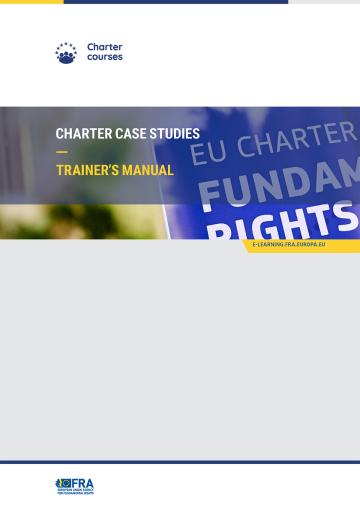
    Europos Sąjungos pagrindinių teisių chartija (ESPTC) – tai ES žmogaus teisių
    aktas. Jos visada privalo laikytis ES institucijos ir valstybės narės,
    veikdamos ES teisės taikymo srityje. Tačiau įvertinti, ar konkretus atvejis
    patenka į ES teisės taikymo sritį, toli gražu nėra paprasta. Todėl būtina
    rengti mokymus ir teikti mokymo medžiagą teisės specialistams, kad jie
    galėtų suprasti Chartijos taikymo sritį, kaip nustatyta jos 51 straipsnyje.
    Šio instruktoriaus vadovo tikslas – pateikti rekomendacijas dėl tokių
    mokymų organizavimo ir vykdymo, remiantis kelių bylų analizėmis, kurių
    ateityje gali būti įtraukta daugiau.
  • Handbook / Guide / Manual
    25
    May
    2018
    New language versions - Danish, Lithuanian, Slovenian
    10 November 2021
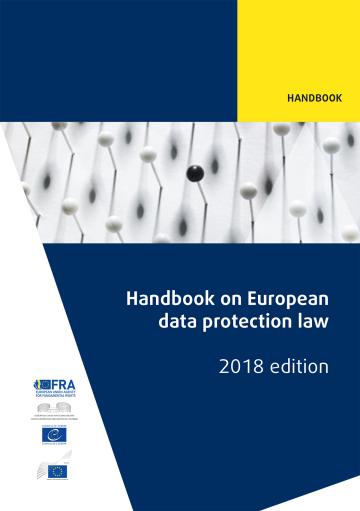
    Dėl sparčios informacinių technologijų plėtros padidėjo poreikis užtikrinti patikimą asmens duomenų apsaugą
    taikant tiek Europos Sąjungos, tiek Europos Tarybos priemones. Siekiant užtikrinti šią svarbią teisę, kyla naujų
    ir svarbių uždavinių, nes dėl technologinės pažangos plečiamos tokių sričių, kaip stebėjimas, ryšių perėmimas
    ir duomenų saugojimas, ribos. Šis vadovas parengtas siekiant supažindinti teisės specialistus, kurie neturi
    itin daug žinių apie duomenų apsaugą, su šia naujai besiformuojančia teisės sritimi.
  • Fundamental Rights Report
    8
    June
    2022
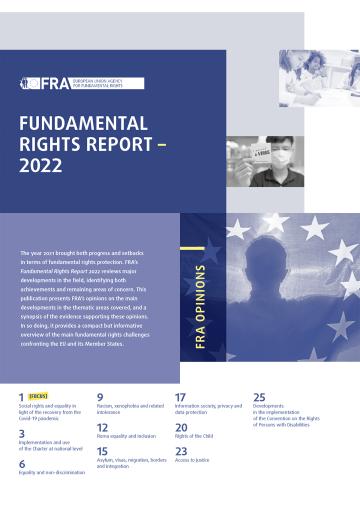
    2021 m. pagrindinių teisių apsaugos srityje padaryta pažanga, tačiau neišvengta ir nesėkmių. FRA 2022 m. ataskaitoje apie pagrindinių teisių būklę apžvelgiami svarbiausi pokyčiai šioje srityje, aptariami laimėjimai ir neišspręsti probleminiai klausimai. Šiame leidinyje pateikiamos FRA nuomonės apie pagrindines nagrinėjamų teminių sričių naujoves ir trumpa faktinių duomenų, kuriais grindžiamos šios nuomonės, apžvalga.
  • Report / Paper / Summary
    8
    March
    2021
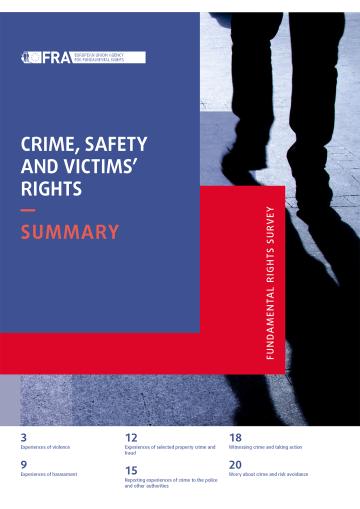
    Šioje santraukoje pateikiamos pagrindinės FRA
    antros pagrindinės ataskaitos, grindžiamos
    pagrindinių teisių tyrimu, įžvalgos. Tyrimo metu iš
    maždaug 35 000 asmenų surinkti duomenys apie jų
    patirtį, suvokimą ir nuomonę tam tikrais klausimais,
    įvairiai susijusiais su žmogaus teisėmis.
  • Report / Paper / Summary
    21
    January
    2021
    German language version now available
    26 January 2021
    Nacionalinės žmogaus teisių institucijos (NŽTI) yra gyvybiškai svarbi žmogaus teisių apsaugos sistemos dalis, veikianti šalies lygmeniu. Didindamos informuotumą, teikdamos rekomendacijas, vykdydamos stebėseną ir užtikrindamos valdžios institucijų atskaitomybę, šios institucijos atlieka pagrindinį vaidmenį sprendžiant sunkiausius šių dienų uždavinius žmogaus teisių srityje – kovoti su tokiais nuolat susirūpinimą keliančiais reiškiniais kaip diskriminacija ir nelygybė, naujomis problemomis, pvz., dirbtinio intelekto poveikiu teisėms, ir COVID-19 pandemija.
  • Handbook / Guide / Manual
    5
    December
    2018
    Last versions available are EL and NL
    11 March 2021
    Šiame vadove paaiškinama, kas yra profiliavimas, kokios teisinės sistemos jį reglamentuoja ir kodėl teisėtai vykdyti profiliavimą yra būtina siekiant užtikrinti pagrindines teises ir ypač veiksmingą viešąją tvarką bei sienų valdymą. Vadove pateikiama ir praktinių patarimų, kaip išvengti neteisėto profiliavimo vykdant policijos ir sienų valdymo operacijas.
  • Report / Paper / Summary
    3
    September
    2020
    Summary version now available
    21 January 2021
    National Human Rights Institutions (NHRIs) are a vital part of the country-level human rights protection system. This report, published 10 years after FRA’s first in-depth study on NHRIs, looks at such bodies in the EU, as well as the Republic of North Macedonia, the Republic of Serbia, and the United Kingdom of Great Britain and Northern Ireland. It explores relevant developments, challenges to their effectiveness and ways to maximise their impact.
  • Periodic updates / Series
    21
    July
    2026
    This is the second bulletin in FRA’s new quarterly series monitoring the situation of migrants, asylum seekers and refugees. It covers key developments and ongoing concerns from 1 April to 30 June 2026.

    Following regular reporting on fundamental rights issues related to migration and asylum from 2015 to 2023, FRA resumed the series in 2026 under the EU's 2024 Asylum and Migration Management Regulation, ahead of the June 2026 implementation of the EU Migration and Asylum Pact. The first bulletin, published in April 2026, covered developments from 1 January 2025 to 31 March 2026.
  • In brief / Factsheet
    30
    June
    2026
    This factsheet examines case law on cross-border child abduction, meaning the unlawful removal of a child from one EU Member State to another. Jointly published by the European Court of Human Rights and the EU Agency for Fundamental Rights, it explains how courts handle issues where EU law and human rights law overlap. It highlights key court decisions from the Court of Justice of the European Union (CJEU) and the European Court of Human Rights (ECtHR) to show how these two legal systems work together on issues of child abduction and prioritising the best interests of the child.