Equality

Romai

Highlights

  • Report / Paper / Summary
    2
    October
    2025
    This report examines the fundamental rights and living conditions of Roma and Travellers across 10 EU Member States and
    3 accession countries. The survey evaluates progress towards the EU Roma strategic framework’s 2030 objectives, covering areas such as discrimination, poverty, education, employment, health, and housing.
  • Data explorer
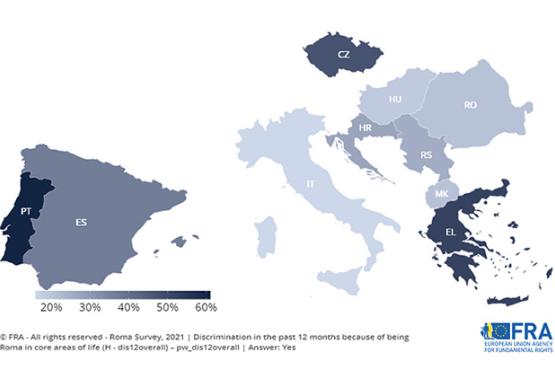
    FRA’s 2021 survey on Roma in Croatia, Czechia, Greece, Hungary, Italy, North Macedonia, Portugal, Romania, Serbia and Spain collected information from 8,461 respondents living in private households who self-identify as Roma, are 16 or older and have lived in the survey countries for at least the 12 months before the survey.
  • Report / Paper / Summary
    25
    October
    2022
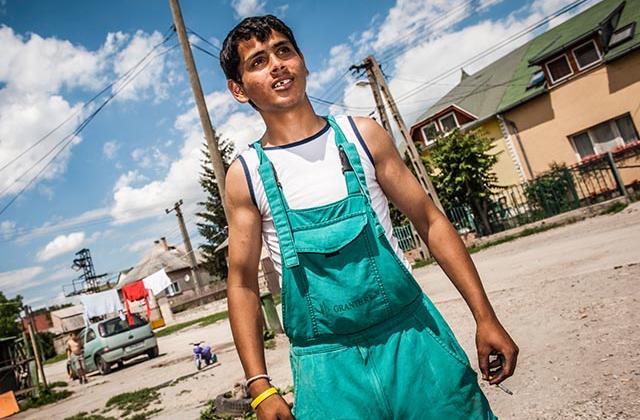
    This report presents findings from FRA’s 2021 survey on Roma in Croatia, Czechia, Greece, Hungary, Italy, Portugal, Romania and Spain, as well as in North Macedonia and Serbia. The survey includes interviews with more than 8,400 Roma, collecting information on more than 20,000 individuals living in their households. By focusing on Roma, the survey provides unique data and information that are not available from European general population surveys, which do not disaggregate on grounds of ethnic origin. The findings present a bleak but familiar picture of exclusion, deprivation, discrimination and racism.
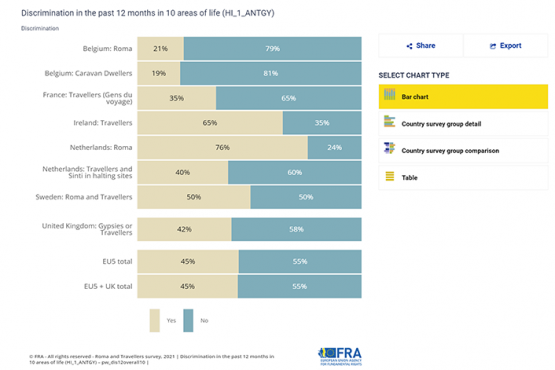
  • Data explorer
    FRA’s 2019 survey on Roma and Travellers in Belgium, France, Ireland, the Netherlands, Sweden and the United Kingdom interviewed almost 4 700 Roma and Travellers, collecting information on more than 8 200 individuals living in their households.

    Produktai
    16
    November
    2018
    This report presents the main insights gained during the EU Fundamental Rights Agency’s project on local engagement for Roma inclusion, which explores how to best involve Roma in integration efforts at the local level. Bringing together local authorities and residents, especially Roma, it investigated what aspects work, which ones do not, and why this is the case.
    19
    July
    2018
    Across the European Union, Member States are faced with the challenge of integrating Europe’s most deprived
    and disenfranchised minority groups. As a follow up to the EU-MIDIS II findings on Roma, this report presents
    FRA’s findings relating to the issues of education and employment. Encouraging Roma participation in education
    and employment equips communities with higher incomes, better life opportunities and greater social inclusion.
    6
    June
    2018
    The year 2017 brought both progress and setbacks in terms of rights protection. The European Pillar of Social Rights marked an important move towards a more ‘social Europe’. But, as experiences with the EU Charter of Fundamental Rights underscore, agreement on a text is merely a first step. Even in its eighth year as the EU's binding bill of rights, the Charter's potential was not fully exploited, highlighting the need to more actively promote its use.
    17
    May
    2018
    Pilietinės visuomenės organizacijos Europos Sąjungoje atlieka esminį vaidmenį skatindamos pagrindines teises, bet dėl teisinių ir praktinių suvaržymų joms tai daryti tapo sunkiau.
    Nors sunkumų patiriama visose ES valstybėse narėse, jų pobūdis ir mastas labai nevienodi. Iš esmės šiuo klausimu nėra duomenų ir neatlikta tyrimų (nei lyginamųjų tyrimų).
    Todėl FRA ataskaitoje nagrinėjamos įvairios sunkumų, su kuriais susiduria pilietinės visuomenės organizacijos, veikiančios žmogaus teisių srityje ES, rūšys ir pobūdis. Joje taip pat aprašoma perspektyvi praktika, kurią pasitelkus galima kovoti su tokiomis nerimą keliančiomis tendencijomis.
    Video
    This video blog by FRA Director Michael O'Flaherty is released periodically and addresses burning fundamental rights themes.
    Video
    Poor sanitation, hunger, youth unemployment – Roma in the EU face these basic challenges in their daily life, finds the European Union Agency for Fundamental Rights’ latest Report.
    6
    April
    2018
    Despite ambitious initiatives, the fundamental rights situation of Roma in the EU remains profoundly troubling. This report examines the persisting phenomenon of anti-Gypsyism and its effect on Roma inclusion efforts. It first presents data on key manifestations of anti-Gypsyism, namely discrimination, harassment and hate crime.
    21
    March
    2018
    Pagal Europos nediskriminavimo teisę, kurią sudaro pirmiausia ES nediskriminavimo direktyvos ir
    Žmogaus teisių ir pagrindinių laisvų apsaugos konvencijos 14 straipsnis bei Protokolas Nr. 12,
    draudžiama diskriminuoti įvairiomis aplinkybėmis ir įvairiais pagrindais. Šiame vadove iš šių dviejų
    šaltinių kilusi Europos nediskriminavimo teisė nagrinėjama kaip viena kitą papildančios sistemos;
    jomis pakaitomis remiamasi – tiek, kiek jos sutampa, ir atkreipiamas dėmesys į skirtumus, jei jų
    yra.
    6
    December
    2017
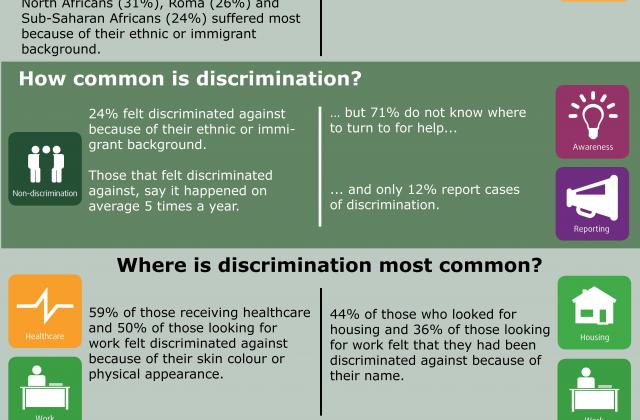
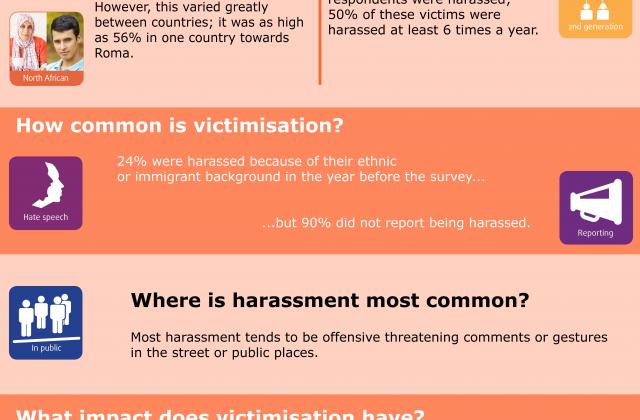
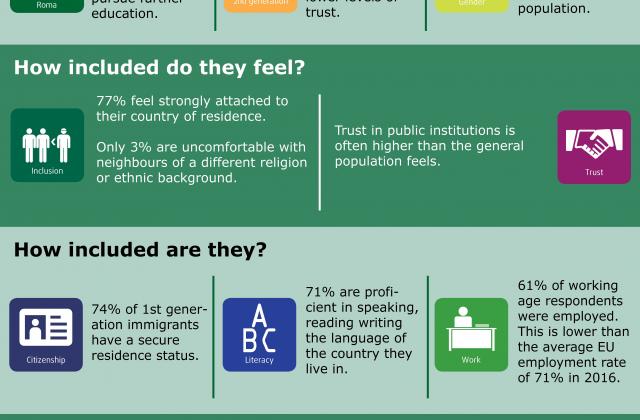
    Seventeen years after adoption of EU laws that forbid discrimination, immigrants, descendants of immigrants, and minority ethnic groups continue to face widespread discrimination across the EU and in all areas of life – most often when seeking employment. For many, discrimination is a recurring experience. This is just one of the findings of FRA’s second European Union Minorities and Discrimination Survey (EU-MIDIS II), which collected information from over 25,500 respondents with different ethnic minority and immigrant backgrounds across all 28 EU Member States.
    The EU Agency for Fundamental Rights (FRA) launches its second EU Minorities and Discrimination Survey (EU-MIDIS II).
    This survey involved interviews with 25,515 people with different ethnic minority and immigrant backgrounds across 28 EU countries. It explores issues concerning discrimination as well as experiences of harassment, hate-motivated violence and discriminatory profiling.
    This infographic illustrates the main experiences immigrants and ethnic minorities across the EU have when it comes to discrimination. It draws from the findings from FRA's EU-MIDIS II survey.
    This infographic illustrates the main experiences immigrants and ethnic minorities across the EU have when it comes to victimisation. It draws from the findings from FRA's EU-MIDIS II survey.
    This infographic illustrates the main experiences immigrants and ethnic minorities across the EU have when it comes to inclusion. It draws from the findings from FRA's EU-MIDIS II survey.
    30
    May
    2017
    Diverse efforts at both EU and national levels sought to bolster fundamental rights protection in 2016, while some measures threatened to undermine such protection.
    30
    May
    2017
    Diverse efforts at both EU and national levels sought to bolster fundamental rights protection in 2016, while some measures threatened to undermine such protection.
    29
    May
    2017
    This year marks the 10th anniversary of the EU Agency for Fundamental Rights. Such a milestone offers an opportunity for reflection – both on the progress that provides cause for celebration and on the lingering shortcomings that must be addressed.
    Video
    This playlist contains video clips from each locality which took part in the Local Engagement for Roma Inclusion (LERI) research.
    Video
    The EU Agency for Fundamental Rights (FRA) explores what works and what doesn’t when it comes to Roma inclusion at the local level.