Asylum

Asylum, migration and borders

The increase in migration has presented opportunities and challenges across Europe. FRA encourages rights-compliant responses.

We provide practical expertise on this complex issue. This includes regular updates, focus papers and toolkits. We also outline policy alternatives and best practices.

    Publications and Data

    Publications and Data

    Displaying results 201 - 210 of 234
    Report / Paper / Summary
    10
    November
    2014
    The report examines the procedures for and conduct of checks that border guards carry out on third-country national passengers entering European Union (EU) territory at five international airports.
    Report / Paper / Summary
    29
    October
    2014
    Primarily using data and information collected from five EU Member States, this paper briefly describes the phenomenon of forced marriage and selected legislative measures taken to address it. It lists promising practices
    for the prevention of forced marriage and for supporting victims. The paper covers only one among many forms of violence against women analysed by FRA in its Violence against women: an EU-wide survey. Main results report (2014).
    Report / Paper / Summary
    27
    October
    2014
    This summary, and the related full report, look at how fundamental rights obligations
    translate into practical border management tasks.
    The report points out challenges as well as promising practices of integrating fundamental
    rights compliance into operational tasks that do not compromise but instead enhance the
    effectiveness of border checks.
    Fundamental Rights Report
    9
    July
    2014
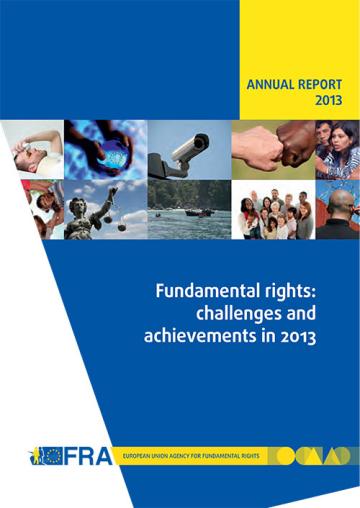
    The EU and its Member States took a variety of important steps in 2013 to protect and promote fundamental rights by
    assuming
    new international commitments, revamping legislation and pursuing innovative policies on the ground. Yet, fundamental
    rights violations seized the spotlight with distressing frequency: would‑be migrants drowning off the EU’s coast,
    unprecedented mass surveillance, racist and extremist‑motivated murders, child poverty and Roma deprivation.
    Handbook / Guide / Manual
    30
    June
    2014
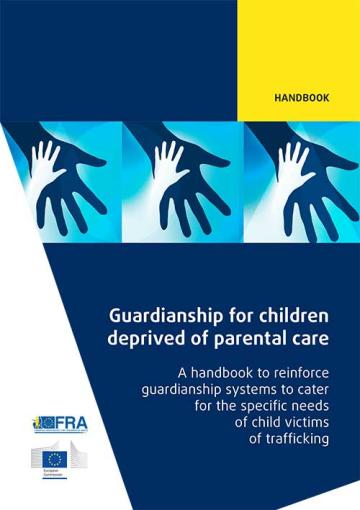
    This handbook aims to strengthen the protection of children, specifically addressing the particular needs of child victims of trafficking.
    Handbook / Guide / Manual
    27
    June
    2014
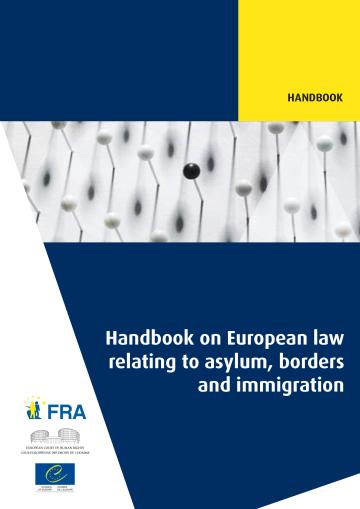
    ** Please note than an updated 2020 edition of this handbook is now available.** The Handbook on European law relating to asylum, borders and immigration is jointly produced by the European Court of Human Rights and the FRA. It examines the relevant law in the field of asylum, borders and immigration stemming from both European systems: the European Union and the Council of Europe. It provides an accessible guide to the various European standards relevant to asylum, borders and immigration.
    Fundamental Rights Report
    6
    June
    2014
    This year’s FRA annual report looks at fundamental rights-related developments in asylum, immigration and integration; border control and visa policy; information society, respect for private life and data protection; the rights of the child and the protection of children; equality and non-discrimination; racism, xenophobia and related intolerance; access to justice and judicial cooperation; rights of crime victims; EU Member States and international obligations.
    Report / Paper / Summary
    27
    March
    2014
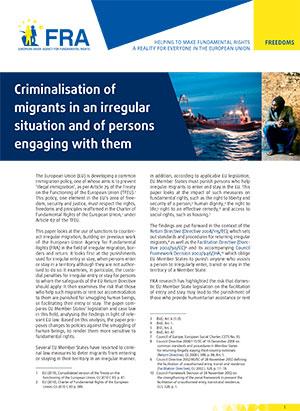
    This paper examines the sanctions applied to counteract irregular migration, building on previous work by the European Union Agency for Fundamental Rights (FRA) on the rights of migrants in an irregular situation.
    In brief / Factsheet
    5
    March
    2014
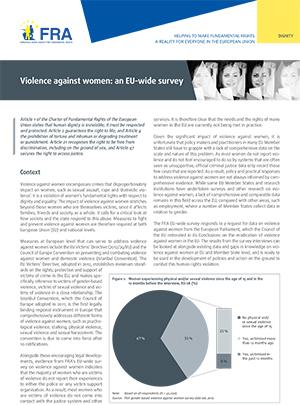
    This factsheet presents some examples of survey findings, which are placed alongside general considerations as possible ‘ways forward’ for responding to violence against women.
    Report / Paper / Summary
    20
    December
    2013
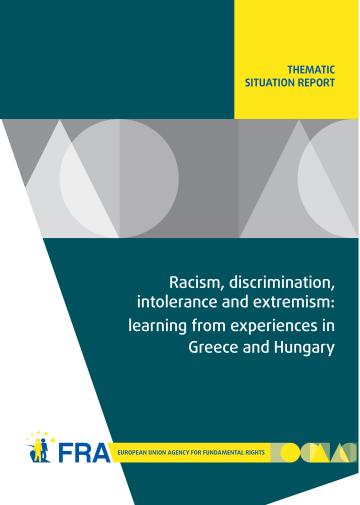
    This thematic situation report examines the effectiveness of responses by public authorities, civil society organisations and others to counter racism, discrimination, intolerance and extremism in Greece and Hungary. The report goes on to make proposals for fighting racist crime, increasing trust in the police, and combating extremism throughout the EU.