eu-charter

Carta drepturilor fundamentale a Uniunii Europene

Articolul 54 - Interzicerea abuzului de drept

Articolul 54 - Interzicerea abuzului de drept

Nici una dintre dispozițiile prezentei carte nu trebuie să fie interpretată ca implicând vreun drept de a desfășura orice activitate sau de a îndeplini orice act îndreptat împotriva oricăruia dintre drepturile și libertățile recunoscute prin prezenta cartă sau de a le impune restrângeri mai ample decât cele prevăzute prin prezenta cartă..

Explicaţii

  • Text:

    Acest articol corespunde articolului 17 din CEDO:

    `Nicio dispoziţie din prezenta convenţie nu poate fi interpretată ca implicând, pentru un stat, un grup, sau un individ, un drept oarecare de a desfăşura o activitate sau de a îndeplini un act ce urmăreşte distrugerea drepturilor sau a libertăţilor recunoscute de prezenta convenţie sau de a aduce limitări mai ample acestor drepturi şi libertăţi decât acelea prevăzute de această convenţie.`

    [*] Nota editorului: trimiterile la numerele articolelor din tratate au fost actualizate şi, totodată, au fost rectificate câteva erori materiale.

    Source:
    Jurnalul Oficial al Uniunii Europene C 303/17 - 14.12.2007
    Preamble - Explanations relating to the Charter of Fundamental Rights:
    Explicaţiile redate în continuare au fost redactate iniţial sub autoritatea prezidiului Convenţiei care a elaborat Carta drepturilor fundamentale a Uniunii Europene. Acestea au fost actualizate sub autoritatea prezidiului Convenţiei Europene, având în vedere adaptarea de către respectiva Convenţie a textului cartei (în special la articolele 51 şi 52), precum şi evoluţia dreptului Uniunii. Cu toate că aceste explicaţii nu au valoare juridică în sine, acestea constituie un preţios instrument de interpretare destinat clarificării dispoziţiilor cartei.

Jurisprudență

Dreptul constituțional național

16 results found

  • Basic Law for the Federal Republic of Germany
    Țara:
    Germany

    Article 18 Whoever abuses the freedom of expression, in particular the freedom of the press (paragraph (1) of Article 5), the freedom of teaching (paragraph (3) of Article 5), the freedom of assembly (Article 8), the freedom of association (Article 9), the privacy of correspondence, posts and telecommunications (Article 10), the rights of property (Article 14), or the right of asylum (Article 16a) in order to combat the free democratic basic order shall forfeit these basic rights. This forfeiture and its extent shall be declared by the Federal Constitutional Court.

  • Constitution of the Hellenic Republic
    URL:
    Țara:
    Greece

    Article 25(...) Abuse of rights shall be prohibited. (...)

  • Constitution of the Hellenic Republic
    Țara:
    Greece

    Article 25 (3) The abusive exercise of rights is not permitted […]

  • Constitution of the Republic of Bulgaria
    Țara:
    Bulgaria

    Art. 57. (2) Rights shall not be abused, nor shall they be exercised to the detriment of the rights or the legitimate interests of others.

  • Constitution of the Republic of Croatia
    Țara:
    Croatia


  • Constitution of the Republic of Estonia
    Țara:
    Estonia

    Article 10. The rights, freedoms and duties set out in this chapter do not preclude other rights, freedoms and duties which arise from the spirit of the Constitution or are in accordance therewith, and which are in conformity with the principles of human dignity, social justice and democratic government founded on the rule of law.

  • Czechia / Charter of Fundamental Rights and Freedoms
    Țara:
    Czechia

    Article 4 (...) (4) When employing the provisions concerning limitations upon the fundamental rights and freedoms, the essence and significance of these rights and freedoms must be preserved. Such limitations shall not be misused for purposes other than those for which they were enacted.

  • European Convention on Human Rights - Article 17
    Țara:
    Austria

    Article 17

    Nothing in this Convention may be interpreted as implying for any State, group or person any right to engage in any activity or perform any act aimed at the destruction of any of the rights and freedoms set forth herein or at their limitation to a greater extent than is provided for in the Convention.

  • Grundgesetz für die Bundesrepublik Deutschland
    Țara:
    Germany

    Artikel 18 Wer die Freiheit der Meinungsäußerung, insbesondere die Pressefreiheit (Artikel 5 Abs. 1), die Lehrfreiheit (Artikel 5 Abs. 3), die Versammlungsfreiheit (Artikel 8), die Vereinigungsfreiheit (Artikel 9), das Brief-, Post- und Fernmeldegeheimnis (Artikel 10), das Eigentum (Artikel 14) oder das Asylrecht (Artikel 16a) zum Kampfe gegen die freiheitliche demokratische Grundordnung mißbraucht, verwirkt diese Grundrechte. Die Verwirkung und ihr Ausmaß werden durch das Bundesverfassungsgericht ausgesprochen.

  • Konvention zum Schutze der Menschenrechte und Grundfreiheiten
    Țara:
    Austria

    Artikel 17 Keine Bestimmung dieser Konvention darf dahin ausgelegt werden, daß sie für einen Staat, eine Gruppe oder eine Person das Recht begründet, eine Tätigkeit auszuüben oder eine Handlung zu begehen, die auf die Abschaffung der in der vorliegenden Konvention festgelegten Rechte und Freiheiten oder auf weitergehende Beschränkungen dieser Rechte und Freiheiten, als in der Konvention vorgesehen, hinzielt.

  • Portugal / Constitution of the Portuguese Republic
    Țara:
    Portugal

    Article 16 (Scope and interpretation of fundamental rights) (1) The fundamental rights enshrined in the Constitution shall not exclude any other set out in applicable international laws and legal rules. (2) The constitutional precepts concerning fundamental rights must be interpreted and completed in harmony with the Universal Declaration of Human Rights.

    ...
    Article 18 (Legal force) (1) The constitutional precepts with regard to rights, freedoms and guarantees are directly applicable and are binding on public and private entities. (2) The law may only restrict rights, freedoms and guarantees in cases expressly provided for in the Constitution, and such restrictions must be limited to those needed to safeguard other constitutionally protected rights and interests. (3). Laws that restrict rights, freedoms and guarantees must have a general and abstract nature and may not have a retroactive effect or reduce the extent or scope of the essential content of the constitutional precepts.

  • Slovakia / Constitution of the Slovak Republic
    Țara:
    Slovakia

    Article 1 (1) The Slovak Republic is a sovereign, democratic state governed by the rule of law.(...)

  • The Constitution of the Republic of Cyprus
    Țara:
    Cyprus

    Article 34
    Nothing in this Part may be interpreted as implying for any Community, group or person any right to engage in any activity or perform any act aimed at the undermining or destruction of the constitutional order established by this Constitution or at the destruction of any of the rights and liberties set forth in this Part or at their limitation to a greater extent than is provided for therein.

  • Tο Σύνταγμα της Κυπριακής Δημοκρατίας
    Țara:
    Cyprus

    ΑΡΘΡΟΝ 34
    Ουδέν εκ των εν τω παρόντι, μέρει διαλαμβανομένων δύναται να ερμηνευθή ως παρέχον οιονδήποτε δικαίωμα εις οιονδήποτε κοινότητα, ομάδα ή άτομον να επιδοθή εις οιανδήποτε δράσιν ή εκτέλεσιν οιασδήποτε πράξεως σκοπούσης την υπονόμευσιν ή την κατάργησιν της υπό του Συντάγματος καθιδρυομένης συνταγματικής τάξεως ή την κατάργησιν οιουδήποτε εκ των εν τω παρόντι μέρει καθοριζομένων δικαιωμάτων ή ελευθεριών ή τον περιορισμόν αυτών εις μεγαλύτερον του οριζομένου εν τω παρόντι μέρει βαθμόν.

  • Το Σύνταγμα της Ελλάδας
    Țara:
    Greece

    Άρθρο 25 (3) Η καταχρηστική άσκηση δικαιώματος δεν επιτρέπεται. [...]

  • КОНСТИТУЦИЯ на Република България
    Țara:
    Bulgaria

    Чл. 57. (2) Не се допуска злоупотреба с права, както и тяхното упражняване, ако то накърнява права или законни интереси на други.

Legislația UE

0 results found

Drept internațional

0 results found

Produse

  • Handbook / Guide / Manual
    21
    March
    2018
    Dreptul european privind nediscriminarea, așa cum a fost constituit prin directivele UE privind
    nediscriminarea și prin articolul 14 din Convenția europeană pentru apărarea drepturilor omului și
    a libertăților fundamentale și prin Protocolul nr. 12 la convenție, interzice discriminarea într-o serie
    de contexte și pentru o gamă largă de criterii. Prezentul manual analizează dreptul european privind
    nediscriminarea rezultat din aceste două surse cu titlu de sisteme complementare, făcând referire
    la oricare dintre acestea în măsura în care se suprapun și semnalând diferențele, acolo unde există.
  • Report / Paper / Summary
    27
    November
    2019
    French and German versions now available
    01 March 2022
    Facial recognition technology (FRT) makes it possible to compare digital facial images to determine whether they are of the same person. Comparing footage obtained from video cameras (CCTV) with images in databases is referred to as ‘live facial recognition technology’. Examples of national law enforcement authorities in the EU using such technology are sparse – but several are testing its potential. This paper therefore looks at the fundamental rights implications of relying on live FRT, focusing on its use for law enforcement and border-management purposes.
  • Leaflet / Flyer
    16
    January
    2020
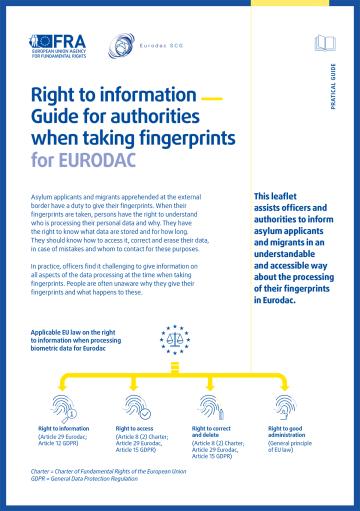
    Acest pliant ajută ofițerii și autoritățile să informeze solicitanții de azil și migranții într-un mod ușor de înțeles și accesibil cu privire la prelucrarea amprentelor lor în Eurodac.
  • Report / Paper / Summary
    8
    March
    2021
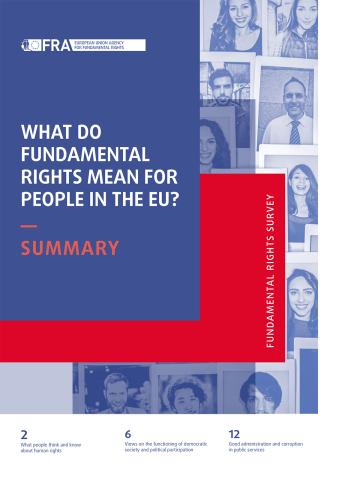
    Rezumatul de față prezintă principalele constatări ale celui de al doilea raport principal întocmit de FRA pe baza Sondajului privind drepturile fundamentale. Sondajul a colectat date de la aproximativ 35 000 de persoane cu privire la experiențele, percepțiile și opiniile acestora referitoare la o serie de aspecte care intră în sfera drepturilor omului sub diverse forme.
  • Report / Paper / Summary
    29
    January
    2021
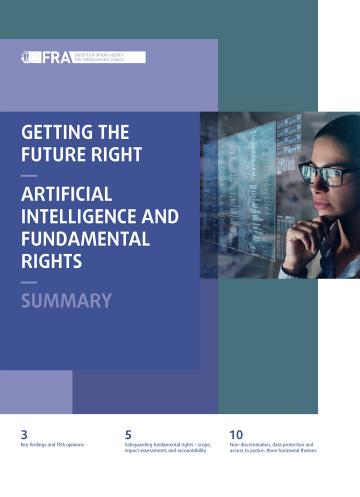
    Raportul FRA privind inteligența artificială și drepturile fundamentale prezintă exemple concrete ale modului în care întreprinderile și administrațiile publice din UE utilizează sau încearcă să utilizeze IA. Acesta se concentrează pe patru domenii principale: prestațiile sociale, activitățile polițienești bazate pe analiza predictivă, serviciile de sănătate și publicitatea direcționată. Raportul analizează implicațiile potențiale asupra drepturilor fundamentale și analizează modul în care aceste drepturi sunt luate în considerare la utilizarea sau dezvoltarea aplicațiilor IA.
  • Report / Paper / Summary
    16
    December
    2020
    Rezumatul de față prezintă principalele constatări
    ale primului raport întocmit de FRA pe baza
    Sondajului privind drepturile fundamentale.
    Sondajul a colectat date de la aproximativ 35 000
    de persoane referitor la experiențele, la percepțiile
    și la opiniile acestora cu privire la o serie de
    aspecte care intră în sfera drepturilor omului sub
    diverse forme.
  • Report / Paper / Summary
    21
    January
    2021
    German language version now available
    26 January 2021
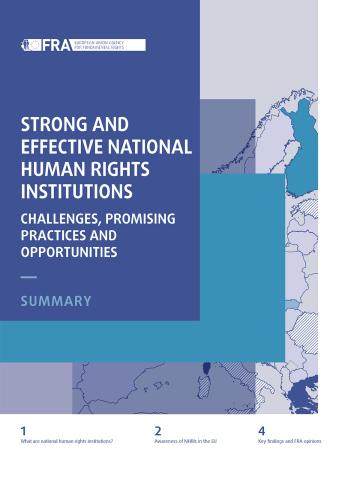
    Instituțiile naționale pentru apărarea drepturilor omului (INDO) reprezintă o parte vitală a sistemului de protecție a drepturilor omului existent la nivelul unei țări. Prin eforturile lor de sensibilizare, consiliere, monitorizare și responsabilizare a autorităților, aceste instituții au un rol central în depășirea marilor provocări legate de drepturile omului din zilele noastre, abordând atât preocupări persistente, precum cele referitoare la discriminare și inegalitate, cât și chestiuni noi, cum ar fi implicațiile inteligenței artificiale și ale pandemiei de COVID-19 asupra acestor drepturi.
  • Handbook / Guide / Manual
    5
    December
    2018
    Last versions available are EL and NL
    11 March 2021
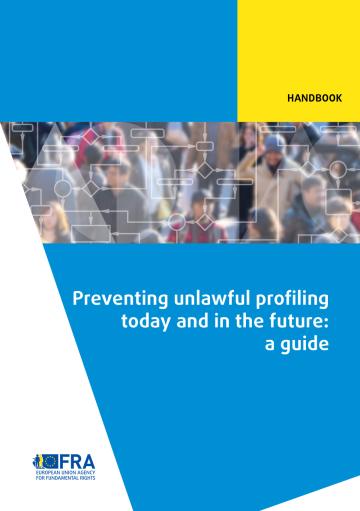
    Prezentul ghid explică ce este crearea de profiluri, cadrele juridice care o reglementează și motivele pentru care utilizarea profilurilor în mod legal este necesară pentru respectarea drepturilor fundamentale și, totodată, esențială pentru eficiența activității polițienești și de gestionare a frontierelor. De asemenea, ghidul oferă îndrumări practice care să ajute la evitarea situațiilor în care utilizarea profilurilor în cadrul operațiunilor poliției și ale autorităților de gestionare a frontierelor este ilegală.
  • Report / Paper / Summary
    3
    September
    2020
    Summary version now available
    21 January 2021
    National Human Rights Institutions (NHRIs) are a vital part of the country-level human rights protection system. This report, published 10 years after FRA’s first in-depth study on NHRIs, looks at such bodies in the EU, as well as the Republic of North Macedonia, the Republic of Serbia, and the United Kingdom of Great Britain and Northern Ireland. It explores relevant developments, challenges to their effectiveness and ways to maximise their impact.
  • Report / Paper / Summary
    24
    June
    2020
    Summary version now available
    07 December 2020
    FRA’s Fundamental Rights Survey collected data from 35,000 people about their experiences, perceptions and opinions on a range of issues that are variously encompassed by human rights. This report presents a small selection of the survey results. It focuses on findings with respect to respondents’ opinions about human – or fundamental rights; their views and perceptions on the functioning of democratic societies – as a pillar on which human rights can flourish; and on their thoughts on and engagement with public services that have a duty to enforce human rights law and to protect people’s rights.