eu-charter

Euroopa Liidu põhiõiguste harta

Artikkel 54 - Õiguste kuritarvitamise keeld

Artikkel 54 - Õiguste kuritarvitamise keeld

Harta sätteid ei või tõlgendada nii, nagu õigustaksid need tegevust või toimingut, mille eesmärk on mõne hartaga tunnustatud õiguse või vabaduse tühistamine või selle piiramine suuremal määral, kui hartaga on ette nähtud..

Selgitused

  • Text:

    Käesolev artikkel vastab Euroopa inimõiguste ja põhivabaduste kaitse konventsiooni artiklile 17: `Midagi käesolevas konventsioonis ei või tõlgendada selliselt, et see annab mingile riigile, isikute grupile või üksikisikule õiguse tegevuseks või teoks, mille eesmärgiks on konventsiooniga sätestatud ükskõik missuguste õiguste või vabaduste kaotamine või nende piiramine suuremal määral kui see on ette nähtud konventsioonis.`

    [*] Toimetaja märkus: toimetamise käigus kaasajastati aluslepingute artiklinumbrite viited ning parandati mõned olulised vead.

    Source:
    Euroopa Liidu Teataja C 303/17 - 14.12.2007
    Preamble - Explanations relating to the Charter of Fundamental Rights:
    Käesolevad selgitused valmistati algselt ette Euroopa Liidu põhiõiguste harta koostanud konvendi presiidiumi juhtimisel. Selgitusi ajakohastati Euroopa Konvendi presiidiumi vastutusel, pidades silmas nimetatud konvendi poolt harta tekstis (eelkõige artiklites 51 ja 52) tehtud kohandusi ning liidu õiguse arengut. Kuigi selgitustel endil pole õigusjõudu, on nad harta tõlgendamisel väärtuslikuks vahendiks, mille eesmärk on selgitada harta sätteid.

Pretsedendiõigus

Siseriiklik konstutsionaalne õigus

16 results found

  • Basic Law for the Federal Republic of Germany
    Riik:
    Germany

    Article 18 Whoever abuses the freedom of expression, in particular the freedom of the press (paragraph (1) of Article 5), the freedom of teaching (paragraph (3) of Article 5), the freedom of assembly (Article 8), the freedom of association (Article 9), the privacy of correspondence, posts and telecommunications (Article 10), the rights of property (Article 14), or the right of asylum (Article 16a) in order to combat the free democratic basic order shall forfeit these basic rights. This forfeiture and its extent shall be declared by the Federal Constitutional Court.

  • Constitution of the Hellenic Republic
    URL:
    Riik:
    Greece

    Article 25(...) Abuse of rights shall be prohibited. (...)

  • Constitution of the Hellenic Republic
    Riik:
    Greece

    Article 25 (3) The abusive exercise of rights is not permitted […]

  • Constitution of the Republic of Bulgaria
    Riik:
    Bulgaria

    Art. 57. (2) Rights shall not be abused, nor shall they be exercised to the detriment of the rights or the legitimate interests of others.

  • Constitution of the Republic of Croatia
    Riik:
    Croatia


  • Constitution of the Republic of Estonia
    Riik:
    Estonia

    Article 10. The rights, freedoms and duties set out in this chapter do not preclude other rights, freedoms and duties which arise from the spirit of the Constitution or are in accordance therewith, and which are in conformity with the principles of human dignity, social justice and democratic government founded on the rule of law.

  • Czechia / Charter of Fundamental Rights and Freedoms
    Riik:
    Czechia

    Article 4 (...) (4) When employing the provisions concerning limitations upon the fundamental rights and freedoms, the essence and significance of these rights and freedoms must be preserved. Such limitations shall not be misused for purposes other than those for which they were enacted.

  • European Convention on Human Rights - Article 17
    Riik:
    Austria

    Article 17

    Nothing in this Convention may be interpreted as implying for any State, group or person any right to engage in any activity or perform any act aimed at the destruction of any of the rights and freedoms set forth herein or at their limitation to a greater extent than is provided for in the Convention.

  • Grundgesetz für die Bundesrepublik Deutschland
    Riik:
    Germany

    Artikel 18 Wer die Freiheit der Meinungsäußerung, insbesondere die Pressefreiheit (Artikel 5 Abs. 1), die Lehrfreiheit (Artikel 5 Abs. 3), die Versammlungsfreiheit (Artikel 8), die Vereinigungsfreiheit (Artikel 9), das Brief-, Post- und Fernmeldegeheimnis (Artikel 10), das Eigentum (Artikel 14) oder das Asylrecht (Artikel 16a) zum Kampfe gegen die freiheitliche demokratische Grundordnung mißbraucht, verwirkt diese Grundrechte. Die Verwirkung und ihr Ausmaß werden durch das Bundesverfassungsgericht ausgesprochen.

  • Konvention zum Schutze der Menschenrechte und Grundfreiheiten
    Riik:
    Austria

    Artikel 17 Keine Bestimmung dieser Konvention darf dahin ausgelegt werden, daß sie für einen Staat, eine Gruppe oder eine Person das Recht begründet, eine Tätigkeit auszuüben oder eine Handlung zu begehen, die auf die Abschaffung der in der vorliegenden Konvention festgelegten Rechte und Freiheiten oder auf weitergehende Beschränkungen dieser Rechte und Freiheiten, als in der Konvention vorgesehen, hinzielt.

  • Portugal / Constitution of the Portuguese Republic
    Riik:
    Portugal

    Article 16 (Scope and interpretation of fundamental rights) (1) The fundamental rights enshrined in the Constitution shall not exclude any other set out in applicable international laws and legal rules. (2) The constitutional precepts concerning fundamental rights must be interpreted and completed in harmony with the Universal Declaration of Human Rights.

    ...
    Article 18 (Legal force) (1) The constitutional precepts with regard to rights, freedoms and guarantees are directly applicable and are binding on public and private entities. (2) The law may only restrict rights, freedoms and guarantees in cases expressly provided for in the Constitution, and such restrictions must be limited to those needed to safeguard other constitutionally protected rights and interests. (3). Laws that restrict rights, freedoms and guarantees must have a general and abstract nature and may not have a retroactive effect or reduce the extent or scope of the essential content of the constitutional precepts.

  • Slovakia / Constitution of the Slovak Republic
    Riik:
    Slovakia

    Article 1 (1) The Slovak Republic is a sovereign, democratic state governed by the rule of law.(...)

  • The Constitution of the Republic of Cyprus
    Riik:
    Cyprus

    Article 34
    Nothing in this Part may be interpreted as implying for any Community, group or person any right to engage in any activity or perform any act aimed at the undermining or destruction of the constitutional order established by this Constitution or at the destruction of any of the rights and liberties set forth in this Part or at their limitation to a greater extent than is provided for therein.

  • Tο Σύνταγμα της Κυπριακής Δημοκρατίας
    Riik:
    Cyprus

    ΑΡΘΡΟΝ 34
    Ουδέν εκ των εν τω παρόντι, μέρει διαλαμβανομένων δύναται να ερμηνευθή ως παρέχον οιονδήποτε δικαίωμα εις οιονδήποτε κοινότητα, ομάδα ή άτομον να επιδοθή εις οιανδήποτε δράσιν ή εκτέλεσιν οιασδήποτε πράξεως σκοπούσης την υπονόμευσιν ή την κατάργησιν της υπό του Συντάγματος καθιδρυομένης συνταγματικής τάξεως ή την κατάργησιν οιουδήποτε εκ των εν τω παρόντι μέρει καθοριζομένων δικαιωμάτων ή ελευθεριών ή τον περιορισμόν αυτών εις μεγαλύτερον του οριζομένου εν τω παρόντι μέρει βαθμόν.

  • Το Σύνταγμα της Ελλάδας
    Riik:
    Greece

    Άρθρο 25 (3) Η καταχρηστική άσκηση δικαιώματος δεν επιτρέπεται. [...]

  • КОНСТИТУЦИЯ на Република България
    Riik:
    Bulgaria

    Чл. 57. (2) Не се допуска злоупотреба с права, както и тяхното упражняване, ако то накърнява права или законни интереси на други.

ELi õigus

0 results found

Rahvusvaheline õigus

0 results found

Tooted

  • Handbook / Guide / Manual
    21
    March
    2018
    New language versions: Lithuanian, Portuguese and Slovak
    28 October 2021
    Diskrimineerimine eri kontekstides ja alustel on keelatud Euroopa võrdse kohtlemise õigusega, mille moodustavad ELi võrdse kohtlemise direktiivid ning Euroopa inimõiguste ja põhivabaduste kaitse konventsiooni artikkel 14 ja konventsiooni protokoll nr 12. Käesolevas käsiraamatus vaadeldakse nendest kahest allikast lähtuvaid Euroopa võrdse kohtlemise õigusnorme üksteist täiendavate süsteemidena, tuginedes neile vaheldumisi ja rõhutades samas ka erinevusi (kui neid esineb).
  • Report / Paper / Summary
    27
    November
    2019
    French and German versions now available
    01 March 2022
    Facial recognition technology (FRT) makes it possible to compare digital facial images to determine whether they are of the same person. Comparing footage obtained from video cameras (CCTV) with images in databases is referred to as ‘live facial recognition technology’. Examples of national law enforcement authorities in the EU using such technology are sparse – but several are testing its potential. This paper therefore looks at the fundamental rights implications of relying on live FRT, focusing on its use for law enforcement and border-management purposes.
  • Leaflet / Flyer
    16
    January
    2020
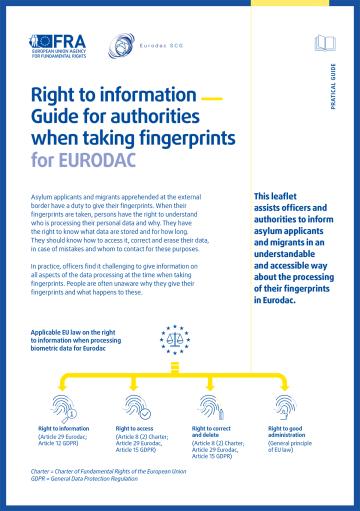
    See teabeleht aitab ametnikel ja ametiasutustel teavitada varjupaigataotlejaid ning rändajaid arusaadaval ja kättesaadaval viisil nende sõrmejälgede töötlemisest Eurodac-süsteemis.
  • Report / Paper / Summary
    8
    March
    2021
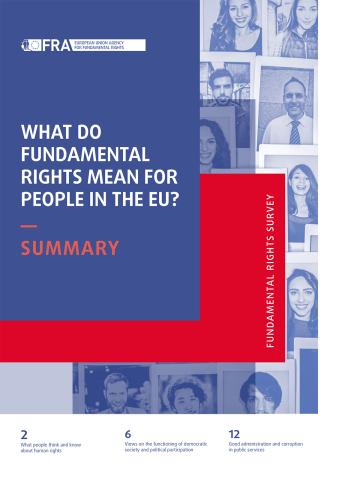
    Käesolevas kokkuvõttes tutvustatakse FRA
    põhiõiguste uuringu teise põhiaruande olulisemaid
    järeldusi. Uuringu käigus koguti ligikaudu 35 000
    inimeselt andmeid nende kogemuste, arusaamade
    ja arvamuste kohta mitmesugustes inimõigustega
    seotud küsimustes.
  • Report / Paper / Summary
    29
    January
    2021
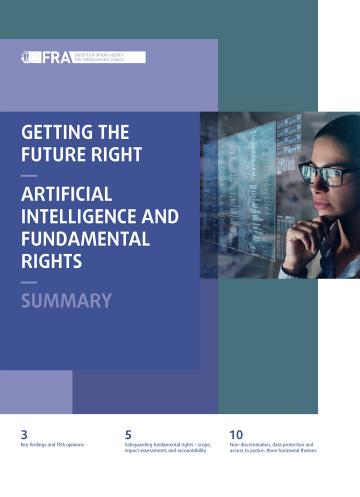
    FRA aruandes tehisintellekti ja põhiõiguste kohta tuuakse konkreetseid näiteid sellest, kuidas ELi ettevõtted ja avaliku sektori asutused kasutavad või püüavad kasutada tehisintellekti. Ülevaates tutvustatakse uuringu põhiaruandes välja toodud peamisi järeldusi. Need võivad ELi ja liikmesriikide poliitikakujundajatel aidata edendada tehisintellekti põhiste vahendite kasutamist, austades inim- ja põhiõigusi.
  • Report / Paper / Summary
    16
    June
    2020
    Käesolevas ülevaates tutvustatakse peamisi
    õppetunde Euroopa Liidu Põhiõiguste Ameti
    esimesest aruandest põhiõiguste uuringu kohta.
    Uuringus koguti ligikaudu 35 000 inimeselt
    andmeid nende kogemuste, arusaamade ja
    arvamuste kohta seoses rea küsimustega, mis
    puutuvad eri moel kokku inimõigustega.
  • Report / Paper / Summary
    21
    January
    2021
    German language version now available
    26 January 2021
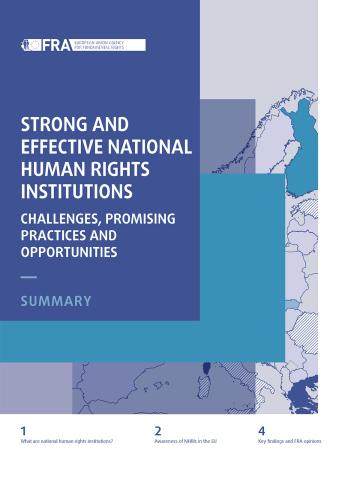
    Inimõigustega tegelevad riiklikud asutused on oluline osa inimõiguste kaitse süsteemist riigi tasandil. Teadlikkuse suurendajate, nõustajate ning ametiasutuste jälgijate ja vastutusele võtjatena on neil keskne roll tänapäeva suurte inimõigusprobleemide lahendamisel ning nad tegelevad nii alaliste probleemidega, nagu diskrimineerimine ja ebavõrdsus, kui ka uute küsimustega, nagu COVID-19 pandeemia ja tehisintellekti mõju inimõigustele.
  • Handbook / Guide / Manual
    5
    December
    2018
    Last versions available are EL and NL
    11 March 2021
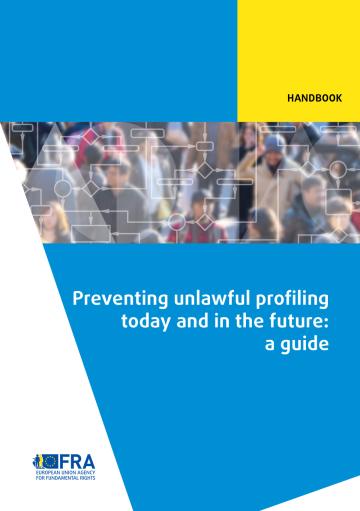
    Käesolevas juhendis selgitatakse, mida profiilide koostamine endast kujutab, milliste õigusaktidega seda reguleeritakse ning miks on nii profiilide koostamise seaduslikkus põhiõiguste tagamiseks kui ka politseitegevuse ja piirihalduse tõhus toimimine olulised. Juhendis antakse ka praktilisi soovitusi selle kohta, kuidas vältida politsei- ja piirivalvetoimingutes ebaseaduslikku profiilide koostamist.
  • Report / Paper / Summary
    3
    September
    2020
    Summary version now available
    21 January 2021
    National Human Rights Institutions (NHRIs) are a vital part of the country-level human rights protection system. This report, published 10 years after FRA’s first in-depth study on NHRIs, looks at such bodies in the EU, as well as the Republic of North Macedonia, the Republic of Serbia, and the United Kingdom of Great Britain and Northern Ireland. It explores relevant developments, challenges to their effectiveness and ways to maximise their impact.
  • Report / Paper / Summary
    24
    June
    2020
    Summary version now available
    07 December 2020
    FRA’s Fundamental Rights Survey collected data from 35,000 people about their experiences, perceptions and opinions on a range of issues that are variously encompassed by human rights. This report presents a small selection of the survey results. It focuses on findings with respect to respondents’ opinions about human – or fundamental rights; their views and perceptions on the functioning of democratic societies – as a pillar on which human rights can flourish; and on their thoughts on and engagement with public services that have a duty to enforce human rights law and to protect people’s rights.