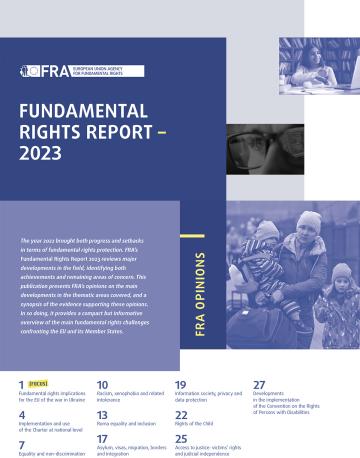
Vuonna 2022 perusoikeuksien suojelussa tapahtui sekä edistystä että takaiskuja. Euroopan unionin perusoikeusviraston (FRA) vuoden 2023 perusoikeusraportissa tarkastellaan perusoikeuksien tilanteen kehitystä pääpiirteissään ja tuodaan esiin sekä saavutuksia että jäljellä olevia huolenaiheita. Julkaisussa on FRA:n lausuntoja pääasiallisesta kehityksestä käsitellyillä aihealueilla sekä yleiskatsaus lausuntojen perustana olevaan näyttöön.
Tógadh céimeanna chun tosaigh agus céimeanna ar gcúl araon i ndáil le cosaint ceart bunúsach sa bhliain 2022. In Tuarascáil um Chearta Bunúsacha 2023 de chuid FRA, féachtar siar ar na mórfhorbairtí sa réimse agus sainaithnítear na héachtaí a bhí ann agus réimsí ar ábhair imní iad go fóill araon. San fhoilseachán seo, cuirtear i láthair tuairimí FRA faoi na príomhfhorbairtí sna réimsí téamacha a chumhdaítear agus déantar achoimre ar an bhfianaise a thacaíonn leis na tuairimí sin.
A 2022-es év egyaránt hozott előrelépést és visszaesést az alapvető jogok védelme terén. Az FRA 2023. évi alapjogi jelentése áttekinti a terület legfontosabb fejleményeit, valamint meghatározza az elért eredményeket és a fennmaradó aggályos területeket. Ez a kiadvány bemutatja az FRA véleményét az érintett témakörök főbb fejleményeiről, valamint a véleményeket alátámasztó bizonyítékok összefoglalóját.
Over the span of nearly eight years, there have been developments in showing respect for the human rights of those who arrive at the EU’s borders. Russia’s war of aggression against Ukraine has shown how a large and sudden influx of people can be managed effectively and respectfully. Notwithstanding the improvements, the growing number of people crossing or attempting to enter the EU pose a wide range of fundamental rights challenges.
In this bulletin, FRA takes stock of concerns and improvements regarding the fundamental rights of migrants, asylum seekers and refugees. It highlights the EU Member States’ legal and practical responses. It identifies key trends, promising practices, long-standing and emerging patterns, and persistent concerns.
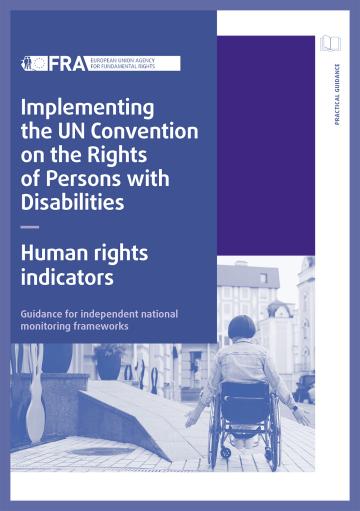
This guide helps independent national monitoring frameworks to fulfil their monitoring responsibility set out in Article 33 of the Convention on the Rights of Persons with Disabilities (CRPD). It focuses on the use of indicators. It does not deal with aspects such as compliance with the Paris Principles or the efficiency of complaints mechanisms. Its objective is to support national monitoring frameworks in designing or improving indicators for assessing progress of CRPD implementation at national level.
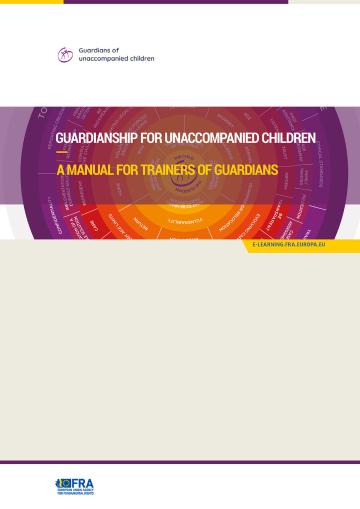
This manual is designed to help institutions, organisations and individuals to train guardians of unaccompanied children or to deliver ‘train-the-trainers’ courses. It can be used in a range of training contexts, such as professional and academic training, on-the-job training and continuing training. The manual is based on human and fundamental rights principles and ethical standards and recognises that the child and the guardian have their own personal stories, resources and capacities. It enhances guardians’ confidence to promote the child’s rights and best interests. It also enhances their confidence to act independently and impartially in relation to different state
officials, service providers and other community members.
Vojenská agresia Ruska voči Ukrajine vyvolala situácie, ktoré Európa celé desaťročia nezažila. Odvtedy prináša smrť, spôsobuje rozsiahle ničenie a neopísateľné utrpenie. Vyvolala aj masový pohyb ľudí, ktorý od druhej svetovej vojny nemá obdobu. V záujme ich ochrany EÚ prvýkrát aktivovala smernicu o dočasnej ochrane. Všetky členské štáty EÚ sú teda povinné poskytnúť ochranu osobám vysídleným z Ukrajiny.
Russia’s military aggression against Ukraine triggered scenes not seen in Europe for decades. It has since caused death, immense destruction, and unspeakable suffering. It also set in motion a mass movement of people not seen since World War II. To protect them, the EU activated the Temporary Protection Directive for the first time. In doing so, all EU Member States must offer protection to those displaced from Ukraine.
La agresión militar de Rusia contra Ucrania provocó escenas que no se vivían en Europa desde hacía décadas. El conflicto ha causado desde entonces muertes, inmensa destrucción y un sufrimiento indecible. También implicó desplazamientos masivos de población a una escala como no se conocía desde la Segunda Guerra Mundial.
Venemaa sõjaline agressioon Ukrainasse on põhjustanud olukorra, mida ei ole Euroopas aastakümneid esinenud. See on põhjustanud surma, tohutut hävingut ja kirjeldamatuid kannatusi. See käivitas ka inimeste massilise rände, mille sarnast ei ole toimunud teisest maailmasõjast saadik. Põgenike kaitseks aktiveeris EL esmakordselt ajutise kaitse direktiivi. See kohustas kõiki ELi liikmesriike pakkuma Ukraina põgenikele aruandes.
Oroszország Ukrajnával szembeni katonai agressziója Európában évtizedek óta nem látott helyzeteket váltott ki. Halált, hatalmas pusztítást és elmondhatatlan szenvedést okoz. Emellett a II. világháború óta nem látott mértékű tömeges elvándorlást indított el. A lakóhelyüket elhagyni kényszerült személyek védelme érdekében az EU első alkalommal aktiválta az átmeneti védelemről szóló irányelvet. Ezzel összhangban valamennyi uniós tagállam köteles védelmet biztosítani az Ukrajnából menekülőknek.
L’aggressione militare della Russia contro l’Ucraina ha scatenato scenari che l’Europa non viveva da decenni. Da allora ha causato morte, distruzioni massicce e indicibili sofferenze. Ha inoltre innescato spostamenti di massa di persone che non si vedevano dalla seconda guerra mondiale. Per tutelare i profughi, l’UE ha attivato per la prima volta la direttiva sulla protezione temporanea. In tal modo, tutti gli Stati membri dell’UE devono offrire protezione agli sfollati in fuga dall’Ucraina.
Rosyjska napaść zbrojna na Ukrainę była początkiem scen niespotykanych w Europie od dziesięcioleci. Spowodowała śmierć, ogromne zniszczenia i niedające się opisać cierpienie. Wywołała również masowy przepływ ludzi, jakiego nie widziano od czasów drugiej wojny światowej. Aby ich chronić, UE uruchomiła unijną dyrektywę w sprawie tymczasowej ochrony. Tym samym wszystkie państwa członkowskie UE są zobowiązane do zapewnienia ochrony osobom przesiedlonym z Ukrainy.
Agresiunea militară a Rusiei împotriva Ucrainei a declanșat scene nemaivăzute în Europa de zeci de ani. De atunci a cauzat moarte, distrugeri masive și suferințe de nedescris. De asemenea, a declanșat o mișcare în masă de oameni, nemaiîntâlnită de la Al Doilea Război Mondial. Pentru a-i proteja, UE a activat pentru prima dată Directiva privind protecția temporară. Procedând astfel, toate statele membre ale UE sunt obligate să ofere protecție persoanelor strămutate din Ucraina.
Directive 2012/29/EU represents a milestone in the development of victims’ rights. It establishes minimum standards for the rights, support and protection of victims of crime. It defines the scope of support services, guarantees the right to effective protection against secondary victimisation and comprehensively regulates the measures required for this purpose. This report covers three core components underpinning victims’ rights: support services, crime reporting, and protection from secondary and repeat victimisation. Examples highlight the relevant legal provisions in Member States and how specific rights under the Victims’ Rights Directive work in practice.
National Human Rights Institutions (NHRIs) continue to play a key role in upholding fundamental rights. FRA keeps track of the accreditation status and the mandates of the NHRIs. In 2022, the NHRI in Cyprus was upgraded to an ‘A-status’ institution. In addition, the mandates of six NHRIs changed to include child protection or the protection of LGBTI people.
The European Union Agency for Fundamental Rights (FRA) and the European Union Agency for Asylum (EUAA) joined forces to create this tool focusing on temporary protection for unaccompanied children fleeing Ukraine.
La Agencia de Asilo de la Unión Europea (EUAA) y la Agencia de los Derechos Fundamentales de la Unión Europea (FRA) han sumado esfuerzos para elaborar una serie de herramientas prácticas destinadas a tutores de menores no acompañados con necesidades de protección internacional. El objetivo es ayudar a los tutores a desempeñar sus tareas y responsabilidades cotidianas durante el procedimiento de asilo, en particular el procedimiento de Dublín y la protección temporal.
Az Európai Unió Menekültügyi Ügynöksége (EUAA) és az Európai Unió Alapjogi Ügynöksége (FRA) egyesítette erőit, hogy kidolgozzon egy gyakorlati eszköztár sorozatot a, nemzetközi védelemre szoruló kísérő nélküli kiskorúak gyámjai számára. A cél a gyámok támogatása a menekültügyi eljárás – beleértve a dublini eljárást és az átmeneti védelmet is – során felmerülő mindennapi feladataikban és kötelezettségeikben.
L’Agenzia dell’Unione europea per l’asilo (EUAA) e l’Agenzia dell’Unione europea per i diritti fondamentali (FRA) hanno unito le loro forze nello sviluppo di una serie di strumenti pratici per i tutori di minori non accompagnati con esigenze di protezione internazionale. L’obiettivo è sostenere i tutori nei loro compiti e responsabilità quotidiani durante la procedura di asilo, compresa la procedura Dublino e la protezione temporanea.