eu-charter

Eiropas Savienības Pamattiesību harta

54. pants - Tiesību ļaunprātīgas izmantošanas aizliegums

54. pants - Tiesību ļaunprātīgas izmantošanas aizliegums

Nekas no šajā Hartā noteiktā nav interpretējams kā tiesības iesaistīties kādā darbībā vai veikt kādu darbību, kas vērsta uz kādu šajā Hartā atzītu tiesību un brīvību iznīcināšanu vai to ierobežošanu lielākā mērā, nekā tas paredzēts Hartā..

Paskaidrojumi

  • Text:

    Šis pants atbilst ECK 17. pantam:

     `Nekas no šajā Konvencijā noteiktā nav interpretējams kā tāds, kas ietver tiesības kādai valstij, grupai vai personai iesaistīties kādā darbībā vai veikt kādu darbību, kas vērsta uz kādu šajā Konvencijā paredzētu tiesību un brīvību iznīcināšanu vai to ierobežošanu lielākā mērā, nekā tas paredzēts šajā Konvencijā.`.

    [*] Redakcionāla piezīme – ir atjauninātas atsauces uz Līgumu pantu numuriem, kā arī labotas dažas tehniskas kļūdas.

    Source:
    Eiropas Savienības Oficiālais Vēstnesis C 303/17 - 14.12.2007
    Preamble - Explanations relating to the Charter of Fundamental Rights:
    Šie paskaidrojumi ir sagatavoti Eiropas Savienības Pamattiesību hartu izstrādājušā Konventa prezidija vadībā. Tie ir atjaunināti Eiropas Konventa prezidija vadībā, ņemot vērā Konventa izdarītos Hartas teksta (jo īpaši 51. un 52. panta) precizējumus un Savienības tiesību turpmāku attīstību. Kaut arī šiem paskaidrojumiem nav juridiska spēka, tie ir vērtīgi interpretācijas līdzekļi, kas paredzēti Hartas noteikumu izskaidrošanai.

Tiesu prakse

Valstu konstitucionālās tiesības

16 results found

  • Basic Law for the Federal Republic of Germany
    Valsts:
    Germany

    Article 18 Whoever abuses the freedom of expression, in particular the freedom of the press (paragraph (1) of Article 5), the freedom of teaching (paragraph (3) of Article 5), the freedom of assembly (Article 8), the freedom of association (Article 9), the privacy of correspondence, posts and telecommunications (Article 10), the rights of property (Article 14), or the right of asylum (Article 16a) in order to combat the free democratic basic order shall forfeit these basic rights. This forfeiture and its extent shall be declared by the Federal Constitutional Court.

  • Constitution of the Hellenic Republic
    URL:
    Valsts:
    Greece

    Article 25(...) Abuse of rights shall be prohibited. (...)

  • Constitution of the Hellenic Republic
    Valsts:
    Greece

    Article 25 (3) The abusive exercise of rights is not permitted […]

  • Constitution of the Republic of Bulgaria
    Valsts:
    Bulgaria

    Art. 57. (2) Rights shall not be abused, nor shall they be exercised to the detriment of the rights or the legitimate interests of others.

  • Constitution of the Republic of Croatia
    Valsts:
    Croatia


  • Constitution of the Republic of Estonia
    Valsts:
    Estonia

    Article 10. The rights, freedoms and duties set out in this chapter do not preclude other rights, freedoms and duties which arise from the spirit of the Constitution or are in accordance therewith, and which are in conformity with the principles of human dignity, social justice and democratic government founded on the rule of law.

  • Czechia / Charter of Fundamental Rights and Freedoms
    Valsts:
    Czechia

    Article 4 (...) (4) When employing the provisions concerning limitations upon the fundamental rights and freedoms, the essence and significance of these rights and freedoms must be preserved. Such limitations shall not be misused for purposes other than those for which they were enacted.

  • European Convention on Human Rights - Article 17
    Valsts:
    Austria

    Article 17

    Nothing in this Convention may be interpreted as implying for any State, group or person any right to engage in any activity or perform any act aimed at the destruction of any of the rights and freedoms set forth herein or at their limitation to a greater extent than is provided for in the Convention.

  • Grundgesetz für die Bundesrepublik Deutschland
    Valsts:
    Germany

    Artikel 18 Wer die Freiheit der Meinungsäußerung, insbesondere die Pressefreiheit (Artikel 5 Abs. 1), die Lehrfreiheit (Artikel 5 Abs. 3), die Versammlungsfreiheit (Artikel 8), die Vereinigungsfreiheit (Artikel 9), das Brief-, Post- und Fernmeldegeheimnis (Artikel 10), das Eigentum (Artikel 14) oder das Asylrecht (Artikel 16a) zum Kampfe gegen die freiheitliche demokratische Grundordnung mißbraucht, verwirkt diese Grundrechte. Die Verwirkung und ihr Ausmaß werden durch das Bundesverfassungsgericht ausgesprochen.

  • Konvention zum Schutze der Menschenrechte und Grundfreiheiten
    Valsts:
    Austria

    Artikel 17 Keine Bestimmung dieser Konvention darf dahin ausgelegt werden, daß sie für einen Staat, eine Gruppe oder eine Person das Recht begründet, eine Tätigkeit auszuüben oder eine Handlung zu begehen, die auf die Abschaffung der in der vorliegenden Konvention festgelegten Rechte und Freiheiten oder auf weitergehende Beschränkungen dieser Rechte und Freiheiten, als in der Konvention vorgesehen, hinzielt.

  • Portugal / Constitution of the Portuguese Republic
    Valsts:
    Portugal

    Article 16 (Scope and interpretation of fundamental rights) (1) The fundamental rights enshrined in the Constitution shall not exclude any other set out in applicable international laws and legal rules. (2) The constitutional precepts concerning fundamental rights must be interpreted and completed in harmony with the Universal Declaration of Human Rights.

    ...
    Article 18 (Legal force) (1) The constitutional precepts with regard to rights, freedoms and guarantees are directly applicable and are binding on public and private entities. (2) The law may only restrict rights, freedoms and guarantees in cases expressly provided for in the Constitution, and such restrictions must be limited to those needed to safeguard other constitutionally protected rights and interests. (3). Laws that restrict rights, freedoms and guarantees must have a general and abstract nature and may not have a retroactive effect or reduce the extent or scope of the essential content of the constitutional precepts.

  • Slovakia / Constitution of the Slovak Republic
    Valsts:
    Slovakia

    Article 1 (1) The Slovak Republic is a sovereign, democratic state governed by the rule of law.(...)

  • The Constitution of the Republic of Cyprus
    Valsts:
    Cyprus

    Article 34
    Nothing in this Part may be interpreted as implying for any Community, group or person any right to engage in any activity or perform any act aimed at the undermining or destruction of the constitutional order established by this Constitution or at the destruction of any of the rights and liberties set forth in this Part or at their limitation to a greater extent than is provided for therein.

  • Tο Σύνταγμα της Κυπριακής Δημοκρατίας
    Valsts:
    Cyprus

    ΑΡΘΡΟΝ 34
    Ουδέν εκ των εν τω παρόντι, μέρει διαλαμβανομένων δύναται να ερμηνευθή ως παρέχον οιονδήποτε δικαίωμα εις οιονδήποτε κοινότητα, ομάδα ή άτομον να επιδοθή εις οιανδήποτε δράσιν ή εκτέλεσιν οιασδήποτε πράξεως σκοπούσης την υπονόμευσιν ή την κατάργησιν της υπό του Συντάγματος καθιδρυομένης συνταγματικής τάξεως ή την κατάργησιν οιουδήποτε εκ των εν τω παρόντι μέρει καθοριζομένων δικαιωμάτων ή ελευθεριών ή τον περιορισμόν αυτών εις μεγαλύτερον του οριζομένου εν τω παρόντι μέρει βαθμόν.

  • Το Σύνταγμα της Ελλάδας
    Valsts:
    Greece

    Άρθρο 25 (3) Η καταχρηστική άσκηση δικαιώματος δεν επιτρέπεται. [...]

  • КОНСТИТУЦИЯ на Република България
    Valsts:
    Bulgaria

    Чл. 57. (2) Не се допуска злоупотреба с права, както и тяхното упражняване, ако то накърнява права или законни интереси на други.

ES tiesības

0 results found

Starptautisko tiesību akti

0 results found

Produkti

  • Report / Paper / Summary
    24
    June
    2020
    Summary version now available
    07 December 2020
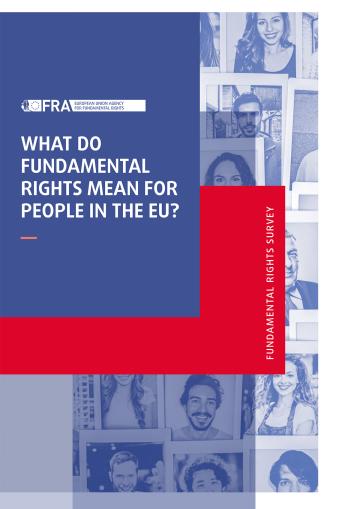
    FRA’s Fundamental Rights Survey collected data from 35,000 people about their experiences, perceptions and opinions on a range of issues that are variously encompassed by human rights. This report presents a small selection of the survey results. It focuses on findings with respect to respondents’ opinions about human – or fundamental rights; their views and perceptions on the functioning of democratic societies – as a pillar on which human rights can flourish; and on their thoughts on and engagement with public services that have a duty to enforce human rights law and to protect people’s rights.
  • Fundamental Rights Report
    11
    June
    2020
    Now available in all 24 official EU languages
    12 August 2020
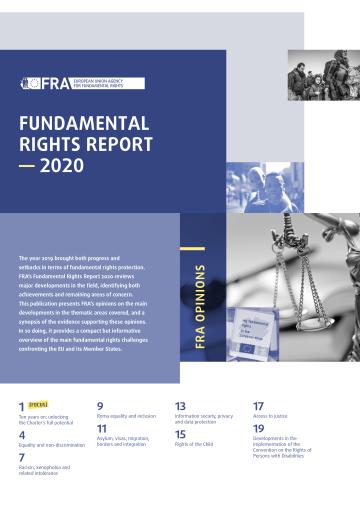
    Pamattiesību aizsardzības jomā 2019. gadā bija
    vērojami gan sasniegumi, gan neveiksmes. FRA
    “2020. gada ziņojumā par pamattiesībām” ir aplūkoti
    galvenie jaunumi pamattiesību jomā, nosakot gan
    sasniegumus, gan jomas, kas aizvien rada bažas. Šajā
    publikācijā sniegti FRA atzinumi par galvenajiem
    jaunumiem attiecīgajās tematiskajās jomās un šos
    atzinumus pamatojošs pierādījumu apkopojums.
    Tādējādi ir nodrošināts kompakts, bet informatīvs
    pārskats par galvenajām pamattiesību problēmām, ar
    ko saskaras ES un tās dalībvalstis.
  • Handbook / Guide / Manual
    13
    June
    2019
    New language versions: ES, HU, IT, NL, PL
    15 September 2020
    Rokasgrāmatas “Bērni, kas palikuši bez vecāku gādības un atrodas ES dalībvalstī, kura nav viņu
    mītnes valsts” mērķis ir stiprināt visu attiecīgo bērnu aizsardzības dalībnieku reakciju. Šo meiteņu
    un zēnu aizsardzība ir īpaši svarīga, un tas ir ES dalībvalstu pienākums, kas izriet no starptautiskā
    un Eiropas tiesiskā regulējuma. Rokasgrāmatā galvenā uzmanība pievērsta cilvēku tirdzniecības
    upuriem un riskam pakļautajiem bērniem, īstenojot 2017. gada paziņojumā paredzēto darbību, ar ko
    pastiprina ES rīcību pret cilvēku tirdzniecību, un tajā ņemti vērā konstatētie modeļi, tostarp attiecībā
    uz nozieguma dzimumu specifiku.
  • Report / Paper / Summary
    27
    March
    2020
    French version now available
    24 April 2020
    Council of Europe (CoE) and European Union (EU) Member States have an undeniable sovereign right to control the entry of non-nationals into their territory. While exercising border control, states have a duty to protect the fundamental rights of all people under their jurisdiction, regardless of their nationality and/or legal status. Under EU law, this includes providing access to asylum procedures.
  • Leaflet / Flyer
    20
    November
    2019
    French and German versions now available
    21 April 2020
    Child rights come first. Measures to ensure child protection and participation apply to all children in the EU. This brochure guides you to relevant FRA reports and tools that can support you when promoting and protecting the rights of all children in the EU.
  • Fundamental Rights Report
    6
    June
    2018
    Finnish version now available
    27 January 2020
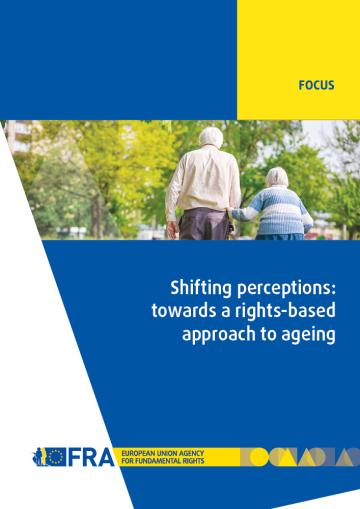
    European societies are not getting any younger! It is a simple truth we must face both about ourselves and Europe as a whole. In two generations, by 2080, those aged 65 or above will account for almost 30% of the European Union’s population.
  • Periodic updates / Series
    22
    October
    2026
    This is the third bulletin in FRA’s new quarterly series monitoring the situation of migrants, asylum seekers and refugees. It covers key developments and ongoing concerns between 1 July and 30 September 2026. FRA reported regularly on fundamental rights issues related to migration and asylum from 2015 to 2023. FRA resumed its quarterly bulletins on migration in 2026 as envisaged in the EU's 2024 Asylum and Migration Management Regulation, ahead of the implementation of the EU Migration and Asylum Pact in June 2026.
    Publication series: Migration Bulletins
  • Periodic updates / Series
    15
    October
    2026
    EU law requires independent monitoring of certain migration-related activities such as screening, the asylum border procedure and forced returns. This publication provides an overview and an update on the functioning of this EU-mandated monitoring. The report also provides an update on investigations into reported incidents of ill-treatment at borders and shows that there are still significant gaps when it comes to investigating promptly and effectively rights violations at borders.
  • Report / Paper / Summary
    9
    October
    2026
    Criminal investigations rely on large amounts of personal data processed by law enforcement authorities. This sensitive information must be handled in line with EU data protection rules and people’s rights. The Law Enforcement Directive sets out rules for how authorities can process data in a way that safeguards fundamental rights and freedoms. This report looks at how data protection rules are applied in practice in all EU Member States. It highlights challenges concerning understanding and compliance, the role and resources of data protection officers, and effective supervision. The results contribute to an EU-level assessment of how the directive is applied in practice, pointing to areas for future improvement.
  • Report / Paper / Summary
    5
    October
    2026
    FRA and EIGE conducted the European Union gender-based violence survey (EU-GBV survey) in eight EU Member States – Cyprus, Czechia, Germany, Hungary, Ireland, Luxembourg, Romania and Sweden. This report describes the measures taken to carry out the survey, which resulted in a final dataset of 15,447 interviews across the eight survey countries.