Top Menu

  • За агенцията за основните права (FRA)
  • Сътрудничество
  • Newsroom
  • Cookies
  • Contact

Select site language

  • Български
  • Čeština
  • Dansk
  • Deutsch
  • Ελληνικά
  • English
  • Español
  • Eesti
  • Suomi
  • Français
  • Gaeilge
  • Hrvatski
  • Magyar
  • Italiano
  • Lietuvių
  • Latviešu
  • Malti
  • Nederlands
  • Polski
  • Português
  • Română
  • Slovenčina
  • Slovenščina
  • Svenska

Custom Topbar

Home

Search the FRA website

      • Work on rights
        • Правосъдие, права на жертвите и съдебно сътрудничество
          • Права на жертвите
          • Права на обвиняемите
          • Гражданско правосъдие
          • Съдебно сътрудничество и върховенство на закона
          • Сигурност
          • Стопанска дейност и права на човека
        • Равенство, недискриминация и расизъм
          • Деца, младежи и възрастни хора
          • Лица с увреждания
          • Престъпления от омраза
          • Расов и етнически произход
          • Религия и убеждения
          • Роми
          • Пол, сексуална ориентация и полова идентичност
        • Убежище, миграция и граници
          • Достъп до убежище
          • Граници и информационни системи
          • Закрила на детето
          • Незаконна миграция, връщане и задържане на имигранти
          • Законна миграция и интегриране
          • Трафик на хора и трудова експлоатация
        • Защита на данните, неприкосновеност на личния живот и нови технологии
          • Изкуствен интелект и големи информационни масиви
          • Граници и информационни системи
          • Защита на данните
          • Незаконно профилиране
        • Подкрепа за системи и защитници на правата на човека
          • Харта на основните права на Европейския съюз
          • Междуправителствени системи във връзка с правата на човека
          • Национални системи и органи във връзка с правата на човека
          • Гражданско общество
        • Environmental and social sustainability
          • Climate change and environmental protection
          • Just and green transition
          • Business and human rights
          • Human rights due diligence
          • Consumer protection
      • Хартата на основните права на Европейския съюз
        • Какво представляват основните права?
        • What is the EU Charter of Fundamental Rights?
        • Преамбюл
        • Дял I: Достойнство
          • 1 - Човешко достойнство
          • 2 - Право на живот
          • 3 - Право на неприкосновеност на личността
          • 4 - Забрана на изтезанията и на нечовешкото или унизително отношение или наказание
          • 5 - Забрана на робството и на принудителния труд
        • Дял II: Свободи
          • 6 - Право на свобода и сигурност
          • 7 - Зачитане на личния и семейния живот
          • 8 - Защита на личните данни
          • 9 - Право на встъпване в брак и право на създаване на семейство
          • 10 - Свобода на мисълта, съвестта и религията
          • 11 - Свобода на изразяване на мнение и свобода на информация
          • 12 - Свобода на събранията и сдруженията
          • 13 - Свобода на изкуствата и науките
          • 14 - Право на образование
          • 15 - Свобода при избор на професия и право на труд
          • 16 - Свобода на стопанската инициатива
          • 17 - Право на собственост
          • 18 - Право на убежище
          • 19 - Защита в случай на принудително отвеждане, експулсиране и екстрадиране
        • Дял III: Равенство
          • 20 - Равенство пред закона
          • 21 - Недискриминация
          • 22 - Културно, религиозно и езиково многообразие
          • 23 - Равенство между жените и мъжете
          • 24 - Права на детето
          • 25 - Права на възрастните хора
          • 26 - Интеграция на хората с увреждания
        • Дял IV: Солидарност
          • 27 - Право на информиране и консултиране на работниците в предприятието
          • 28 - Право на колективни преговори и действия
          • 29 - Право на достъп до услугите за намиране на работа
          • 30 - Защита при неоснователно уволнение
          • 31 - Справедливи и равни условия на труд
          • 32 - Забрана на детския труд и защита на работещите младежи
          • 33 - Семеен и професионален живот
          • 34 - Социална сигурност и социална помощ
          • 35 - Закрила на здравето
          • 36 - Достъп до услугите от общ икономически интерес
          • 37 - Опазване на околната среда
          • 38 - Защита на потребителите
        • Дял V: Гражданство
          • 39 - Право на гражданите да избират и да бъдат избирани в изборите за Европейския парламент
          • 40 - Право на гражданите да избират и да бъдат избирани в общинските избори
          • 41 - Право на добра администрация
          • 42 - Право на достъп до документи
          • 43 - Европейски омбудсман
          • 44 - Право на петиции
          • 45 - Свободно движение и пребиваване
          • 46 - Дипломатическа и консулска закрила
        • Дял VI: Правосъдие
          • 47 - Право на ефективни правни средства за защита и на справедлив съдебен процес
          • 48 - Презумпция за невиновност и право на защита
          • 49 - Принципи на законност и пропорционалност на престъплението и наказанието
          • 50 - Право на всеки да не бъде съден или наказван два пъти за едно и също престъпление
        • Дял VII: Общи pазпоредби
          • 51 - Приложно поле
          • 52 - Обхват и тълкуване на правата и принципите
          • 53 - Степен на закрила
          • 54 - Забрана на злоупотребата с право
      • Tools
        • EU Fundamental Rights Information System - EFRIS
        • Criminal detention database
        • Anti-Muslim hatred database
        • National human rights structures navigator
        • Case-law database
        • Charterpedia
        • FRA e-learning platform
        • Data visualisation
        • Equality data collection: promising practices
        • Fighting hate crime: promising practices
      • Продукти
    • About FRA
      • Who we are
        • Structure of FRA
        • Management Board
          • Management Board members
          • Management Board meeting documents
        • Executive Board
        • Scientific Committee
          • Scientific Committee members
        • Director
        • Management team
      • What we do
        • Research and data
        • Capacity-building
        • Advising
        • Convening people
        • FRA for children
          • What are my rights?
          • Where do my rights come from?
        • Areas of work
          • Multi-annual Framework 2007-2022
        • Work Programme
          • Archive
        • Annual Activity report
          • Archive
        • Projects
      • Working at FRA
        • Vacancies and selections
          • Previous vacancies
        • What we offer
        • Work-life balance
        • Application instructions
        • Seconded National Experts
        • Traineeship
        • Study visits at FRA
      • Procurement
        • Ongoing procedures
        • Closed procedures
        • Contracts awarded
      • Finance and budget
        • Financial Rules
        • Financial documents
      • Достъп до документи
        • Access to documents
        • Заявление за достъп до документи
      • Data protection within FRA
        • Records registry
    • Cooperation
      • институциите на ЕС и други органи
        • European Parliament
        • Council of the European Union
        • European Commission
        • EU agencies
          • Justice and Home Affairs Agencies Network
        • European Committee of the Regions
        • European Economic and Social Committee
        • European Ombudsman
        • EU CRPD Framework
          • насърчаване
          • Protection
          • Monitoring
          • Review process
          • Resources
      • Държавите — членки на ЕС
        • National Liaison Officers
        • National Parliaments
      • Съвет на Европа
      • Гражданско общество и Платформата за основните права
        • Activities
        • Civic space
        • Platform library
        • How to register
      • Национални институции по правата на човека, органи за равно третиране и институции на омбудсмана
      • ООН, ОССЕ и други международни организации
        • EEA and Norway Grants
      • FRANET
    • Newsroom
      • Media contacts
      • News
      • Press releases
      • Stories
      • Events
        • Past Events
      • FRA products 2026
        • FRA products 2025
        • FRA products 2024
        • FRA products 2023
        • FRA products 2022
        • FRA products 2021
        • FRA Products 2020
        • FRA Products 2019
      • Multimedia
        • Videos
        • Infographics
        • Podcasts
      • Speeches
      • Press packs
        • EU LGBTIQ survey - Press pack
        • Fundamental Rights Survey
        • EU LGBTI survey II
        • From institutions to community living for persons with disabilities: perspectives from the ground
        • Second European Union Minorities and Discrimination Survey – Main results
        • Second European Union Minorities and Discrimination Survey (EU-MIDIS II) Muslims
        • Together in the EU: Promoting the participation of migrants and their descendants
        • Second European Union Minorities and Discrimination Survey (EU-MIDIS II) Roma
        • Severe labour exploitation in the EU
        • Child-friendly justice – perspectives and experiences of professionals: Press pack
        • Fundamental rights at EU borders
        • Violence against women press pack
        • Jewish people’s experiences and perceptions of hate crime, discrimination and antisemitism
        • EU LGBT Press pack
        • Child-friendly justice – perspectives and experiences of children
      • Newsletter
    • Account
      • Log in

Main menu

Home
  • Work on rights
    Work on rights
    • Правосъдие, права на жертвите и съдебно сътрудничество
      • Права на жертвите
      • Права на обвиняемите
      • Гражданско правосъдие
      • Съдебно сътрудничество и върховенство на закона
      • Сигурност
      • Стопанска дейност и права на човека
    • Равенство, недискриминация и расизъм
      • Деца, младежи и възрастни хора
      • Лица с увреждания
      • Престъпления от омраза
      • Расов и етнически произход
      • Религия и убеждения
      • Роми
      • Пол, сексуална ориентация и полова идентичност
    • Убежище, миграция и граници
      • Достъп до убежище
      • Граници и информационни системи
      • Закрила на детето
      • Незаконна миграция, връщане и задържане на имигранти
      • Законна миграция и интегриране
      • Трафик на хора и трудова експлоатация
    • Защита на данните, неприкосновеност на личния живот и нови технологии
      • Изкуствен интелект и големи информационни масиви
      • Граници и информационни системи
      • Защита на данните
      • Незаконно профилиране
    • Подкрепа за системи и защитници на правата на човека
      • Харта на основните права на Европейския съюз
      • Междуправителствени системи във връзка с правата на човека
      • Национални системи и органи във връзка с правата на човека
      • Гражданско общество
    • Environmental and social sustainability
      • Climate change and environmental protection
      • Just and green transition
      • Business and human rights
      • Human rights due diligence
      • Consumer protection
  • Хартата на основните права на Европейския съюз
    Хартата на основните права на Европейския съюз
    • Какво представляват основните права?
    • What is the EU Charter of Fundamental Rights?
    • Преамбюл
    • Дял I: Достойнство
      • 1 - Човешко достойнство
      • 2 - Право на живот
      • 3 - Право на неприкосновеност на личността
      • 4 - Забрана на изтезанията и на нечовешкото или унизително отношение или наказание
      • 5 - Забрана на робството и на принудителния труд
    • Дял II: Свободи
      • 6 - Право на свобода и сигурност
      • 7 - Зачитане на личния и семейния живот
      • 8 - Защита на личните данни
      • 9 - Право на встъпване в брак и право на създаване на семейство
      • 10 - Свобода на мисълта, съвестта и религията
      • 11 - Свобода на изразяване на мнение и свобода на информация
      • 12 - Свобода на събранията и сдруженията
      • 13 - Свобода на изкуствата и науките
      • 14 - Право на образование
      • 15 - Свобода при избор на професия и право на труд
      • 16 - Свобода на стопанската инициатива
      • 17 - Право на собственост
      • 18 - Право на убежище
      • 19 - Защита в случай на принудително отвеждане, експулсиране и екстрадиране
    • Дял III: Равенство
      • 20 - Равенство пред закона
      • 21 - Недискриминация
      • 22 - Културно, религиозно и езиково многообразие
      • 23 - Равенство между жените и мъжете
      • 24 - Права на детето
      • 25 - Права на възрастните хора
      • 26 - Интеграция на хората с увреждания
    • Дял IV: Солидарност
      • 27 - Право на информиране и консултиране на работниците в предприятието
      • 28 - Право на колективни преговори и действия
      • 29 - Право на достъп до услугите за намиране на работа
      • 30 - Защита при неоснователно уволнение
      • 31 - Справедливи и равни условия на труд
      • 32 - Забрана на детския труд и защита на работещите младежи
      • 33 - Семеен и професионален живот
      • 34 - Социална сигурност и социална помощ
      • 35 - Закрила на здравето
      • 36 - Достъп до услугите от общ икономически интерес
      • 37 - Опазване на околната среда
      • 38 - Защита на потребителите
    • Дял V: Гражданство
      • 39 - Право на гражданите да избират и да бъдат избирани в изборите за Европейския парламент
      • 40 - Право на гражданите да избират и да бъдат избирани в общинските избори
      • 41 - Право на добра администрация
      • 42 - Право на достъп до документи
      • 43 - Европейски омбудсман
      • 44 - Право на петиции
      • 45 - Свободно движение и пребиваване
      • 46 - Дипломатическа и консулска закрила
    • Дял VI: Правосъдие
      • 47 - Право на ефективни правни средства за защита и на справедлив съдебен процес
      • 48 - Презумпция за невиновност и право на защита
      • 49 - Принципи на законност и пропорционалност на престъплението и наказанието
      • 50 - Право на всеки да не бъде съден или наказван два пъти за едно и също престъпление
    • Дял VII: Общи pазпоредби
      • 51 - Приложно поле
      • 52 - Обхват и тълкуване на правата и принципите
      • 53 - Степен на закрила
      • 54 - Забрана на злоупотребата с право
  • Tools
    Tools
    • EU Fundamental Rights Information System - EFRIS
    • Criminal detention database
    • Anti-Muslim hatred database
    • National human rights structures navigator
    • Case-law database
    • Charterpedia
    • FRA e-learning platform
    • Data visualisation
    • Equality data collection: promising practices
    • Fighting hate crime: promising practices
  • Продукти

You are here

  • Home
  • Work On Rights
  • Environmental and social sustainability
  • Human rights due diligence
  • A Human Rights Approach to Due Diligence: Reflections on key principles
22
October
2025

A Human Rights Approach to Due Diligence: Reflections on key principles

Human rights due diligence
Equality, non-discrimination and racism
Justice, victims’ rights and judicial cooperation
Environmental and social sustainability
This publication discusses how businesses can meet their human rights and environmental responsibilities. It focuses on key elements of mandatory human rights due diligence and presents reflections on principles from international law and EU law. The paper explains why risk-based human rights due diligence is needed and how it should be implemented. It also highlights the importance of stakeholder engagement, access to remedies, and oversight. It aims to inform EU policymakers and stakeholders about ways to effectively promote responsible business conduct and to ensure adequate protection of rightsholders.
Read news item
  • Read Online
  • Related
Export to PDF
Search inside this publication
  • Executive summary
  • Introduction
  • 1. Why is mandatory human rights due diligence needed?
    • 1.1 The EU context
  • 2. A risk-based approach within human rights due diligence
    • 2.1. Business responsibility to respect human rights
    • 2.2. Risk-based approach to identification and assessment of adverse impacts
    • 2.3. Shared responsibility in implementing due diligence across the chain of activities
    • 2.4. Ongoing monitoring in line with a risk-based approach
    • 2.5. A risk-based approach to responsible disengagement
  • 3. Stakeholder engagement
    • 3.1. Conditions and stages of effective stakeholder engagement
  • 4. Access to effective remedies and civil liability
    • 4.1. Civil liability provisions and due diligence obligations
    • 4.2. Overriding mandatory application
    • 4.3. Representation of victims in civil proceedings for effective access to justice
  • 5. Oversight and enforcement
    • 5.1. Supervisory authorities
    • 5.2. Dissuasive penalties and their uniform application
  • About this publication


1. Why is mandatory human rights due diligence needed?

Companies can contribute to advancing human rights and environmental protection, providing employment, livelihood stability and innovation. However, their activities can also result in interference with human rights, even leading to human rights violations such as modern-day slavery. Business activities can negatively affect the entire spectrum of internationally recognised human rights: civil and political rights and economic, social and cultural rights. See the global heat map of the German Institute for Human Rights (GIHR) (Figure 1).

Figure 1 – Corporate human rights abuses, 2017–2022
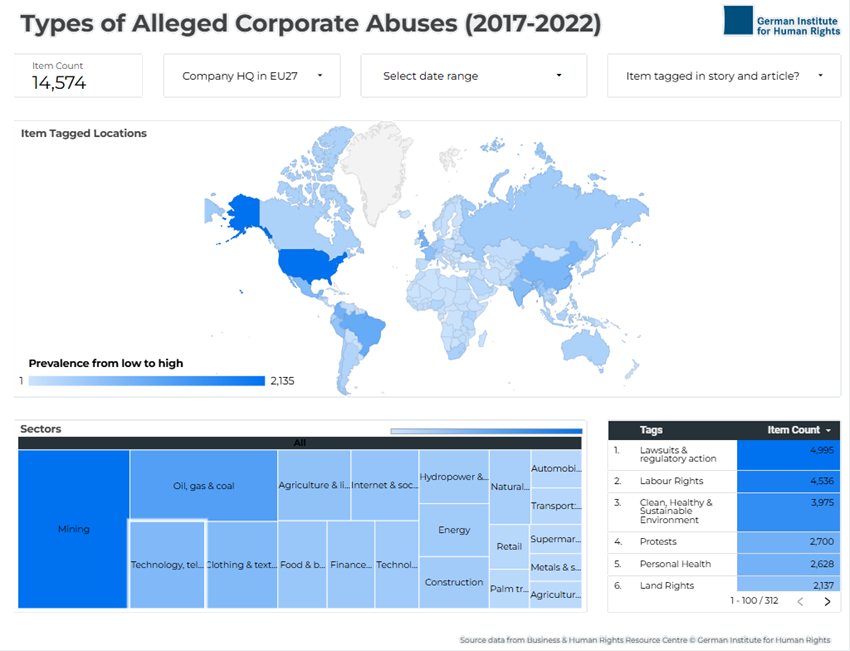
Source: GIHR, ‘New research tool - "Global Heat Map of Alleged Corporate Abuses"’, GIHR website.

Human rights impacts and environmental degradation that companies or their subsidiaries may cause or contribute to can be prevented and mitigated through human rights and environmental due diligence processes [7]
 Resolution adopted by the UN General Assembly, A/RES/79/1, The Pact for the Future, 22 September 2024.
In its pact for the future, the UN encourages the private sector to contribute to sustainability, the achievement of the 2030 Agenda and the sustainable development goals, through partnership-based approaches and accountability in working towards implementing UN frameworks.
.

Although international voluntary frameworks have helped companies understand their responsibility to respect human rights, many still do not adequately integrate sustainability aspects into their operations [8]
 European Parliamentary Research Service, ‘Towards a mandatory EU system of due diligence for supply chains’, 2020.
.


1.1 The EU context

In line with the UNGPs [9] See footnote 1.
, the EU has adopted a comprehensive approach to human rights, sustainability and responsible business through a ‘smart mix’ [10]
 European External Action Service, ‘Business and human rights’, EEAS website, 2024.
of policy measures and legislation. Collectively, these aim to improve business practices, prevent harm and ensure effective access to remedy for affected individuals and communities. Through these measures, the EU has taken significant steps to incorporate international human rights treaties and international voluntary frameworks on business and human rights into its legal order. That includes adopting legal standards and requirements aligned with the principles and expectations laid down in the UNGPs and OECD Guidelines [11]
 OECD, OECD guidelines for multinational enterprises on responsible business conduct, OECD Publishing, Paris, 2023.
.

Relevant measures include those adopted under, or implementing the objective of, the European Green Deal [12]
 European Commission, ‘The European Green Deal: Striving to be the first climate-neutral continent’, European Commission website.
. They enhance corporate accountability for adverse human rights and environmental impacts, including horizonal regulatory frameworks such as the CSDDD, the Corporate Sustainability Reporting Directive, the Taxonomy Regulation and the Sustainable Finance Disclosure Regulation [13]
 Regulation (EU) 2019/2088 of the European Parliament and of the Council of 27 November 2019 on sustainability‐related disclosures in the financial services sector (OJ L 317, 9.12.2019, p. 1).
, along with sector-specific requirements such as the Conflict Minerals Regulation [14]
 Regulation (EU) 2017/821 of the European Parliament and of the Council of 17 May 2017 laying down supply chain due diligence obligations for Union importers of tin, tantalum and tungsten, their ores, and gold originating from conflict-affected and high-risk areas (OJ L 130, 19.5.2017, p. 1).
, the Dual-Use Exports Control Regulation [15]
 Regulation (EU) 2021/821 of the European Parliament and of the Council of 20 May 2021 setting up a Union regime for the control of exports, brokering, technical assistance, transit and transfer of dual-use items (recast) (OJ L 206, 11.6.2021, p. 1).
, the Critical Raw Materials Act [16]
 Regulation (EU) 2024/1252 of the European Parliament and of the Council of 11 April 2024 establishing a framework for ensuring a secure and sustainable supply of critical raw materials and amending Regulations (EU) No 168/2013, (EU) 2018/858, (EU) 2018/1724 and (EU) 2019/1020 (OJ L, 2024/1252, 3.5.2024).
, and the Forced Labour Regulation [17]
 Regulation (EU) 2024/3015 of the European Parliament and of the Council of 27 November 2024 on prohibiting products made with forced labour on the Union market and amending Directive (EU) 2019/1937 (OJ L, 2024/3015, 12.12.2024).
.Among these, the CSDDD [18]
 Directive (EU) 2024/1760 of 13 June 2024 on corporate sustainability due diligence and amending Directive (EU) 2019/1937 and Regulation (EU) 2023/2859 (OJ L, 2024/1760, 5.7.2024).
is the landmark law introducing mandatory HRDD across various stages of a company’s ‘chain of activities’ [19]
 Article 3(1)(g) of Directive (EU) 2024/1760 of the European Parliament and of the Council of 13 June 2024 on corporate sustainability due diligence and amending Directive (EU) 2019/1937 and Regulation (EU) 2023/2859 (OJ L, 2024/1760, 5.7.2024).
and requiring large companies operating in the EU to adopt and put into effect climate change mitigation plans.

These laws aim to ensure accountability for adverse impacts on people and the environment. Some of these laws are now subject to revision. In such recast process, it is important that the essence of these laws is preserved so that the EU can deliver on the Green Deal in a way that advances a just transition that serves the EU internal market and its people.

In the EU, companies encounter legal uncertainty and unnecessary administrative burdens due to an unclear and fragmented legal landscape across the internal market. Several Member States have adopted their own due diligence laws, while others have not and some still are considering it [20]
 European Commission, Impact assessment report accompanying the document proposal for a Directive of the European Parliament and of the Council on corporate sustainability due diligence and amending Directive (EU) 2019/1937, SWD/2022/42 final of 22 February 2022.
.

The CSDDD represents a clear step towards necessary legal harmonisation within the EU internal market, replacing a fragmented landscape of national due diligence regimes – such as those already enacted in France (Devoir de vigilance), Germany (Lieferkettengesetz), and adopted in the Netherlands (Wet zorgplicht kinderarbeid) – with a coherent and uniform EU-wide standard [21]
 Loi n° 2017-399 relative au devoir de vigilance des sociétés mères et des entreprises donneuses d'ordre [Law on the Duty of Vigilance of Parent Companies and Ordering Companies], Journal Officiel de la République Française n°0074, 27 March 2017; Gesetz über die unternehmerischen Sorgfaltspflichten zur Vermeidung von Menschenrechtsverletzungen in Lieferketten[Lieferkettensorgfaltspflichtengesetz, Supply Chain Due Diligence Act], Bundesgesetzblatt I, 22 July 2021; Wet zorgplicht kinderarbeid [Child Labour Due Diligence Act], Senate of the Netherlands, 14 May 2019.
. This uniformity reduces compliance burdens for multinational corporations while setting a baseline level of protection for rights holders across jurisdictions.
Introduction2. A risk-based approach within human rights due diligence
Related
FRA, 2026
Opinion / Position Paper
Environmental and social sustainability
Climate change and environmental protection
Consumer protection
25
February
2026

Opinion on Draft Simplified European Sustainability Reporting Standards

This FRA Opinion on the draft simplified European Sustainability Reporting Standards informs the European Commission ahead of the standards’ adoption. This Opinion applies a risk-based human rights approach to assess whether the proposed simplifications preserve essential safeguards for people adversely affected by corporate activities. The Opinion provides practical, proportionate suggestions to strengthen the simplified framework and ensure that efficiency gains do not come at the expense of fundamental rights.
Creative collage of law and justice, gavel and scales
BillionPhotos.com / adobestock.com, 2025
Report / Paper / Summary
EU Charter of Fundamental Rights
Support for human rights systems and defenders
8
December
2025

Better legislation – Human rights impact assessments in lawmaking

This report examines how human rights impact assessments (HRIAs) are built into lawmaking across the EU and its Member States. It highlights that, although progress has been made, the use of HRIAs remains uneven and often superficial. In many EU countries, the EU Charter of Fundamental Rights is frequently overlooked. The report identifies insufficient consultation with external experts, limited stakeholder participation and a lack of evaluation once laws are in force. To address these gaps, it offers practical recommendations for more systematic, inclusive and evidence-based HRIAs that strengthen human rights protection and ensure better, more accountable legislation throughout the EU.
Read news item
Industry smoking chimneys with forest overlay.
Report / Paper / Summary
Consumer protection
Justice, victims’ rights and judicial cooperation
Environmental and social sustainability
7
March
2024

Enforcing consumer rights to combat greenwashing

Tackling greenwashing is an issue where human rights, consumer rights and climate goals align. Companies use greenwashing to convince people to buy products that are not always as environmentally friendly as they claim to be. They mislead consumers and harm the environment. This report shows how a human rights approach can combat greenwashing. It is based on consultations with experts in 10 Member States. The report identifies gaps in existing laws and enforcement. It includes case studies of consumers seeking remedies for misleading environmental claims.
Read news item
Woman watching a virtual screen
HQUALITY © adobestock.com, 2020
Report / Paper / Summary
Artificial intelligence and big data
Data protection, privacy and new technologies
14
December
2020
Slovenian version now available
20 December 2024

Getting the future right – Artificial intelligence and fundamental rights

Artificial intelligence (AI) already plays a role in deciding what unemployment benefits someone gets, where a burglary is likely to take place, whether someone is at risk of cancer, or who sees that catchy advertisement for low mortgage rates. Its use keeps growing, presenting seemingly endless possibilities. But we need to make sure to fully uphold fundamental rights standards when using AI. This report presents concrete examples of how companies and public administrations in the EU are using, or trying to use, AI. It focuses on four core areas – social benefits, predictive policing, health services and targeted advertising.
Read the press release
Watch the launch video
Read press release
© Freshideas / Adobestock
Report / Paper / Summary
Business and human rights
Justice, victims’ rights and judicial cooperation
Environmental and social sustainability
Business and human rights
6
October
2020

Business and human rights – access to remedy

Business activity affects not just customers, employees, and contractors along supply chains, but often entire communities and the environment. This makes it vital that every business complies with human rights. This comparative report looks at the realities victims face when they seek redress for business-related human rights abuses. It presents the findings of fieldwork research on the views of professionals regarding the different ways people can pursue complaints. The findings highlight that obstacles to achieving justice are often multi-layered.
Read news item
За агенцията за основните права (FRA)

Научете повече за Агенцията и нейната работа тук.

  • За агенцията за основните права (FRA)
  • Харта за защита на човешките права
  • Къде да потърсите помощ
  • Абонирайте се за актуализации
Потърсете ни
Address
European Union Agency for Fundamental Rights
Schwarzenbergplatz 11
A-1040 Vienna, Austria
E-mail
Свържете се с нас
Newsletter
Абонирайте се за актуализации
  • Facebook
  • Twitter
  • LinkedIn
  • YouTube
  • Newsletter
  • E-mail
  • RSS

© European Union Agency for Fundamental Rights, 2007-2026

  • About this website
  • Legal notice
  • Cookies
  • Data Protection
  • Accessibility