The Fundamental Rights Report: Challenges and Achievements in 2025 is FRA’s flagship annual publication. It provides an overview of the state of fundamental rights in the EU and highlights selected critical developments from 2025. This year, it focuses on four areas: rights protection in a rapidly changing digital environment; the housing crisis and rising homelessness rates; employment challenges for people from non-EU countries; and the implementation of the EU Charter of Fundamental Rights. The publication is a valuable resource for those seeking to stay informed about the EU’s shifting landscape of fundamental rights.
This publication presents findings from an EU-wide survey on public attitudes to children’s use of social media. It presents people’s key concerns and their views on the minimum age limits for accessing social media platforms. The survey draws on the views of both teenagers and adults – those most directly affected. The findings offer a useful evidence base for policy discussions on social media age restrictions in the EU.
The report ‘Assessing high-risk artificial intelligence’ examines the development and use of artificial intelligence (AI) in five areas defined as high-risk under the AI Act: asylum, education, employment, law enforcement and public benefits. This video provides information about the findings of the report, underlining the need for a responsible use of AI which in turn earns public trust, fuels innovation and drives sustainable technological progress.
Artificial Intelligence comes with both benefits and risks. Safe AI use that accounts for fundamental rights is thus crucial. While the 2024 EU AI Act was a milestone in this regard, its broad definitions regarding AI systems and high-risk AI could introduce loopholes for fundamental rights compliance. This report offers an empirical basis for much-needed practical guidance on the Act’s implementation. Based on interviews with AI developers, sellers, and users, FRA addresses challenges of its use in critical domains, like asylum, education, and employment. Our findings help guide next steps in realising the AI Act’s potential to ensure responsible innovation.
In an increasingly digital world, tech advances affect almost all aspects of our lives and our rights. This FRF theme tackles topics such as regulating digitalisation without stifling innovation or surveillance-based advertising. Notable speakers include Catherine De Bolle, Executive Director at EUROPOL, Daniel Howden, Founder and Director of Lighthouse Reports, Nanna-Louise Linde, Vice-President for European Government Affairs at Microsoft, Alexandria Walden, Global Head of Human Rights at Google, among others.
Artificial intelligence is everywhere and affects everyone – from deciding what content people see on their social media feeds to determining who will receive state benefits. AI technologies are typically based on algorithms that make predictions to support or even fully automate decision-making.
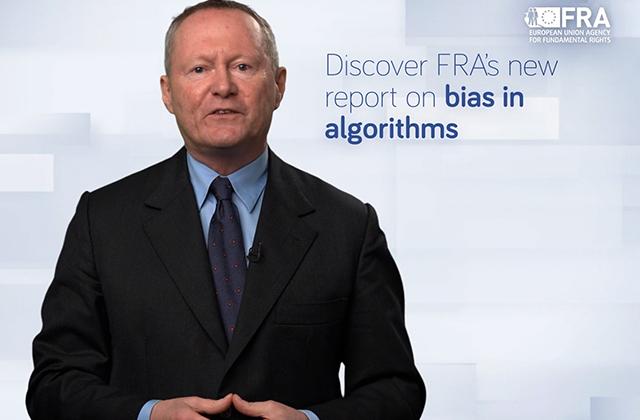
In this vlog, FRA Director Michael O'Flaherty talks about artificial intelligence and algorithms. While AI can be a powerful force for good, he points out that humans must supervise very closely the application of AI and a permanent testing of every possible application is needed. On 8 December, FRA is publishing a new report on bias in algorithms.
Automation and AI have radically transformed how we work, live and play. In this video, Director of the EU Agency for Fundamental Rights, Michael O'Flaherty, discusses the implications of AI for our most basic of human rights.
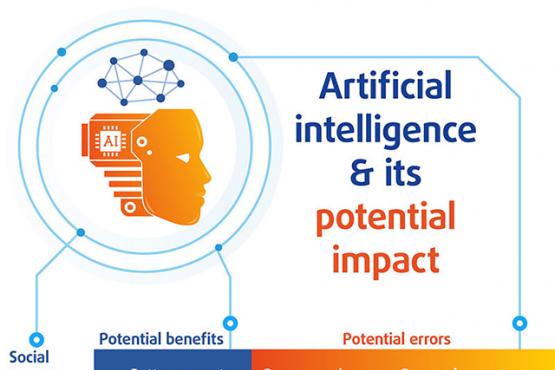
Artificial intelligence (AI) already plays a role in many decisions that affect our daily lives. From deciding what unemployment benefits someone gets to where a burglary is likely to take place. But we need to make sure to fully uphold fundamental rights standards when using AI. Drawing on the ‘Getting the future right – Artificial intelligence and fundamental rights’ report, FRA explores the potential benefits and possible errors that can occur focusing on four core areas – social benefits, predictive policing, health services and targeted advertising.
Докладът на FRA относно изкуствения интелект и основните права представя конкретни примери за начина, по който дружествата и държавните администрации в ЕС използват или се опитват да използват ИИ. В настоящото резюме се представят основните заключения от доклада. Те могат да послужат за информация при създаване на политики на равнището на ЕС и на национално равнище за регламентиране на използването на инструменти с ИИ в съответствие с правата на човека и основните права.
Zpráva agentury FRA o umělé inteligenci a základních právech uvádí konkrétní příklady toho, jak společnosti a orgány veřejné správy v EU používají nebo se pokoušejí používat umělou inteligenci. Toto shrnutí předkládá hlavní poznatky zprávy. Ty mohou sloužit jako podpůrné informace pro úsilí tvůrců politik na úrovni EU i jednotlivých států v oblasti regulace používání nástrojů umělé inteligence v souladu s lidskými a základními právy.
I FRA’s rapport om kunstig intelligens og grundlæggende rettigheder gives der konkrete eksempler på, hvordan virksomheder og offentlige forvaltninger i EU bruger eller forsøger at bruge kunstig intelligens. Dette resumé indeholder hovedresultaterne fra rapporten. Disse kan danne grundlag for EU’s og medlemsstaternes politiske bestræbelser på at regulere brugen af AI-værktøjer i overensstemmelse med menneskerettighederne og de grundlæggende rettigheder.
Der Bericht der FRA über künstliche Intelligenz und Grundrechte präsentiert konkrete Beispiele dafür, wie Unternehmen und Behörden in der EU künstliche Intelligenz einsetzen oder einzusetzen versuchen. Diese Zusammenfassung stellt die wichtigsten Erkenntnisse aus dem Bericht vor, die sowohl auf Unionsebene als auch auf nationaler Ebene für die Politikgestaltung auf dem Gebiet des menschen- und grundrechtskonformen Einsatzes von KI-Tools genutzt werden können.
Η έκθεση του FRA σχετικά με την τεχνητή νοημοσύνη και τα θεμελιώδη δικαιώματα παρουσιάζει συγκεκριμένους τρόπους με τους οποίους οι εταιρείες και οι δημόσιες διοικητικές αρχές στην ΕΕ χρησιμοποιούν, ή προσπαθούν να χρησιμοποιήσουν, την ΤΝ. Η παρούσα σύνοψη περιέχει τα βασικά σημεία της έκθεσης. Οι εν λόγω πληροφορίες μπορούν να αποτελέσουν τη βάση για τη χάραξη πολιτικής σε ενωσιακό και εθνικό επίπεδο σχετικά με τη χρήση εργαλείων ΤΝ που σέβονται τα ανθρώπινα και τα θεμελιώδη δικαιώματα.
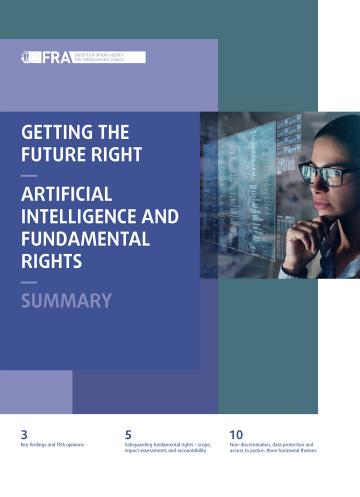
FRA’s report on artificial intelligence and fundamental rights presents concrete examples of how companies and public administrations in the EU are using, or trying to use, AI. This summary presents the main insights from the report. These can inform EU and national policymaking efforts to regulate the use of AI tools in compliance with human and fundamental rights.
En el informe de la Agencia de los Derechos Fundamentales de la Unión Europea sobre inteligencia artificial (IA) y derechos fundamentales se presentan ejemplos concretos de cómo las empresas y las administraciones públicas de la Unión Europea están utilizando o tratan de utilizar la IA. En este resumen se presentan las perspectivas más destacadas del informe. Esto puede servir como fundamento para el intento de las políticas nacionales y de la Unión por regular el uso de las herramientas de IA respetando los derechos fundamentales y humanos.
FRA aruandes tehisintellekti ja põhiõiguste kohta tuuakse konkreetseid näiteid sellest, kuidas ELi ettevõtted ja avaliku sektori asutused kasutavad või püüavad kasutada tehisintellekti. Ülevaates tutvustatakse uuringu põhiaruandes välja toodud peamisi järeldusi. Need võivad ELi ja liikmesriikide poliitikakujundajatel aidata edendada tehisintellekti põhiste vahendite kasutamist, austades inim- ja põhiõigusi.
Euroopan unionin perusoikeusviraston tekoälyä ja perusoikeuksia koskevassa raportissa esitetään konkreettisia esimerkkejä siitä, miten yritykset ja julkishallinnon yksiköt EU:ssa käyttävät tai yrittävät käyttää tekoälyä. Siinä keskitytään neljään keskeiseen alaan – sosiaalietuuksiin, ennakoivaan poliisitoimintaan, terveyspalveluihin ja kohdennettuun mainontaan. Raportissa käsitellään mahdollisia vaikutuksia perusoikeuksiin ja analysoidaan, miten nämä oikeudet otetaan huomioon tekoälysovellusten käytössä tai kehittämisessä.
Le rapport de la FRA consacré à l’intelligence artificielle et aux droits fondamentaux présente des exemples concrets de la manière dont les entreprises et les administrations publiques de l’UE utilisent ou tentent d’utiliser l’IA.