Systems

Parama žmogaus teisių sistemoms ir gynėjams

<p>Many organisations work to defend your rights. We help their efforts with independent evidence, advice and expertise.</p>
<p>We support their frontline work. And we shine a light on potential risks and priority areas. Together we make your rights a reality.</p>

    Produktai

    Publications and Data

    Displaying results 51 - 60 of 92
    Periodic updates / Series
    19
    June
    2019
    In 2018, some 2,299 people are estimated to have died or gone missing at sea while crossing the sea to reach Europe to escape war or persecution or to pursue a better life. This is on average more than six people per day. Before mid-2017, a significant share of migrants in distress at sea have been rescued by civil society vessels deployed with a humanitarian mandate to reduce fatalities and bring rescued migrants to safety. In 2018, however, authorities in some Member States viewed civil society-deployed rescue vessels with hostility. As a reaction, they seized rescue vessels, arrested crew members, and initiated legal procedures against them (more than a dozen altogether). In some cases, rescue vessels were blocked in harbours due to flag issues.
    Report / Paper / Summary
    12
    June
    2019
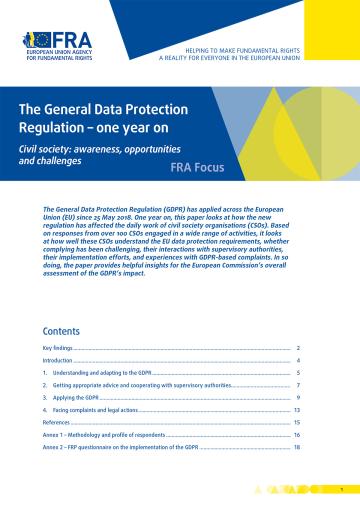
    The General Data Protection Regulation (GDPR) has applied across the European Union (EU) since 25 May 2018. One year on, this paper looks at how the new regulation has affected the daily work of civil society organisations (CSOs).
    Fundamental Rights Report
    6
    June
    2019
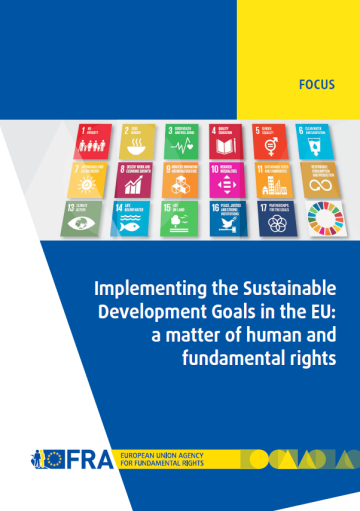
    This year’s focus explores the interrelationship between the human and fundamental rights framework and the Sustainable
    Development Goals (SDGs) of the global Agenda 2030 in the context of Member States’ and the EU’s internal policies.
    It takes a closer look at the SDGs related to reducing inequality (SDG 10) and promoting peace, justice and strong
    institutions (SDG 16).
    Fundamental Rights Report
    6
    June
    2019
    2018 m. pagrindinių teisių apsaugos srityje padaryta pažanga, tačiau neišvengta ir nesėkmių. Europos Sąjungos pagrindinių teisių agentūros (angl. FRA) 2019 m. ataskaitoje apie pagrindinių teisių būklę apžvelgiami svarbiausi šios srities pokyčiai, taip pat aptariami laimėjimai ir neišspręsti susirūpinimą keliantys klausimai. Šiame leidinyje pateikiamos FRA nuomonės apie pagrindines nagrinėjamų teminių sričių naujoves ir trumpa faktinių duomenų, kuriais grindžiamos šios nuomonės, apžvalga.
    Country sheets
    22
    March
    2019
    Valstybės narės yra aiškiai įpareigotos skatinti Chartijos taikymą. Tokias pastangas remia ir šios šalių informacijos suvestinės, kuriose pateikiami Chartijos taikymo pavyzdžiai ir atkreipiamas dėmesys į Chartijos kuriamą pridėtinę vertę.
    Report / Paper / Summary
    26
    November
    2018
    Civil society organisations play a critical role in democracies, and the importance of their work is widely recognised in international legal and policy documents. However, they face many obstacles when it comes to their day-to-day work. Based on the results of an online consultation with FRA's civil society network, the Fundamental Rights Platform (FRP), in September 2018, this paper complements the January 2018 report.
    Report / Paper / Summary
    26
    October
    2018
    The EU Agency for Fundamental Rights’ 2018 Fundamental Rights Forum
    brought together more than 700 human rights champions at a time of
    widening social divisions and increasingly polarised politics across
    Europe.
    Handbook / Guide / Manual
    23
    October
    2018
    BG, DA and EL versions now available
    04 November 2020
    Chartija, kaip labai šiuolaikiškas žmogaus teisių katalogas, į kurį įtraukta daug teisių, kurių nėra įtvirtintuose teisių aktuose, popieriuje atrodo išties gerai. Išmanantieji pagrindinius ES teisės principus paprastai greitai nurodo, kad Chartija yra visada privaloma Europos Sąjungai, bet valstybėms narėms tik tada, kai jos „įgyvendina ES teisę“. Tačiau ką iš tiesų reiškia šis dažnai cituojamas Chartijos 51 straipsnis?
    Report / Paper / Summary
    1
    October
    2018
    This note draws attention to the recent trend of criminalising search and rescue operations (SAR) in the Mediterranean Sea carried out by non-governmental organisations (NGOs) or other private entities. This includes seizing rescue vessels, as well as arrests for crew members, in some EU Member States. Most of such incidents concerned NGOs operating in the Central Mediterranean Sea.