This is a recording from the afternoon session of the high-level virtual event "Doing Artificial Intelligence the European way" which took place on 14 December 2020.
The European Convention on Human Rights and European Union law provide an increasingly important framework for the protection of the rights of foreigners. European Union legislation relating to asylum, borders and immigration is developing fast. There is an impressive body of case law by the European Court of Human Rights relating in particular to Articles 3, 5, 8 and 13 of the ECHR. The Court of Justice of the European Union is increasingly asked to pronounce on the interpretation of European Union law provisions in this field. The third edition of this handbook, updated up to July 2020, presents this European Union legislation and the body of case law by the two European courts in an accessible way.
The EU is founded on the values of democracy, rule of law and respect for human rights. Yet these values, and discussions on fundamental rights at the EU and Member State level, can seem remote in people’s daily lives. With this in mind, FRA explored what people understand, know and experience with respect to their fundamental rights in practice. The resulting data provide comprehensive and comparable evidence on these aspects.
Le présent résumé présente les principaux
enseignements tirés du premier rapport de la FRA
inspiré de son enquête sur les droits
fondamentaux. L’enquête a recueilli des données
auprès de quelque 35 000 personnes sur leurs
expériences, leurs perceptions et leurs opinions au
sujet d’un ensemble de questions relevant, à des
degrés divers, des droits humains.
Artificial intelligence is here. It’s not going away. It can be a force for good, but it needs to be watched so carefully in terms of respect for our human fundamental rights. The EU Fundamental Rights Agency is deeply committed to this work.Our ambition is not just to ensure that AI respects our rights, but also that it protects and promotes them.
Will AI revolutionise the delivery of our public services? And what's the right balance? How is the private sector using AI to automate decisions — and what implications
might that have? Are some form of binding rules necessary to monitor and regulate the use of AI technology - and what should these rules look like?
How do we embrace progress while protecting our fundamental rights? As data-driven decision making increasingly touches our daily lives, what does this mean
for our fundamental rights? A step into the dark? Or the next giant leap? The time to answer these questions is here and now. Let’s seize the opportunities, but understand the challenges. Let’s make AI work for everyone in Europe…And get the future right.
Artificial intelligence (AI) already plays a role in deciding what unemployment benefits someone gets, where a burglary is likely to take place, whether someone is at risk of cancer, or who sees that catchy advertisement for low mortgage rates. Its use keeps growing, presenting seemingly endless possibilities. But we need to make sure to fully uphold fundamental rights standards when using AI. This report presents concrete examples of how companies and public administrations in the EU are using, or trying to use, AI. It focuses on four core areas – social benefits, predictive policing, health services and targeted advertising.
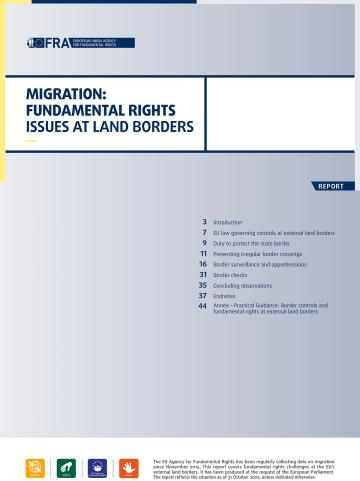
This report looks at fundamental rights compliance at the European Union (EU)’s external land borders, including rivers and lakes. On 30 January 2020, the European Parliament requested the EU Agency for Fundamental Rights (FRA) to prepare a report on these borders. It noted that the report should focus on the correct application of the safeguards in the European asylum acquis and the provisions of the Schengen Borders Code (Regulation (EU) 2016/399).
This report outlines some of the measures EU Member States have put in place to protect public health as Europe faces the ‘second wave’ of the Coronavirus pandemic. It highlights how these may affect fundamental rights, especially social rights.
The EU Agency for Fundamental Rights has been regularly collecting data on asylum and migration since September 2015. This report focuses on the fundamental rights situation of people arriving in Member States and EU candidate countries particularly affected by migration. It addresses fundamental rights concerns between 1 July and 30 September 2020.
Business activity affects not just customers, employees, and contractors along supply chains, but often entire communities and the environment. This makes it vital that every business complies with human rights. This comparative report looks at the realities victims face when they seek redress for business-related human rights abuses. It presents the findings of fieldwork research on the views of professionals regarding the different ways people can pursue complaints. The findings highlight that obstacles to achieving justice are often multi-layered.
Often living in substandard and overcrowded housing conditions, Roma and Travellers face an increased risk of contracting COVID-19. They are also disproportionately affected by measures taken to contain the virus. This FRA Bulletin takes a closer look at this reality in 15 EU Member States, focusing on education; employment; poverty; healthcare; housing; and anti-Gypsyism. It also outlines civil society efforts to tackle the diverse challenges triggered by the Coronavirus pandemic.
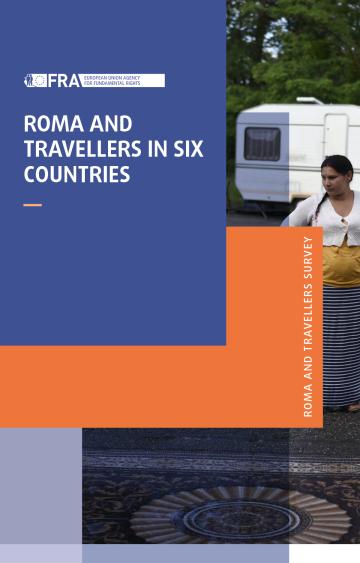
This report presents findings from FRA’s 2019 survey on Roma and Travellers in Belgium, France, Ireland, the Netherlands, Sweden and the United Kingdom. The survey included interviews with almost 4,700 Roma and Travellers, collecting information on more than 8,200 individuals living in their households.
National Human Rights Institutions (NHRIs) are a vital part of the country-level human rights protection system. This report, published 10 years after FRA’s first in-depth study on NHRIs, looks at such bodies in the EU, as well as the Republic of North Macedonia, the Republic of Serbia, and the United Kingdom of Great Britain and Northern Ireland. It explores relevant developments, challenges to their effectiveness and ways to maximise their impact.
As we enter the second half of 2020, the constraints on our daily lives brought about by the Coronavirus pandemic have become a firm reality. New local lockdowns and the reintroduction of restrictive measures prompted by fresh outbreaks of the virus are a stark reminder that COVID-19 continues to shape our lives – and our enjoyment of fundamental rights – in profound ways. There is compelling evidence of how the pandemic has exacerbated existing challenges in our societies. This FRA Bulletin outlines some of the measures EU Member States adopted to safely reopen their societies and economies while continuing to mitigate the spread of COVID-19. It highlights the impact these measures may have on civil, political and socioeconomic rights.
This paper presents key findings from FRA’s second consultation of its Fundamental Rights Platform, focusing on the experiences of civil society organisations (CSOs) working on human rights. FRA started an annual consultation with organisations participating in its platform in 2018.
The EU Agency for Fundamental Rights has been regularly collecting data on asylum and migration since September 2015. This report focuses on the fundamental rights situation of people arriving in Member States and EU candidate countries particularly affected by migration. It addresses fundamental rights concerns between 1 April and 30 June 2020.
This practical guidance addresses border-management staff in European Union (EU) Member States who work at the operational level. It aims to support them in implementing the fundamental rights safeguards of the Schengen Borders Code (Regulation (EU) No. 2016/399) and related EU law instruments in their daily work, when carrying out controls at external land borders.
Les présentes orientations sont destinées aux agents chargés de la gestion des frontières au sein des États membres de l’Union européenne (UE) qui travaillent au niveau opérationnel. Elles visent à les aider à mettre en oeuvre, dans leurs activités quotidiennes, les garanties relatives aux droits fondamentaux du code frontières Schengen [règlement (UE) 2016/399] et le droit de l’Union correspondant.