Since September 2020, three National Human Rights Institutions (NHRIs) had a change in their accreditation status, two new institutions were created and nine have had a change in tasks covered by their mandates. Following up on the September 2020 report “Strong and effective national human rights institutions – challenges, promising practices and opportunities”, this update provides an overview of developments in the accreditation status and mandates of NHRIS in the past 12 months. The update covers the 27 EU Member States as well as three additional states within FRA’s mandate (Albania, North Macedonia and Serbia).
The EU Agency for Fundamental Rights has been regularly collecting data on asylum and migration since September 2015. This report focuses on the fundamental rights situation of people arriving in Member States and EU candidate countries particularly affected by migration. It addresses fundamental rights concerns between 1 January and 30 June 2021.
Civil society organisations play a vital role in promoting fundamental rights, but they face diverse challenges across the European Union. This report presents FRA’s findings on a range of such challenges. The findings are based on research, and on two online consultations with civil society organisations, carried out in 2020.
Les organisations de la société civile jouent un rôle essentiel dans la promotion des droits fondamentaux, mais sont confrontées à diverses problématiques dans l’Union européenne. Ce rapport présente les conclusions de la FRA concernant quelques-unes de ces problématiques, conclusions qui se fondent sur des recherches ainsi que sur deux consultations en ligne auprès d’organisations de la société civile, menées en 2020.
This note sets out human rights standards stemming from both the European Convention on Human Rights and European Union (EU) law that apply to effective remedies for human rights violations at borders, together with those on complaints mechanisms and investigations into complaints of rights violations at borders.
La présente note passe en revue les normes relatives aux droits de l'homme qui découlent de la Convention européenne des droits de l'homme et du droit de l’Union européenne (UE) et qui régissent les recours effectifs contre les violations des droits de l'homme aux frontières, les mécanismes de plainte et les enquêtes sur les plaintes concernant des violations des droits aux frontières.
Τα εγκλήματα μίσους που υποκινούνται από τον ρατσισμό, την ξενοφοβία, τη θρησκευτική μισαλλοδοξία ή την αναπηρία ενός ατόμου, τον γενετήσιο προσανατολισμό, την ταυτότητα φύλου, την έκφραση φύλου και τα χαρακτηριστικά του φύλου αποτελούν σοβαρές εκφράσεις διακρίσεων. Εκτός από την παραβίαση των δικαιωμάτων των μεμονωμένων θυμάτων, ένα τέτοιο έγκλημα αποδυναμώνει την κοινωνική συνοχή και βλάπτει το κοινωνικό σύνολο.
This report examines why victims do not report bias-motivated incidents and the barriers that they face when reporting incidents through national crime reporting systems. By mapping existing practices that have a bearing on the victim’s experiences when reporting bias-motivated violence and harassment, it aims to provide evidence to support national efforts to encourage and facilitate reporting – and ultimately assist Member States in delivering on their duties with regard to combating hate crime.
La presente relazione esamina i motivi per cui le vittime non denunciano gli episodi motivati da pregiudizi e le barriere che incontrano quando denunciano gli episodi attraverso i sistemi nazionali di denuncia dei reati. Mappando le prassi esistenti che hanno un impatto sulle esperienze delle vittime quando denunciano la violenza e le molestie motivate da pregiudizi, si vuole fornire prove a sostegno degli sforzi nazionali per incoraggiare e facilitare la denuncia — e in definitiva aiutare gli Stati membri ad adempiere ai loro obblighi in materia di lotta contro i reati d’odio.
The Employers Sanctions Directive was primarily enacted to dissuade employers from recruiting migrants in an irregular situation, but it also contains provisions to protect workers. It facilitates access to justice for exploited workers and sets out workers’ rights to claim back payment of outstanding wages. The directive also contains provisions to enhance the effectiveness of labour inspections. This report describes how the 25 Member States bound by the directive have been implementing its protective provisions, focusing on the impact these provisions have on migrant workers in an irregular situation who are victims of exploitation and other labour
law violations.
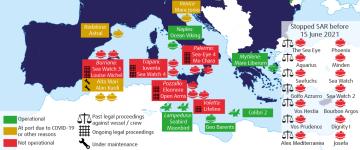
The International Organization for Migration estimates that about 813 people died or went missing crossing the Mediterranean Sea to reach Europe to escape war, persecution or to pursue a better life in 2021, up to 15 June. This is an average of almost five people per day. The EU Agency for Fundamental Rights (FRA) collects data on NGO ships involved in search and rescue in the Mediterranean, legal proceedings against them, as well as difficulties in disembarking migrants in safe ports.
This Coronavirus Bulletin focuses on equitable access to vaccines. It outlines the situation in the 27 EU Member States from 1 March to 30 April 2021. The bulletin looks at two main areas: planning and prioritisation in deploying Covid-19 vaccinations and their rollout in the countries. It covers information and communication campaigns, as well as (pre)registration channels for and the administration of vaccinations.
Il 2020 è stato caratterizzato sia da progressi
sia da battute d’arresto in termini di tutela dei
diritti fondamentali. La Relazione sui diritti
fondamentali 2021 dell’Agenzia dell’Unione
europea per i diritti fondamentali (FRA) fa il punto
della situazione sui principali sviluppi in materia,
individuando i risultati ottenuti e i settori che destano
ancora preoccupazione.
2020 m. pagrindinių teisių apsaugos srityje padaryta
pažanga, tačiau neišvengta ir nesėkmių. Europos
Sąjungos pagrindinių teisių agentūros (angl. FRA)
2021 m. ataskaitoje apie pagrindinių teisių būklę
apžvelgiami svarbiausi šios srities pokyčiai, taip
pat aptariami laimėjimai ir neišspręsti susirūpinimą
keliantys klausimai.
Pamattiesību aizsardzības jomā 2020. gadā bija
vērojami gan sasniegumi, gan neveiksmes. FRA
2021. gada ziņojumā par pamattiesībām aplūkoti
galvenie jaunumi pamattiesību jomā, nosakot gan
sasniegumus, gan jomas, kas aizvien rada bažas.
Is-sena 2020 ġabet magħha kemm progress kif
ukoll ostakli f’termini ta’ protezzjoni tad-drittijiet
fundamentali. Ir-Rapport dwar id-Drittijiet
Fundamentali 2021 tal-FRA jirrieżamina l-iżviluppi
ewlenin fil-qasam, filwaqt li jidentifika kemm ilkisbiet
kif ukoll l-oqsma ta’ tħassib li fadal.
Het jaar 2020 kende zowel vooruitgang als
teleurstellingen bij de bescherming van grondrechten.
In het Verslag over de grondrechten 2021 van het
FRA worden de belangrijkste ontwikkelingen op het
gebied van de grondrechten geëvalueerd en wordt
niet alleen ingegaan op de behaalde successen,
maar ook gewezen op blijvende punten van zorg.
Rok 2020 przyniósł zarówno postęp, jak i regres
pod względem ochrony praw podstawowych.
Sprawozdanie FRA na temat praw podstawowych
z 2021 r. zawiera przegląd najważniejszych zmian,
jakie miały miejsce w tym obszarze, wskazując
zarówno na osiągnięcia, jak i kwestie, które nadal
wymagają stosownych działań.
O ano de 2020 trouxe avanços e retrocessos no âmbito
da proteção dos direitos fundamentais. O Relatório
sobre os Direitos Fundamentais 2021 da FRA analisa
os principais desenvolvimentos neste domínio,
identificando tanto as realizações quanto os problemas
que persistem.
Anul 2020 a adus atât progrese, cât și pași înapoi în
ceea ce privește protecția drepturilor fundamentale.
Documentul FRA Fundamental Rights Report 2021
(Raportul privind drepturile fundamentale 2021)
analizează evoluțiile majore din domeniu, reliefând
atât realizările, cât și problemele îngrijorătoare rămase
nesoluționate.