This Opinion by the European Union Agency for Fundamental Rights (FRA) aims to inform the European Parliament position concerning legislative proposals on interoperability between EU information technology systems (IT systems) presented on 12 December 2017 and currently discussed by the EU legislators.
This report outlines the fundamental rights implications of collecting, storing and using
biometric and other data in EU IT systems in the area of asylum and migration.
European non-discrimination law, as constituted in particular by the EU non-discrimination directives, and Article 14 of and Protocol 12 to the European Convention on Human Rights, prohibits discrimination across a range of contexts and grounds. This handbook examines European non-discrimination law stemming from these two sources as complementary systems, drawing on them interchangeably to the extent that they overlap, while highlighting differences where these exist.
Civil society organisations in the European Union play a crucial role in promoting fundamental rights, but it has become harder for them to do so – due to both legal and practical restrictions. This report looks at the different types and patterns of challenges faced by civil society organisations working on human rights in the EU.
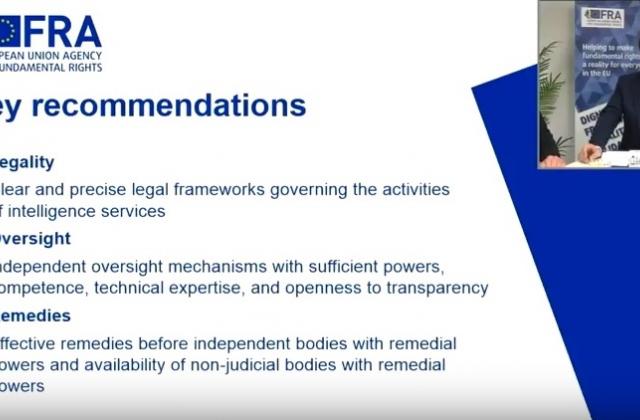
Mario Oetheimer presented FRA’s second surveillance report to the European Parliament’s Civil Liberties, Justice and Home Affairs (LIBE) Committee on 21 November in Brussels.
This is the recording of the online press briefing about mass surveillance as presented by the EU Agency for Fundamental Rights (FRA) on 16 October 2017.
FRA’s Second European Union Minorities and Discrimination Survey surveys around 26,000 individuals from different ethnic minority and immigrant backgrounds across all 28 EU Member States. This technical report presents a detailed overview of the research methods used by FRA when collecting the survey data.
This report is FRA’s second publication addressing a European Parliament request for in-depth research on the impact of surveillance on fundamental rights. It updates FRA’s 2015 legal analysis on the topic, and supplements that analysis with field-based insights gained from extensive interviews with diverse experts in intelligence and related fields, including its oversight.
In 2006 the EU issued its Data Retention Directive. According to the Directive, EU Member States had to store electronic telecommunications data for at least six months and at most 24 months for investigating, detecting and prosecuting serious crime. In 2016, with an EU legal framework on data retention still lacking, the CJEU further clarified what safeguards are required for data retention to be lawful.This paper looks at amendments to national data retention laws in 2016 after the Digital Rights Ireland judgment.
The European Parliament requested this FRA Opinion on the fundamental rights and personal data protection implications of the proposed Regulation for the creation of a European Travel Information and Authorisation System (ETIAS), including an assessment of the fundamental rights aspects of the access
by law enforcement authorities and Europol.
Various proposals on EU-level information systems in the areas of borders and security mention interoperability, aiming to provide fast and easy access to information about third-country nationals.
Up to one third of migrants arriving in the European Union since the summer of 2015 have been children. The current emphasis on speedier asylum processing and making returns more effective may trigger increased use of immigration detention, possibly also affecting children. The detention of children implicates various fundamental rights and will only be in line with EU law if limited to exceptional cases. This report aims to support practitioners in implementing relevant polices in line with applicable law by outlining available safeguards against unlawful and arbitrary detention and highlighting promising practices.
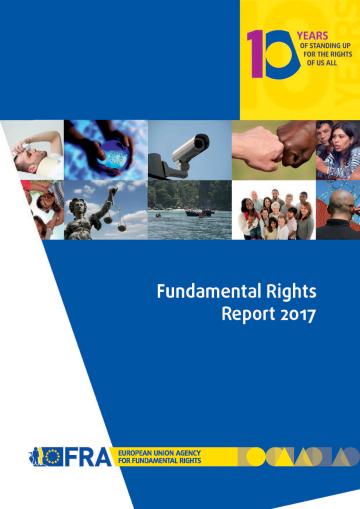
L’année 2017 marque les 10 ans de la création de l’Agence des droits fondamentaux de l’Union européenne. Cet anniversaire offre l’occasion d’examiner à la fois les progrès réalisés en matière de droits fondamentaux et les lacunes persistantes, ainsi que les mesures à prendre pour y répondre.
Diverse efforts at both EU and national levels sought to bolster fundamental rights protection in 2016, while some measures threatened to undermine such protection.
Différents efforts déployés aux niveaux national et de l’Union européenne (UE) visaient à promouvoir la protection des droits fondamentaux en 2016, tandis que certaines mesures risquaient de compromettre cette protection.
Diverse efforts at both EU and national levels sought to bolster fundamental rights protection in 2016, while some measures threatened to undermine such protection.
This year marks the 10th anniversary of the EU Agency for Fundamental Rights. Such a milestone offers an opportunity for reflection – both on the progress that provides cause for celebration and on the lingering shortcomings that must be addressed.
Around 2.5 million children participate in judicial proceedings across the European Union (EU) every year, affected by parental divorce or as victims of, or witnesses to, crime. Although their effective participation in such proceedings is vital for improving the operation of justice, the treatment of children in justice systems remains a concern. FRA investigated to what extent children’s rights to be heard, to be informed, to be protected, and to non-discrimination are fulfilled in practice.
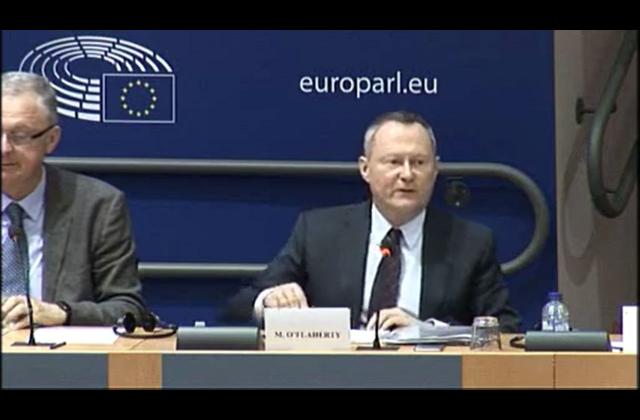
The Agency’s Director, Michael O’Flaherty, took part in a meeting of the European Parliament’s Committee on Civil Liberties, Justice and Home Affairs (LIBE) on 9 February.