Business activity affects not just customers, employees, and contractors along supply chains, but often entire communities and the environment. This makes it vital that every business complies with human rights. This comparative report looks at the realities victims face when they seek redress for business-related human rights abuses. It presents the findings of fieldwork research on the views of professionals regarding the different ways people can pursue complaints. The findings highlight that obstacles to achieving justice are often multi-layered.
Often living in substandard and overcrowded housing conditions, Roma and Travellers face an increased risk of contracting COVID-19. They are also disproportionately affected by measures taken to contain the virus. This FRA Bulletin takes a closer look at this reality in 15 EU Member States, focusing on education; employment; poverty; healthcare; housing; and anti-Gypsyism. It also outlines civil society efforts to tackle the diverse challenges triggered by the Coronavirus pandemic.
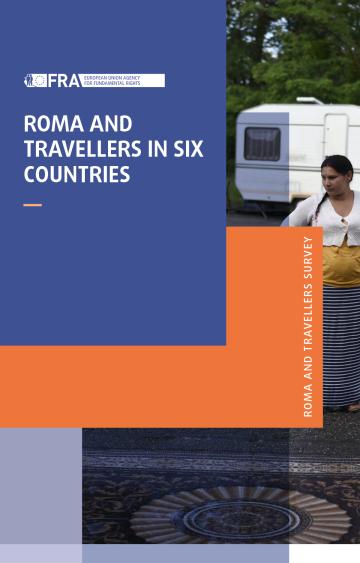
This report presents findings from FRA’s 2019 survey on Roma and Travellers in Belgium, France, Ireland, the Netherlands, Sweden and the United Kingdom. The survey included interviews with almost 4,700 Roma and Travellers, collecting information on more than 8,200 individuals living in their households.
National Human Rights Institutions (NHRIs) are a vital part of the country-level human rights protection system. This report, published 10 years after FRA’s first in-depth study on NHRIs, looks at such bodies in the EU, as well as the Republic of North Macedonia, the Republic of Serbia, and the United Kingdom of Great Britain and Northern Ireland. It explores relevant developments, challenges to their effectiveness and ways to maximise their impact.
As we enter the second half of 2020, the constraints on our daily lives brought about by the Coronavirus pandemic have become a firm reality. New local lockdowns and the reintroduction of restrictive measures prompted by fresh outbreaks of the virus are a stark reminder that COVID-19 continues to shape our lives – and our enjoyment of fundamental rights – in profound ways. There is compelling evidence of how the pandemic has exacerbated existing challenges in our societies. This FRA Bulletin outlines some of the measures EU Member States adopted to safely reopen their societies and economies while continuing to mitigate the spread of COVID-19. It highlights the impact these measures may have on civil, political and socioeconomic rights.
This paper presents key findings from FRA’s second consultation of its Fundamental Rights Platform, focusing on the experiences of civil society organisations (CSOs) working on human rights. FRA started an annual consultation with organisations participating in its platform in 2018.
The EU Agency for Fundamental Rights has been regularly collecting data on asylum and migration since September 2015. This report focuses on the fundamental rights situation of people arriving in Member States and EU candidate countries particularly affected by migration. It addresses fundamental rights concerns between 1 April and 30 June 2020.
This practical guidance addresses border-management staff in European Union (EU) Member States who work at the operational level. It aims to support them in implementing the fundamental rights safeguards of the Schengen Borders Code (Regulation (EU) No. 2016/399) and related EU law instruments in their daily work, when carrying out controls at external land borders.
Les présentes orientations sont destinées aux agents chargés de la gestion des frontières au sein des États membres de l’Union européenne (UE) qui travaillent au niveau opérationnel. Elles visent à les aider à mettre en oeuvre, dans leurs activités quotidiennes, les garanties relatives aux droits fondamentaux du code frontières Schengen [règlement (UE) 2016/399] et le droit de l’Union correspondant.
This paper presents people’s concerns and experiences relating to security. It covers worry about crime, including terrorism and online fraud; experience of online fraud; experience of cyberharassment; and concern about illegal access to data.
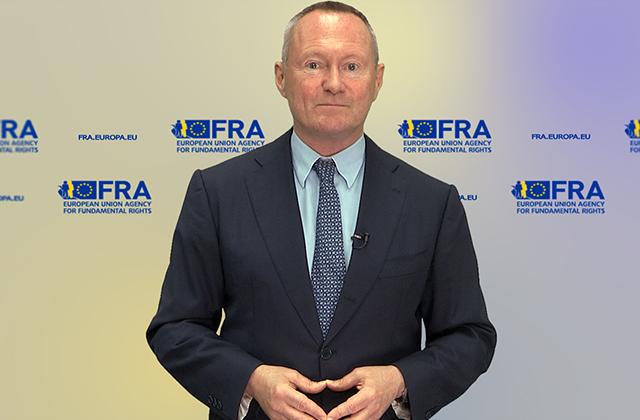
What are the next steps in the digitalisation of justice and of access to justice? This impulse video statement by FRA Director Michael O’Flaherty was recorded for the online conference “Access to Justice in the Digital Age”. The conference takes place on 16 July and is organised by the German Federal Ministry for Justice and Consumer Protection during the German Council Presidency.
The Coronavirus pandemic continues to interrupt everyday life in the EU in unprecedented ways. But the way it affects our societies is shifting. As governments gradually lift some of the measures put in place to contain the spread of COVID-19, new fundamental rights concerns arise: how to ensure that the rights to life and health are upheld as daily life transitions to a ‘new normal’. This Bulletin looks at declarations of states of emergency, or equivalent, and how they came under scrutiny. It considers
the impact on fundamental rights in important areas of daily life, and includes a thematic focus on the pandemic's impact on older people.
FRA’s Fundamental Rights Survey collected data from 35,000 people about their experiences, perceptions and opinions on a range of issues that are variously encompassed by human rights. This report presents a small selection of the survey results. It focuses on findings with respect to respondents’ opinions about human – or fundamental rights; their views and perceptions on the functioning of democratic societies – as a pillar on which human rights can flourish; and on their thoughts on and engagement with public services that have a duty to enforce human rights law and to protect people’s rights.
This document presents data from the FRA Fundamental Rights Survey. It includes data on opinions and experiences of people in the European Union (EU) linked to data protection and technology.
This focus takes a closer look at the application of the Charter of Fundamental Rights of the European Union, which has been legally binding for 10 years. At EU level, it has gained visibility and sparked a new fundamental rights culture. At national level, awareness and use of the Charter are limited. Courts increasingly use the Charter, showing the impact of this modern instrument. But its use by governments and parliaments remains low. For instance, there is little indication of anyone regularly scrutinising national legislation that transposes EU law for compatibility with the Charter.
The year 2019 brought both progress and setbacks in terms of fundamental rights protection. FRA’s Fundamental Rights Report 2020 reviews major developments in the field, identifying both achievements and remaining areas of concern. This publication presents FRA’s opinions on the main developments in the thematic areas covered, and a synopsis of the evidence supporting these opinions. In so doing, it provides a compact but informative overview of the main fundamental rights challenges confronting the EU and its Member States.
L’année 2019 a été marquée à la fois par des avancées et des régressions en matière de protection des droits fondamentaux. Le Rapport sur les droits fondamentaux 2020 de la FRA examine les principales évolutions dans ce domaine, en recensant les progrès accomplis et les sujets de préoccupation persistants. La présente publication expose les avis de la FRA sur les principales évolutions dans les domaines thématiques couverts ainsi qu’un résumé des éléments factuels qui étayent ces avis. Elle fournit ainsi une vue d’ensemble concise mais instructive des principaux défis en matière de droits fondamentaux auxquels l’Union européenne (UE) et ses États membres doivent faire face.
Bhí idir dul chun cinn agus dul ar gcúl le tabhairt faoi
deara i ndáil le cosaint na gceart bunúsach in 2019.
Déantar athbhreithniú i dTuarascáil um Chearta
Bunúsacha 2020 FRA ar mhórfhorbairtí san earnáil,
agus tarraingítear aird ar éachtaí agus ar réimsí ar
ábhair imní iad go fóill. San fhoilseachán seo cuirtear
i láthair tuairimí FRA maidir leis na príomhfhorbairtí
sna réimsí téamacha atá curtha san áireamh, mar aon
le hachoimre ar an bhfianaise atá ag tacú leis na
tuairimí seo. Ar an gcaoi sin, soláthraítear
forbhreathnú gairid, ach faisnéiseach, ar na
príomhdhúshláin i dtaca le cearta bunúsacha atá os
comhair an AE agus a Bhallstáit.
FRA’s Fundamental Rights Report 2020 reviews major developments in the field in 2019, identifying both achievements and areas of concern. It also presents FRA’s opinions on these developments, including a synopsis of the evidence supporting these opinions. This year’s focus chapter explores how to unlock the full potential of the EU Charter of Fundamental Rights.
The Coronavirus pandemic continues to interrupt everyday life in the EU in unprecedented ways. But the way it affects our societies is shifting. As governments gradually lift some of the measures put in place to contain the spread of COVID-19, new fundamental rights concerns arise: how to ensure that the rights to life and health are upheld as daily life transitions to a ‘new normal’. This Bulletin looks at declarations of states of emergency, or equivalent, and how they came under scrutiny. It considers the impact on fundamental rights in important areas of daily life, and includes a thematic focus on the processing of users’ data to help contain COVID-19, particularly by contact-tracing apps. It covers the period 21 March – 30 April 2020.