This Opinion aims to
inform the European Parliament’s position on the legislative proposal amending the
Visa Information System, the Visa Code and other related provisions of EU law. The
European Commission presented the proposal on 16 May 2018 and EU legislators are
currently discussing it.
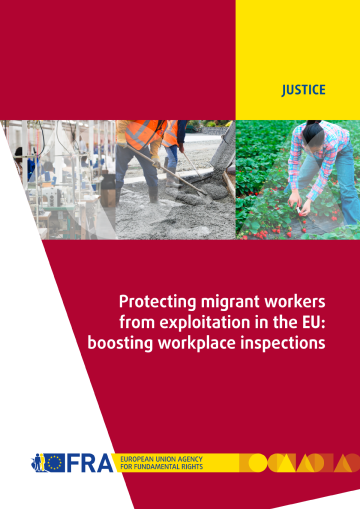
Severe labour exploitation is widespread across the European Union. While workplace inspections can help counter this phenomenon, they need to be strengthened to do so effectively. Based on interviews and focus group discussions with almost 240 exploited workers active in diverse economic sectors, this report provides important evidence on how unscrupulous employers manipulate and undermine inspections, and on what can be done to counteract such efforts.
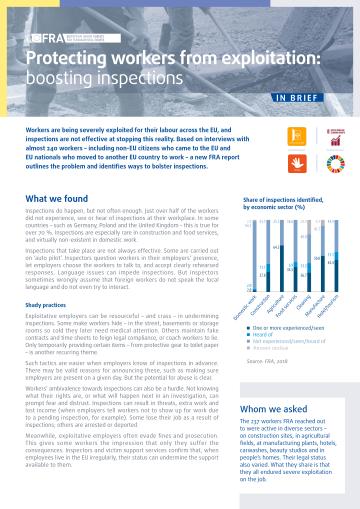
Workers are being severely exploited for their labour across the EU, and
inspections are not effective at stopping this reality. Based on interviews with
almost 240 workers – including non-EU citizens who came to the EU and
EU nationals who moved to another EU country to work – a new FRA report
outlines the problem and identifies ways to bolster inspections.
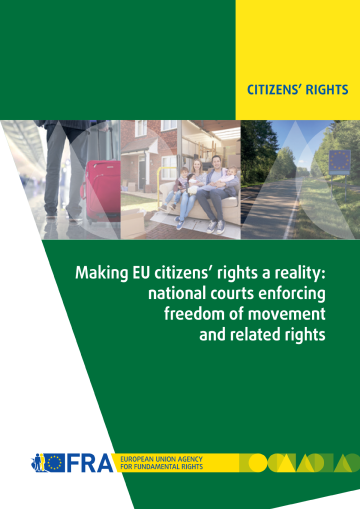
The founding treaties, the EU Charter of Fundamental Rights and secondary EU law all provide for EU citizens’ freedom to move and reside freely in any EU country of their choice. Growing numbers of citizens, and their family members, are making use of this freedom and related rights, such as the right not to be discriminated against based on nationality and the right to vote in certain elections in the host Member State. But making these rights a reality remains a challenge. This report presents an EU-wide, comparative overview of the application of the Free Movement Directive (2004/38/EC) across the 28 Member States based on a review of select case law at national level.
The EU Agency for Fundamental Rights has been collecting relevant data since September 2015, in light of the increasing numbers of refugees, asylum seekers and migrants entering the EU. This report focuses on the fundamental rights situation of people arriving in Member States particularly affected by large migration movements. The countries covered are: Austria, Bulgaria, Croatia, Denmark, Finland, France, Germany, Greece, Hungary, Italy, the Netherlands, Poland, Spain and Sweden.
Across the European Union, Member States are faced with the challenge of integrating Europe’s most deprived
and disenfranchised minority groups. As a follow up to the EU-MIDIS II findings on Roma, this report presents
FRA’s findings relating to the issues of education and employment. Encouraging Roma participation in education
and employment equips communities with higher incomes, better life opportunities and greater social inclusion.
The EU Return Directive (2008/115/EC) in Article 8 (6) introduced an important fundamental rights safeguard for third-country nationals ordered to leave the EU because they do not or no longer fulfil the conditions for entry and/or stay. According to the Directive, Member States must provide for an effective forced-return monitoring system.
Across the European Union, people face hatred because of their skin colour, ethnicity, religion, gender or sexuality. In response, the EU and its Member States have introduced laws against hate crime and support services for victims. But these will only fulfil their potential if victims report hate-motivated harassment and violence to the police, and if police officers record such incidents as hate crimes. This report provides rich and detailed information on hate crime recording and data collection systems across the EU, including any systemic cooperation with civil society.
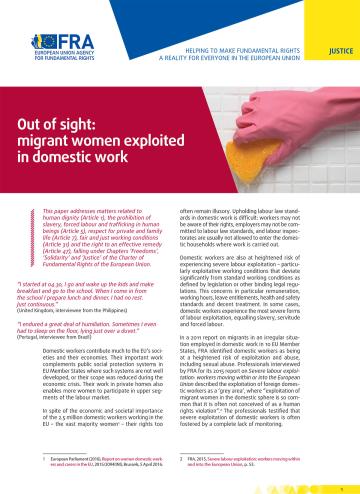
The stories of the domestic workers FRA interviewed for this paper reveal appalling working conditions and fundamental rights abuses in private homes across the EU. These stories indicate that, seven years on from FRA’s first report on domestic workers in 2011, little has changed in terms of the risks and experiences of severe labour exploitation domestic workers in the EU face.
In the latest edition of his video blog, FRA Director Michael O'Flaherty focuses on the importance of shifting perceptions towards a rights-based approach to ageing.
The Consolidated Annual Activity Report (CAAR) 2017
provides an overview of the activities and achievements
of the European Union Agency for Fundamental
Rights (FRA) in that year. It follows the guidelines of
the European Union (EU) Agencies Network.
European societies are not getting any younger! It is a simple truth we must face both about ourselves and Europe as a whole. In two generations, by 2080, those aged 65 or above will account for almost 30% of the European Union’s population.
The year 2017 brought both progress and setbacks in terms of rights protection. The European Pillar of Social Rights marked an important move towards a more ‘social Europe’. But, as experiences with the EU Charter of Fundamental Rights underscore, agreement on a text is merely a first step. Even in its eighth year as the EU's binding bill of rights, the Charter's potential was not fully exploited, highlighting the need to more actively promote its use.
The year 2017 brought both progress and setbacks in terms of fundamental rights protection. FRA’s Fundamental Rights Report 2018 reviews major developments in the field, identifying both achievements and remaining areas of concern.
We live in a world of big data, where technological developments in the area of machine learning and artificial intelligence have changed the way we live. Decisions and processes concerning everyday life are increasingly automated, based on data. This affects fundamental rights in various ways. This focus paper specifically deals with discrimination, a fundamental rights area particularly affected by technological developments.
EU Member States, and the EU itself have ratified
the CRPD, committing themselves to achieving independent
living for persons with disabilities. Doing so
requires a meaningful and sustainable shift from institutional
to community-based living arrangements. This
publication summarises the findings from the three
FRA reports focusing on different aspects of deinstitutionalisation.
In view of the increasing numbers of refugees, asylum seekers and migrants entering the EU, the EU Agency for Fundamental Rights has been collecting relevant data since September 2015. This report focuses on the fundamental rights situation of people arriving in Member States particularly affected by large migration movements. This report addresses fundamental rights concerns between 1 March-30 April 2018.
The rapid development of information technology has exacerbated the need for robust personal data protection, the right to which is safeguarded by both European Union (EU) and Council of Europe (CoE) instruments. Safeguarding this important right entails new and significant challenges as technological advances expand the frontiers of areas such as surveillance, communication interception and data storage. This handbook is designed to familiarise legal practitioners not specialised in data protection with this emerging area of the law.
Civil society organisations in the European Union play a crucial role in promoting fundamental
rights, but it has become harder for them do so – due to both legal and practical restrictions.
This summary outlines the main
findings and FRA’s opinions on the different
types and patterns of challenges faced by civil society
organisations across the EU,