EU Member States, and the EU itself have ratified
the CRPD, committing themselves to achieving independent
living for persons with disabilities. Doing so
requires a meaningful and sustainable shift from institutional
to community-based living arrangements. This
publication summarises the findings from the three
FRA reports focusing on different aspects of deinstitutionalisation.
The rapid development of information technology has exacerbated the need for robust personal data protection, the right to which is safeguarded by both European Union (EU) and Council of Europe (CoE) instruments. Safeguarding this important right entails new and significant challenges as technological advances expand the frontiers of areas such as surveillance, communication interception and data storage. This handbook is designed to familiarise legal practitioners not specialised in data protection with this emerging area of the law.
Civil society organisations in the European Union play a crucial role in promoting fundamental
rights, but it has become harder for them do so – due to both legal and practical restrictions.
This summary outlines the main
findings and FRA’s opinions on the different
types and patterns of challenges faced by civil society
organisations across the EU,
With terrorism, cyber-attacks and sophisticated cross-border criminal networks posing growing threats, the work of intelligence services has become more urgent, complex and international. Such work can strongly interfere with fundamental rights, especially privacy and data protection. While continuous technological advances potentially exacerbate the threat of such interference, effective oversight and remedies can curb the potential for abuse.
The methods used to determine the age of
an applicant may include “invasive” medical tests which interfere with the rights of the child, including their right to dignity,
integrity and privacy. It is often a challenge to find the right balance between protecting children from harm and promoting
their participation in these procedures. This report provides important insights and identifies the implications of collecting
children’s biometric data and conducting age assessments.
The right to access justice and all other relevant procedural rights are not just rights in themselves; they also protect against violations of every other right. Respect for children’s rights in the area of justice is therefore essential. International treaties, the Charter of Fundamental Rights of the European Union, European Union (EU) secondary law, and national legislation provide a number of relevant rights.
This report outlines the fundamental rights implications of collecting, storing and using
biometric and other data in EU IT systems in the area of asylum and migration.
European non-discrimination law, as constituted in particular by the EU non-discrimination directives, and Article 14 of and Protocol 12 to the European Convention on Human Rights, prohibits discrimination across a range of contexts and grounds. This handbook examines European non-discrimination law stemming from these two sources as complementary systems, drawing on them interchangeably to the extent that they overlap, while highlighting differences where these exist.
Civil society organisations in the European Union play a crucial role in promoting fundamental rights, but it has become harder for them to do so – due to both legal and practical restrictions. This report looks at the different types and patterns of challenges faced by civil society organisations working on human rights in the EU.
Guardians are a key element of a protection system for children who are temporarily or
permanently deprived of their family environment and cannot have their interests represented
by their parents. Great disparities exist between the types of guardianship provided
to children in and within European Union (EU) Member States. This report explores the key
features of guardianship systems put in place to cater for the needs of all children in need
of protection, including child victims and those at risk of becoming victims of trafficking in
human beings or of other forms of exploitation.
This survey involved interviews with 25,515 people with different ethnic minority and immigrant backgrounds across 28 EU countries. It explores issues concerning discrimination as well as experiences of harassment, hate-motivated violence and discriminatory profiling.
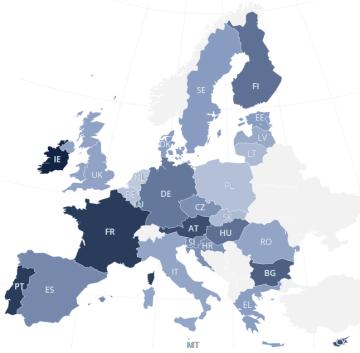
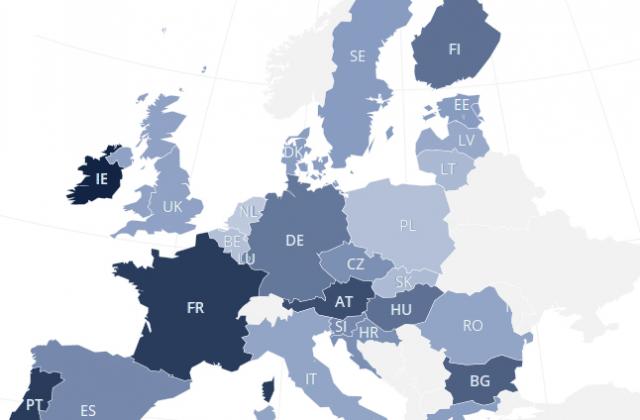
International treaties, the Charter of Fundamental Rights of the European Union, European Union (EU) secondary law and national legislation provide a number of rights to citizens. The maps and tables presented show the various patterns concerning age requirements for children to acquire rights in the EU. They also identify inconsistencies, protection gaps and restrictions deriving from different age thresholds. The reference period was until April 2016. Any legislative developments since then have been included whenever relevant or if known.
This report is FRA’s second publication addressing a European Parliament request for in-depth research on the impact of surveillance on fundamental rights. It updates FRA’s 2015 legal analysis on the topic, and supplements that analysis with field-based insights gained from extensive interviews with diverse experts in intelligence and related fields, including its oversight.
Muslims living in the EU face discrimination in a broad range of settings – and particularly when looking for work, on the job, and when trying to access public or private services. The report examines how characteristics – such as an individual's first and last name, skin colour and the wearing of visible religious symbols like a headscarf, for example – may trigger discriminatory treatment and harassment.
The European Parliament requested this FRA Opinion on the fundamental rights and personal data protection implications of the proposed Regulation for the creation of a European Travel Information and Authorisation System (ETIAS), including an assessment of the fundamental rights aspects of the access
by law enforcement authorities and Europol.
Various proposals on EU-level information systems in the areas of borders and security mention interoperability, aiming to provide fast and easy access to information about third-country nationals.
Up to one third of migrants arriving in the European Union since the summer of 2015 have been children. The current emphasis on speedier asylum processing and making returns more effective may trigger increased use of immigration detention, possibly also affecting children. The detention of children implicates various fundamental rights and will only be in line with EU law if limited to exceptional cases. This report aims to support practitioners in implementing relevant polices in line with applicable law by outlining available safeguards against unlawful and arbitrary detention and highlighting promising practices.
Diverse efforts at both EU and national levels sought to bolster fundamental rights protection in 2016, while some measures threatened to undermine such protection.
Hate crime is the most severe expression of discrimination and a core fundamental rights abuse. The European Union (EU) has demonstrated its resolve to tackle hate crime with legislation such as the 2008 Framework Decision on combating certain forms and expressions of racism and xenophobia by means of criminal law. Nonetheless, the majority of hate crimes perpetrated in the EU remain unreported and therefore invisible, leaving victims without redress.
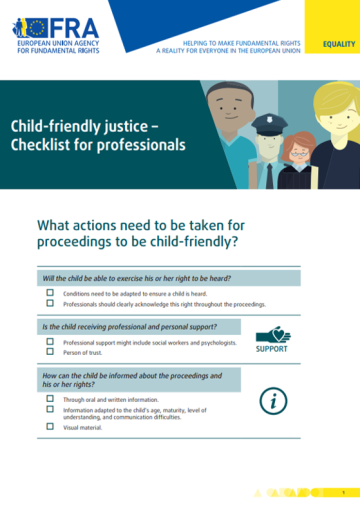
The treatment of children in justice systems remains a concern across the European Union (EU). With this checklist, FRA aims to help professionals by providing a list of actions that need to be taken for judicial proceedings to be child-friendly.