Ta osrednja tema podrobneje obravnava uporabo Listine
Evropske unije o temeljnih pravicah, ki je pravno zavezujoča
že 10 let. Na ravni EU je postala prepoznavnejša, spodbudila
pa je tudi novo kulturo spoštovanja temeljnih pravic. Na
nacionalni ravni sta uporaba Listine in ozaveščenost o njej
omejeni. Na sodiščih se uporaba tega sodobnega instrumenta
povečuje, kar kaže, da ima vpliv, vlade in parlamenti pa ga
še naprej uporabljajo le redko. Tako na primer skoraj nič ne
kaže na to, da kdo redno podrobno preverja, ali je nacionalna
zakonodaja za prenos prava EU skladna z Listino.
Das Jahr 2019 brachte beim Schutz der Grundrechte sowohl Fortschritte als auch Rückschritte. In ihrem Grundrechte-Bericht 2020 untersucht die FRA wichtige Entwicklungen auf diesem Gebiet und zeigt sowohl Erfolge auf als auch Bereiche, in denen es immer noch Probleme gibt. Darüber hinaus formuliert die FRA in dieser Veröffentlichung ihre Stellungnahmen zu den wichtigsten Entwicklungen in den abgedeckten Themenbereichen und gibt einen Überblick über die Informationen, die diesen Stellungnahmen zugrunde liegen. So bietet diese Veröffentlichung einen knappen, aber informativen Überblick über die größten Herausforderungen, mit denen die EU und ihre Mitgliedstaaten im Bereich der Grundrechte konfrontiert sind.
Το 2019 υπήρξε έτος προόδου αλλά και προβλημάτων
όσον αφορά την προστασία των θεμελιωδών
δικαιωμάτων. Στην Έκθεση για τα Θεμελιώδη
Δικαιώματα 2020 του FRA εξετάζονται οι
σημαντικότερες εξελίξεις στον τομέα και
προσδιορίζονται όχι μόνο τα επιτεύγματα, αλλά και
τα ζητήματα που εξακολουθούν να προκαλούν
ανησυχία. Στην παρούσα δημοσίευση
παρουσιάζονται οι γνώμες του FRA σχετικά με τις
κυριότερες εξελίξεις στους εξεταζόμενους θεματικούς
τομείς και συνοπτική τεκμηρίωση των γνωμών
αυτών. Με αυτόν τον τρόπο, παρέχεται μια συνοπτική
και ταυτόχρονα κατατοπιστική επισκόπηση των
βασικών προκλήσεων τις οποίες αντιμετωπίζουν η ΕΕ
και τα κράτη μέλη στον τομέα των θεμελιωδών
δικαιωμάτων.
The year 2019 brought both progress and setbacks in terms of fundamental rights protection. FRA’s Fundamental Rights Report 2020 reviews major developments in the field, identifying both achievements and remaining areas of concern. This publication presents FRA’s opinions on the main developments in the thematic areas covered, and a synopsis of the evidence supporting these opinions. In so doing, it provides a compact but informative overview of the main fundamental rights challenges confronting the EU and its Member States.
En el año 2019 se produjeron tanto avances como
retrocesos en materia de protección de los derechos
fundamentales. El Informe sobre los derechos
fundamentales 2020 de la Agencia de los Derechos
Fundamentales de la Unión Europea (FRA) analiza
los principales acontecimientos en este ámbito,
destacando tanto los progresos realizados como
las dificultades que todavía persisten. La publicación
presenta los dictámenes de la FRA sobre los
principales avances realizados en los ámbitos
temáticos contemplados, así como un resumen
de las pruebas que respaldan tales dictámenes.
Esto permite disponer de una visión de conjunto,
compacta, pero muy ilustrativa, de los principales
desafíos en materia de derechos fundamentales
a los que se enfrentan la UE y sus Estados miembros.
L’année 2019 a été marquée à la fois par des avancées et des régressions en matière de protection des droits fondamentaux. Le Rapport sur les droits fondamentaux 2020 de la FRA examine les principales évolutions dans ce domaine, en recensant les progrès accomplis et les sujets de préoccupation persistants. La présente publication expose les avis de la FRA sur les principales évolutions dans les domaines thématiques couverts ainsi qu’un résumé des éléments factuels qui étayent ces avis. Elle fournit ainsi une vue d’ensemble concise mais instructive des principaux défis en matière de droits fondamentaux auxquels l’Union européenne (UE) et ses États membres doivent faire face.
Bhí idir dul chun cinn agus dul ar gcúl le tabhairt faoi
deara i ndáil le cosaint na gceart bunúsach in 2019.
Déantar athbhreithniú i dTuarascáil um Chearta
Bunúsacha 2020 FRA ar mhórfhorbairtí san earnáil,
agus tarraingítear aird ar éachtaí agus ar réimsí ar
ábhair imní iad go fóill. San fhoilseachán seo cuirtear
i láthair tuairimí FRA maidir leis na príomhfhorbairtí
sna réimsí téamacha atá curtha san áireamh, mar aon
le hachoimre ar an bhfianaise atá ag tacú leis na
tuairimí seo. Ar an gcaoi sin, soláthraítear
forbhreathnú gairid, ach faisnéiseach, ar na
príomhdhúshláin i dtaca le cearta bunúsacha atá os
comhair an AE agus a Bhallstáit.
År 2019 innebar både framgångar och motgångar för
skyddet av de grundläggande rättigheterna. FRA:s
Rapport om grundläggande rättigheter 2020 innehåller
en granskning av de viktigaste händelserna på
området och pekar ut både framsteg och återstående
problemområden. I publikationen presenteras FRA:s
yttranden om den huvudsakliga utvecklingen på de
berörda tematiska områdena, tillsammans med en
översikt över bakgrunden till dessa yttranden. Det ger
en kortfattad men informativ översikt över de
viktigaste utmaningarna för EU och dess
medlemsstater när det gäller grundläggande
rättigheter.
FRA’s Fundamental Rights Report 2020 reviews major developments in the field in 2019, identifying both achievements and areas of concern. It also presents FRA’s opinions on these developments, including a synopsis of the evidence supporting these opinions. This year’s focus chapter explores how to unlock the full potential of the EU Charter of Fundamental Rights.
The Coronavirus pandemic continues to interrupt everyday life in the EU in unprecedented ways. But the way it affects our societies is shifting. As governments gradually lift some of the measures put in place to contain the spread of COVID-19, new fundamental rights concerns arise: how to ensure that the rights to life and health are upheld as daily life transitions to a ‘new normal’. This Bulletin looks at declarations of states of emergency, or equivalent, and how they came under scrutiny. It considers the impact on fundamental rights in important areas of daily life, and includes a thematic focus on the processing of users’ data to help contain COVID-19, particularly by contact-tracing apps. It covers the period 21 March – 30 April 2020.
The EU Agency for Fundamental Rights has been regularly collecting data on migration since September 2015. This report focuses on the fundamental rights situation of people arriving in Member States and EU candidate countries particularly affected by large migration movements. It addresses key fundamental rights concerns between 1 January and 31 March 2020.
In recent years, thousands of girls and boys have reached Europe without their parents, and sought international protection. Many of them experienced violence, abuse and neglect in their home countries, and while in transit. They have the right to be protected in line with the provisions of the UN Convention on the Rights of the Child, the European Convention on Human Rights, and European Union law. This report explores the challenges and good practices gathered in the implementation of such relocation programmes. Based on information FRA collected in 10 EU Member States, it aims to help national authorities to support the relocation of unaccompanied children by taking measures that are fully rights compliant and practically feasible.
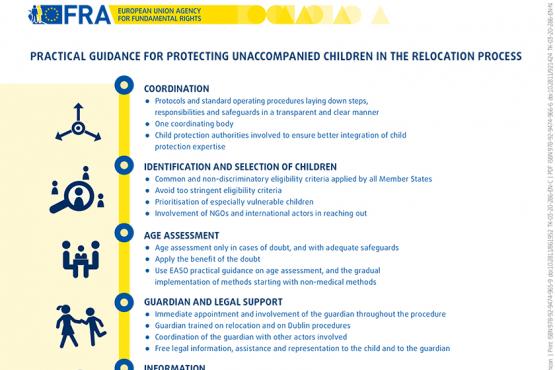
Based on the lessons learned from relocation
experiences and on existing international and EU legal
standards, FRA has developed a number of practical
suggestions for the adjustment of relocation efforts to
the protection needs of unaccompanied children. This
guidance aims to be a practical tool for Member States
that wish to engage in the relocation of unaccompanied
children and in any future responsibility-sharing
mechanisms, and to gain knowledge on how this can
be done while respecting the child’s best interests.
The outbreak of COVID-19 affects people’s daily life in the 27 EU Member States. As the number of infected people in the EU territory began to mount rapidly in February and March, governments put in place a raft of measures – often introduced in a period of only a few days – in an effort to contain the spread of the virus. Many of these measures reflect how, in exceptional emergency situations, the urgent need to save lives justifies restrictions on other rights, such as the freedom of movement and of assembly. This report outlines some of the measures EU Member States have put in place to protect public health during the COVID-19 pandemic. It covers the period 1 February – 20 March 2020.
Children in migration are more vulnerable than adults, particularly when they are unaccompanied. Their vulnerability makes them more exposed to violence, exploitation and trafficking in human beings, as well as physical, psychological and sexual abuse. This report looks into challenges to the fundamental rights of children in migration throughout 2019. It pulls together the main issues identified in FRA’s Quarterly Bulletins on migration in selected EU Member States.
Council of Europe (CoE) and European Union (EU) Member States have an undeniable sovereign right to control the entry of non-nationals into their territory. While exercising border control, states have a duty to protect the fundamental rights of all people under their jurisdiction, regardless of their nationality and/or legal status. Under EU law, this includes providing access to asylum procedures.
Les États membres du Conseil de l’Europe (CdE) et de l’Union européenne (UE) jouissent du droit indéniable de contrôler souverainement l’entrée des étrangers sur leur territoire. Dans l’exercice du contrôle de leurs frontières, les États ont le devoir de protéger les droits fondamentaux de toutes les personnes qui se trouvent sous leur juridiction, indépendamment de leur nationalité et/ou de leur situation juridique. Cela englobe la fourniture d’un accès aux procédures d’asile, conformément au droit de l’UE.
Greece needs solid, sustained support and solidarity as it faces great migration challenges, says FRA Director Michael O’Flaherty after 2 days of meetings in Athens with authorities.
The EU Agency for Fundamental Rights (FRA) urges Member States to agree on a simple and practical workflow as soon as possible, to avoid lack of clarity and delays in the relocation process. This paper provides practical suggestions on relocation of unaccompanied children from Greece, building on lessons learned from previous mandatory and voluntary relocation schemes. The paper provides FRA input on the initiative of the European Commission and a group of Member States to relocate unaccompanied children.
In today’s media landscape the way in which journalists and editors receive, process and publish news is constantly changing. Journalists face immense time pressure, as news frequently breaks online To facilitate training on the coverage of migration news, this Trainer’s Manual is a tool to be used together with the e-Media Toolkit.