The EU Agency for Fundamental Rights has been regularly collecting data on migration since September 2015. This report focuses on the fundamental rights situation of people arriving in Member States and EU candidate countries particularly affected by large migration movements. It addresses key fundamental rights concerns between 1 January and 31 March 2020.
In this vlog Michael O'Flaherty outlines fundamental rights considerations when developing technological responses to public health, as he introduces the focus of FRA's next COVID-19 bulletin.
This report presents select findings from FRA’s 2019 survey on LGBTI people in the EU and North Macedonia and Serbia. With almost 140,000 participants, it is the largest survey of its kind. It follows the agency’s first survey on LGBT people in the EU, conducted in 2012. The new survey results show little progress over the past seven years.
In recent years, thousands of girls and boys have reached Europe without their parents, and sought international protection. Many of them experienced violence, abuse and neglect in their home countries, and while in transit. They have the right to be protected in line with the provisions of the UN Convention on the Rights of the Child, the European Convention on Human Rights, and European Union law. This report explores the challenges and good practices gathered in the implementation of such relocation programmes. Based on information FRA collected in 10 EU Member States, it aims to help national authorities to support the relocation of unaccompanied children by taking measures that are fully rights compliant and practically feasible.
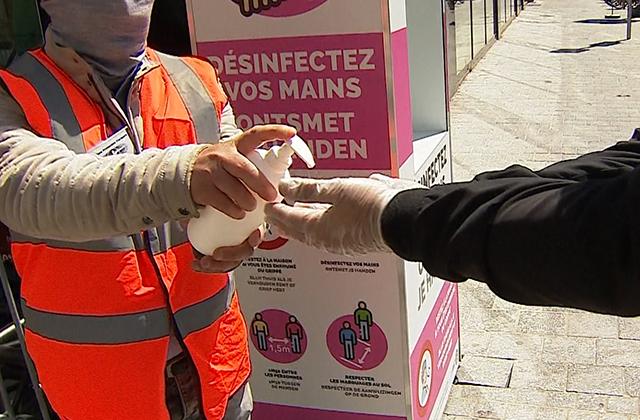
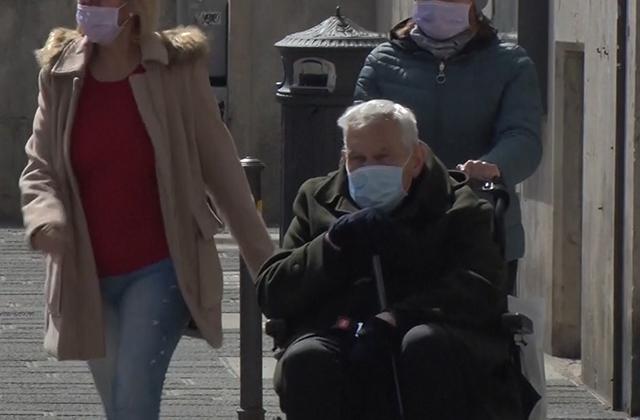
The outbreak of COVID-19 affects people’s daily life in the 27 EU Member States. As the number of infected people in the EU territory began to mount rapidly in February and March, governments put in place a raft of measures – often introduced in a period of only a few days – in an effort to contain the spread of the virus. Many of these measures reflect how, in exceptional emergency situations, the urgent need to save lives justifies restrictions on other rights, such as the freedom of movement and of assembly. This report outlines some of the measures EU Member States have put in place to protect public health during the COVID-19 pandemic. It covers the period 1 February – 20 March 2020.
Council of Europe (CoE) and European Union (EU) Member States have an undeniable sovereign right to control the entry of non-nationals into their territory. While exercising border control, states have a duty to protect the fundamental rights of all people under their jurisdiction, regardless of their nationality and/or legal status. Under EU law, this includes providing access to asylum procedures.
In the latest edition of his video blog, FRA Director Michael O'Flaherty speaks about the importance and power of hope accompanying the work of FRA in 2020. Particularly after a troubled start of the year.
Тази брошура помага на служителите и органите да информират кандидатите за убежище и мигрантите по разбираем и достъпен начин относно обработката на техните пръстови отпечатъци в системата Евродак.
Denne folder hjælper grænsevagter og myndigheder med at informere asylansøgere og immigranter om behandlingen af deres fingeraftryk i Eurodac på en forståelig og lettilgængelig måde.
Το παρόν φυλλάδιο βοηθά τους αρμόδιους υπαλλήλους και τις αρχές να ενημερώνουν με εύκολο και απλό τρόπο τους αιτούντες άσυλο και τους μετανάστες σχετικά με την επεξεργασία των δακτυλικών τους αποτυπωμάτων στο Eurodac.
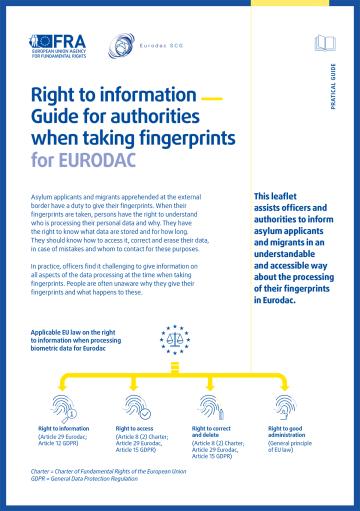
This leaflet assists officers and authorities to inform asylum applicants and migrants in an understandable and accessible way about the processing of their fingerprints in Eurodac.
Tämä esite auttaa virkamiehiä ja viranomaisia kertomaan turvapaikanhakijoille ja maahanmuuttajille ymmärrettävällä ja helposti saavutettavalla tavalla sormenjälkien käsittelystä Eurodacissa.
Ez a szóróanyag támogatja a hatóságok dolgozóit abban, hogy közérthető és hozzáférhető módon tudják tájékoztatni a bevándorlókat és menedékkérőket az ujjlenyomataik Eurodac általi feldolgozásáról.
Deze folder is bedoeld om ambtenaren en autoriteiten te helpen om asielzoekers en migranten op een begrijpelijke manier uit te leggen hoe hun vingerafdrukken in Eurodac worden verwerkt.
Tento leták má pomôcť úradníkom a inštitúciám v zrozumiteľnej a dostupnej forme informovať žiadateľov o azyl a migrantov o spracúvaní ich odtlačkov prstov v Eurodacu.
In the latest edition of his video blog, FRA Director Michael O'Flaherty speaks about the human rights challenges, but also the opportunities, that come along with the development of artificial intelligence technology.
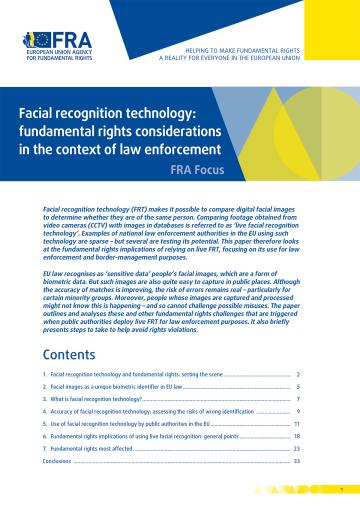
Facial recognition technology (FRT) makes it possible to compare digital facial images to determine whether they are of the same person. Comparing footage obtained from video cameras (CCTV) with images in databases is referred to as ‘live facial recognition technology’. Examples of national law enforcement authorities in the EU using such technology are sparse – but several are testing its potential. This paper therefore looks at the fundamental rights implications of relying on live FRT, focusing on its use for law enforcement and border-management purposes.
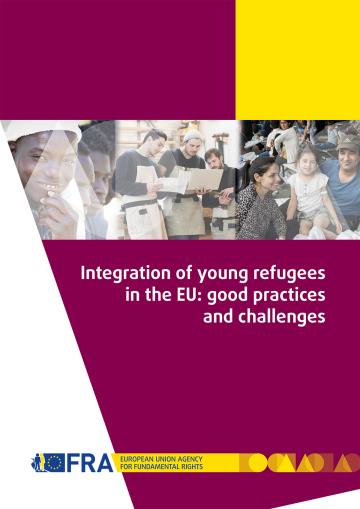
Over 2.5 million people applied for international protection in the 28 EU Member States in 2015 and 2016. Many of those who were granted some form of protection are young people, who are likely to stay and settle in the EU. The EU Agency for Fundamental Rights interviewed some of them, as well as professionals working with them in 15 locations across six EU Member States: Austria, France, Germany, Greece, Italy and Sweden. This report presents the result of FRA’s fieldwork research, focusing on young people between the
ages of 16 and 24.
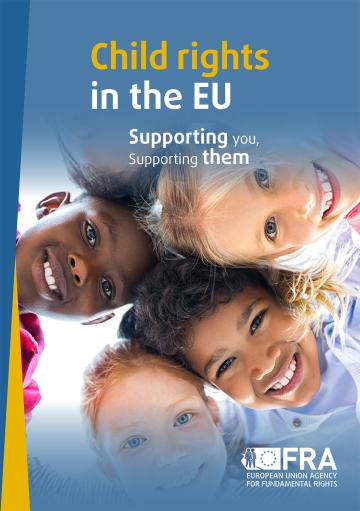
Child rights come first. Measures to ensure child protection and participation apply to all children in the EU. This brochure guides you to relevant FRA reports and tools that can support you when promoting and protecting the rights of all children in the EU.