Leta 2020 je bil na področju varstva temeljnih pravic
sicer dosežen napredek, a je bilo hkrati opazno
tudi nazadovanje. Poročilo o temeljnih pravicah
za leto 2021, ki ga je pripravila Agencija Evropske
unije za temeljne pravice, povzema razvoj glavnih
dogodkov na tem področju ter izpostavlja dosežke
in področja, ki so še vedno zaskrbljujoča.
År 2020 innebar både framgångar och motgångar för
skyddet av de grundläggande rättigheterna. FRA:s
Rapport om grundläggande rättigheter 2021 innehåller
en granskning av de viktigaste händelserna på
området och pekar ut både framsteg och återstående
problemområden.
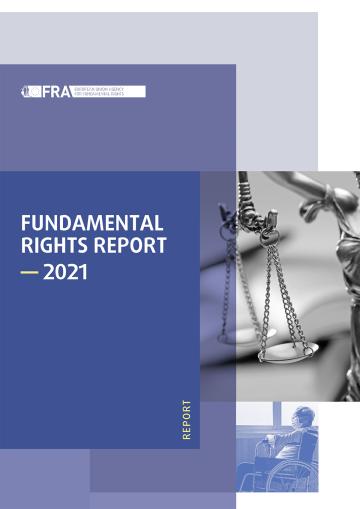
FRA’s Fundamental Rights Report 2021 reviews major developments in the field in 2020, identifying both achievements and areas of concern. It also presents FRA’s opinions on these developments, including a synopsis of the evidence supporting these opinions. This year’s focus chapter explores the impact of the COVID-19 pandemic on fundamental rights. The remaining chapters cover: the EU Charter of Fundamental Rights; equality and non-discrimination; racism, xenophobia and related intolerance; Roma equality and inclusion; asylum, borders and migration; information society, privacy and data protection; rights of the child; access to justice; and the implementation of the Convention on the Rights of Persons with Disabilities.
This focus looks at COVID-19’s impact on fundamental rights. It underscores that a human rights-based approach to tackling the pandemic requires balanced measures that are based on law, necessary, temporary and proportional. It also requires addressing the pandemic’s socio-economic impact, protecting the vulnerable and fighting racism.
This opinion illustrates the extent and nature of lived experiences of inequality and discrimination across the EU. It does so with reference to the grounds of discrimination and areas of life covered by the racial and employment equality directives, as well as in relation to the grounds and areas covered by the proposed Equal Treatment Directive.
This report looks at the practical implementation of the presumption of innocence in criminal proceedings, and related rights, in 9 EU Member States (Austria, Belgium, Bulgaria, Cyprus, Germany, Italy, Lithuania, Poland and Portugal). Article 48 of the EU Charter of Fundamental Rights guarantees the presumption of innocence – but, as FRA’s research underscores, it can be undermined in many ways.
This note outlines how to help ensure a dignified stay for third-country nationals who are apprehended or intercepted at external borders. Specifically, FRA identifies twelve points for protection-sensitive and fundamental rights-compliant planning and design of initial-reception facilities at such borders. These are based on the agency’s work at external borders, including data collection and research activities.
This is the second main report from FRA’s Fundamental Rights Survey, which collected data from 35,000 people on a range of issues. This report focuses on respondents’ experiences as victims of selected types of crime, including violence, harassment, and property crime. The report also examines how often these crimes are reported to the police, and presents further details relating to harassment and violence, such as the perpetrators and where the incidents took place.
Lots of small, positive acts can lead to great things. FRA’s Friso Roscam Abbing explains how you can defend human rights by something as simple as voting. Friso shares all he learned from the fall of the Iron Curtain. And how you too can affect such world-changing events by exercising your rights at home. By using your right to vote, you too can make a difference.
An equal society is a better society for everyone. FRA’s Ursula Till-Tentschert warns against sidelining women — once empowered, there is nothing they cannot do. Ursula remembers the injustice of having to sew at school while her brothers carved models from wood. It is only a short step from classroom discrimination to outright prejudice. She celebrates the EU laws that protect us. But she says they will only truly work if we also smash the invisible social barriers to empowerment.
National Human Rights Institutions (NHRIs) are a vital part of the country-level human rights protection system. By raising awareness, providing advice, monitoring and holding authorities to account, they have a central role in navigating the great human rights challenges of our day – tackling both persistent concerns like discrimination and inequality, and novel issues such as the rights implications of artificial intelligence and of the COVID-19 pandemic.
In 2020 (until 15 December), the International Organization for Migration estimated that about 1,054 people have died or gone missing while crossing the Mediterranean Sea to reach Europe to escape war or persecution or to pursue a better life. This is an average of almost three people per day. In the past years, a significant number of migrants in distress at sea have been rescued by civil society vessels deployed with a humanitarian mandate to reduce fatalities and bring rescued migrants to safety. Since 2018, however, national authorities initiated some 50 administrative and criminal proceedings against crew members or vessels, also seizing the latter. In some cases, rescue vessels were blocked in harbours due to flag issues or the inability to meet maritime safety-related and other technical requirements.
Evropská úmluva o lidských právech a právo Evropské unie poskytují stále důležitější rámec pro ochranu práv cizinců. Právní předpisy Evropské unie týkající se azylu, hranic a přistěhovalectví se rychle vyvíjejí. Existuje rozsáhlá judikatura Evropského soudu pro lidská práva týkající se zejména článků 3, 5, 8 a 13 EÚLP. Soudní dvůr Evropské unie je stále častěji žádán, aby se vyjádřil k výkladu ustanovení práva Evropské unie v této oblasti. Třetí vydání této příručky, aktualizované k červenci 2020, představuje tyto právní předpisy Evropské unie a judikaturu obou evropských soudů přístupným způsobem. Příručka je určena právníkům, soudcům, státním zástupcům, imigračním úředníkům a nevládním organizacím v členských státech EU a Rady Evropy.
The European Convention on Human Rights and European Union law provide an increasingly important framework for the protection of the rights of foreigners. European Union legislation relating to asylum, borders and immigration is developing fast. There is an impressive body of case law by the European Court of Human Rights relating in particular to Articles 3, 5, 8 and 13 of the ECHR. The Court of Justice of the European Union is increasingly asked to pronounce on the interpretation of European Union law provisions in this field. The third edition of this handbook, updated up to July 2020, presents this European Union legislation and the body of case law by the two European courts in an accessible way.
Euroopa inimõiguste konventsioon ja Euroopa Liidu õigus moodustavad üha olulisema raamistiku välismaalaste õiguste kaitseks. Varjupaiga, piiride ja sisserändega seotud Euroopa Liidu õigusaktid arenevad kiiresti. Euroopa Inimõiguste Kohtu kohtupraktika
on ulatuslik, eelkõige seoses Euroopa inimõiguste konventsiooni artiklitega 3, 5, 8 ja 13. Euroopa Liidu Kohtul palutakse üha sagedamini võtta seisukoht Euroopa Liidu õiguse sätete tõlgendamise kohta selles valdkonnas. Käsiraamatu kolmandas väljaandes, mida on ajakohastatud kuni juulini 2020, tutvustatakse arusaadavalt Euroopa Liidu õigusakte ja Euroopa mõlema kohtu kohtupraktikat. See on ette nähtud ELi ja Euroopa Nõukogu liikmesriikide õigusala töötajatele, kohtunikele, prokuröridele, sisserändeametnikele ja vabaühendustele.
Euroopan ihmisoikeussopimus ja Euroopan unionin oikeus sisältävät yhä tärkeämmäksi käyvän ulkomaalaisten oikeuksien suojaamista koskevan säännöstön. Euroopan unionin oikeus turvapaikkaoikeudesta, rajoista ja maahanmuutosta kehittyy nopeasti. Euroopan ihmisoikeustuomioistuimessa on kertynyt runsaasti oikeuskäytäntöä, erityisesti Euroopan ihmisoikeussopimuksen 3, 5, 8 ja 13 artiklasta. Euroopan unionin tuomioistuimelta pyydetään yhä useammin lausuntoa unionin oikeuden tämän alan säännösten tulkinnasta. Käsikirjan kolmannessa painoksessa, jota on päivitetty heinäkuuhun 2020 saakka, esitetään EU:n lainsäädäntöä ja molempien tuomioistuinten oikeuskäytäntöä helposti saatavilla olevassa muodossa.
Europska konvencija o ljudskim pravima i pravo Europske unije čine sve važniji okvir za zaštitu prava stranaca. Zakonodavstvo Europske unije u području azila, granica i imigracije brzo se razvija. Dostupna je opsežna sudska praksa Europskog suda za ljudska prava koja se konkretno odnosi na članke 3., 5., 8. i 13. EKLJP‑a. Od Suda Europske unije sve se češće traži da donosi odluke o tumačenju odredaba prava Europske unije u tom području. U trećem izdanju ovog priručnika, koji je ažuriran u skladu s informacijama dostupnima do srpnja 2020., na pristupačan su način predstavljeni zakonodavstvo Europske unije i sudska praksa navedenih dvaju europskih sudova. Priručnik je namijenjen pravnim stručnjacima, sudcima, tužiteljima, imigracijskim službenicima i nevladinim organizacijama u državama članicama EU‑a i Vijeća Europe.
Az emberi jogok európai egyezménye és az európai uniós jog egyre fontosabb keretet biztosít a külföldiek jogainak védelméhez. A menekültügyre, a határokra és a bevándorlásra vonatkozó európai uniós joganyag gyorsan fejlődik. Az Emberi Jogok Európai Bíróságának tekintélyes esetjogi korpusza alakult ki, különösen az EJEE 3., 5., 8. és 13. cikkével kapcsolatban. Az Európai Unió Bíróságát egyre gyakrabban kérik fel, hogy nyilatkozzon az Európai Unió e területre vonatkozó jogi rendelkezéseinek értelmezéséről. E kézikönyv 2020 júliusáig aktualizált harmadik kiadása hozzáférhető módon mutatja be ezeket az európai uniós jogszabályokat, valamint a két európai bíróság ítélkezési gyakorlatát. A kézikönyv az EU és az Európa Tanács tagállamaiban dolgozó gyakorló jogi szakembereknek, bíráknak, ügyészeknek, bevándorlási tisztviselőknek és nem kormányzati szervezeteknek szól.
Europos žmogaus teisių konvencija ir Europos Sąjungos teisė – tai vis svarbesnė užsieniečių teisių apsaugos sistema. Europos Sąjungos teisės aktai, susiję su prieglobsčiu, sienomis ir imigracija, sparčiai tobulėja. Europos Žmogaus Teisių Teismas yra suformavęs įspūdingą teismų praktiką, visų pirma susijusią su EŽTK 3, 5, 8 ir 13 straipsniais. Europos Sąjungos Teisingumo Teismo vis dažniau prašoma pasisakyti dėl Europos Sąjungos teisės nuostatų aiškinimo šioje srityje. Trečiame šio vadovo leidime, atnaujintame iki 2020 m. liepos mėn., prieinamai pristatomi šie Europos Sąjungos teisės aktai ir dviejų Europos Sąjungos teismų praktikos visuma.
Eiropas Cilvēktiesību konvencijā un Eiropas Savienības tiesību aktos ir paredzēts aizvien lielāku nozīmi iegūstošs tiesiskais regulējums ārvalstnieku tiesībām. Eiropas Savienības likumdošana saistībā ar patvērumu, robežām un imigrāciju strauji attīstās. iropas Cilvēktiesību tiesai ir iespaidīga apjoma judikatūra, jo īpaši saistībā ar ECTK 3., 5., 8. un 13. pantu. Eiropas Savienības Tiesai tiek aizvien biežāk lūgts interpretēt Eiropas Savienības tiesību aktus šajā jomā. Šīs rokasgrāmatas 3. izdevums, kas ir aktualizēts līdz 2020. gada jūlijam, iepazīstina ar Eiropas Savienības likumdošanu un divu Eiropas tiesu judikatūras kopumu saprotamā veidā.