The EU is founded on the values of democracy, rule of law and respect for human rights. Yet these values, and discussions on fundamental rights at the EU and Member State level, can seem remote in people’s daily lives. With this in mind, FRA explored what people understand, know and experience with respect to their fundamental rights in practice. The resulting data provide comprehensive and comparable evidence on these aspects.
This report outlines some of the measures EU Member States have put in place to protect public health as Europe faces the ‘second wave’ of the Coronavirus pandemic. It highlights how these may affect fundamental rights, especially social rights.
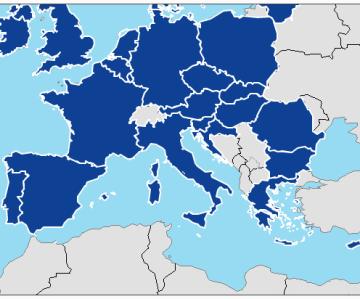
National Human Rights Institutions (NHRIs) are a vital part of the country-level human rights protection system. This report, published 10 years after FRA’s first in-depth study on NHRIs, looks at such bodies in the EU, as well as the Republic of North Macedonia, the Republic of Serbia, and the United Kingdom of Great Britain and Northern Ireland. It explores relevant developments, challenges to their effectiveness and ways to maximise their impact.
As we enter the second half of 2020, the constraints on our daily lives brought about by the Coronavirus pandemic have become a firm reality. New local lockdowns and the reintroduction of restrictive measures prompted by fresh outbreaks of the virus are a stark reminder that COVID-19 continues to shape our lives – and our enjoyment of fundamental rights – in profound ways. There is compelling evidence of how the pandemic has exacerbated existing challenges in our societies. This FRA Bulletin outlines some of the measures EU Member States adopted to safely reopen their societies and economies while continuing to mitigate the spread of COVID-19. It highlights the impact these measures may have on civil, political and socioeconomic rights.
This paper presents key findings from FRA’s second consultation of its Fundamental Rights Platform, focusing on the experiences of civil society organisations (CSOs) working on human rights. FRA started an annual consultation with organisations participating in its platform in 2018.
FRA’s Fundamental Rights Survey collected data from 35,000 people about their experiences, perceptions and opinions on a range of issues that are variously encompassed by human rights. This report presents a small selection of the survey results. It focuses on findings with respect to respondents’ opinions about human – or fundamental rights; their views and perceptions on the functioning of democratic societies – as a pillar on which human rights can flourish; and on their thoughts on and engagement with public services that have a duty to enforce human rights law and to protect people’s rights.
In 2019, the International Organization for Migration estimated that 1,866 people have died or gone missing while crossing the Mediterranean Sea to reach Europe to escape war or persecution or to pursue a better life. This is an average of five people per day. In recent years, a significant proportion of migrants in distress at sea have been rescued by civil society vessels deployed with a humanitarian mandate to reduce fatalities and bring rescued migrants to safety. Since 2018, however, authorities in some EU Member States started viewing civil society-deployed rescue vessels with hostility. As a reaction, national authorities initiated about 40 administrative and criminal proceedings against crew members or vessels, including seizing the latter. In some cases, rescue vessels were blocked in harbours due to flag issues or the inability to meet technical requirements.
In diesem Fokus wird die Anwendung der Charta der Grundrechte
der Europäischen Union, die seit zehn Jahren rechtsverbindlich
ist, näher beleuchtet. Auf EU-Ebene hat sie an Außenwirkung
gewonnen und Impulse für eine neue Grundrechtekultur
gesetzt. Auf nationaler Ebene sind der Bekanntheitsgrad und die
Anwendung der Charta begrenzt. Die Gerichte nutzen die Charta in
zunehmendem Maße, was deutlich macht, welche Wirkung dieses
moderne Instrument besitzt. Von Regierungen und Parlamenten
wird sie jedoch kaum genutzt. So gibt es beispielsweise nur wenige
Anhaltspunkte dafür, dass die einzelstaatlichen Rechtsvorschriften,
mit denen EU-Recht umgesetzt wird, regelmäßig daraufhin
überprüft werden, ob sie mit der Charta im Einklang stehen.
This focus takes a closer look at the application of the Charter of Fundamental Rights of the European Union, which has been legally binding for 10 years. At EU level, it has gained visibility and sparked a new fundamental rights culture. At national level, awareness and use of the Charter are limited. Courts increasingly use the Charter, showing the impact of this modern instrument. But its use by governments and parliaments remains low. For instance, there is little indication of anyone regularly scrutinising national legislation that transposes EU law for compatibility with the Charter.
Le présent Focus examine dans le détail l’application de la Charte des droits fondamentaux de l’Union européenne, qui est juridiquement contraignante depuis dix ans. Au niveau de l’Union européenne (UE), la Charte a gagné en visibilité et a été le moteur d’une nouvelle culture des droits fondamentaux. Au niveau national, la connaissance et l’utilisation de la Charte sont limitées. Les instances judiciaires ont de plus en plus recours à la Charte, ce qui démontre l’importance de cet instrument moderne. Cependant, son utilisation par les gouvernements et les parlements reste faible. Par exemple, rien n’indique qu’une quelconque autorité soit chargée de contrôler régulièrement la législation nationale transposant le droit de l’UE afin de s’assurer de sa compatibilité avec la Charte.
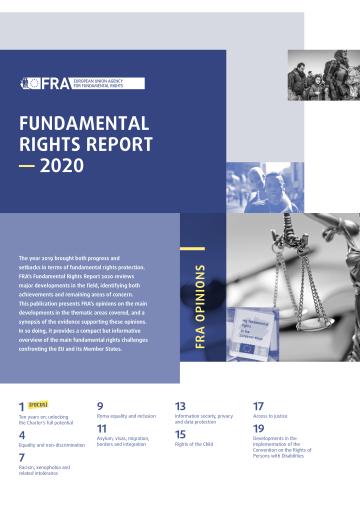
The year 2019 brought both progress and setbacks in terms of fundamental rights protection. FRA’s Fundamental Rights Report 2020 reviews major developments in the field, identifying both achievements and remaining areas of concern. This publication presents FRA’s opinions on the main developments in the thematic areas covered, and a synopsis of the evidence supporting these opinions. In so doing, it provides a compact but informative overview of the main fundamental rights challenges confronting the EU and its Member States.
En el año 2019 se produjeron tanto avances como
retrocesos en materia de protección de los derechos
fundamentales. El Informe sobre los derechos
fundamentales 2020 de la Agencia de los Derechos
Fundamentales de la Unión Europea (FRA) analiza
los principales acontecimientos en este ámbito,
destacando tanto los progresos realizados como
las dificultades que todavía persisten. La publicación
presenta los dictámenes de la FRA sobre los
principales avances realizados en los ámbitos
temáticos contemplados, así como un resumen
de las pruebas que respaldan tales dictámenes.
Esto permite disponer de una visión de conjunto,
compacta, pero muy ilustrativa, de los principales
desafíos en materia de derechos fundamentales
a los que se enfrentan la UE y sus Estados miembros.
2019. aastal oli põhiõiguste kaitses nii edasiminekut
kui ka tagasilööke. Euroopa Liidu Põhiõiguste Ameti
(FRA) 2020. aasta põhiõiguste aruandes esitatakse
valdkonna põhiarengute ülevaade, tuues esile
saavutused ja endiselt probleemsed valdkonnad.
Selles väljaandes esitatakse FRA arvamused peamiste
hõlmatud teemavaldkondade arengu kohta ja neid
arvamusi toetavate tõendite kokkuvõte. Sellega
antakse kokkuvõtlik, kuid informatiivne ülevaade
põhiõiguste valdkonna peamistest probleemidest ELis
ja liikmesriikides.
Vuonna 2019 perusoikeuksien suojelussa tapahtui sekä
edistystä että takaiskuja. Euroopan unionin
perusoikeusviraston (FRA) vuoden 2020
perusoikeusraportissa tarkastellaan perusoikeuksien
tilanteen kehitystä pääpiirteissään ja tuodaan esiin
sekä saavutuksia että jäljellä olevia huolenaiheita.
Julkaisussa on FRA:n lausuntoja pääasiallisesta
kehityksestä käsitellyillä aihealueilla sekä
yleiskatsaus lausuntojen perustana olevaan näyttöön.
Siinä esitetään tiivis ja informatiivinen yhteenveto
perusoikeuksien keskeisistä haasteista, joihin EU:n ja
sen jäsenvaltioiden on vastattava.
L’année 2019 a été marquée à la fois par des avancées et des régressions en matière de protection des droits fondamentaux. Le Rapport sur les droits fondamentaux 2020 de la FRA examine les principales évolutions dans ce domaine, en recensant les progrès accomplis et les sujets de préoccupation persistants. La présente publication expose les avis de la FRA sur les principales évolutions dans les domaines thématiques couverts ainsi qu’un résumé des éléments factuels qui étayent ces avis. Elle fournit ainsi une vue d’ensemble concise mais instructive des principaux défis en matière de droits fondamentaux auxquels l’Union européenne (UE) et ses États membres doivent faire face.
Bhí idir dul chun cinn agus dul ar gcúl le tabhairt faoi
deara i ndáil le cosaint na gceart bunúsach in 2019.
Déantar athbhreithniú i dTuarascáil um Chearta
Bunúsacha 2020 FRA ar mhórfhorbairtí san earnáil,
agus tarraingítear aird ar éachtaí agus ar réimsí ar
ábhair imní iad go fóill. San fhoilseachán seo cuirtear
i láthair tuairimí FRA maidir leis na príomhfhorbairtí
sna réimsí téamacha atá curtha san áireamh, mar aon
le hachoimre ar an bhfianaise atá ag tacú leis na
tuairimí seo. Ar an gcaoi sin, soláthraítear
forbhreathnú gairid, ach faisnéiseach, ar na
príomhdhúshláin i dtaca le cearta bunúsacha atá os
comhair an AE agus a Bhallstáit.
Godina 2019. donijela je i napredovanja i nazadovanja
u pogledu zaštite temeljnih prava. U Izvješću FRA-e
o temeljnim pravima 2020. daje se pregled važnih
promjena i postignuća u tom području te se ističu
područja koja još izazivaju zabrinutost. U ovoj
publikaciji navode se mišljenja FRA-e o glavnim
promjenama u obuhvaćenim tematskim područjima
i ukratko iznose dokazi koji potkrjepljuju ta mišljenja.
Na taj se način pruža sažet, ali informativan pregled
glavnih pitanja povezanih s temeljnim pravima
s kojima se suočavaju EU i njegove države članice.
A 2019-es év előrelépést és egyúttal visszaeséseket is
hozott az alapjogok védelme terén. Az FRA 2020. évi
alapjogi jelentése áttekinti a terület legfontosabb
fejleményeit, és felhívja a figyelmet az eredményekre,
illetve az aggályos kérdésekre. Ez a kiadvány ismerteti
az FRA véleményét az érintett tematikus területeken
bekövetkezett legfontosabb fejleményekről, és
összefoglalja a véleményt alátámasztó tényeket.
Ennek során tömör, de informatív áttekintést nyújt az
EU és tagállamai előtt álló fő alapjogi kihívásokról.
Il 2019 è stato caratterizzato sia da progressi che da
battute d’arresto in termini di tutela dei diritti
fondamentali. La Relazione sui diritti fondamentali
2020 dell’Agenzia dell’Unione europea per i diritti
fondamentali (FRA) fa il punto della situazione sui
principali sviluppi in materia, individuando i risultati
ottenuti e i settori che destano ancora preoccupazione.
Questa pubblicazione presenta i pareri della FRA sui
principali sviluppi nelle aree tematiche contemplate
nonché una sintesi delle informazioni su cui si fondano
tali pareri, tracciando così un quadro sintetico ma
informativo delle principali sfide con cui si confrontano
l’UE e gli Stati membri nell’ambito dei diritti
fondamentali.
2019 m. pagrindinių teisių apsaugos srityje padaryta
pažanga, tačiau neišvengta ir nesėkmių. Europos
Sąjungos pagrindinių teisių agentūros (angl. FRA)
2020 m. ataskaitoje apie pagrindinių teisių būklę
apžvelgiami svarbiausi šios srities pokyčiai, taip pat
aptariami laimėjimai ir neišspręsti susirūpinimą
keliantys klausimai. Šiame leidinyje pateikiamos FRA
nuomonės apie pagrindines nagrinėjamų teminių sričių
naujoves ir trumpa faktinių duomenų, kuriais
grindžiamos šios nuomonės, apžvalga. Jame glaustai,
tačiau informatyviai apžvelgiamos didžiausios ES ir jos
valstybėse narėse kylančios su pagrindinėmis teisėmis
susijusios problemos.