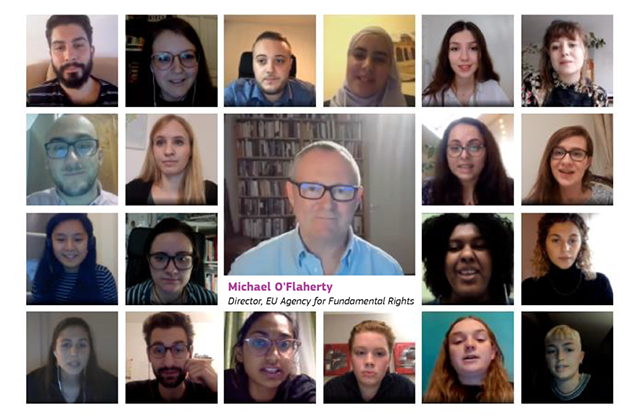
On 23 February 2021, FRA’s Director, Michael O’Flaherty, listened to fundamental rights concerns and discussed ways to solve them. The second Fundamental Rights Dialogue invited young people to participate in shaping our societies, placing human rights centre stage.
Crime can touch any of us – as witnesses or as victims. But no matter who you are, we all have rights when it comes to justice. These three short clips show some aspects of working together for justice, rights of victims of crime and rights of witnesses of crime.
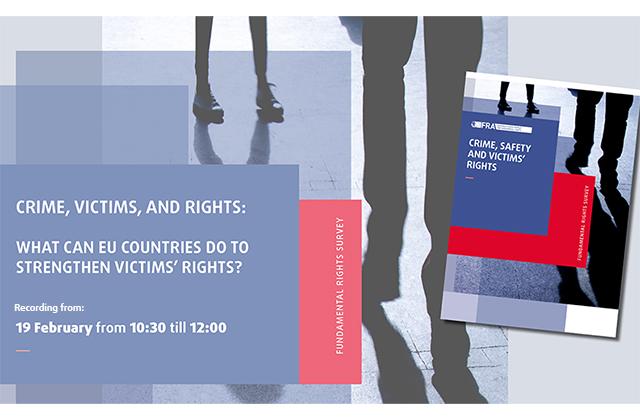
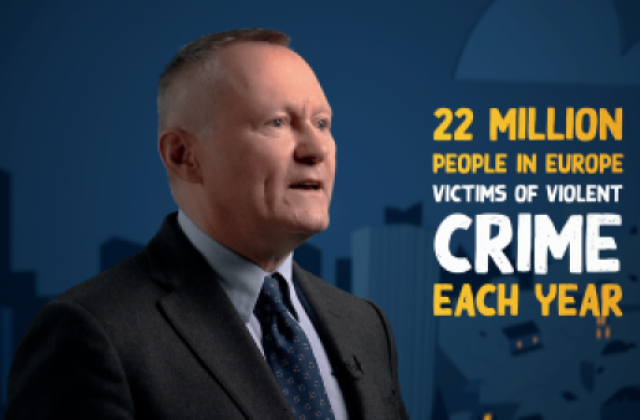
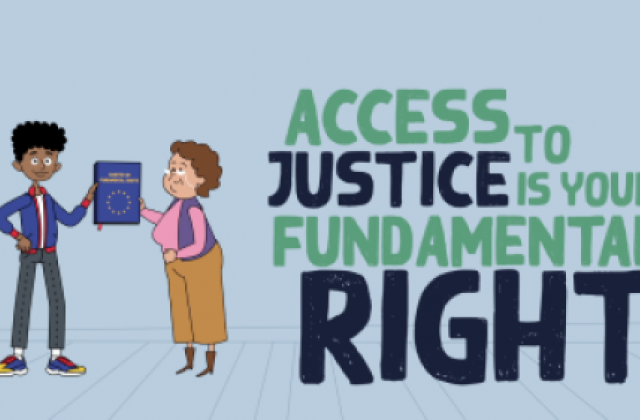
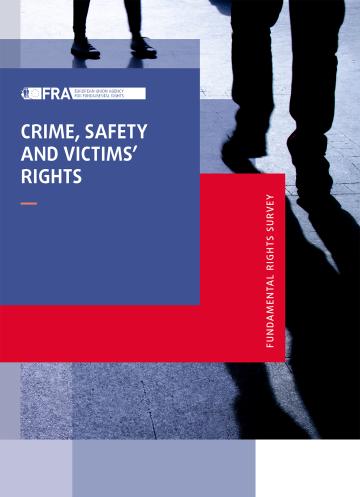
We don’t all experience crime in the same way, and we might deal with it differently. But it’s vital – as victims or witnesses – that our rights are guaranteed, because access to justice is our fundamental right. Watch FRA Director Michael O’Flaherty speaking on the Fundamental Rights Survey report on crime, safety and victims’ rights.
Crime can touch any of us – as witnesses or as victims. But no matter who you are, we all have rights when it comes to justice. It is for this reason that the European Union Agency for Fundamental Rights asked 35,000 people across Europe about their experiences of crime in its Fundamental Rights Survey, and the results are in.
This is the second main report from FRA’s Fundamental Rights Survey, which collected data from 35,000 people on a range of issues. This report focuses on respondents’ experiences as victims of selected types of crime, including violence, harassment, and property crime. The report also examines how often these crimes are reported to the police, and presents further details relating to harassment and violence, such as the perpetrators and where the incidents took place.
Lots of small, positive acts can lead to great things. FRA’s Friso Roscam Abbing explains how you can defend human rights by something as simple as voting. Friso shares all he learned from the fall of the Iron Curtain. And how you too can affect such world-changing events by exercising your rights at home. By using your right to vote, you too can make a difference.
An equal society is a better society for everyone. FRA’s Ursula Till-Tentschert warns against sidelining women — once empowered, there is nothing they cannot do. Ursula remembers the injustice of having to sew at school while her brothers carved models from wood. It is only a short step from classroom discrimination to outright prejudice. She celebrates the EU laws that protect us. But she says they will only truly work if we also smash the invisible social barriers to empowerment.
Never take today’s freedoms for granted. FRA’s Jana Gajdošová remembers authoritarian rule in her native Czechoslovakia. Then, shortages, secret police and petty corruption were the norm. The State Security even posted spies to watch churchgoers at mass. Jana tells how the repression she experienced in her childhood inspired her to fight for the rights we all enjoy now in Europe. If you care for freedom, this is a must-listen.
On 13 November, the Fundamental Rights Agency (FRA) hosted its first Fundamental Rights Dialogue - a virtual event that gave young people an opportunity to voice their fundamental rights concerns and discussed ways to solve them with FRA's Director Michael O'Flaherty.
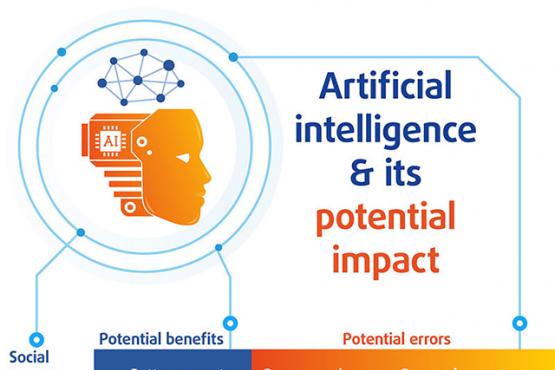
Artificial intelligence (AI) already plays a role in many decisions that affect our daily lives. From deciding what unemployment benefits someone gets to where a burglary is likely to take place. But we need to make sure to fully uphold fundamental rights standards when using AI. Drawing on the ‘Getting the future right – Artificial intelligence and fundamental rights’ report, FRA explores the potential benefits and possible errors that can occur focusing on four core areas – social benefits, predictive policing, health services and targeted advertising.
Докладът на FRA относно изкуствения интелект и основните права представя конкретни примери за начина, по който дружествата и държавните администрации в ЕС използват или се опитват да използват ИИ. В настоящото резюме се представят основните заключения от доклада. Те могат да послужат за информация при създаване на политики на равнището на ЕС и на национално равнище за регламентиране на използването на инструменти с ИИ в съответствие с правата на човека и основните права.
Zpráva agentury FRA o umělé inteligenci a základních právech uvádí konkrétní příklady toho, jak společnosti a orgány veřejné správy v EU používají nebo se pokoušejí používat umělou inteligenci. Toto shrnutí předkládá hlavní poznatky zprávy. Ty mohou sloužit jako podpůrné informace pro úsilí tvůrců politik na úrovni EU i jednotlivých států v oblasti regulace používání nástrojů umělé inteligence v souladu s lidskými a základními právy.
I FRA’s rapport om kunstig intelligens og grundlæggende rettigheder gives der konkrete eksempler på, hvordan virksomheder og offentlige forvaltninger i EU bruger eller forsøger at bruge kunstig intelligens. Dette resumé indeholder hovedresultaterne fra rapporten. Disse kan danne grundlag for EU’s og medlemsstaternes politiske bestræbelser på at regulere brugen af AI-værktøjer i overensstemmelse med menneskerettighederne og de grundlæggende rettigheder.
Der Bericht der FRA über künstliche Intelligenz und Grundrechte präsentiert konkrete Beispiele dafür, wie Unternehmen und Behörden in der EU künstliche Intelligenz einsetzen oder einzusetzen versuchen. Diese Zusammenfassung stellt die wichtigsten Erkenntnisse aus dem Bericht vor, die sowohl auf Unionsebene als auch auf nationaler Ebene für die Politikgestaltung auf dem Gebiet des menschen- und grundrechtskonformen Einsatzes von KI-Tools genutzt werden können.
Η έκθεση του FRA σχετικά με την τεχνητή νοημοσύνη και τα θεμελιώδη δικαιώματα παρουσιάζει συγκεκριμένους τρόπους με τους οποίους οι εταιρείες και οι δημόσιες διοικητικές αρχές στην ΕΕ χρησιμοποιούν, ή προσπαθούν να χρησιμοποιήσουν, την ΤΝ. Η παρούσα σύνοψη περιέχει τα βασικά σημεία της έκθεσης. Οι εν λόγω πληροφορίες μπορούν να αποτελέσουν τη βάση για τη χάραξη πολιτικής σε ενωσιακό και εθνικό επίπεδο σχετικά με τη χρήση εργαλείων ΤΝ που σέβονται τα ανθρώπινα και τα θεμελιώδη δικαιώματα.
FRA’s report on artificial intelligence and fundamental rights presents concrete examples of how companies and public administrations in the EU are using, or trying to use, AI. This summary presents the main insights from the report. These can inform EU and national policymaking efforts to regulate the use of AI tools in compliance with human and fundamental rights.
En el informe de la Agencia de los Derechos Fundamentales de la Unión Europea sobre inteligencia artificial (IA) y derechos fundamentales se presentan ejemplos concretos de cómo las empresas y las administraciones públicas de la Unión Europea están utilizando o tratan de utilizar la IA. En este resumen se presentan las perspectivas más destacadas del informe. Esto puede servir como fundamento para el intento de las políticas nacionales y de la Unión por regular el uso de las herramientas de IA respetando los derechos fundamentales y humanos.
FRA aruandes tehisintellekti ja põhiõiguste kohta tuuakse konkreetseid näiteid sellest, kuidas ELi ettevõtted ja avaliku sektori asutused kasutavad või püüavad kasutada tehisintellekti. Ülevaates tutvustatakse uuringu põhiaruandes välja toodud peamisi järeldusi. Need võivad ELi ja liikmesriikide poliitikakujundajatel aidata edendada tehisintellekti põhiste vahendite kasutamist, austades inim- ja põhiõigusi.