Top Menu

  • Par FRA
  • Sadarbība
  • Newsroom
  • Cookies
  • Contact

Select site language

  • Български
  • Čeština
  • Dansk
  • Deutsch
  • Ελληνικά
  • English
  • Español
  • Eesti
  • Suomi
  • Français
  • Gaeilge
  • Hrvatski
  • Magyar
  • Italiano
  • Lietuvių
  • Latviešu
  • Malti
  • Nederlands
  • Polski
  • Português
  • Română
  • Slovenčina
  • Slovenščina
  • Svenska

Custom Topbar

Home

Search the FRA website

      • Work on rights
        • Tiesiskums, cietušo tiesības un tiesu iestāžu sadarbība
          • Cietušo tiesības
          • Apsūdzētā tiesības
          • Civiltiesības
          • Tiesu iestāžu sadarbība un tiesiskums
          • Drošība
          • Uzņēmējdarbība un cilvēktiesības
        • Līdztiesība, nediskriminācija un rasisms
          • Bērni, jaunieši un gados vecāki cilvēki
          • Cilvēki ar invaliditāti
          • Naida noziegumi
          • Rases un etniskā piederība
          • Reliģija un pārliecība
          • Romi
          • Dzimums, seksuālā orientācija un dzimte
        • Patvērums, migrācija un robežas
          • Patvēruma pieejamība
          • Robežu un informācijas sistēmas
          • Bērnu aizsardzība
          • Neatbilstīga migrācija, atgriešanās un imigrantu aizturēšana
          • Likumīga migrācija un integrācija
          • Cilvēku tirdzniecība un darbaspēka ekspluatācija
        • Datu aizsardzība, privātums un jaunās tehnoloģijas
          • Mākslīgais intelekts un lielie dati
          • Robežu un informācijas sistēmas
          • Datu aizsardzība
          • Pretlikumīga profilēšana
        • Atbalsts cilvēktiesību sistēmām un aizstāvjiem
          • ES Pamattiesību harta
          • Starpvaldību cilvēktiesību sistēmas
          • Valsts cilvēktiesību sistēmas un struktūras
          • Pilsoniskā sabiedrība
        • Environmental and social sustainability
          • Climate change and environmental protection
          • Just and green transition
          • Business and human rights
          • Human rights due diligence
          • Consumer protection
      • ES Pamattiesību harta
        • Kas ir pamattiesības?
        • What is the EU Charter of Fundamental Rights?
        • Preambula
        • I Sadaļa: Cieņa
          • 1 - Cilvēka cieņa
          • 2 - Tiesības uz dzīvību
          • 3 - Tiesības uz personas neaizskaramību
          • 4 - Spīdzināšanas un necilvēcīgas vai pazemojošas izturēšanās vai sodu aizliegums
          • 5 - Verdzības un piespiedu darba aizliegums
        • II Sadaļa: Brīvības
          • 6 - Tiesības uz brīvību un drošību
          • 7 - Privātās un ģimenes dzīves neaizskaramība
          • 8 - Personas datu aizsardzība
          • 9 - Tiesības stāties laulībā un tiesības izveidot ģimeni
          • 10 - Domu, pārliecības un ticības brīvība
          • 11 - Vārda un informācijas brīvība
          • 12 - Pulcēšanās un biedrošanās brīvība
          • 13 - Humanitāro un eksakto zinātņu brīvība
          • 14 - Tiesības uz izglītību
          • 15 - Brīvība izvēlēties profesiju un tiesības strādāt
          • 16 - Darījumdarbības brīvība
          • 17 - Tiesības uz īpašumu
          • 18 - Patvēruma tiesības
          • 19 - Aizsardzība pārvietošanas, izraidīšanas vai izdošanas gadījumā
        • III Sadaļa: Vienlīdzība
          • 20 - Vienlīdzība likuma priekšā
          • 21 - Diskriminācijas aizliegums
          • 22 - Kultūru, reliģiju un valodu daudzveidība
          • 23 - Vīriešu un sieviešu līdztiesība
          • 24 - Bērnu tiesības
          • 25 - Vecāka gadagājuma cilvēku tiesības
          • 26 - Invalīdu integrācija
        • IV Sadaļa: Solidaritāte
          • 27 - Darba ņēmēju tiesības uz informāciju un konsultācijām uzņēmumā
          • 28 - Tiesības uz kolektīvām sarunām un rīcību
          • 29 - Tiesības izmantot darbā iekārtošanas pakalpojumus
          • 30 - Aizstāvība nepamatotas atlaišanas gadījumā
          • 31 - Godīgi un taisnīgi darba apstākļi
          • 32 - Bērnu darba aizliegšana un strādājošu jauniešu aizsardzība
          • 33 - Ģimenes dzīve un darbs
          • 34 - Sociālais nodrošinājums un sociālā palīdzība
          • 35 - Veselības aizsardzība
          • 36 - Pieeja pakalpojumiem ar vispārēju tautsaimniecisku nozīmi
          • 37 - Vides aizsardzība
          • 38 - Patērētāju tiesību aizsardzība
        • V Sadaļa: Pilsoņu tiesības
          • 39 - Tiesības balsot un tiesības kandidēt Eiropas Parlamenta vēlēšanās
          • 40 - Tiesības balsot un tiesības kandidēt pašvaldību vēlēšanās
          • 41 - Tiesības uz labu pārvaldību
          • 42 - Tiesības piekļūt dokumentiem
          • 43 - Eiropas ombuds
          • 44 - Tiesības iesniegt lūgumrakstu
          • 45 - Pārvietošanās un uzturēšanās brīvība
          • 46 - Diplomātiskā un konsulārā aizsardzība
        • VI Sadaļa: Tiesiskums
          • 47 - Tiesības uz efektīvu tiesību aizsardzību un taisnīgu tiesu
          • 48 - Nevainīguma prezumpcija un tiesības uz aizstāvību
          • 49 - Noziedzīgu nodarījumu un sodu likumības un samērīguma principi
          • 50 - Tiesības netikt divreiz tiesātam vai sodītam krimināllietā par to pašu noziedzīgo nodarījumu
        • VII Sadaļa: Vispārīgi noteikumi
          • 51 - Piemērošanas joma
          • 52 - Tiesību un principu piemērošana un interpretēšana
          • 53 - Aizsardzības līmenis
          • 54 - Tiesību ļaunprātīgas izmantošanas aizliegums
      • Tools
        • EU Fundamental Rights Information System - EFRIS
        • Criminal detention database
        • Anti-Muslim hatred database
        • National human rights structures navigator
        • Case-law database
        • Charterpedia
        • FRA e-learning platform
        • Data visualisation
        • Equality data collection: promising practices
        • Fighting hate crime: promising practices
      • Produkti
    • About FRA
      • Who we are
        • Structure of FRA
        • Management Board
          • Management Board members
          • Management Board meeting documents
        • Executive Board
        • Scientific Committee
          • Scientific Committee members
        • Director
        • Management team
      • What we do
        • Research and data
        • Capacity-building
        • Advising
        • Convening people
        • FRA for children
          • What are my rights?
          • Where do my rights come from?
        • Areas of work
          • Multi-annual Framework 2007-2022
        • Work Programme
          • Archive
        • Annual Activity report
          • Archive
        • Projects
      • Working at FRA
        • Vacancies and selections
          • Previous vacancies
        • What we offer
        • Work-life balance
        • Application instructions
        • Seconded National Experts
        • Traineeship
        • Study visits at FRA
      • Procurement
        • Ongoing procedures
        • Closed procedures
        • Contracts awarded
      • Finance and budget
        • Financial Rules
        • Financial documents
      • Piekļuve dokumentiem
        • Access to documents
        • Pieteikums piekļuvei dokumentiem
      • Data protection within FRA
        • Records registry
    • Cooperation
      • ES iestādes un citas struktūras
        • European Parliament
        • Council of the European Union
        • European Commission
        • EU agencies
          • Justice and Home Affairs Agencies Network
        • European Committee of the Regions
        • European Economic and Social Committee
        • European Ombudsman
        • EU CRPD Framework
          • Promotion
          • Protection
          • Monitoring
          • Review process
          • Resources
      • ES dalībvalstis
        • National Liaison Officers
        • National Parliaments
      • Eiropas Padome
      • Pilsoniskā sabiedrība un pamattiesību platforma
        • Activities
        • Civic space
        • Platform library
        • How to register
      • Valsts cilvēktiesību iestādes, līdztiesības struktūras un tiesībsarga iestādes
      • ANO, EDSO un citas starptautiskās organizācijas
        • EEA and Norway Grants
      • FRANET
    • Newsroom
      • Media contacts
      • News
      • Press releases
      • Stories
      • Events
        • Past Events
      • FRA products 2026
        • FRA products 2025
        • FRA products 2024
        • FRA products 2023
        • FRA products 2022
        • FRA products 2021
        • FRA Products 2020
        • FRA Products 2019
      • Multimedia
        • Videos
        • Infographics
        • Podcasts
      • Speeches
      • Press packs
        • EU LGBTIQ survey - Press pack
        • Fundamental Rights Survey
        • EU LGBTI survey II
        • From institutions to community living for persons with disabilities: perspectives from the ground
        • Second European Union Minorities and Discrimination Survey – Main results
        • Second European Union Minorities and Discrimination Survey (EU-MIDIS II) Muslims
        • Together in the EU: Promoting the participation of migrants and their descendants
        • Second European Union Minorities and Discrimination Survey (EU-MIDIS II) Roma
        • Severe labour exploitation in the EU
        • Child-friendly justice – perspectives and experiences of professionals: Press pack
        • Fundamental rights at EU borders
        • Violence against women press pack
        • Jewish people’s experiences and perceptions of hate crime, discrimination and antisemitism
        • EU LGBT Press pack
        • Child-friendly justice – perspectives and experiences of children
      • Newsletter
    • Account
      • Log in

Main menu

Home
  • Work on rights
    Work on rights
    • Tiesiskums, cietušo tiesības un tiesu iestāžu sadarbība
      • Cietušo tiesības
      • Apsūdzētā tiesības
      • Civiltiesības
      • Tiesu iestāžu sadarbība un tiesiskums
      • Drošība
      • Uzņēmējdarbība un cilvēktiesības
    • Līdztiesība, nediskriminācija un rasisms
      • Bērni, jaunieši un gados vecāki cilvēki
      • Cilvēki ar invaliditāti
      • Naida noziegumi
      • Rases un etniskā piederība
      • Reliģija un pārliecība
      • Romi
      • Dzimums, seksuālā orientācija un dzimte
    • Patvērums, migrācija un robežas
      • Patvēruma pieejamība
      • Robežu un informācijas sistēmas
      • Bērnu aizsardzība
      • Neatbilstīga migrācija, atgriešanās un imigrantu aizturēšana
      • Likumīga migrācija un integrācija
      • Cilvēku tirdzniecība un darbaspēka ekspluatācija
    • Datu aizsardzība, privātums un jaunās tehnoloģijas
      • Mākslīgais intelekts un lielie dati
      • Robežu un informācijas sistēmas
      • Datu aizsardzība
      • Pretlikumīga profilēšana
    • Atbalsts cilvēktiesību sistēmām un aizstāvjiem
      • ES Pamattiesību harta
      • Starpvaldību cilvēktiesību sistēmas
      • Valsts cilvēktiesību sistēmas un struktūras
      • Pilsoniskā sabiedrība
    • Environmental and social sustainability
      • Climate change and environmental protection
      • Just and green transition
      • Business and human rights
      • Human rights due diligence
      • Consumer protection
  • ES Pamattiesību harta
    ES Pamattiesību harta
    • Kas ir pamattiesības?
    • What is the EU Charter of Fundamental Rights?
    • Preambula
    • I Sadaļa: Cieņa
      • 1 - Cilvēka cieņa
      • 2 - Tiesības uz dzīvību
      • 3 - Tiesības uz personas neaizskaramību
      • 4 - Spīdzināšanas un necilvēcīgas vai pazemojošas izturēšanās vai sodu aizliegums
      • 5 - Verdzības un piespiedu darba aizliegums
    • II Sadaļa: Brīvības
      • 6 - Tiesības uz brīvību un drošību
      • 7 - Privātās un ģimenes dzīves neaizskaramība
      • 8 - Personas datu aizsardzība
      • 9 - Tiesības stāties laulībā un tiesības izveidot ģimeni
      • 10 - Domu, pārliecības un ticības brīvība
      • 11 - Vārda un informācijas brīvība
      • 12 - Pulcēšanās un biedrošanās brīvība
      • 13 - Humanitāro un eksakto zinātņu brīvība
      • 14 - Tiesības uz izglītību
      • 15 - Brīvība izvēlēties profesiju un tiesības strādāt
      • 16 - Darījumdarbības brīvība
      • 17 - Tiesības uz īpašumu
      • 18 - Patvēruma tiesības
      • 19 - Aizsardzība pārvietošanas, izraidīšanas vai izdošanas gadījumā
    • III Sadaļa: Vienlīdzība
      • 20 - Vienlīdzība likuma priekšā
      • 21 - Diskriminācijas aizliegums
      • 22 - Kultūru, reliģiju un valodu daudzveidība
      • 23 - Vīriešu un sieviešu līdztiesība
      • 24 - Bērnu tiesības
      • 25 - Vecāka gadagājuma cilvēku tiesības
      • 26 - Invalīdu integrācija
    • IV Sadaļa: Solidaritāte
      • 27 - Darba ņēmēju tiesības uz informāciju un konsultācijām uzņēmumā
      • 28 - Tiesības uz kolektīvām sarunām un rīcību
      • 29 - Tiesības izmantot darbā iekārtošanas pakalpojumus
      • 30 - Aizstāvība nepamatotas atlaišanas gadījumā
      • 31 - Godīgi un taisnīgi darba apstākļi
      • 32 - Bērnu darba aizliegšana un strādājošu jauniešu aizsardzība
      • 33 - Ģimenes dzīve un darbs
      • 34 - Sociālais nodrošinājums un sociālā palīdzība
      • 35 - Veselības aizsardzība
      • 36 - Pieeja pakalpojumiem ar vispārēju tautsaimniecisku nozīmi
      • 37 - Vides aizsardzība
      • 38 - Patērētāju tiesību aizsardzība
    • V Sadaļa: Pilsoņu tiesības
      • 39 - Tiesības balsot un tiesības kandidēt Eiropas Parlamenta vēlēšanās
      • 40 - Tiesības balsot un tiesības kandidēt pašvaldību vēlēšanās
      • 41 - Tiesības uz labu pārvaldību
      • 42 - Tiesības piekļūt dokumentiem
      • 43 - Eiropas ombuds
      • 44 - Tiesības iesniegt lūgumrakstu
      • 45 - Pārvietošanās un uzturēšanās brīvība
      • 46 - Diplomātiskā un konsulārā aizsardzība
    • VI Sadaļa: Tiesiskums
      • 47 - Tiesības uz efektīvu tiesību aizsardzību un taisnīgu tiesu
      • 48 - Nevainīguma prezumpcija un tiesības uz aizstāvību
      • 49 - Noziedzīgu nodarījumu un sodu likumības un samērīguma principi
      • 50 - Tiesības netikt divreiz tiesātam vai sodītam krimināllietā par to pašu noziedzīgo nodarījumu
    • VII Sadaļa: Vispārīgi noteikumi
      • 51 - Piemērošanas joma
      • 52 - Tiesību un principu piemērošana un interpretēšana
      • 53 - Aizsardzības līmenis
      • 54 - Tiesību ļaunprātīgas izmantošanas aizliegums
  • Tools
    Tools
    • EU Fundamental Rights Information System - EFRIS
    • Criminal detention database
    • Anti-Muslim hatred database
    • National human rights structures navigator
    • Case-law database
    • Charterpedia
    • FRA e-learning platform
    • Data visualisation
    • Equality data collection: promising practices
    • Fighting hate crime: promising practices
  • Produkti

You are here

  • Home
  • Work On Rights
  • Environmental and social sustainability
  • Climate change and environmental protection
  • Towards a fundamental rights-compliant European Green Deal
Towards a fundamental rights-compliant European Green Deal
glebzter/AdobeStock
15
January
2025

Towards a fundamental rights-compliant European Green Deal

Climate change and environmental protection
Business and human rights
Environmental and social sustainability
Climate change affects the daily lives of everyone in the EU and has significant environmental, economic, social and health impacts. To tackle this, the European Green Deal was adopted in 2019. This report examines the Green Deal from a fundamental rights perspective, with the aim of protecting the right to a safe, clean, healthy and sustainable environment for all. It highlights the lack of fundamental rights in EU climate policy and the need to incorporate these rights into future legislation. It also considers how applying a human-rights-based approach to climate policy could support a fair and inclusive transition.
Read news item
  • Read Online
  • Related
Export to PDF
Search inside this publication
  • Introduction
  • 1. A human-rights-based approach to the Green Deal
  • 2. The human right to a safe, clean, healthy and sustainable environment
    • 2.1. The European Union’s commitment to environmental protection
    • 2.2. International recognition of the human right to a safe, clean, healthy and sustainable environment
    • 2.3. The Council of Europe and the human right to a safe, clean, healthy and sustainable environment
  • 3. The Green Deal through a fundamental rights lens
    • 3.1. EU funds and the common provisions regulation
      • 3.1.1. Just Transition Mechanism & Social Climate Fund
      • 3.1.2. Recovery and Resilience Facility
    • 3.2. EU action to address energy poverty
    • 3.3. The European Pillar of Social Rights
    • 3.4. The EU environment action programme to 2030
  • 4. Challenges from existing EU legislation and policies
    • 4.1. Reinforcing existing inequalities through the green transition
    • 4.2. Climate change, health and impact on vulnerable groups
    • 4.3. Energy poverty and fundamental rights
    • 4.4. Employment and green jobs in the just transition
    • 4.5. Equal access to essential services
    • 4.6. Monitoring the just transition
  • Ways forward
    • Systematic integration of fundamental rights in the EU’s green transition
    • Effective application of fundamental rights as enabling conditions of EU funds
    • A monitoring framework for a just transition
    • Ensure effective participation
    • Access to justice and adequate enforcement
  • Abbreviations
  • About this publication


3. The Green Deal through a fundamental rights lens

The Green Deal calls on governments to dramatically reduce greenhouse gas emissions by supplying clean and affordable energy, mobilising industry for a clean and circular economy, building and renovating in an energy- and resource-efficient way. Figure 1 illustrates the elements of the Green Deal.

Figure 1 – The European Green Deal
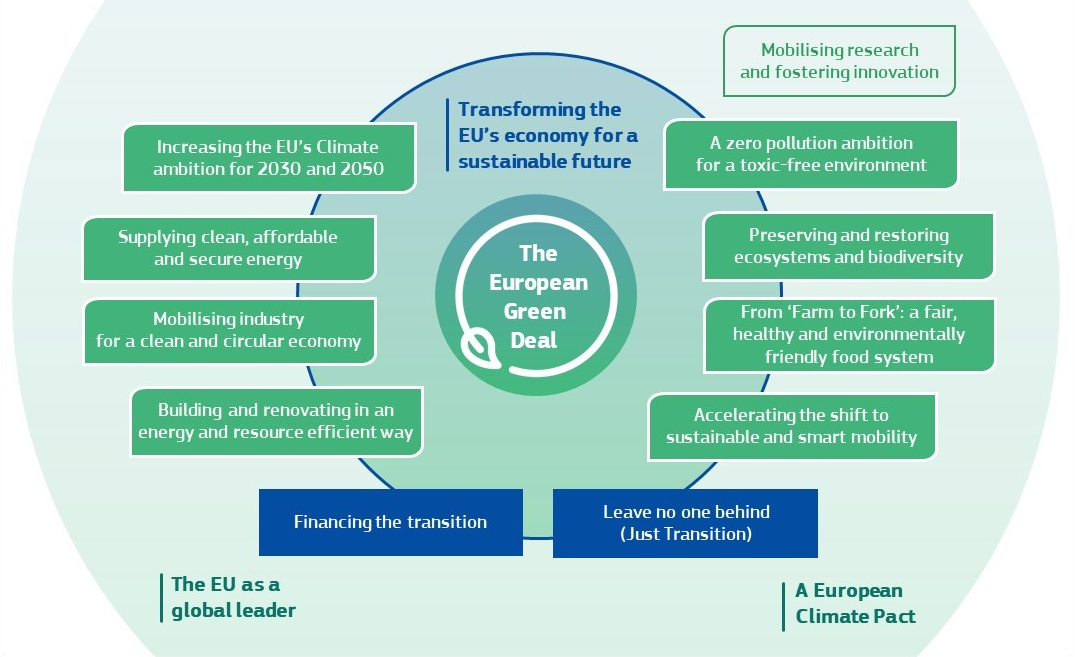
Figure 1 illustrates the various elements of the Green Deal. Transforming the EU’s economy for a sustainable future contains the following elements: increasing the EU’s climate ambition for 2030 and 2050; supplying clean, affordable and secure energy; mobilising industry for a clean and circular economy; building and renovating in an energy- and resource-efficient way; mobilising research and fostering innovation; a zero pollution ambition for a toxic-free environment; preserving and restoring ecosystems and biodiversity; from farm to fork: a fair, health and environmentally friendly food system; accelerating the shift to sustainable and smart mobility; financing the transition; leaving no one behind (just transition).

© European Commission

Source: Commission communication – The European Green Deal, COM(2019) 640.

The Green Deal focuses not only on meeting climate goals, but also promises numerous benefits for Europe, its economies and its citizens, such as cleaner air, water and soil, increased food security and support for agricultural producers.

The ‘fit for 55’ package as part of the Green Deal is a set of proposals to revise and update EU legislation transforming the EU’s climate goal of reducing EU emissions by at least 55 % by 2030 into a binding legal obligation. The EU has established tools and provisions designed to support a fair and just transition and ensure that the most affected vulnerable groups are not left behind during the green transition. The following sections describe these measures and their fundamental rights implications and safeguards. The most important among these are the EU cohesion funds and the Just Transition Mechanism. The centrepiece of NextGenerationEU is the Recovery and Resilience Facility (RRF), which was created to mitigate the pandemic’s economic and social impact and to achieve the EU’s climate targets. The EU has placed particular emphasis on tackling energy poverty and the EU environment action programme (EAP) to 2030 is aimed at reducing emissions and reaching the EU’s climate goals.

In addition, the European Pillar of Social Rights is an overarching social policy instrument of the EU which has relevance to various aspects of the green transition.


3.1. EU funds and the common provisions regulation

One third of the EU’s multiannual 2021–2028 budget and the NextGenerationEU instrument to recover from the COVID-19 pandemic has been allocated to green investments: both established mechanisms and new funds provide specific economic and social support for the green transition.

EU funding managed by the Commission, in partnership with national and regional authorities, accounts for approximately 80 % of the EU budget and is implemented under a 7-year cycle (long-term budget) until 2027. The common provisions regulation lays down common provisions on the Just Transition Fund (JTF), the European Regional Development Fund, the European Social Fund Plus, the Cohesion Fund and others. Article 9 of the regulation defines the horizontal principles for EU shared management funding, which requires Member States to comply with the Charter and the CRPD. Further, Member States and the Commission are obliged to ensure gender equality and non-discrimination based on gender, racial or ethnic origin, religion or belief, disability, age or sexual orientation and accessibility for persons with disabilities during the preparation, implementation, monitoring, reporting and evaluation of programmes.

The JTF was established to mitigate the potential negative consequences of the green transition, focusing on those territories most likely affected by the transition towards climate neutrality, with the overall goal of reducing regional disparities.

In 2023, FRA research explored how the enabling conditions in applying EU funds related to the Charter and the CRPD are upheld in practice. It identified several areas for improvement, including the need for meaningful participation of fundamental rights bodies and civil society in all relevant phases of the implementing programmes. It further highlighted the need to build capacities, the development of tools and the provision of sufficient resources for the relevant bodies and organisations by Member States. The report also stressed the need to enhance monitoring and provide access to transparent, independent complaint mechanisms.

Not all EU funds fall under the common provisions regulation and, as such, not all are subject to the enabling condition on the Charter in the implementation of the programmes, for example the Social Climate Fund (SCF) and the NextGenerationEU Fund (see Sections 3.1.1 and 3.1.2).


3.1.1. Just Transition Mechanism & Social Climate Fund

The transition to a more sustainable Europe is supported by funds under the Just Transition Mechanism and the JTF, along with the SCF and the European Globalisation Adjustment Fund, among others. The mechanism aims at alleviating, for the most affected territories, the economic, environmental and social costs of the transition towards climate neutrality by 2050.

The overarching goals of the mechanism target (i) companies and sectors active in or comprising carbon-intensive industries, (ii) Member States and regions with high dependence on fossil fuel and carbon-intensive industries, and (iii) protecting people and citizens most vulnerable to the transition by:

  • facilitating employment opportunities in new sectors and those in transition;
  • offering re-skilling opportunities;
  • improving energy-efficient housing;
  • fighting energy poverty;
  • facilitating access to clean, affordable and secure energy.

Member States are required, in their territorial just transition plans, to identify the ‘most negatively affected territories, including the social, economic and environmental impact of the transition to a climate-neutral economy of the Union by 2050, identifying the potential number of affected jobs and job losses, the depopulation risks, and the development needs and objectives, to be reached by 2030 and linked to the transformation or closure of greenhouse gas-intensive activities in those territories’.

As outlined in Section 3.1, the implementation of major EU funds must consider the horizontal enabling condition of compliance with the Charter and the CRPD. Furthermore, the regulation that establishes the JTF requires Member States to prepare their territorial just transition plans in compliance with the EPSR (see Article 11).

The SCF is part of a larger effort to reduce greenhouse gas emissions in the EU by 55 % by 2030 (‘fit for 55’), which will launch in 2026. It focuses on ‘vulnerable households, micro-businesses and transport users’ who are negatively impacted by the costs of the green energy transition in the areas of buildings and road transportation. The objective of supporting vulnerable households is to ‘help tackle energy poverty and improve access to zero and low emission mobility.’ Member States are due to submit their proposals on the use of the fund by June 2025. The regulation establishing the fund requires Member States to set up their national social climate plans in a manner consistent with the action plan for the implementation of the EPSR (EPSR action plan).


3.1.2. Recovery and Resilience Facility

The RRF was established as the centre piece of the NextGenerationEU funding in 2021 to support the economic recovery from the coronavirus pandemic and build a greener, more digital and more resilient future for the EU. National plans were required to allocate at least 37 % of their budget to green measures. Funding provided under the RRF must support equal opportunities, including gender equality, and contribute to the implementation of the EPSR. As such, it strengthens EU efforts to support greening of policies and mitigating impact of necessary climate transition issues in connection with economic impacts of the COVID-19 pandemic. With respect to fundamental rights, the regulation provides one limited reference to the Charter in its recital (33): ‘Recovery and resilience plans should not affect the right to conclude or enforce collective agreements or to take collective action in accordance with the Charter of Fundamental Rights of the European Union, and Union and national law and practices.’

A 2023 FRA report on social rights in the RRF  finds that ‘some Member States put forward measures in their plans that may raise concerns about compatibility with the EU Charter of Fundamental Rights or the CRPD. For example, using facility funds to refurbish or build institutions for people with disabilities may not comply with Article 19 of the CRPD on living independently and being included in the community’. The measures address a number of social vulnerabilities among a variety of population groups in the EU, including women, children and young people in situations of vulnerability, people with disabilities, older people, Roma people and people in precarious working conditions. Out of 4 473 measures adopted, 869 addressed the social and territorial cohesion and only 7 % social protection, including social services and the integration of people in vulnerable situations. The European Institute for Gender Equality’s assessment of the RRF is that its gender equality provisions fall short in comparison with the legal and policy commitments to gender equality by the EU and the Member States, along with the 2024 international NGO report of the Citizens Observatory for Green Deal Financing finding a lack of attention for social inclusion and fundamental rights in the RRF.


3.2. EU action to address energy poverty

The revised EU energy efficiency directive and the social climate fund regulation define energy poverty in the following terms:

‘Energy poverty’ means a household’s lack of access to essential energy services, where such services provide basic levels and decent standards of living and health, including adequate heating, hot water, cooling, lighting, and energy to power appliances, in the relevant national context, existing national social policy and other relevant national policies, caused by a combination of factors, including at least non-affordability, insufficient disposable income, high energy expenditure and poor energy efficiency of homes


In September 2023, the new energy efficiency directive  was published, establishing targets for reducing the EU’s energy consumption by 11.7 % until 2030. It obliges Member States to prioritise vulnerable customers and social housing within the scope of their energy savings measures and to actively address energy poverty. Member States are encouraged to make the best possible use of funds to ensure a just and inclusive energy transition.

In October 2023, the Commission published its recommendation to tackle energy poverty across the EU, calling on Member States to take swift action to implement the definition of energy poverty and to set out structural measures to ensure affordability and access to energy.

The Energy Poverty Advisory Hub is an EU-funded initiative aimed at knowledge sharing, capacity building and technical assistance for local governments in the Member States. It includes an online platform with information materials, training courses and sharing good practices, along with direct technical assistance to local governments in tackling energy poverty via two grant calls in 2022 and 2023. It also produced a methodology guidebook, which identified several primary and secondary indicators to measure energy poverty across the EU.

The recast electricity directive (Directive (EU) 2019/944), adopted as part of the clean energy for all Europeans package, establishes a right to universal service, where Member States are obliged to ensure electricity supply for household customers (Article 27), easily and clearly comparable, with transparent and non-discriminatory prices and implemented in a transparent and non-discriminatory way. In substance it is in line with the Charter principle, which recognises and respects access to services of general economic interest (Article 36), but does not refer directly to the Charter’s provision or other relevant international human rights instruments, such as the CRPD.

The 2024 revised energy performance of buildings directive aims to increase the rate of renovation in the EU, particularly for the worst-performing buildings in each country. Member States must support the introduction of minimum energy performance standards with an enabling framework including technical assistance and financing support, in particular targeting vulnerable households (recital 29). Further financial incentives target, as a priority, vulnerable households, people affected by energy poverty and people living in social housing (Article 17 (18)).

Similarly, the 2024 electricity market reform directive (Directive (EU) 2024/1711) and Regulation (EU) 2024/1747 explicitly address energy poverty and vulnerable energy customers. They foresee protection from electricity disconnection (Article 28a) and non-discriminatory access to energy supplies, including the right to energy sharing (Article 15a).


3.3. The European Pillar of Social Rights

Although not a legally binding instrument, the EPSR enshrines 20 basic principles of EU social policies relating to equal opportunities and access to the labour market, fair working conditions and social protection and inclusion in broader terms, such as homelessness. The EPSR action plan was adopted in 2020 with the aim of strengthening the social dimension of all EU policies. It seeks to ‘ensure that the transition to climate-neutrality, digitalisation and demographic change are socially fair and just, and making the Green Deal and the upcoming 2030 Digital Decade successes for all Europeans.’

The EPSR provides a clear reference point for the Just Transition Mechanism, emphasising the need to focus on those most vulnerable to the impacts of climate change: jobseekers, those at risk of poverty, children, young people, old people, women and workers with disabilities. The EPSR is to ‘serve as a guide toward efficient employment and social outcomes when responding to current and future challenges, which are directly aimed at fulfilling people’s essential needs, and towards ensuring better enactment and implementation of social rights.’

The EPSR action plan increasingly takes into account the green transition and the consequences of climate change, but has not done so in a systematic or holistic way. For example, the 2024 Commission staff working document on access to essential services in the EU describes access to energy, water and transport under the aspects of climate change and the green transition. It notes concrete actions such as developing and funding sustainable transport solutions and provides examples of groups in vulnerable situations, such as low-income households, the elderly and persons with disabilities, that could benefit from certain measures.

As the social and environmental agenda are intrinsically linked, the EPSR should be aligned with the ‘European Green Deal’.

European Trade Union Confederation, 2021

The EPSR action plan requires Member States to make full use of the EU funds when planning the allocation of financial resources. A European Parliament briefing on the social and labour market impact of the green transition stresses that the scope and size of such funds is limited: since EU competence in the area of social policy is limited, the policy action relied upon will be at the national and regional levels.

Success or failure of regional, national, and European responses will be determined by the ability of policymakers to set up an integrated policy framework comprising social, labour market and industrial policy elements.


3.4. The EU environment action programme to 2030

Building on the Green Deal, the EAP aims to speed up the transition to a climate-neutral, resource-efficient economy, recognising that human well-being and prosperity depend on healthy ecosystems.

The 8th EAP, adopted on 2 May 2022, established the EU’s common agenda for environment policy until 2030 and particularly calls for active engagement of all stakeholders at all levels of governance, to ensure that EU climate and environment laws are effectively implemented. It provides the policy basis for the EU’s achievement of the environmental goals under the United Nation’s 2030 Agenda and its SDGs.

Six priority objectives should be achieved by 2030: achieving the 2030 greenhouse gas emission reduction target and climate neutrality by 2050; enhancing adaptive capacity, strengthening resilience and reducing vulnerability to climate change; accelerating the transition to a circular economy; pursuing a zero-pollution ambition, including for air, water and soil and protecting the health and well-being of Europeans; protecting, preserving and restoring biodiversity and enhancing natural capital;  and reducing environmental and climate pressures related to production and consumption. These are especially relevant when highlighting the link between greening and impact on human rights through just transition.

It recognises the right to a clean, healthy and sustainable environment, as laid out in Resolution 48/13 of the United Nations Human Rights Council, as an enabling condition for attaining the priority objectives of the 8th EAP.

The EAP is the key instrument of the Green Deal until 2030 and is anchored in the TFEU. It is required to be implemented in line with the SDGs and the EPSR but lacks explicit anchoring in the Charter.

2. The human right to a safe, clean, healthy and sustainable environment4. Challenges from existing EU legislation and policies
Related
Photograph of an elderly couple which is covered in blankets and is sitting next to a heater studying a bill.
AdobeStock@257248327
Report / Paper / Summary
Just and green transition
Environmental and social sustainability
29
January
2026

Fundamental rights and housing in the EU’s climate and energy transition

Making homes energy efficient and equipping them with clean energy can help the EU to reach its climate and energy goals. These measures improve living conditions and support fighting energy poverty, but they can also compromise affordability and displace low-income families. This report looks at housing renovation and clean energy installation programmes and wider EU climate and energy transition policies. It analyses their impact on fundamental rights. It finds that measures often inadvertently exclude people or risk exacerbating existing inequalities. Climate and social policies must comply with fundamental rights obligations. This report builds on FRA’s 2025 publication: Towards a fundamental rights-compliant European Green Deal.
Read Press Release
Report / Paper / Summary
Environmental and social sustainability
Climate change and environmental protection
15
December
2025

Climate change - ECtHR and CJEU Case-Law

This factsheet outlines key judgments of the Court of Justice of the European Union (CJEU) and the European Court of Human Rights (ECtHR) relating to the intersection of climate change and human rights. The issues examined include territorial jurisdiction, standards of protection, standing and victim status, and procedural guarantees in climate-related cases, including the rights of access to information. It is intended to assist legal practitioners, policymakers, and researchers in understanding and applying the evolving human rights jurisprudence in the context of climate change within the European legal space.
Read news item
Creative collage of law and justice, gavel and scales
BillionPhotos.com / adobestock.com, 2025
Report / Paper / Summary
EU Charter of Fundamental Rights
Support for human rights systems and defenders
8
December
2025

Better legislation – Human rights impact assessments in lawmaking

This report examines how human rights impact assessments (HRIAs) are built into lawmaking across the EU and its Member States. It highlights that, although progress has been made, the use of HRIAs remains uneven and often superficial. In many EU countries, the EU Charter of Fundamental Rights is frequently overlooked. The report identifies insufficient consultation with external experts, limited stakeholder participation and a lack of evaluation once laws are in force. To address these gaps, it offers practical recommendations for more systematic, inclusive and evidence-based HRIAs that strengthen human rights protection and ensure better, more accountable legislation throughout the EU.
Read news item
Fundamental Rights Report
Support for human rights systems and defenders
Asylum, migration and borders
Data protection, privacy and new technologies
Equality, non-discrimination and racism
Justice, victims’ rights and judicial cooperation
10
June
2025

Fundamental Rights Report 2025 - FRA opinions

This publication is an excerpt from the Fundamental Rights Report 2025, the annual report of the European Union Agency for Fundamental Rights (FRA). It presents selected critical developments in fundamental rights in 2024, as well as the key findings and FRA opinions from the report’s chapters.
Read press release
Download full report
Download opinions
Lady justice with EU flag as background
respiro888 / Adobestock.com, 2019
Fundamental Rights Report
Support for human rights systems and defenders
Asylum, migration and borders
Data protection, privacy and new technologies
Equality, non-discrimination and racism
Justice, victims’ rights and judicial cooperation
10
June
2025

Fundamental Rights Report 2025

The Fundamental Rights Report 2025 is the annual report of the European Union Agency for Fundamental Rights (FRA). It provides an overview of the state of fundamental rights in the EU and highlights selected critical developments and trends in 2024. The report covers issues such as inclusive elections, gender-based violence, and the implementation of the EU Charter of Fundamental Rights. It presents FRA’s opinions on these developments, setting out the actions that the EU and Member States should take. This annual publication is a valuable resource for those seeking to stay informed about the EU’s shifting landscape of fundamental rights.
Read press release
Download full report
Download opinions
Report / Paper / Summary
Religion and belief
Equality, non-discrimination and racism
Hate crime
Racial and ethnic origin
25
October
2024

Being Muslim in the EU - Experiences of Muslims

Racism towards Muslims is increasing in countries across the EU. Muslims face racial discrimination and racist harassment because of their religion, skin colour or ethnic background. This report shows a sharp rise since the last survey in 2016.
Read press release
FRA's Fundamental rights report 2024
Fundamental Rights Report
Support for human rights systems and defenders
Asylum, migration and borders
Data protection, privacy and new technologies
Equality, non-discrimination and racism
Justice, victims’ rights and judicial cooperation
Environmental and social sustainability
5
June
2024

Fundamental Rights Report 2024

FRA’s Fundamental Rights Report 2024 analyses the year’s developments in fundamental rights. It focuses on the most pressing fundamental rights concerns facing Europe in 2023: the cost-of-living crisis, rights concerns at the EU’s external borders and migration, and threats to democracy. Re-structured, this year’s new approach is a shorter and sharper analysis. It also presents FRA’s opinions on these developments, including a summary of the evidence supporting these opinions.
Read press release
Download full report
Download opinions
Industry smoking chimneys with forest overlay.
Report / Paper / Summary
Consumer protection
Justice, victims’ rights and judicial cooperation
Environmental and social sustainability
7
March
2024

Enforcing consumer rights to combat greenwashing

Tackling greenwashing is an issue where human rights, consumer rights and climate goals align. Companies use greenwashing to convince people to buy products that are not always as environmentally friendly as they claim to be. They mislead consumers and harm the environment. This report shows how a human rights approach can combat greenwashing. It is based on consultations with experts in 10 Member States. The report identifies gaps in existing laws and enforcement. It includes case studies of consumers seeking remedies for misleading environmental claims.
Read news item
Report / Paper / Summary
Child protection
Asylum, migration and borders
Equality, non-discrimination and racism
Children, youth and older people
31
January
2024

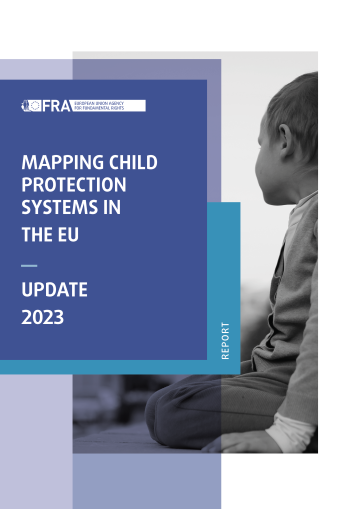
Mapping Child Protection Systems in the EU – Update 2023

Children’s rights exist to ensure the safety and wellbeing of every child. Improved child protection systems ensure that these rights are met. In recent years, the EU has taken significant steps to improve child protection systems. This mapping of child protection systems gives an overview of the state of such systems at national level and developments since 2015. It promotes the improvement of integrated child protection systems. It is an update of FRA’s mapping of child protection systems in 2015, based on data collected in 2023 in the 27 EU Member States. By publishing this, FRA aims to support securing the sustainable well-being, safety and rights of all children living in the EU.
Access the data explorer
Montage of faces of various Black people.
Report / Paper / Summary
Racial and ethnic origin
Equality, non-discrimination and racism
Hate crime
25
October
2023

Being Black in the EU – Experiences of people of African descent

FRA's first Being Black in the EU report exposed widespread and entrenched racism against people of African descent in Europe. Now updated with new data, this report revisits the situation revealing persistent racial discrimination, harassment and violence. Overall, experiences of racial discrimination increased in the EU countries since 2016, reaching as high as 77%. The lack of progress is alarming despite binding anti-discrimination law in the EU since 2000 and significant EU policy developments since then.
Read press release
Report / Paper / Summary
Support for human rights systems and defenders
Asylum, migration and borders
Data protection, privacy and new technologies
Equality, non-discrimination and racism
Justice, victims’ rights and judicial cooperation
20
October
2023

FRA Strategic Plan 2023-2028

FRA’s strategic priorities and objectives are based on the agency’s role and mission as defined in its amended founding regulation. They build on FRA’s 2018–2022 strategy as well as how it performed, its experience and its vision. Their design takes into account future fundamental rights challenges facing Europe, the agency’s mandate, the broader operational context and the resources available.
Little Girl With Down Syndrome And Boy Hugging
kali9 © iStockphoto.com, 2022
Handbook / Guide / Manual
People with disabilities
Equality, non-discrimination and racism
20
March
2023

Implementing the UN Convention on the Rights of Persons with Disabilities: Human rights indicators

This guide helps independent national monitoring frameworks to fulfil their monitoring responsibility set out in Article 33 of the Convention on the Rights of Persons with Disabilities (CRPD). It focuses on the use of indicators. It does not deal with aspects such as compliance with the Paris Principles or the efficiency of complaints mechanisms. Its objective is to support national monitoring frameworks in designing or improving indicators for assessing progress of CRPD implementation at national level.
Read news item
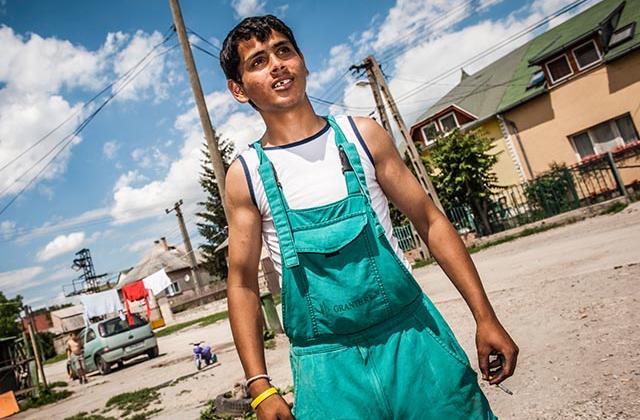
Roma man outside housing in Hungary
Christophe Vander Eecken / EEA and Norway Grants
Report / Paper / Summary
Roma
Equality, non-discrimination and racism
Children, youth and older people
Hate crime
25
October
2022
02 November 2022

Roma in 10 European Countries - Main results

This report presents findings from FRA’s 2021 survey on Roma in Croatia, Czechia, Greece, Hungary, Italy, Portugal, Romania and Spain, as well as in North Macedonia and Serbia. The survey includes interviews with more than 8,400 Roma, collecting information on more than 20,000 individuals living in their households. By focusing on Roma, the survey provides unique data and information that are not available from European general population surveys, which do not disaggregate on grounds of ethnic origin. The findings present a bleak but familiar picture of exclusion, deprivation, discrimination and racism.
Read Press Release
Explore survey data
Download dataset
Par FRA

Uzziniet vairāk par aģentūru un tās darbu šeit.

  • Par FRA
  • ES Pamattiesību Harta
  • Kur vērsties pēc palīdzības
  • Jaunumi
  • Abonēt jaunākās ziņas
Sazināties
Address
European Union Agency for Fundamental Rights
Schwarzenbergplatz 11
A-1040 Vienna, Austria
E-mail
Sazinieties ar mums
Newsletter
Abonēt jaunākās ziņas
  • Facebook
  • Twitter
  • LinkedIn
  • YouTube
  • Newsletter
  • E-mail
  • RSS

© European Union Agency for Fundamental Rights, 2007-2026

  • About this website
  • Legal notice
  • Cookies
  • Data Protection
  • Accessibility