eu-charter

Carta dos Direitos Fundamentais da UE

Artigo 6.o- Direito à liberdade e à segurança

Artigo 6.o- Direito à liberdade e à segurança

Toda a pessoa tem direito à liberdade e segurança.

Anotações

  • Text:

    Os direitos consagrados no artigo 6.o correspondem aos direitos garantidos pelo artigo 5.o da CEDH, cujo sentido e âmbito são iguais, de acordo com o disposto no n.o 3 do artigo 52.o da Carta. Resulta daí que as restrições que lhes possam ser legitimamente impostas não poderão exceder as autorizadas pela CEDH nos termos do disposto no artigo 5.o:
    `1. Toda a pessoa tem direito à liberdade e segurança. Ninguém pode ser privado da sua liberdade, salvo nos casos seguintes e de acordo com o procedimento legal:
    a) Se for preso em consequência de condenação por tribunal competente;
    b) Se for preso ou detido legalmente, por desobediência a uma decisão tomada, em conformidade com a lei, por um tribunal, ou para garantir o cumprimento de uma obrigação prescrita pela lei;
    c) Se for preso e detido a fim de comparecer perante a autoridade judicial competente, quando houver suspeita razoável de ter cometido uma infracção, ou quando houver motivos razoáveis para crer que é necessário impedi-lo de cometer uma infracção ou de se pôr em fuga depois de a ter cometido;
    d) Se se tratar da detenção legal de um menor, feita com o propósito de o educar sob vigilância, ou da sua detenção legal com o fim de o fazer comparecer perante a autoridade competente;
    e) Se se tratar da detenção legal de uma pessoa susceptível de propagar uma doença contagiosa, de um alienado mental, de um alcoólico, de um toxicómano ou de um vagabundo;
    f) Se se tratar de prisão ou detenção legal de uma pessoa para lhe impedir a entrada ilegal no território ou contra a qual está em curso um processo de expulsão ou de extradição.
    2. Qualquer pessoa presa deve ser informada, no mais breve prazo e em língua que compreenda, das razões da sua prisão e de qualquer acusação formulada contra ela.
    3. Qualquer pessoa presa ou detida nas condições previstas no parágrafo 1, alínea c), do presente artigo deve ser apresentada imediatamente a um juiz ou outro magistrado habilitado pela lei para exercer funções judiciais e tem direito a ser julgada num prazo razoável, ou posta em liberdade durante o processo. A colocação em liberdade pode estar condicionada a uma garantia que assegure a comparência do interessado em juízo.
    4. Qualquer pessoa privada da sua liberdade por prisão ou detenção tem direito a recorrer a um tribunal, a fim de que este se pronuncie, em curto prazo de tempo, sobre a legalidade da sua detenção e ordene a sua libertação, se a detenção for ilegal.
    5. Qualquer pessoa vítima de prisão ou detenção em condições contrárias às disposições deste artigo tem direito a indemnização.`
    Os direitos consignados no artigo 6.o devem ser respeitados especialmente quando o Parlamento Europeu e o Conselho adoptam actos legislativos na área da cooperação judiciária em matéria penal, com base nos artigos 82.o, 83.o e 85.o do Tratado sobre o Funcionamento da União Europeia, nomeadamente tendo em vista a definição de disposições mínimas comuns em matéria de qualificação de infracções e de penas e determinados aspectos do direito processual.

    Source:
    Jornal Oficial da União Europeia C 303/17 - 14.12.2007
    Preamble - Explanations relating to the Charter of Fundamental Rights:
    As presentes anotações, inicialmente elaboradas sob a responsabilidade do Praesidium da Convenção que redigiu a Carta dos Direitos Fundamentais da União Europeia, foram actualizadas sob a responsabilidade do Praesidium da Convenção Europeia, à luz das adaptações ao texto (nomeadamente aos artigos 51.o e 52.o) da Carta introduzidas pela Convenção Europeia e da evolução do direito da União. Embora não tenham em si força de lei, constituem um valioso instrumento de interpretação destinado a clarificar as disposições da Carta.

Jurisprudência

Direitos constitucionais nacionais

42 results found

  • Grundgesetz für die Bundesrepublik Deutschland
    País:
    Germany

    Artikel 104 (1) Die Freiheit der Person kann nur auf Grund eines förmlichen Gesetzes und nur unter Beachtung der darin vorgeschriebenen Formen beschränkt werden. Festgehaltene Personen dürfen weder seelisch noch körperlich mißhandelt werden. (2) Über die Zulässigkeit und Fortdauer einer Freiheitsentziehung hat nur der Richter zu entscheiden. Bei jeder nicht auf richterlicher Anordnung beruhenden Freiheitsentziehung ist unverzüglich eine richterliche Entscheidung herbeizuführen. Die Polizei darf aus eigener Machtvollkommenheit niemanden länger als bis zum Ende des Tages nach dem Ergreifen in eigenem Gewahrsam halten. Das Nähere ist gesetzlich zu regeln. (3) Jeder wegen des Verdachtes einer strafbaren Handlung vorläufig Festgenommene ist spätestens am Tage nach der Festnahme dem Richter vorzuführen, der ihm die Gründe der Festnahme mitzuteilen, ihn zu vernehmen und ihm Gelegenheit zu Einwendungen zu geben hat. Der Richter hat unverzüglich entweder einen mit Gründen versehenen schriftlichen Haftbefehl zu erlassen oder die Freilassung anzuordnen. (4) Von jeder richterlichen Entscheidung über die Anordnung oder Fortdauer einer Freiheitsentziehung ist unverzüglich ein Angehöriger des Festgehaltenen oder eine Person seines Vertrauens zu benachrichtigen.

  • Konstytucja Rzeczypospolitej Polskiej
    País:
    Poland

    Art. 41.1. Każdemu zapewnia się nietykalność osobistą i wolność osobistą. Pozbawienie lub ograniczenie wolności może nastąpić tylko na zasadach i w trybie określonych w ustawie.2. Każdy pozbawiony wolności nie na podstawie wyroku sądowego ma prawo odwołania się do sądu w celu niezwłocznego ustalenia legalności tego pozbawienia. O pozbawieniu wolności powiadamia się niezwłocznie rodzinę lub osobę wskazaną przez pozbawionego wolności. 3. Każdy zatrzymany powinien być niezwłocznie i w sposób zrozumiały dla niego poinformowany o przyczynach zatrzymania. Powinien on być w ciągu 48 godzin od chwili zatrzymania przekazany do dyspozycji sądu. Zatrzymanego należy zwolnić, jeżeli w ciągu 24 godzin od przekazania do dyspozycji sądu nie zostanie mu doręczone postanowienie sądu o tymczasowym aresztowaniu wraz z przedstawionymi zarzutami. 4. Każdy pozbawiony wolności powinien być traktowany w sposób humanitarny. 5. Każdy bezprawnie pozbawiony wolności ma prawo do odszkodowania.

  • Konvention zum Schutze der Menschenrechte und Grundfreiheiten
    País:
    Austria

    Artikel 5 (1) Jedermann hat ein Recht auf Freiheit und Sicherheit.

  • La Constitution Belge
    País:
    Belgium

    Article 12.La liberté individuelle est garantie.
    Nul ne peut être poursuivi que dans les cas prévus par la loi, et dans la forme qu'elle prescrit.
    Hors le cas de flagrant délit, nul ne peut être arrêté qu'en vertu d'une ordonnance motivée du juge qui doit être signifiée au plus tard dans les quarante-huit heures de la privation de liberté et ne peut emporter qu'une mise en détention préventive.

  • Latvijas Republikas Satversme
    País:
    Latvia

    94. Ikvienam ir tiesības uz brīvību un personas neaizskaramību. Nevienam nedrīkst atņemt vai ierobežot brīvību citādi kā tikai saskaņā ar likumu.

  • Lietuvos Respublikos Konstitucija
    País:
    Lithuania

    20 straipsnis. Žmogaus laisvė neliečiama.Niekas negali būti savavališkai sulaikytas arba laikomas suimtas. Niekam neturi būti atimta laisvė kitaip, kaip tokiais pagrindais ir pagal tokias procedūras, kokias yra nustatęs įstatymas.Nusikaltimo vietoje sulaikytas asmuo per 48 valandas turi būti pristatytas į teismą, kur sulaikytajam dalyvaujant sprendžiamas sulaikymo pagrįstumas. Jeigu teismas nepriima nutarimo asmenį suimti, sulaikytasis tuojau pat paleidžiamas.

  • Luxembourg / Constitution of the Grand Ducal of Luxembourg
    País:
    Luxembourg

    Art. 17. (1) La liberté individuelle est garantie. 

    (2) Nul ne peut être poursuivi, arrêté ou privé de sa liberté que dans les cas prévus et dans la forme déterminée par la loi. 

    (3) Sauf le cas de flagrant délit, nul ne peut être arrêté qu’en vertu d’une décision de justice motivée, qui doit être notifiée au moment de l’arrestation ou au plus tard dans les vingt-quatre heures. 

    (4) Toute personne accusée d’une infraction est présumée innocente jusqu’à ce que sa culpabilité ait été légalement établie. 

    Toute personne doit être informée sans délai des raisons de son arrestation ou de la privation de sa liberté, des accusations portées contre elle et des moyens de recours légaux dont elle dispose pour recouvrer sa liberté.

  • Magyarország Alaptörvénye
    País:
    Hungary

    IV. cikk (SZABADSÁG ÉS FELELŐSSÉG) (1) Mindenkinek joga van a szabadsághoz és a személyi biztonsághoz. (2) Senkit nem lehet szabadságától másként, mint törvényben meghatározott okokból és törvényben meghatározott eljárás alapján megfosztani. Tényleges életfogytig tartó szabadságvesztés csak szándékos, erőszakos bűncselekmény elkövetése miatt szabható ki. (3) A bűncselekmény elkövetésével gyanúsított és őrizetbe vett személyt a lehető legrövidebb időn belül szabadon kell bocsátani, vagy bíróság elé kell állítani. A bíróság köteles az elé állított személyt meghallgatni és írásbeli indokolással ellátott határozatban szabadlábra helyezéséről vagy letartóztatásáról haladéktalanul dönteni. (4) Akinek szabadságát alaptalanul vagy törvénysért ően korlátozták, kárának megtérítésére jogosult.

  • Netherlands / Constitution of the Kingdom of the Netherlands
    País:
    Netherlands

    Article 15 1. Other than in the cases laid down by or pursuant to Act of Parliament, no one may be deprived of his liberty. 2. Anyone who has been deprived of his liberty other than by order of a court may request a court to order his release. In such a case he shall be heard by the court within a period to be laid down by Act of Parliament. The court shall order his immediate release if it considers the deprivation of liberty to be unlawful. 3. The trial of a person who has been deprived of his liberty pending trial shall take place within a reasonable period. 4. A person who has been lawfully deprived of his liberty may be restricted in the exercise of fundamental rights in so far as the exercise of such rights is not compatible with the deprivation of liberty.

  • Portugal / Constituição da República Portuguesa
    País:
    Portugal

    rtigo 27.º (Direito à liberdade e à segurança) 1. Todos têm direito à liberdade e à segurança. 2. Ninguém pode ser total ou parcialmente privado da liberdade, a não ser em consequência de sentença judicial condenatória pela prática de acto punido por lei com pena de prisão ou de aplicação judicial de medida de segurança. 3. Exceptua-se deste princípio a privação da liberdade, pelo tempo e nas condições que a lei determinar, nos casos seguintes: a) Detenção em flagrante delito; b) Detenção ou prisão preventiva por fortes indícios de prática de crime doloso a que corresponda pena de prisão cujo limite máximo seja superior a três anos; c) Prisão, detenção ou outra medida coactiva sujeita a controlo judicial, de pessoa que tenha penetrado ou permaneça irregularmente no território nacional ou contra a qual esteja em curso processo de extradição ou de expulsão; d) Prisão disciplinar imposta a militares, com garantia de recurso para o tribunal competente; e) Sujeição de um menor a medidas de protecção, assistência ou educação em estabelecimento adequado, decretadas pelo tribunal judicial competente; f) Detenção por decisão judicial em virtude de desobediência a decisão tomada por um tribunal ou para assegurar a comparência perante autoridade judiciária competente; g) Detenção de suspeitos, para efeitos de identificação, nos casos e pelo tempo estritamente necessários; h) Internamento de portador de anomalia psíquica em estabelecimento terapêutico adequado, decretado ou confirmado por autoridade judicial competente. 4. Toda a pessoa privada da liberdade deve ser informada imediatamente e de forma compreensível das razões da sua prisão ou detenção e dos seus direitos. 5. A privação da liberdade contra o disposto na Constituição e na lei constitui o Estado no dever de indemnizar o lesado nos termos que a lei estabelecer.

  • Romania / Constitution of Romania
    País:
    Romania

    Article 23(1) Individual freedom and security of a person are inviolable. (2) Search, detainment, or arrest of a person shall be permitted only in the cases and under the procedure provided by law. (3) Detention shall not exceed twenty-four hours. (4) Preventive custody shall be ordered by a judge and only in the course of criminal proceedings. (5) During the criminal proceedings, the preventive custody may only be ordered for 30 days at the most and extended for 30 days at the most each, without the overall length exceeding a reasonable term, and no longer than i80 days. (6) After the lawsuit has begun, the court is bound, according to the law, to check, on a regular basis and no later than 60 days, the lawfulness and grounds of the preventive custody, and to order at once the release of the defendant if the grounds for the preventive custody have ceased to exist or if the court finds there are no new grounds justifying the continuance of the custody. (7) The decisions by a court of law on preventive custody may be subject to the legal proceedings stipulated by the law. (8) Any person detained or arrested shall be promptly informed, in a language he understands, of the grounds for his detention or arrest, and notified of the charges against him, as soon as practicable; the notification of the charges shall be made only in the presence of a lawyer of his own choosing or appointed ex officio. (9) The release of a detained or arrested person shall be mandatory if the reasons for such steps have ceased to exist, as well as under other circumstances stipulated by the law. (10) A person under preventive custody shall have the right to apply for provisional release, under judicial control or on bail. (13) The freedom deprivation sanction can only be based on criminal grounds.

  • Slovakia / Constitution of the Slovak Republic
    País:
    Slovakia

    Article 17(1) Personal freedom is guaranteed. (2) No one shall be prosecuted or deprived of freedom other than for reasons and in a manner which shall be laid down by law. No one may be deprived of freedom solely because of his inability to fulfil a contractual obligation. (3) The person charged or suspected of a criminal offence may be detained only in cases laid down by law. A detained person must be immediately informed of the reasons for the detainment, and after interrogation at the latest within 48 hours and, in crimes of terrorism within 96 hours, must be either released or brought before the court. The judge must question the detained person and decide on his custody or release within 48 hours and, for especially serious criminal offences within 72 hours from the hand over. (4) An accused person may be arrested only upon a written, substantiated order of a judge. The arrested person must be brought before the court within 24 hours. The judge must question the arrested person and decide on his custody or release within 48 hours and, for especially serious offences within 72 hours from the hand over. (5) A person may be taken into custody only for reasons and for a period laid down by law and on the basis of a court ruling. (6) The law shall lay down in which cases a person can be admitted to, or kept in, a health care institution without his consent. Such measures must be reported within 24 hours to the court which will then decide on this placement within five days. (7) The mental state of a person accused of a criminal act may be examined only on the basis of a written court order.

  • Slovenia / Constitution of the Republic of Slovenia
    País:
    Slovenia

    Article 19 Everyone has the right to personal liberty. No one may be deprived of his liberty except in such cases and pursuant to such procedures as are provided by law.Anyone deprived of his liberty must be immediately informed in his mother tongue, or in a language which he understands, of the reasons for being deprived of his liberty. Within the shortest possible time thereafter, he must also be informed in writing of why he has been deprived of his liberty. He must be instructed immediately that he is not obliged to make any statement, that he has the right to immediate legal representation of his own free choice and that the competent authority must, on his request, notify his relatives or those close to him of the deprivation of his liberty.

    Article 20A person reasonably suspected of having committed a criminal offence may be detained only on the basis of a court order when this is absolutely necessary for the course of criminal proceedings or for reasons of public safety.Upon detention, but not later than twenty-four hours thereafter, the person detained must be handed the written court order with a statement of reasons. The person detained has the right to appeal against the court order, and such appeal must be decided by a court within forty-eight hours. Detention may last only as long as there are legal reasons for such, but no longer than three months from the day of the deprivation of liberty. The Supreme Court may extend the detention a further three months.If no charges are brought by the end of these terms, the suspected person shall be released.

  • Spain / Constitution of the Kingdom of Spain
    País:
    Spain

    Article 17 (1). Every person has the right to freedom and security. No one may be deprived of his or her freedom except in accordance with the provisions of this section and in the cases and in the manner provided for by the law.2. Preventive arrest may last no longer than the time strictly necessary in order to carry out the investigations aimed at establishing the events; in any case the person arrested must be set free or handed over to the judicial authorities within a maximum period of seventy-two hours. 3. Every person arrested must be informed immediately, and in a way understandable to him or her, of his or her rights and of the grounds for his or her arrest, and may not be compelled to make a statement. The arrested person shall be guaranteed the assistance of a lawyer during police and judicial proceedings, under the terms to be laid down by the law. 4. An habeas corpus procedure shall be provided for by law in order to ensure the immediate handing over to the judicial authorities of any person illegally arrested. Likewise, the maximum period of provisional imprisonment shall be determined by law.

  • Suomen perustuslaki
    País:
    Finland

    7 § Oikeus elämään sekä henkilökohtaiseen vapauteen ja koskemattomuuteen Jokaisella on oikeus elämään sekä henkilökohtaiseen vapauteen, koskemattomuuteen ja turvallisuuteen. Ketään ei saa tuomita kuolemaan, kiduttaa eikä muutoinkaan kohdella ihmisarvoa loukkaavasti. Henkilökohtaiseen koskemattomuuteen ei saa puuttua eikä vapautta riistää mielivaltaisesti eikä ilman laissa säädettyä perustetta. Rangaistuksen, joka sisältää vapaudenmenetyksen, määrää tuomioistuin. Muun vapaudenmenetyksen laillisuus voidaan saattaa tuomioistuimen tutkittavaksi. Vapautensa menettäneen oikeudet turvataan lailla.

  • The Belgian Constitution
    País:
    Belgium

    Article 12. The freedom of the individual is guaranteed.
    No one can be prosecuted except in the cases provided for by the law, and in the
    form prescribed by the law.
    Except in the case of a flagrant offence, no one can be arrested except on the
    strength of a reasoned judge’s order, which must be served at the latest within forty-eight
    hours from the deprivation of liberty and which may only result in provisional detention.

  • The Constitution of the Republic of Cyprus
    País:
    Cyprus

    Article 11
    1. Every person has the right to liberty and security of person.
    2. No person shall be deprived of his liberty save in the following cases when and as provided by law: -
    (a) the detention of a person after conviction by a competent court;
    (b) the arrest or detention of a person for non-compliance with the lawful order of a court;
    (c) the arrest or detention of a person effected for the purpose of bringing him before the competent legal authority on reasonable suspicion of having committed an offence or when it is reasonably considered necessary to prevent his committing anoffence or fleeing after having done so;
    (d) the detention of a minor by a lawful order for the purpose of educational supervision or his lawful detention for the purpose of bringing him before the competent legal authority;
    (e) the detention of persons for the prevention of spreading of infectious diseases, of persons of unsound mind, alcoholics or drug addicts or vagrants;
    (f) the arrest or detention of a person to prevent him effecting an unauthorised entry into the territory of the Republic or of an alien against whom action is being taken with a view to deportation or extradition.
    3. Save when and as provided by law in case of a flagrant offence punishable with death or imprisonment, no person shall be arrested save under the authority of a reasoned judicial warrant issued according to the formalities prescribed by the law.
    4. Every person arrested shall be informed at the time of his arrest in a language which he understands of the reasons for his arrest and shall be allowed to have the services of a lawyer of his own choosing.
    5. The person arrested shall, as soon as is practicable after his arrest, and in any event not later than twenty-four hours after the arrest, be brought before a judge, if not earlier released.
    6. The judge before whom the person arrested is brought shall promptly proceed to inquire into the grounds of the arrest in a language understandable by the person arrested and shall, as soon as possible and in any event not later than three days from such appearance, either release the person arrested on such terms as he may deem fit or where the investigation into the commission of the offence for which he has been arrested has not been completed remand him in custody and may remand him in custody from time to time for a period not exceeding eight days at any one time:
    Provided that the total period of such remand in custody shall not exceed three months of the date of the arrest on the expiration of which every person or authority having the custody of the person arrested shall forthwith set him free.
    Any decision of the judge under this paragraph shall be subject to appeal.
    7. Every person who is deprived of his liberty by arrest or detention shall be entitled to take proceedings by which the lawfulness of his detention shall be decided speedily by a court and his release ordered if the detention is not lawful.
    8. Every person who has been the victim of arrest or detention in contravention of the provisions of this Article shall have an enforceable right to compensation.

  • The Constitutional Act of Denmark
    País:
    Denmark

    Section 71. Subsection 1. Personal liberty shall be inviolable. No Danish subject shall, in any manner whatsoever, be deprived of his liberty because of his political or religious convictions or because of his descent. Subsection 2. A person shall be deprived of his liberty only when this is warranted by law. Subsection 3. Any person who is taken into custody shall be brought before a judge within twenty-four hours. When the person taken into custody cannot be released immediately, the judge shall decide, in an order to be given as soon as possible and at the latest within three days, stating the grounds, whether the person taken into custody shall be committed to prison; and in cases in which he can be released on bail, the judge shall also determine the nature and amount of such bail. This provision may be disregarded by statute as far as Greenland is concerned, if for local considerations such departure may be deemed necessary. Subsection 4. The pronouncement of the judge may be separately appealed against at once to a higher court of justice by the person concerned. Subsection 5. No person shall be remanded in custody for an offence which can involve only punishment by fine or simple detention. Subsection 6. Outside criminal procedure, the legality of deprivation of liberty not executed by order of a judicial authority, and not warranted by legislation relating to aliens, shall at the request of the person so deprived of his liberty, or the request of any person acting on his behalf, be brought before the ordinary courts of justice or other judicial authority for decision. Rules governing this procedure shall be provided by statute. Subsection 7. The persons referred to in Sub-section (6) shall be under supervision by a board set up by the Folketing, to which board the persons concerned shall be permitted to apply.
    Section 85. The provisions of Sections 71, 78, and 79 shall be applicable only to the armed forces, subject to such limitations as are consequential to the provisions of military laws.

  • The Fundamental Law of Hungary
    País:
    Hungary

     Article IV (Freedom and Responsibility)(1) Everyone shall have the right to liberty and security of the person.
    (2) No one shall be deprived of liberty except for reasons specified in an Act and in accordance with the procedure laid down in an Act. Life imprisonment without parole may only be imposed for the commission of intentional and violent criminal offences.
    (3) Any person suspected of having committed a criminal offence and taken into detention
    must, as soon as possible, be released or brought before a court. The court shall be obliged to hear the person brought before it and shall without delay make a decision with a written statement of reasons to release or to arrest that person.
    (4) Everyone whose liberty has been restricted without a well-founded reason or unlawfully
    shall have the right to compensation.

  • Tο Σύνταγμα της Κυπριακής Δημοκρατίας
    País:
    Cyprus

    ΑΡΘΡΟΝ 11
    1. Έκαστος έχει το δικαίωμα ελευθερίας και προσωπικής ασφαλείας.
    2. Ουδείς στερείται της ελευθερίας αυτού, ειμή ότε και όπως ο νόμος ορίζει εις τας περιπτώσεις:
    (α) κρατήσεως ατόμου μετά την καταδίκην αυτού υπό αρμοδίου δικαστηρίου,
    (β) συλλήψεως ή κρατήσεως ατόμου λόγω μη συμμορφώσεως προς νόμιμον διαταγήν δικαστηρίου,
    (γ) συλλήψεως ή κρατήσεως ατόμου ενεργουμένης προς τον σκοπόν προσαγωγής αυτού ενώπιον της αρμοδίας κατά νόμον αρχής επί τη ευλόγω υπονοία ότι διέπραξεν αδίκημα ή οσάκις η σύλληψις ή κράτησις θεωρηθή ευλόγως αναγκαία προς παρεμπόδισιν διαπράξεως αδικήματος ή αποδράσεως μετά την διάπραξιν αυτού,
    (δ) περιορισμού ανηλίκου δυνάμει νομίμου διαταγής προς τον σκοπόν αναμορφωτικής επιβλέψεως ή νομίμου κρατήσεως προς τον σκοπόν προσαγωγής αυτού ενώπιον της αρμοδίας κατά νόμον αρχής,
    (ε) περιορισμού ατόμων προς παρεμπόδισιν επεκτάσεως μεταδοτικών νόσων, ατόμων ασθενών διανοητικώς, αλκοολικών, τοξικομανών ή αλητών, και
    (στ) σύλληψης ή κράτησης ατόμου προς παρεμπόδιση της χωρίς άδεια εισόδου στο έδαφος της Δημοκρατίας ή σύλληψης ή κράτησης αλλοδαπού εναντίον του οποίου έγιναν ενέργειες προς το σκοπό απέλασης ή έκδοσης ή σύλληψης ή κράτησης πολίτη της Δημοκρατίας προς το σκοπό της έκδοσης ή παράδοσής του με βάση ευρωπαϊκό ένταλμα σύλληψης ή σύμφωνα με διεθνή σύμβαση που δεσμεύει τη Δημοκρατία, υπό τον όρο ότι τέτοια σύμβαση εφαρμόζεται αντίστοιχα και από τον αντισυμβαλλόμενο. Η σύλληψη ή η κράτηση όμως οποιουδήποτε προσώπου προς το σκοπό έκδοσης ή παράδοσής του δεν είναι δυνατή εάν το αρμόδιο κατά νόμο όργανο ή αρχή έχει ουσιώδη λόγο να πιστεύει ότι το αίτημα της έκδοσης ή παράδοσης έγινε με σκοπό την ποινική δίωξη ή την τιμωρία προσώπου συνεπεία της φυλής, της θρησκείας, της εθνικότητας, της εθνοτικής καταγωγής, των πολιτικών πεποιθήσεων ή των νόμιμων κατά το διεθνές δίκαιο διεκδικήσεων συλλογικών ή ατομικών δικαιωμάτων.
    3. Εξαιρουμένου του δια φυλακίσεως, ότε και όπως ο νόμος ορίζη, τιμωρουμένου αυτοφώρου αδικήματος, ουδείς συλλαμβάνεται, ειμή κατόπιν ητιολογημένου δικαστικού εντάλματος εκδοθέντος συμφώνως προς τους υπό του νόμου προδιαγεγραμμένους τύπους, ή με βάση ευρωπαϊκό ένταλμα σύλληψης.
    4. Πας συλλαμβανόμενος πληροφορείται κατά την στιγμήν της συλλήψεως αυτού εις καταληπτήν υπ’ αυτού γλώσσαν τους λόγους της συλλήψεως αυτού και δικαιούται να τύχη των υπηρεσιών συνηγόρου της εκλογής αυτού.
    5. Ο συλληφθείς προσάγεται ενώπιον του δικαστού ως οιόν τε συντομώτερον ευθύς μετά την σύλληψιν αυτού, πάντως δε το βραδύτερον εντός είκοσι τεσσάρων ωρών από της συλλήψεως, εφ’ όσον δεν αφεθή πρότερον ελεύθερος.
    6. Ο δικαστής, ενώπιον του οποίου προσήχθη ο συλληφθείς, χωρεί ταχέως εις διερεύνησιν των λόγων της συλλήψεως εις καταληπτήν υπό του συλληφθέντος γλώσσαν και, ως οιόν τε συντομώτερον, πάντως δε το βραδύτερον εντός τριών ημερών από της τοιαύτης προσαγωγής, ή απολύει τον συλληφθέντα υπό τους κατά την κρίσιν αυτού καταλλήλους όρους ή διατάσσει την κράτησιν αυτού, οσάκις η περί της διαπράξεως του αδικήματος ανάκρισις, δι’ ο συνελήφθη, δεν συνεπληρώθη και δύναται να διατάσση εκάστοτε την κράτησιν αυτού επί περίοδον χρόνου μη υπερβαίνουσαν τας οκτώ ημέρας. Ο συνολικός χρόνος όμως της τοιαύτης κρατήσεως δέον να μη υπερβαίνη τους τρεις μήνας από της ημερομηνίας της συλλήψεως, μετά την παρέλευσιν των οποίων παν άτομον ή αρχή έχουσα υπό κράτησιν τον συλληφθέντα απολύει αυτόν παρευθύς. Πάσα κατά τα ανωτέρω απόφασις του δικαστού υπόκειται εις έφεσιν.
    7. Πας στερηθείς της ελευθερίας αυτού δια συλλήψεως ή κρατήσεως δικαιούται να προσφύγη εις το αρμόδιον δικαστήριον, ίνα τούτο κρίνη ταχέως την νομιμότητα της κρατήσεως και διατάξη την απόλυσιν αυτού, εάν η κράτησις δεν είναι νόμιμος.
    8. Ο κατά παράβασιν των διατάξεων του παρόντος άρθρου συλληφθείς ή κρατηθείς έχει αγώγιμον δικαίωμα προς αποζημίωσιν.

Direito da UE

13 results found

  • 2002/584/JHA: Council Framework Decision of 13 June 2002 on the European arrest warrant and the surrender procedures between Member States

    Preamble 

    (12) This Framework Decision respects fundamental rights and observes the principles recognised by Article 6 of the Treaty on European Union and reflected in the Charter of Fundamental Rights of the European Union(7), in particular Chapter VI thereof. Nothing in this Framework Decision may be interpreted as prohibiting refusal to surrender a person for whom a European arrest warrant has been issued when there are reasons to believe, on the basis of objective elements, that the said arrest warrant has been issued for the purpose of prosecuting or punishing a person on the grounds of his or her sex, race, religion, ethnic origin, nationality, language, political opinions or sexual orientation, or that that person's position may be prejudiced for any of these reasons.

    Article 27: Possible prosecution for other offences

    2. Except in the cases referred to in paragraphs 1 and 3, a person surrendered may not be prosecuted, sentenced or otherwise deprived of his or her liberty for an offence committed prior to his or her surrender other than that for which he or she was surrendered.


  • Directive (EU) 2024/1346 of the European Parliament and of the Council of 14 May 2024 laying down standards for the reception of applicants for international protection

    Preamble 


    (31) Applicants who are in detention should be treated with full respect for human dignity and their reception should be specifically designed to meet their needs in that situation. In particular, Member States should ensure that Article 24 of the Charter and Article 37 of the 1989 United Nations Convention on the Rights of the Child are applied.


    (38) In applying this Directive, Member States should seek to ensure full respect for the principles of the best interests of the child and of family unity, in accordance with the Charter, the 1989 United Nations Convention on the Rights of the Child, the European Convention for the Protection of Human Rights and Fundamental Freedoms and, where applicable, the Council of Europe Convention on Preventing and Combating Violence against Women and Domestic Violence.


    (75) This Directive respects the fundamental rights and observes the principles recognised in particular by the Charter. In particular, this Directive seeks to ensure full respect for human dignity and to promote the application of Articles 1, 4, 6, 7, 18, 21, 24 and 47 of the Charter and has to be implemented accordingly.

    Article 19: General rules on material reception conditions and health care

    2.   Member States shall ensure that material reception conditions and health care received in accordance with Article 22 provide an adequate standard of living for applicants, which guarantees their subsistence, protects their physical and mental health and respects their rights under the Charter.

    Article 21: Reception conditions in a Member State other than the one in which the applicant is required to be present

    From the moment applicants have been notified of a decision to transfer them to the Member State responsible in accordance with Regulation (EU) 2024/1351, they shall not be entitled to the reception conditions set out in Articles 17 to 20 of this Directive in any Member State other than the one in which they are required to be present in accordance with Regulation (EU) 2024/1351. This shall be without prejudice to the need to ensure a standard of living in accordance with Union law, including the Charter, and international obligations.

  • Directive 2011/36/EU of the European Parliament and of the Council of 5 April 2011 on preventing and combating trafficking in human beings and protecting its victims, and replacing Council Framework Decision 2002/629/JHA

    Preamble 
    (1) Trafficking in human beings is a serious crime, often committed within the framework of organised crime, a gross violation of fundamental rights and explicitly prohibited by the Charter of Fundamental Rights of the European Union. Preventing and combating trafficking in human beings is a priority for the Union and the Member States.


    (8) Children are more vulnerable than adults and therefore at greater risk of becoming victims of trafficking in human beings. In the application of this Directive, the child’s best interests must be a primary consideration, in accordance with the Charter of Fundamental Rights of the European Union and the 1989 United Nations Convention on the Rights of the Child.

    (10) This Directive is without prejudice to the principle of non-refoulement in accordance with the 1951 Convention relating to the Status of Refugees (Geneva Convention), and is in accordance with Article 4 and Article 19(2) of the Charter of Fundamental Rights of the European Union.


    (33) This Directive respects fundamental rights and observes the principles recognised in particular by the Charter of Fundamental Rights of the European Union and notably human dignity, the prohibition of slavery, forced labour and trafficking in human beings, the prohibition of torture and inhuman or degrading treatment or punishment, the rights of the child, the right to liberty and security, freedom of expression and information, the protection of personal data, the right to an effective remedy and to a fair trial and the principles of the legality and proportionality of criminal offences and penalties. In particular, this Directive seeks to ensure full respect for those rights and principles and must be implemented accordingly.

    Article 1: Subject matter

    This Directive establishes minimum rules concerning the definition of criminal offences and sanctions in the area of trafficking in human beings. It also introduces common provisions, taking into account the gender perspective, to strengthen the prevention of this crime and the protection of the victims thereof.

  • Regulation (EU) No 656/2014 of the European Parliament and of the Council of 15 May 2014 establishing rules for the surveillance of the external sea borders in the context of operational cooperation coordinated by Frontex

    Preamble 


    (19) This Regulation respects the fundamental rights and observes the principles recognised by Articles 2 and 6 of the Treaty on European Union (TEU) and by the Charter, in particular respect for human dignity, the right to life, the prohibition of torture and of inhuman or degrading treatment or punishment, the prohibition of trafficking in human beings, the right to liberty and security, the right to the protection of personal data, the right to asylum and to protection against removal and expulsion, the principles of non-refoulement and non-discrimination, the right to an effective remedy and the rights of the child. This Regulation should be applied by Member States and the Agency in accordance with those rights and principles.

  • Directive (EU) 2016/800 of the European Parliament and of the Council of 11 May 2016 on procedural safeguards for children who are suspects or accused persons in criminal proceedings

    Preamble

    (31) Member States should be able to derogate temporarily from the obligation to provide assistance by a lawyer in the pre-trial phase for compelling reasons, namely where there is an urgent need to avert serious adverse consequences for the life, liberty or physical integrity of a person, or where immediate action by the investigating authorities is imperative to prevent substantial jeopardy to criminal proceedings in relation to a serious criminal offence, inter alia, with a view to obtaining information concerning the alleged co-perpetrators of a serious criminal offence, or in order to avoid the loss of important evidence regarding a serious criminal offence. During a temporary derogation for one of those compelling reasons, the competent authorities should be able to question children without the lawyer being present, provided that they have been informed of their right to remain silent and can exercise that right, and that such questioning does not prejudice the rights of the defence, including the right not to incriminate oneself. It should be possible to carry out questioning, to the extent necessary, for the sole purpose of obtaining information that is essential to avert serious adverse consequences for the life, liberty or physical integrity of a person, or to prevent substantial jeopardy to criminal proceedings. Any abuse of this temporary derogation would, in principle, irretrievably prejudice the rights of the defence.‘
     

    (33) Confidentiality of communication between children and their lawyer is key to ensuring the effective exercise of the rights of the defence and is an essential part of the right to a fair trial. Member States should therefore respect the confidentiality of meetings and other forms of communication between the lawyer and the child in the context of the assistance by a lawyer provided for in this Directive, without derogation.

    (35) Children who are suspects or accused persons in criminal proceedings should have the right to an individual assessment to identify their specific needs in terms of protection, education, training and social integration, to determine if and to what extent they would need special measures during the criminal proceedings, the extent of their criminal responsibility and the appropriateness of a particular penalty or educative measure.

    Article 3: Definitions
    For the purposes of this Directive the following definitions apply:
    (1) ‘child’ means a person below the age of 18;
    (2) ‘holder of parental responsibility’ means any person having parental responsibility over a child;  [...]
    With regard to point (1) of the first paragraph, where it is uncertain whether a person has reached the age of 18, that person shall be presumed to be a child.


    Article 4: Right to information
    1.   Member States shall ensure that when children are made aware that they are suspects or accused persons in criminal proceedings, they are informed promptly about their rights [...].


    Article 5 - Right of the child to have the holder of parental responsibility informed
    1.   Member States shall ensure that the holder of parental responsibility is provided, as soon as possible, with the information that the child has a right to receive in accordance with Article 4.

    Article 6: Assistance by a lawyer
    2.   Member States shall ensure that children are assisted by a lawyer in accordance with this Article in order to allow them to exercise the rights of the defence effectively.


    Article 10: Limitation of deprivation of liberty
    1.   Member States shall ensure that deprivation of liberty of a child at any stage of the proceedings is limited to the shortest appropriate period of time. Due account shall be taken of the age and individual situation of the child, and of the particular circumstances of the case.
    2.   Member States shall ensure that deprivation of liberty, in particular detention, shall be imposed on children only as a measure of last resort. Member States shall ensure that any detention is based on a reasoned decision, subject to judicial review by a court. Such a decision shall also be subject to periodic review, at reasonable intervals of time, by a court, either ex officio or at the request of the child, of the child's lawyer, or of a judicial authority which is not a court. Without prejudice to judicial independence, Member States shall ensure that decisions to be taken pursuant to this paragraph are taken without undue delay. 
     

    Article 11: Alternative measures
    Member States shall ensure that, where possible, the competent authorities have recourse to measures alternative to detention (alternative measures).
     

    Article 12: Specific treatment in the case of deprivation of liberty
    1.   Member States shall ensure that children who are detained are held separately from adults, unless it is considered to be in the child's best interests not to do so.
    2.   Member States shall also ensure that children who are kept in police custody are held separately from adults, unless:
    (a) it is considered to be in the child's best interests not to do so; or
    (b) in exceptional circumstances, it is not possible in practice to do so, provided that children are held together with adults in a manner that is compatible with the child's best interests.
    3.   Without prejudice to paragraph 1, when a detained child reaches the age of 18, Member States shall provide for the possibility to continue to hold that person separately from other detained adults where warranted, taking into account the circumstances of the person concerned, provided that this is compatible with the best interests of children who are detained with that person.
    4.   Without prejudice to paragraph 1, and taking into account paragraph 3, children may be detained with young adults, unless this is contrary to the child's best interests.
    5.   When children are detained, Member States shall take appropriate measures to:
    (a) ensure and preserve their health and their physical and mental development;
    (b) ensure their right to education and training, including where the children have physical, sensory or learning disabilities;
    (c) ensure the effective and regular exercise of their right to family life;
    (d) ensure access to programmes that foster their development and their reintegration into society; and
    (e) ensure respect for their freedom of religion or belief.
    The measures taken pursuant to this paragraph shall be proportionate and appropriate to the duration of the detention.
    Points (a) and (e) of the first subparagraph shall also apply to situations of deprivation of liberty other than detention. The measures taken shall be proportionate and appropriate to such situations of deprivation of liberty.
    Points (b), (c), and (d) of the first subparagraph shall apply to situations of deprivation of liberty other than detention only to the extent that is appropriate and proportionate in the light of the nature and duration of such situations.
    6.   Member States shall endeavour to ensure that children who are deprived of liberty can meet with the holder of parental responsibility as soon as possible, where such a meeting is compatible with investigative and operational requirements. This paragraph shall be without prejudice to the nomination or designation of another appropriate adult pursuant to Article 5 or 15.
     

  • Regulation (EU) 2023/1543 of the European Parliament and of the Council of 12 July 2023 on European Production Orders and European Preservation Orders for electronic evidence in criminal proceedings and for the execution of custodial sentences

    Preamble 


    (13) The respect for private and family life and the protection of natural persons regarding the processing of personal data are fundamental rights. In accordance with Article 7 and Article 8(1) of the Charter, everyone has the right to respect for their private and family life, home and communications and to the protection of personal data concerning them.

    (46) The principle of ne bis in idem is a fundamental principle of law in the Union, as recognised by the Charter and developed by the case law of the Court of Justice of the European Union. Where the issuing authority has grounds to believe that parallel criminal proceedings could be ongoing in another Member State, it should consult the authorities of that Member State in accordance with Council Framework Decision 2009/948/JHA . In any case, a European Production Order or a European Preservation Order is not to be issued where the issuing authority has grounds to believe that this would be contrary to the ne bis in idem principle.

    Article 1: Subject matter

    1. This Regulation lays down the rules under which an authority of a Member State, in criminal proceedings, may issue a European Production Order or a European Preservation Order and thereby order a service provider offering services in the Union and established in another Member State, or, if not established, represented by a legal representative in another Member State, to produce or to preserve electronic evidence regardless of the location of the data. This Regulation is without prejudice to the powers of national authorities to address service providers established or represented on their territory for the purpose of ensuring that they comply with national measures similar to those referred to in the first subparagraph.

    2. The issuing of a European Production Order or of a European Preservation Order may also be requested by a suspect or an accused person, or by a lawyer on that person’s behalf within the framework of applicable defence rights in accordance with national criminal procedural law.

    3. This Regulation shall not have the effect of modifying the obligation to respect the fundamental rights and legal principles as enshrined in the Charter and in Article 6 TEU, and any obligations applicable to law enforcement authorities or judicial authorities in this respect shall remain unaffected. This Regulation applies without prejudice to fundamental principles, in particular the freedom of expression and information, including the freedom and pluralism of the media, respect for private and family life, the protection of personal data, as well as the right to effective judicial protection.

  • Directive 2013/48/EU of the European Parliament and of the Council of 22 October 2013 on the right of access to a lawyer in criminal proceedings and in European arrest warrant proceedings

    Preamble 

    (1) Article 47 of the Charter of Fundamental Rights of the  European Union (the Charter), Article 6 of the European  Convention for the Protection of Human Rights and  Fundamental Freedoms (the ECHR) and Article 14 of the International Covenant on Civil and Political Rights (the ICCPR) enshrine the right to a fair trial. Article 48(2) of the Charter guarantees respect for the rights of the defence.


    (12) This Directive lays down minimum rules concerning the right of access to a lawyer in criminal proceedings and in proceedings for the execution of a European arrest warrant pursuant to Council Framework Decision 2002/584/JHA of 13 June 2002 on the European arrest warrant and the surrender procedures between Member States (European arrest warrant proceedings) and the right to have a third party informed upon deprivation of liberty and to communicate with third persons and with consular authorities while deprived of liberty. In doing so, it promotes the application of the Charter, in particular Articles 4, 6, 7, 47 and 48 thereof, by building upon Articles 3, 5, 6 and 8 ECHR, as interpreted by the European Court of Human Rights, which, in its case-law, on an ongoing basis, sets standards on the right of access to a lawyer. That case-law provides, inter alia, that the fairness of proceedings requires that a suspect or accused person be able to obtain the whole range of services specifically associated with legal assistance. In that regard, the lawyers of suspects or accused persons should be able to secure without restriction, the fundamental aspects of the defence.

    (52) This Directive upholds the fundamental rights and principles recognised by the Charter, including the prohibition of torture and inhuman and degrading treatment, the right to liberty and security, respect for private and family life, the right to the integrity of the person, the rights of the child, integration of persons with disabilities, the right to an effective remedy and the right to a fair trial, the presumption of innocence and the rights of the defence. This Directive should be implemented in accordance with those rights and principles.

    Article 1: Subject matter

    This Directive lays down minimum rules concerning the rights of suspects and accused persons in criminal proceedings and of persons subject to proceedings pursuant to Framework Decision 2002/584/JHA (‘European arrest warrant proceedings’) to have access to a lawyer, to have a third party informed of the deprivation of liberty and to communicate with third persons and with consular authorities while deprived of liberty.

    Article 11: Legal aid

    This Directive is without prejudice to national law in relation to legal aid, which shall apply in accordance with the Charter and the ECHR.

     
  • Directive 2012/13/EU of the European Parliament and of the Council of 22 May 2012 on the right to information in criminal proceedings

    Preamble 


    (5) Article 47 of the Charter of Fundamental Rights of the European Union (hereinafter ‘the Charter’) and Article 6 of the European Convention for the Protection of Human Rights and Fundamental Freedoms (hereinafter ‘the ECHR’) enshrine the right to a fair trial. Article 48(2) of the Charter guarantees respect for the rights of the defence.

    (6) Article 6 of the Charter and Article 5 ECHR enshrine the right to liberty and security of person. Any restrictions on that right must not exceed those permitted in accordance with Article 5 ECHR and inferred from the case-law of the European Court of Human Rights.


    (14) This Directive relates to measure B of the Roadmap. It lays down common minimum standards to be applied in the field of information about rights and about the accusation to be given to persons suspected or accused of having committed a criminal offence, with a view to enhancing mutual trust among Member States. This Directive builds on the rights laid down in the Charter, and in particular Articles 6, 47 and 48 thereof, by building upon Articles 5 and 6 ECHR as interpreted by the European Court of Human Rights. In this Directive, the term ‘accusation’ is used to describe the same concept as the term ‘charge’ used in Article 6(1) ECHR.


    Article 1: Subject matter

    This Directive lays down rules concerning the right to information of suspects or accused persons, relating to their rights in criminal proceedings and to the accusation against them. It also lays down rules concerning the right to information of persons subject to a European Arrest Warrant relating to their rights.

  • Treaty on the Functioning of the European Union - Article 82 (ex Article 31 TEU) - Article 83 (ex Article 31 TEU) - Article 85 (ex Article 31 TEU)

    Article 82 (ex Article 31 TEU)

    1. Judicial cooperation in criminal matters in the Union shall be based on the principle of mutual recognition of judgments and judicial decisions and shall include the approximation of the laws and regulations of the Member States in the areas referred to in paragraph 2 and in Article 83. The European Parliament and the Council, acting in accordance with the ordinary legislative procedure, shall adopt measures to: (a) lay down rules and procedures for ensuring recognition throughout the Union of all forms of judgments and judicial decisions; (b) prevent and settle conflicts of jurisdiction between Member States; (c) support the training of the judiciary and judicial staff; (d) facilitate cooperation between judicial or equivalent authorities of the Member States in relation to proceedings in criminal matters and the enforcement of decisions.

    2. To the extent necessary to facilitate mutual recognition of judgments and judicial decisions and police and judicial cooperation in criminal matters having a cross-border dimension, the European Parliament and the Council may, by means of directives adopted in accordance with the ordinary legislative procedure, establish minimum rules. Such rules shall take into account the differences between the legal traditions and systems of the Member States. They shall concern: (a) mutual admissibility of evidence between Member States; (b) the rights of individuals in criminal procedure; (c) the rights of victims of crime; (d) any other specific aspects of criminal procedure which the Council has identified in advance by a decision; for the adoption of such a decision, the Council shall act unanimously after obtaining the consent of the European Parliament. Adoption of the minimum rules referred to in this paragraph shall not prevent Member States from maintaining or introducing a higher level of protection for individuals.

    3. Where a member of the Council considers that a draft directive as referred to in paragraph 2 would affect fundamental aspects of its criminal justice system, it may request that the draft directive be referred to the European Council. In that case, the ordinary legislative procedure shall be suspended. After discussion, and in of a consensus, the European Council shall, within four months of this suspension, refer the draft back to the Council, which shall terminate the suspension of the ordinary legislative procedure. Within the same timeframe, in of disagreement, and if at least nine Member States wish to establish enhanced cooperation on the basis of the draft directive concerned, they shall notify the European Parliament, the Council and the Commission accordingly. In such a case, the authorisation to proceed with enhanced cooperation referred to in Article 20(2) of the Treaty on European Union and Article 329(1) of this Treaty shall be deemed to be granted and the provisions on enhanced cooperation shall apply.


    Article 83 (ex Article 31 TEU)

    1. The European Parliament and the Council may, by means of directives adopted in accordance with the ordinary legislative procedure, establish minimum rules concerning the definition of criminal offences and sanctions in the areas of particularly serious crime with a cross-border dimension resulting from the nature or impact of such offences or from a special need to combat them on a common basis. These areas of crime are the following: terrorism, trafficking in human beings and sexual exploitation of women and children, illicit drug trafficking, illicit arms trafficking, money laundering, corruption, counterfeiting of means of payment, computer crime and organised crime. On the basis of developments in crime, the Council may adopt a decision identifying other areas of crime that meet the criteria specified in this paragraph. It shall act unanimously after obtaining the consent of the European Parliament.

    2. If the approximation of criminal laws and regulations of the Member States proves essential to ensure the effective implementation of a Union policy in an area which has been subject to harmonisation measures, directives may establish minimum rules with regard to the definition of criminal offences and sanctions in the area concerned. Such directives shall be adopted by the same ordinary or special legislative procedure as was followed for the adoption of the harmonisation measures in question, without prejudice to Article 76.

    3. Where a member of the Council considers that a draft directive as referred to in paragraph 1 or 2 would affect fundamental aspects of its criminal justice system, it may request that the draft directive be referred to the European Council. In that case, the ordinary legislative procedure shall be suspended. After discussion, and in of a consensus, the European Council shall, within four months of this suspension, refer the draft back to the Council, which shall terminate the suspension of the ordinary legislative procedure. Within the same timeframe, in of disagreement, and if at least nine Member States wish to establish enhanced cooperation on the basis of the draft directive concerned, they shall notify the European Parliament, the Council and the Commission accordingly. In such a case, the authorisation to proceed with enhanced cooperation referred to in Article 20(2) of the Treaty on European Union and Article 329(1) of this Treaty shall be deemed to be granted and the provisions on enhanced cooperation shall apply.

    ...

    Article 85 (ex Article 31 TEU)

    1. Eurojust's mission shall be to support and strengthen coordination and cooperation between national investigating and prosecuting authorities in relation to serious crime affecting two or more Member States or requiring a prosecution on common bases, on the basis of operations conducted and information supplied by the Member States' authorities and by Europol. In this context, the European Parliament and the Council, by means of regulations adopted in accordance with the ordinary legislative procedure, shall determine Eurojust's structure, operation, field of action and tasks. These tasks may include: (a) the initiation of criminal investigations, as well as proposing the initiation of prosecutions conducted by competent national authorities, particularly those relating to offences against the financial interests of the Union; (b) the coordination of investigations and prosecutions referred to in point (a); (c) the strengthening of judicial cooperation, including by resolution of conflicts of jurisdiction and by close cooperation with the European Judicial Network. These regulations shall also determine arrangements for involving the European Parliament and national Parliaments in the evaluation of Eurojust's activities.

    2. In the prosecutions referred to in paragraph 1, and without prejudice to Article 86, formal acts of judicial procedure shall be carried out by the competent national officials.

  • Communication on a New Pact on Migration and Asylum

    Migration has been a constant feature of human history with a profound impact on European society, its economy and its culture. With a well-managed system, migration can contribute to growth, innovation and social dynamism. Key societal challenges faced by the world today – demography, climate change, security, the global race for talent, and inequality – all have an impact on migration. Policy imperatives such as free movement in the Schengen area, safeguarding fundamental rights, ensuring security, and filling skills gaps, all call for an effective migration policy. The task facing the EU and its Member States, while continuing to address urgent needs, is to build a system that manages and normalises migration for the long term and which is fully grounded in European values and international law.

    ...

Direito internacional

5 results found

  • European Convention on Human Rights - Article 5

    Article 5 – Right to liberty and security

    1 Everyone has the right to liberty and security of person. No one shall be deprived of his liberty save in the following cases and in accordance with a procedure prescribed by law:

    a the lawful detention of a person after conviction by a competent court;

    b the lawful arrest or detention of a person for non-compliance with the lawful order of a court or in order to secure the fulfilment of any obligation prescribed by law;

    c the lawful arrest or detention of a person effected for the purpose of bringing him before the competent legal authority on reasonable suspicion of having committed an offence or when it is reasonably considered necessary to prevent his committing an offence or fleeing after having done so;

    d the detention of a minor by lawful order for the purpose of educational supervision or his lawful detention for the purpose of bringing him before the competent legal authority;

    e the lawful detention of persons for the prevention of the spreading of infectious diseases, of persons of unsound mind, alcoholics or drug addicts or vagrants;

    f the lawful arrest or detention of a person to prevent his effecting an unauthorised entry into the country or of a person against whom action is being taken with a view to deportation or extradition.

    2 Everyone who is arrested shall be informed promptly, in a language which he understands, of the reasons for his arrest and of any charge against him.

    3 Everyone arrested or detained in accordance with the provisions of paragraph 1.c of this article shall be brought promptly before a judge or other officer authorised by law to exercise judicial power and shall be entitled to trial within a reasonable time or to release pending trial. Release may be conditioned by guarantees to appear for trial. 4 Everyone who is deprived of his liberty by arrest or detention shall be entitled to take proceedings by which the lawfulness of his detention shall be decided speedily by a court and his release ordered if the detention is not lawful. 5 Everyone who has been the victim of arrest or detention in contravention of the provisions of this article shall have an enforceable right to compensation.

  • Convention on the Rights of Persons with Disabilities - Article 14

    Article 14 – Liberty and security of person

    1. States Parties shall ensure that persons with disabilities, on an equal basis with others: a) Enjoy the right to liberty and security of person; b) Are not deprived of their liberty unlawfully or arbitrarily, and that any deprivation of liberty is in conformity with the law, and that the existence of a disability shall in no justify a deprivation of liberty.

    2. States Parties shall ensure that if persons with disabilities are deprived of their liberty through any process, they are, on an equal basis with others, entitled to guarantees in accordance with international human rights law and shall be treated in compliance with the objectives and principles of the present Convention, including by provision of reasonable accommodation.

  • International Covenant on Civil and Political Rights

    Article 9

    1. Everyone has the right to liberty and security of person. No one shall be subjected to arbitrary arrest or detention. No one shall be deprived of his liberty except on such grounds and in accordance with such procedure as are established by law.

    2. Anyone who is arrested shall be informed, at the time of arrest, of the reasons for his arrest and shall be promptly informed of any charges against him.

    3. Anyone arrested or detained on a criminal charge shall be brought promptly before a judge or other officer authorized by law to exercise judicial power and shall be entitled to trial within a reasonable time or to release. It shall not be the general rule that persons awaiting trial shall be detained in custody, but release may be subject to guarantees to appear for trial, at any other stage of the judicial proceedings, and, should occasion arise, for execution of the judgement.

    4. Anyone who is deprived of his liberty by arrest or detention shall be entitled to take proceedings before a court, in order that that court may decide without delay on the lawfulness of his detention and order his release if the detention is not lawful.

    5. Anyone who has been the victim of unlawful arrest or detention shall have an enforceable right to compensation.


    Article 10

    1. All persons deprived of their liberty shall be treated with humanity and with respect for the inherent dignity of the human person.

    2. (a) Accused persons shall, save in exceptional circumstances, be segregated from convicted persons and shall be subject to separate treatment appropriate to their status as unconvicted persons; (b) Accused juvenile persons shall be separated from adults and brought as speedily as possible for adjudication.

    3. The penitentiary system shall comprise treatment of prisoners the essential aim of which shall be their reformation and social rehabilitation. Juvenile offenders shall be segregated from adults and be accorded treatment appropriate to their age and legal status.

  • Human Rights Committee, General Comment No. 35 - Article 9: Liberty and Security of person
  • UN General Assembly Resolution 70/175 (2015) - United Nations Standard Minimum Rules for the Treatment of Prisoners (the Nelson Mandela Rules)

Produtos

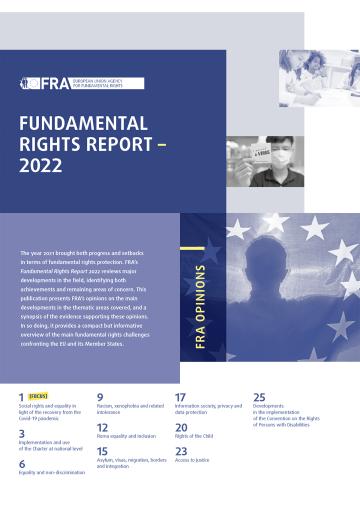
  • Fundamental Rights Report
    8
    June
    2022
    O ano de 2021 trouxe avanços e retrocessos no âmbito da proteção dos direitos fundamentais. O Relatório sobre os Direitos Fundamentais 2022 da FRA analisa os principais desenvolvimentos neste domínio, identificando tanto as realizações quanto os problemas que persistem. A presente publicação apresenta os pareceres da FRA relacionados com os principais desenvolvimentos nas áreas temáticas versadas e uma sinopse dos factos comprovados que sustentam tais pareceres.
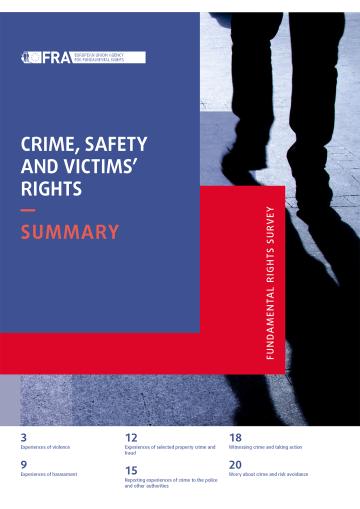
  • Report / Paper / Summary
    8
    March
    2021
    A presente síntese apresenta as principais
    perspetivas do segundo principal relatório da FRA
    baseado no seu Inquérito sobre os Direitos
    Fundamentais. O inquérito recolheu dados de cerca
    de 35 000 pessoas sobre as suas experiências,
    perceções e opiniões em relação a uma pluralidade
    de questões que estão enquadradas de diversos
    modos nos direitos humanos.
  • Periodic updates / Series
    21
    July
    2026
    This is the second bulletin in FRA’s new quarterly series monitoring the situation of migrants, asylum seekers and refugees. It covers key developments and ongoing concerns from 1 April to 30 June 2026.

    Following regular reporting on fundamental rights issues related to migration and asylum from 2015 to 2023, FRA resumed the series in 2026 under the EU's 2024 Asylum and Migration Management Regulation, ahead of the June 2026 implementation of the EU Migration and Asylum Pact. The first bulletin, published in April 2026, covered developments from 1 January 2025 to 31 March 2026.
  • Periodic updates / Series
    21
    April
    2026
    From 2015 to 2023, FRA regularly published bulletins on fundamental rights issues related to migration and asylum. As part of the EU's 2024 Asylum and Migration Management Regulation, FRA is now restarting this reporting ahead of the June 2026 implementation of the EU Migration and Asylum Pact. This first bulletin in the new series takes stock of the situation of migrants, asylum seekers and refugees as of March 2026. It looks at key developments between January 2025 and the end of March 2026, as well as ongoing problems and new areas of concern.
  • Report / Paper / Summary
    14
    April
    2026
    In response to increased arrivals of asylum seekers, in 2015 the European Commission introduced the hotspot approach. Under this approach, the European Commission and EU agencies supported Greece and Italy in identifying, registering and fingerprinting newly arrived people. FRA regularly visited the initial reception facilities hosting them. This report looks back at the lessons learnt from 10 years of FRA visits. It identifies recurring risks to rights and highlights practical measures and promising practices to prevent or address them. These ‘lessons learnt’ can inform the implementation of the 2024 Pact on Migration and Asylum in line with the EU Charter of Fundamental Rights.
  • Report / Paper / Summary
    4
    December
    2025
    Artificial Intelligence comes with both benefits and risks. Safe AI use that accounts for fundamental rights is thus crucial. While the 2024 EU AI Act was a milestone in this regard, its broad definitions regarding AI systems and high-risk AI could introduce loopholes for fundamental rights compliance. This report offers an empirical basis for much-needed practical guidance on the Act’s implementation. Based on interviews with AI developers, sellers, and users, FRA addresses challenges of its use in critical domains, like asylum, education, and employment. Our findings help guide next steps in realising the AI Act’s potential to ensure responsible innovation.
  • Report / Paper / Summary
    27
    November
    2025
    This report looks at the breadth and depth of violence and neglect faced by people with disabilities living in institutions. It highlights the shortcomings by EU Member States in preventing violence and protecting those who are at a higher risk of experiencing it, in line with the UN Convention on the Rights of Persons with Disabilities. Based on research across all EU Member States and FRA observer candidate countries, the report calls for better protection, stronger prevention of violence, and clear accountability. It urges the EU and its Member States to implement their obligations around equality and fundamental rights.
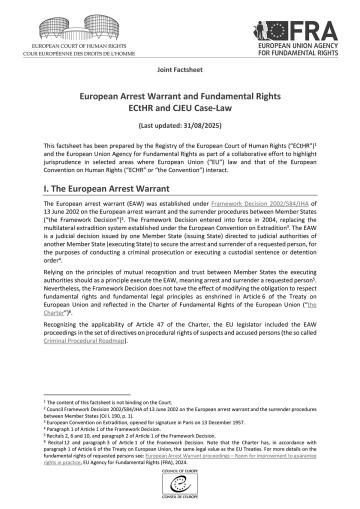
  • In brief / Factsheet
    1
    September
    2025
    This factsheet focuses on the European arrest warrant and EU Member States obligations to respect fundamental rights. EU law and the European Convention on Human Rights sometimes overlap. The publication clarifies where there are similar principles in different legislation and provides examples of case law. In collaboration, the EU Agency for Fundamental Rights and the European Court of Human Rights produced this short publication. It is designed to aid lawyers and policymakers in understanding and applying the jurisprudence in this area. The August 2025 version now contains recent case-law developments.
  • Opinion / Position Paper
    23
    July
    2025
    This position paper examines how the EU can counter the instrumentalisation of migrants while also upholding fundamental rights. Instrumentalisation refers to countries outside the EU using migration to exert political pressure. This position paper defines the phenomenon, provides examples, and outlines legal obligations under EU law. It provides legal analysis and warns that some responses risk undermining fundamental rights at the EU’s external borders, including the right to asylum. To counter instrumentalisation and uphold fundamental rights, the position paper proposes practical measures for Member States to take, such as sanctions, border controls, and cooperation with private operators.
  • In brief / Factsheet
    27
    May
    2025
    This factsheet focuses on the European arrest warrant and EU Member States obligations to respect fundamental rights. EU law and the European Convention on Human Rights sometimes overlap. The publication clarifies where there are similar principles in different legislation and provides examples of case law. In collaboration, the EU Agency for Fundamental Rights and the European Court of Human Rights produced this short publication. It is designed to aid lawyers and policymakers in understanding and applying the jurisprudence in this area. The 2025 version now contains recent case-law developments.