Systems

Apoio aos sistemas e defensores dos direitos humanos

<p>Many organisations work to defend your rights. We help their efforts with independent evidence, advice and expertise.</p>
<p>We support their frontline work. And we shine a light on potential risks and priority areas. Together we make your rights a reality.</p>

    Produtos

    Publications and Data

    Displaying results 41 - 50 of 92
    Report / Paper / Summary
    24
    June
    2020
    Summary version now available
    07 December 2020
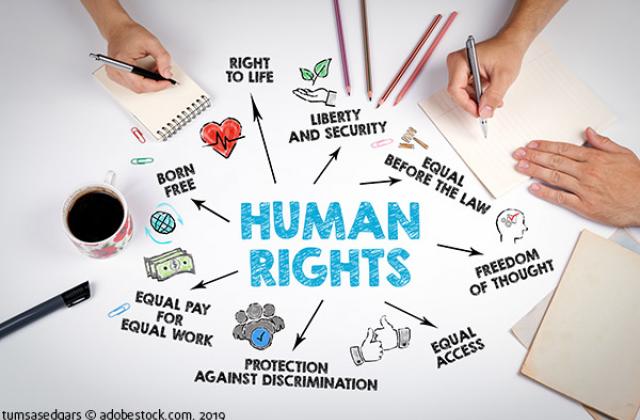
    FRA’s Fundamental Rights Survey collected data from 35,000 people about their experiences, perceptions and opinions on a range of issues that are variously encompassed by human rights. This report presents a small selection of the survey results. It focuses on findings with respect to respondents’ opinions about human – or fundamental rights; their views and perceptions on the functioning of democratic societies – as a pillar on which human rights can flourish; and on their thoughts on and engagement with public services that have a duty to enforce human rights law and to protect people’s rights.
    Report / Paper / Summary
    19
    June
    2020
    In 2019, the International Organization for Migration estimated that 1,866 people have died or gone missing while crossing the Mediterranean Sea to reach Europe to escape war or persecution or to pursue a better life. This is an average of five people per day. In recent years, a significant proportion of migrants in distress at sea have been rescued by civil society vessels deployed with a humanitarian mandate to reduce fatalities and bring rescued migrants to safety. Since 2018, however, authorities in some EU Member States started viewing civil society-deployed rescue vessels with hostility. As a reaction, national authorities initiated about 40 administrative and criminal proceedings against crew members or vessels, including seizing the latter. In some cases, rescue vessels were blocked in harbours due to flag issues or the inability to meet technical requirements.
    Fundamental Rights Report
    11
    June
    2020
    O presente Destaque aborda mais de perto a aplicação da
    Carta dos Direitos Fundamentais da União Europeia, que se
    tornou juridicamente vinculativa há 10 anos. Ao nível da UE,
    a Carta ganhou visibilidade e deu origem a uma nova cultura
    de direitos fundamentais. No plano nacional, a sensibilização
    para a Carta e a sua utilização têm sido limitadas. Os tribunais
    utilizam cada vez mais a Carta, evidenciando o impacto deste
    moderno instrumento. Mas a sua utilização pelos governos
    e parlamentos continua a ser modesta. Por exemplo, há
    poucas indicações sobre a existência ou não de pessoas
    que se dedicam a examinar regularmente se as legislações
    nacionais que transpõem a legislação da UE são compatíveis
    com a Carta.
    Fundamental Rights Report
    11
    June
    2020
    Now available in all 24 official EU languages
    12 August 2020
    O ano de 2019 trouxe avanços e retrocessos no âmbito
    da proteção dos direitos fundamentais. O Relatório
    sobre os Direitos Fundamentais 2020 da FRA analisa os
    principais desenvolvimentos neste domínio,
    identificando tanto as realizações quanto os problemas
    que persistem. A presente publicação apresenta os
    pareceres da FRA relacionados com os principais
    desenvolvimentos nas áreas temáticas versadas
    e uma sinopse dos factos comprovados que sustentam
    tais pareceres. Deste modo, o documento fornece uma
    panorâmica compacta, porém informativa, dos
    principais desafios em matéria de direitos
    fundamentais com que a UE e os seus Estados-
    -Membros são confrontados.
    Fundamental Rights Report
    11
    June
    2020
    FRA’s Fundamental Rights Report 2020 reviews major developments in the field in 2019, identifying both achievements and areas of concern. It also presents FRA’s opinions on these developments, including a synopsis of the evidence supporting these opinions. This year’s focus chapter explores how to unlock the full potential of the EU Charter of Fundamental Rights.
    Handbook / Guide / Manual
    February
    2020
    In today’s media landscape the way in which journalists and editors receive, process and publish news is constantly changing. Journalists face immense time pressure, as news frequently breaks online To facilitate training on the coverage of migration news, this Trainer’s Manual is a tool to be used together with the e-Media Toolkit.
    Report / Paper / Summary
    12
    November
    2019
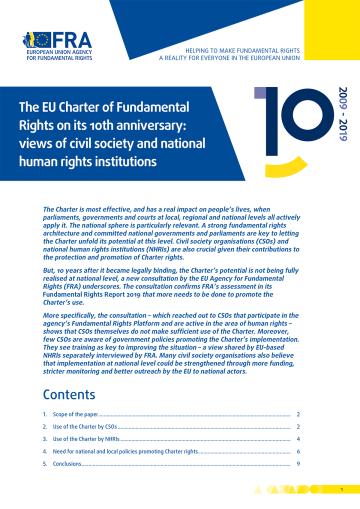
    The Charter is most effective, and has a real impact on people’s lives, when parliaments, governments and courts at local, regional and national levels all actively apply it. The national sphere is particularly relevant. A strong fundamental rights architecture and committed national governments and parliaments are key to letting the Charter unfold its potential at this level. Civil society organisations (CSOs) and national human rights institutions (NHRIs) are also crucial given their contributions to the protection and promotion of Charter rights.