O manual «Crianças privadas de cuidados parentais na UE fora do Estado‑Membro de origem» é
um guia que se destina a reforçar a resposta de todos os intervenientes pertinentes no domínio
da proteção de menores. A proteção destes menores do sexo masculino e feminino é da maior
importância e uma obrigação dos Estados‑Membros da UE, decorrente do quadro jurídico
internacional e europeu. O presente guia dá especial atenção às crianças vítimas do tráfico de
seres humanos e às crianças em risco, em aplicação de uma ação definida na comunicação de 2017
que pretende intensificar a ação da UE contra o tráfico de seres humanos, e tem em conta padrões
identificados, nomeadamente no que diz respeito à especificidade de género do crime.
Algorithms used in machine learning systems and artificial intelligence (AI) can only be as good as the data used for their development. High quality data are essential for high quality algorithms. Yet, the call for high quality data in discussions around AI often remains without any further specifications and guidance as to what this actually means.
O ano de 2018 trouxe avanços e retrocessos no âmbito da proteção dos direitos fundamentais. O Relatório sobre os Direitos Fundamentais 2019 da FRA analisa os principais desenvolvimentos neste domínio, identificando tanto as realizações quanto os problemas que persistem. A presente publicação apresenta os pareceres da FRA relacionados com os principais desenvolvimentos nas áreas temáticas versadas e uma sinopse dos factos comprovados que sustentam tais pareceres.
Despite efforts by the European Union (EU) and its Member States to reduce gender inequalities among citizens of Roma origin, important gender differences persist. Drawing on FRA’s own EU-MIDIS II survey research in nine EU Member States this report highlights the position of Roma women in education, employment and health, as well as the extent to which they experience hate-motivated discrimination, harassment and physical violence.
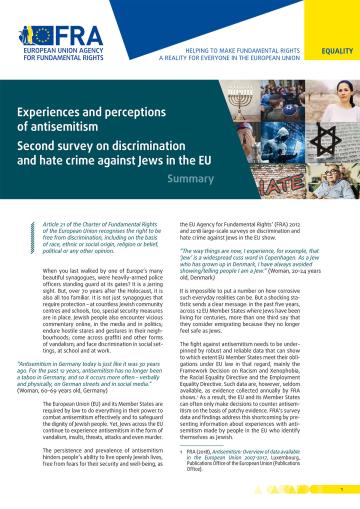
O presente relatório descreve as principais conclusões do segundo inquérito da FRA sobre
as experiências do povo judeu com o crime de ódio, a discriminação e o antissemitismo
na União Europeia — o maior inquérito sobre o povo judeu alguma vez realizado, a nível
mundial.
This paper discusses the evolution of European Court of Human Rights case law relating
to hate crime, providing an update on the most recent rulings. Approaching hate crime
from a fundamental rights perspective, it shows how Member State authorities’ duty to
effectively investigate the bias motivation of crimes flows from key human rights
instruments, such as the European Convention on Human Rights.
This report outlines the main findings of FRA’s second survey on Jewish people’s experiences with hate crime, discrimination and antisemitism in the European Union – the biggest survey of Jewish people ever conducted worldwide. Covering 12 EU Member States, the survey reached almost 16,500 individuals who identify as being Jewish. It follows up on the agency’s first survey, conducted in seven countries in 2012.
O presente guia explica o que é a definição de perfis, os quadros jurídicos que a regulam e a razão pela qual a definição lícita de perfis é necessária para fazer respeitar os direitos fundamentais e indispensável para a eficácia da ação policial e da gestão das fronteiras. O guia fornece igualmente orientações práticas sobre como evitar a definição ilícita de perfis nas operações policiais e de gestão das fronteiras.
The Convention on the Rights of Persons with Disabilities commits both the EU and all of its Member States to realising the right of persons with disabilities to live independently in the community – which includes achieving deinstitutionalisation for those residing in institutional settings. But much remains to be done to make this a reality in practice. This report presents the main insights gained during fieldwork on the drivers of and barriers to deinstitutionalisation. Focusing on the local level, it gives voice to a diverse set of actors – most importantly, to people with disabilities themselves.


 Report / Paper / Summary3March2026
 Report / Paper / Summary27January2026
 Report / Paper / Summary27November2025