Acts of terrorism represent a serious threat to the lives and safety of people, and a profound security challenge for states. At the same time, counter-terrorism legislation, policies and other measures can entail, directly or indirectly, serious limitations to fundamental rights, and can adversely affect individuals, groups and society as a whole. This summary presents FRA’s main findings from its report on Directive (EU) 2017/541 on combating terrorism, the main criminal law instrument at EU level in the field of counter-terrorism.
The Charter of Fundamental Rights of the European Union (CFREU) is the EU’s bill of rights. It always binds the EU institutions and the Member States when they act within the scope of EU law. However, it is far from easy to assess whether a concrete case falls within the scope of EU law. This is why it is necessary to provide training and training material to legal professionals so that they can understand the field of application of the Charter as laid out in its Article 51. This trainer’s manual aims at providing guidance on both the organisation and the implementation of such trainings based on a series of case studies,
which will be extended in the future.
Civil society organisations face diverse challenges across the European Union. FRA’s report on Protecting civic space in the EU presents the agency’s findings on these challenges. It was issued in September of 2021. This summary presents the Key findings and FRA opinions outlined in the report.
Since September 2021, two National Human Rights Institutions (NHRIs) had a change in their accreditation status, one applied for accreditation and five have had a change in tasks covered by their mandates. This new 2022 update provides an overview of developments in the accreditation status and mandates of NHRIs from September 2021 to May 2022. It is a follow up of FRA’s 2020 report on ‘Strong and effective national human rights institutions – challenges, promising practices and opportunities’ and the September 2021 update. It covers the 27 EU Member States and three candidate countries (Albania, North Macedonia and Serbia).
FRA’s Fundamental Rights Report 2022 reviews major developments in the field in 2021, identifying both achievements and areas of concern. It also presents FRA’s opinions on these developments, including a synopsis of the evidence supporting these opinions.
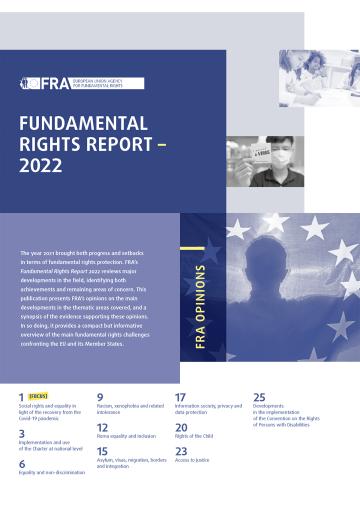
The year 2021 brought both progress and setbacks in terms of fundamental rights protection. FRA’s Fundamental Rights Report 2022 reviews major developments in the field, identifying both achievements and remaining areas of concern. This publication presents FRA’s opinions on the main developments in the thematic areas covered, and a synopsis of the evidence supporting these opinions.
This guide can help cities wishing to improve their efforts to respect human rights. It aims to encourage local authorities to adopt higher human rights standards. The idea is to encourage and foster mutual learning on human and fundamental rights. The European Union Agency for Fundamental Rights (FRA), a group of human rights cities and various practitioners in the EU worked together to produce this guide. The guide draws on the promising practices and experiences of cities, regions, experts, international organisations and networks that can be found in the FRA report Human rights cities in the EU: A framework for reinforcing rights locally.
Children are full-fledged holders of rights. They are beneficiaries of all human and fundamental rights and subjects of special regulations, given their specific characteristics. This handbook aims to illustrate how European law and case law accommodate the specific interests and needs of children. It also considers the importance of parents and guardians or other legal representatives and makes reference, where appropriate, to situations in which rights and responsibilities are most prominently vested in children’s carers. It is a point of reference on both European Union (EU) and Council of Europe (CoE) law related to these subjects, explaining how each issue is regulated under EU law, including the Charter of Fundamental Rights of the European Union, as well as under the European Convention on Human Rights, the European Social Charter and other CoE instruments.
FRA Opinion 1/21 illustrates the extent and nature of lived experiences of inequality and discrimination across the EU. It does so with reference to the grounds of discrimination and areas of life covered by the racial and employment equality directives, as well as by the proposed Equal Treatment Directive. It was issued on 30 April 2021. This summary presents the main recommendations (‘Key findings and opinions’) outlined in FRA Opinion 1/21.
This report examines the EU’s main criminal law instrument in the field of counter-terrorism, Directive (EU) 2017/541. Specifically, it considers how the directive engages issues of fundamental rights, affecting individuals, groups and society as a whole.
Since September 2020, three National Human Rights Institutions (NHRIs) had a change in their accreditation status, two new institutions were created and nine have had a change in tasks covered by their mandates. Following up on the September 2020 report “Strong and effective national human rights institutions – challenges, promising practices and opportunities”, this update provides an overview of developments in the accreditation status and mandates of NHRIS in the past 12 months. The update covers the 27 EU Member States as well as three additional states within FRA’s mandate (Albania, North Macedonia and Serbia).
The year 2020 brought both progress and setbacks in terms of fundamental rights protection. FRA’s Fundamental Rights Report 2021 reviews major developments in the field, identifying both achievements and remaining areas of concern. This publication presents FRA’s opinions on the main developments in the thematic areas covered, and a synopsis of the evidence supporting these opinions.
FRA’s Fundamental Rights Report 2021 reviews major developments in the field in 2020, identifying both achievements and areas of concern. It also presents FRA’s opinions on these developments, including a synopsis of the evidence supporting these opinions. This year’s focus chapter explores the impact of the COVID-19 pandemic on fundamental rights. The remaining chapters cover: the EU Charter of Fundamental Rights; equality and non-discrimination; racism, xenophobia and related intolerance; Roma equality and inclusion; asylum, borders and migration; information society, privacy and data protection; rights of the child; access to justice; and the implementation of the Convention on the Rights of Persons with Disabilities.
This opinion illustrates the extent and nature of lived experiences of inequality and discrimination across the EU. It does so with reference to the grounds of discrimination and areas of life covered by the racial and employment equality directives, as well as in relation to the grounds and areas covered by the proposed Equal Treatment Directive.
This summary presents the main insights from FRA’s second main report based on its Fundamental Rights Survey. The survey collected data from around 35,000 people about their experiences, perceptions and opinions on a range of issues that are variously encompassed by human rights.
This is the second main report from FRA’s Fundamental Rights Survey, which collected data from 35,000 people on a range of issues. This report focuses on respondents’ experiences as victims of selected types of crime, including violence, harassment, and property crime. The report also examines how often these crimes are reported to the police, and presents further details relating to harassment and violence, such as the perpetrators and where the incidents took place.
FRA’s report on artificial intelligence and fundamental rights presents concrete examples of how companies and public administrations in the EU are using, or trying to use, AI. This summary presents the main insights from the report. These can inform EU and national policymaking efforts to regulate the use of AI tools in compliance with human and fundamental rights.
As a parent, you realise children are the future. FRA’s Nicole Romain shares the anxiety she has felt as the mother of a mixed race family living in predominantly white countries. She explains how the Fundamental Rights Charter delivers hope for an inclusive Europe where we all respect and celebrate our differences.
National Human Rights Institutions (NHRIs) are a vital part of the country-level human rights protection system. By raising awareness, providing advice, monitoring and holding authorities to account, they have a central role in navigating the great human rights challenges of our day – tackling both persistent concerns like discrimination and inequality, and novel issues such as the rights implications of artificial intelligence and of the COVID-19 pandemic.