eu-charter

Carta dos Direitos Fundamentais da UE

Artigo 47.o - Direito à acção e a um tribunal imparcial

Artigo 47.o - Direito à acção e a um tribunal imparcial

Toda a pessoa cujos direitos e liberdades garantidos pelo direito da União tenham sido violados tem direito a uma acção perante um tribunal nos termos previstos no presente artigo. Toda a pessoa tem direito a que a sua causa seja julgada de forma equitativa, publicamente e num prazo razoável, por um tribunal independente e imparcial, previamente estabelecido por lei. Toda a pessoa tem a possibilidade de se fazer aconselhar, defender e representar em juízo. É concedida assistência judiciária a quem não disponha de recursos suficientes, na medida em que essa assistência seja necessária para garantir a efectividade do acesso à justiça.

Anotações

  • Text:

    O primeiro parágrafo baseia-se no artigo 13.o da CEDH:

    `Qualquer pessoa cujos direitos e liberdades reconhecidos na presente Convenção tiverem sido violados tem direito a recurso perante uma instância nacional, mesmo quando a violação tiver sido cometida por pessoas que actuarem no exercício das suas funções oficiais.`

    Porém, no direito da União, a protecção é mais alargada, dado que garante um direito a acção em tribunal. O Tribunal de Justiça consagrou este direito como princípio geral do direito da União no seu acórdão de 15 de Maio de 1986 (processo 222/84, Johnston, Colect. 1986, p. 1651; ver também os acórdãos de 15 de Outubro de 1987, processo 222/86, Heylens, Colect. 1987, p. 4097, e de 3 de Dezembro de 1992, processo C-97/91, Borelli, Colect. 1992, p. I-6313). Segundo o Tribunal de Justiça, este princípio geral do direito da União aplica-se também aos Estados-Membros quando estes aplicam o direito da União. A inclusão desta jurisprudência na Carta não teve por objectivo modificar o sistema de controlo jurisdicional previsto pelos Tratados e, nomeadamente, as regras relativas à admissibilidade de acções interpostas directamente no Tribunal de Justiça da União Europeia. A Convenção Europeia estudou o sistema de controlo jurisdicional da União, incluindo as regras relativas à admissibilidade, tendo-os confirmado, alterando embora alguns dos seus aspectos, tal como ficou expresso nos artigos 251.o a 281.o do Tratado sobre o Funcionamento da União Europeia e, em especial, no quarto parágrafo do artigo 263.o No que respeita à totalidade dos direitos garantidos pelo direito da União, o artigo 47.o aplica-se às instituições da União e aos Estados-Membros sempre que estes dêem execução ao direito da União.
    O segundo parágrafo corresponde ao n.o 1 do artigo 6.o da CEDH, que tem a seguinte redacção:
    `Qualquer pessoa tem direito a que a sua causa seja examinada, equitativa e publicamente, num prazo razoável por um tribunal independente e imparcial, estabelecido por lei, o qual decidirá, quer sobre a determinação dos seus direitos e obrigações de carácter civil, quer sobre o fundamento de qualquer acusação em matéria penal dirigida contra ela. O julgamento deve ser público, mas o acesso à sala de audiências pode ser proibido à imprensa ou ao público durante a totalidade ou parte do processo, quando a bem da moralidade, da ordem pública ou da segurança nacional numa sociedade democrática, quando os interesses de menores ou a protecção da vida privada das partes no processo o exigirem, ou, na medida julgada estritamente necessária pelo tribunal, quando, em circunstâncias especiais, a publicidade pudesse ser prejudicial para os interesses da justiça.`
    No direito da União, o direito a julgamento imparcial não se aplica apenas a litígios relativos a direitos e obrigações do foro civil. É uma das consequências do facto de a União ser uma comunidade de direito, tal como estabelecido pelo Tribunal de Justiça no processo 294/83, Os Verdes contra Parlamento Europeu (acórdão de 23 de Abril de 1986, Colect. 1986, p. 1339). Porém, com excepção do seu âmbito de aplicação, as garantias dadas pela CEDH são aplicadas de modo similar na União.

    No que respeita ao terceiro parágrafo, é de notar que, segundo a jurisprudência do Tribunal Europeu dos Direitos do Homem, deve ser concedido apoio judiciário quando a falta de tal apoio torne impossível garantir uma acção judicial efectiva (acórdão TEDH de 9.10.1979, Airey, série A, volume 32, p. 11). Existe igualmente um sistema de apoio judiciário perante o Tribunal de Justiça da União Europeia.

    Source:
    Jornal Oficial da União Europeia C 303/17 - 14.12.2007
    Preamble - Explanations relating to the Charter of Fundamental Rights:
    As presentes anotações, inicialmente elaboradas sob a responsabilidade do Praesidium da Convenção que redigiu a Carta dos Direitos Fundamentais da União Europeia, foram actualizadas sob a responsabilidade do Praesidium da Convenção Europeia, à luz das adaptações ao texto (nomeadamente aos artigos 51.o e 52.o) da Carta introduzidas pela Convenção Europeia e da evolução do direito da União. Embora não tenham em si força de lei, constituem um valioso instrumento de interpretação destinado a clarificar as disposições da Carta.

Jurisprudência

Direitos constitucionais nacionais

50 results found

  • Sweden / Instrument of Government
    País:
    Sweden

    Chapter 2 - Fundamental rights and freedoms:

    Article 9 If a public authority other than a court of law has deprived an individual of his or her liberty on account of a criminal act or because he or she is suspected of having committed such an act, the individual shall be entitled to have the deprivation of liberty examined before a court of law without undue delay. This shall not, however, apply where the matter concerns the transfer to Sweden of responsibility for executing a penal sanction involving deprivation of liberty according to a sentence in another state. Also those who for reasons other than those specified in paragraph one, have been taken forcibly into custody, shall likewise be entitled to have the matter of custody examined before a court of law without undue delay (...) Also those who for reasons other than those specified in paragraph one, have been taken forcibly into custody, shall likewise be entitled to have the matter of custody examined before a court of law without undue delay. In such a case, examination before a tribunal shall be equated with examination before a court of law, provided the composition of the tribunal has been laid down in law and it is stipulated that the chair of the tribunal shall be currently, or shall have been previously, a permanent salaried judge (...);

    Article 10 No one may be sentenced to a penalty or penal sanction for an act which was not subject to a penal sanction at the time it was committed. Nor may anyone be sentenced to a penal sanction which is more severe than that which was in force when the act was committed. The provisions laid down here with respect to penal sanctions also apply to forfeiture and other special legal effects of crime (...);

    Article 11 No court of law may be established on account of an act already committed, or for a particular dispute or otherwise for a particular case. Legal proceedings shall be carried out fairly and within a reasonable period of time. Proceedings in courts of law shall be open to the public.

  • A Magyar Köztársaság Alkotmánya
    País:
    Hungary

    57 § (1) A Magyar Köztársaságban a bíróság előtt mindenki egyenlő, és mindenkinek joga van ahhoz, hogy az ellene emelt bármely vádat, vagy valamely perben a jogait és kötelességeit a törvény által felállított független és pártatlan bíróság igazságos és nyilvános tárgyaláson bírálja el.(…) (5) A Magyar Köztársaságban a törvényben meghatározottak szerint mindenki jogorvoslattal élhet az olyan bírósági, közigazgatási és más hatósági döntés ellen, amely a jogát vagy jogos érdekét sérti. A jogorvoslati jogot - a jogviták ésszerű időn belüli elbírálásának érdekében, azzal arányosan - a jelen lévő országgyűlési képviselők kétharmadának szavazatával elfogadott törvény korlátozhatja.70/K § Az alapvető jogok megsértése miatt keletkezett igények, továbbá a kötelességek teljesítésével kapcsolatban hozott állami döntések elleni kifogások bíróság előtt érvényesíthetők.

  • Basic Law for the Federal Republic of Germany
    País:
    Germany

    Article 19 (...) (4) Should any person’s rights be violated by public authority, he may have recourse to the courts. If no other jurisdiction has been established, recourse shall be to the ordinary courts. The second sentence of paragraph (2) of Article 10 shall not be affected by this paragraph. Article 97 (1) Judges shall be independent and subject only to the law. (...) Article 101 (1) Extraordinary courts shall not be allowed. No one may be removed from the jurisdiction of his lawful judge. (2) Courts for particular fields of law may be established only by a law. Article 103 (1) In the courts every person shall be entitled to a hearing in accordance with law. (2) An act may be punished only if it was defined by a law as a criminal offence before the act was committed. (3) No person may be punished for the same act more than once under the general criminal laws.

  • Bundes-Verfassungsgesetz (B-VG)
    País:
    Austria

    Artikel 83(2) Niemand darf seinem gesetzlichen Richter entzogen werden. Artikel 87(1) Die Richter sind in Ausübung ihres richterlichen Amtes unabhängig.(...) Article 90(1) Die Verhandlungen in Zivil- und Strafrechtssachen vor dem erkennenden Gericht sind mündlich und öffentlich. Ausnahmen bestimmt das Gesetz.

  • Constitution
    País:
    France

    Article 64 Le Président de la République est garant de l'indépendance de l'autorité judiciaire.(...) 

  • Constitution
    País:
    France

    Article 64 The President of the Republic shall be the guarantor of the independence of the
    Judicial Authority (...)

  • Constitution of Finland
    País:
    Finland

    Section 21 Protection under the law Everyone has the right to have his or her case dealt with appropriately and without undue delay by a legally competent court of law or other authority, as well as to have a decision pertaining to his or her rights or obligations reviewed by a court of law or other independent organ for the administration of justice. Provisions concerning the publicity of proceedings, the right to be heard, the right to receive a reasoned decision and the right of appeal, as well as the other guarantees of a fair trial and good governance shall be laid down by an Act.

  • Constitution of Ireland
    País:
    Ireland

    Article 34.1. Justice shall be administered in courts established by law by judges appointed in the manner provided by this Constitution, and, save in such special and limited cases as may be prescribed by law, shall be administered in public.Article 38.1No person shall be tried on any criminal charge save in due course of law.

  • Constitution of Malta
    País:
    Malta

    Article 39(1) Whenever any person is charged with a criminal offence he shall, unless the charge is withdrawn, be afforded a fair hearing within a reasonable time by an independent and impartial court established by law.(2) Any court or other adjudicating authority prescribed by law for the determination of the existence or the extent of civil rights or obligations shall be independent and impartial; and, where proceedings for such a determination are instituted by any person before such a court or other adjudicating authority, the ease shall be given a fair hearing within a reasonable time.(3) Except with the agreement of all the parties thereto, all proceedings of every court and proceedings relating to the determination of the existence or the extent of a person's civil rights or obligations before any other adjudicating authority, including the announcement of the decision of the court or other authority, shall be held in public. (...)

  • Constitution of the Hellenic Republic
    País:
    Greece

    Article 8 No person shall be deprived of the judge assigned to him by law against his will. Judicial committees or extraordinary courts, under any name whatsoever, shall not be constituted. [...] .Article 20 (1) Every person shall be entitled to receive legal protection by the courts and may plead before them his views concerning his rights or interests, as specified by law. (2). The right of a person to a prior hearing also applies in any administrative action or measure adopted at the expense of his rights or interests. [...] .Article 87 (1). Justice shall be administered by courts composed of regular judges who shall enjoy functional and personal independence. (2). In the discharge of their duties, judges shall be subject only to the Constitution and the laws; in no case whatsoever shall they be obliged to comply with provisions enacted in violation of the Constitution. (3). Regular judges shall be inspected by judges of a superior rank, as well as by the Public Prosecutor and the Deputy Prosecutor of the Supreme Civil and Criminal Court; Public Prosecutors shall be inspected by the Supreme Civil and Criminal Court judges and Public Prosecutors of a superior rank, as specified by law [...] Article 97 (1). Felonies and political crimes shall be tried by mixed jury courts composed of ordinary judges and jurors, as specified by law. The judgments of these courts shall be subject to the legal remedies specified by law. (2). Felonies and political crimes which prior to the date of entry into force of this Constitution have, by constituent acts, parliamentary resolutions and special statutes, come under the jurisdiction of courts of appeal shall continue to be tried by the said courts, as long as a statute does not transfer them to the jurisdiction of mixed jury courts. Other felonies may be transferred to the jurisdiction of the same courts of appeal by statute. (3). Crimes of any degree committed through the press shall be under the jurisdiction of ordinary criminal courts, as specified by law. [...]

  • Constitution of the Italian Republic
    País:
    Italy

    Art. 24. Anyone may bring cases before a court of law in order to protect their rights under civil and administrative law. Defense is an inviolable right at every stage and instance of legal proceedings. The poor are entitled by law to proper means for action or defense in all courts. The law shall define the conditions and forms of reparation in case of judicial errors. Art. 25. No case may be removed from the court seized with it as established by law. No punishment may be inflicted except by virtue of a law in force at the time tehe offence was committed. No restriction may be placed on a person's liberty save for as provided by law. Art. 101. Justice is administered in the name of the people. Judges are subject only to the law. Art. 104. The Judiciary is a branch that is autonomous and independent of all other powers. (...) Art. 111. Jurisdiction is implemented through due process regulated by law. All court trials are conducted with adversary proceedings and the parties. are entitled to equal conditions before an impartial judge in third party position. The law provides for the reasonable duration of trials. In criminal law trials, the law provides that the alleged offender shall be
    promptly informed confidentially of the nature and reasons for the charges that are brought and shall have adequate time and conditions to prepare a
    defence. The defendant shall have the right to cross-examine or to have cross-examined before a judge the persons making accusations and to
    summon and examine persons for the defence in the same conditions as the prosecution, as well as the right to produce all other evidence in favour of
    the defence. The defendant is entitled to the assistance of an interpreter in the case that he or she does not speak or understand the language in which
    the court proceedings are conducted. In criminal law proceedings, the formation of evidence is based on the principle of adversary hearings. The guilt of the defendant cannot be established on the basis of statements by persons who, out of their own free choice, have always voluntarily avoided undergoing cross-examination by
    the defendant or the defence counsel. The law regulates the cases in which the formation of evidence does not occur in an adversary proceeding with the consent of the defendant or owing to reasons of ascertained objective impossibility or proven illicit conduct. All judicial decisions shall include a statement of reasons. Appeals to the Court of Cassation in cases of violations of the law are always allowed against sentences and against measures affecting personal freedom pronounced by ordinary and special courts. This rule can only be waived in cases of sentences by military tribunals in time of war. Appeals to the Court of Cassation against decisions of the Council of State
    and the Court of Accounts are permitted only for reasons of jurisdiction. Art. 112. The public prosecutor has the obligation to institute criminal proceedings. Art. 113. The judicial safeguarding of rights and legitimate interests before the bodies of ordinary or administrative justice is always permitted against acts of the public administration. Such judicial protection may not be excluded or limited to particular kinds of appeal or for particular categories of acts. The law determines which judicial bodies are empowered to annul acts of public administration in the cases and with the consequences provided for by the law itself.

  • Constitution of the Republic of Austria
    País:
    Austria

    Article 83(2) No one may be deprived of his lawful judge. Article 87(1) Judges are independent in the exercise of their judicial office.(...) Article 90(1) Hearings in civil and criminal cases are oral and public. Exceptions are regulated by law.

  • Constitution of the Republic of Bulgaria
    País:
    Bulgaria

    Art. 30 [...] (4) Everyone shall be entitled to legal counsel from the moment of detention or from the moment of being charged.(5) Everyone shall be entitled to meet his legal counsel in private. The confidentiality of such communication shall be inviolable. Art. 31(1) Anyone charged with a crime shall be brought before a court within the time established by law. [...] (4) The rights of a defendant shall not be restricted beyond what is necessary for the purposes of a fair trial. Art. 45.
    All citizens shall have the right to lodge complaints, proposals and petitions with the state authorities.
    Art. 56Everyone shall have the right to legal defence whenever his rights or legitimate interests are violated or endangered. He shall have the right to be accompanied by legal counsel when appearing before an agency of the State. Art. 117.
    (1) The judiciary shall protect the rights and legitimate interests of all citizens, legal entities and the State. [...] Art. 120.
    (1) The courts shall supervise the legality of the acts and actions of the administrative bodies.
    (2) Citizens and legal entities shall be free to challange any administrative act which affects them, except those listed expressly by the laws. Art. 122(1) Citizens and legal entities shall have the right to legal counsel at all stages of a trial.(2) The procedure by which the right to legal counsel shall be practiced shall be established by law.

  • Constitution of the Republic of Croatia
    País:
    Croatia

    Article 18
    The right to appeal against individual legal decisions made in first-instance proceedings by courts or other authorized bodies shall be guaranteed.
    By way of exception, the right to appeal may be denied in cases specified by law if other legal protections are ensured.

    Article 26
    All citizens of the Republic of Croatia and aliens shall be equal before the courts,
    governmental agencies and other bodies vested with pubic authority.

    Article 28
    Everyone is presumed innocent and may not be held guilty of a criminal offence until such
    guilt is proven by a binding court judgment.

    Article 29
    Everyone shall be entitled have his or her rights and obligations, or suspicion or accusation of
    a criminal offence decided upon fairly before a legally established, independent and impartial
    court within a reasonable period.
    In the case of suspicion or accusation of a criminal offence, the suspected, accused or indicted
    person shall be entitled:
    – to be informed in detail and in a language he/she understands, within the shortest possible
    term, of the nature and grounds for the charges against him/her and the evidence incriminating
    him/her,
    – to have adequate time and opportunity to prepare his/her defence,
    – to defence counsel and unrestricted communication therewith, and to be informed of this
    right,
    – to mount his/her own defence independently or with the assistance of a defence counsel of
    his/her own choice, and if he/she lacks the resources to engage such counsel, to have free
    counsel provided under the conditions specified by law,
    – to be present at his/her trial insofar as he/she is at the disposal of the court,
    – to interrogate or to arrange for interrogation of witnesses for the prosecution and to demand
    the attendance and questioning of defence witnesses under the same conditions which apply to
    witnesses for the prosecution,
    – to assistance by an interpreter free of charge insofar as he/she does not understand the
    language used in the court.
    An admission of guilt may not be coerced from a suspected, accused or indicted individual.
    Evidence obtained illegally may not be admitted in court proceedings.
    Criminal proceedings may only be initiated before the court at the request of an authorized
    prosecutor.

  • Constitution of the Republic of Estonia
    País:
    Estonia

    Article 15. Everyone whose rights and freedoms have been violated has the right of recourse to the courts. Everyone is entitled to petition the court that hears his or her case to declare unconstitutional any law, other legislative instrument, administrative decision or measure which is relevant in the case.
    The courts observe the Constitution and declare unconstitutional any law, other legislative instrument, administrative decision or measure which violates any rights or freedoms provided in the Constitution or which otherwise contravenes the Constitution.
    Article 24. No one may be transferred, against his or her free will, from the jurisdiction of a court specified by law to the jurisdiction of another court.
    Everyone is entitled to attend any hearing held by a court in his or her case.
    Court hearings are public. The court may, in the cases and pursuant to a procedure provided by law, order a hearing or a part thereof to be held in camera to protect a state secret or a trade secret, public morality or the private and family life of individuals, or where the interests of a minor, a victim, or the administration of justice so require.
    Judgments are pronounced publicly, except in cases where the interests of a minor, a spouse, or a victim require otherwise.
    In accordance with the procedure provided by law, everyone is entitled to appeal a judgment rendered in his or her case to a higher court.

  • Constitution of the Republic of Hungary
    País:
    Hungary

    Article 57(1) In the Republic of Hungary everyone is equal before the law and has the right to have the accusations brought against him, as well as his rights and duties in legal proceedings, judged in a just, public trial by an independent and impartial court established by law. (…) (5) In the Republic of Hungary everyone may seek legal remedy, in accordance with the provisions of the law, to judicial, administrative or other official decisions, which infringe on his rights or justified interests. A law passed by a majority of two-thirds of the votes of the Members of Parliament present may impose restrictions on the right to legal remedy in the interest of, and in proportion with, adjudication of legal disputes within a reasonable period of time.Article 70/KClaims arising from infringement on fundamental rights, and objections to the decisions of public authorities regarding the fulfilment of duties may be brought before a court of law.

  • Constitution of the Republic of Latvia
    País:
    Latvia

    92. Everyone has the right to defend his or her rights and lawful interests in a fair court. Everyone shall be presumed innocent until his or her guilt has been established in accordance with law. Everyone, where his or her rights are violated without basis, has a right to commensurate compensation. Everyone has a right to the assistance of counsel.

  • Constitution of the Republic of Lithuania
    País:
    Lithuania

    Article 20(...) No one may be arbitrarily detained or held arrested. No one may be deprived of his freedom otherwise than on the grounds and according to the procedures which have been established by law.A person detained in flagrante delicto must, within 48 hours, be brought before a court for the purpose of deciding, in the presence of the detainee, on the validity of the detention. If the court does not adopt a decision to arrest the person, the detainee shall be released immediately.Article 29All persons shall be equal before the law, the court, and other State institutions and officials.Article 30The person whose constitutional rights or freedoms are violated shall have the right to apply to court.Compensation for material and moral damage inflicted upon a person shall be established by law.Article 31(...) A person charged with the commission of a crime shall have the right to a public and fair hearing of his case by an independent and impartial court.Article 20. No one may be arbitrarily apprehended or detained. No one may be deprived of his liberty otherwise than on the grounds and according to the procedures established by law. A person apprehended in flagrante delicto must, within 48 hours, be brought before a court for the purpose of deciding, in the presence of this person, on the validity of the apprehension. If the court does not adopt a decision to detain the person, the apprehended person shall be released immediately.
    Article 30. A person whose constitutional rights or freedoms are violated shall have the right to apply to a court. Compensation for material and moral damage inflicted upon a person shall be established by law.
    Article 31. A person charged with committing a crime shall have the right to a public and fair hearing of his case by an independent and impartial court. A person suspected of committing a crime, as well as the accused, shall be guaranteed, from the moment of his apprehension or first interrogation, the right to defence, as well as the right to an advocate.
    Article 109. In the Republic of Lithuania, justice shall be administered only by courts. When administering justice, judges and courts shall be independent. When considering cases, judges shall obey only the law. Courts shall adopt decisions in the name of the Republic of Lithuania.

  • Constitution of the Republic of Poland
    País:
    Poland

    Article 451. Everyone shall have the right to a fair and public hearing of his case, without undue delay, before a competent, impartial and independent court.2. Exceptions to the public nature of hearings may be made for reasons of morality, State security, public order or protection of the private life of a party, or other important private interest. Judgments shall be announced publicly.Article 771. Everyone shall have the right to compensation for any harm done to him by any action of an organ of public authority contrary to law.2. Statutes shall not bar the recourse by any person to the courts in pursuit of claims alleging infringement of freedoms or rights.

  • Constitution of the Republic of Poland
    País:
    Poland

    Article 45.1. Everyone shall have the right to a fair and public hearing of his case, without undue delay, before a competent, impartial and independent court.2. Exceptions to the public nature of hearings may be made for reasons of morality, State security, public order or protection of the private life of a party, or other important private interest. Judgments shall be announced publicly.Article 77.1. Everyone shall have the right to compensation for any harm done to him by any action of an organ of public authority contrary to law.2. Statutes shall not bar the recourse by any person to the courts in pursuit of claims alleging infringement of freedoms or rights.

Direito da UE

35 results found

  • Directive 2012/13/EU of the European Parliament and of the Council of 22 May 2012 on the right to information in criminal proceedings

    Preamble 


    (5) Article 47 of the Charter of Fundamental Rights of the European Union (hereinafter ‘the Charter’) and Article 6 of the European Convention for the Protection of Human Rights and Fundamental Freedoms (hereinafter ‘the ECHR’) enshrine the right to a fair trial. Article 48(2) of the Charter guarantees respect for the rights of the defence.

    (6) Article 6 of the Charter and Article 5 ECHR enshrine the right to liberty and security of person. Any restrictions on that right must not exceed those permitted in accordance with Article 5 ECHR and inferred from the case-law of the European Court of Human Rights.


    (14) This Directive relates to measure B of the Roadmap. It lays down common minimum standards to be applied in the field of information about rights and about the accusation to be given to persons suspected or accused of having committed a criminal offence, with a view to enhancing mutual trust among Member States. This Directive builds on the rights laid down in the Charter, and in particular Articles 6, 47 and 48 thereof, by building upon Articles 5 and 6 ECHR as interpreted by the European Court of Human Rights. In this Directive, the term ‘accusation’ is used to describe the same concept as the term ‘charge’ used in Article 6(1) ECHR.


    Article 1: Subject matter

    This Directive lays down rules concerning the right to information of suspects or accused persons, relating to their rights in criminal proceedings and to the accusation against them. It also lays down rules concerning the right to information of persons subject to a European Arrest Warrant relating to their rights.

  • Directive (EU) 2016/343 of the European Parliament and of the Council of 9 March 2016 on the strengthening of certain aspects of the presumption of innocence and of the right to be present at the trial in criminal proceedings

    Preamble:

    (13) This Directive acknowledges the different needs and levels of protection of certain aspects of the presumption of innocence as regards natural and legal persons. As regards natural persons, such protection is reflected in wellestablished
    case-law of the European Court of Human Rights. The Court of Justice has, however, recognised that the rights flowing from the presumption of innocence do not accrue to legal persons in the same way as they do to natural persons.
    (14) At the current stage of development of national law and of case-law at national and Union level, it is premature to legislate at Union level on the presumption of innocence with regard to legal persons. This Directive should not, therefore, apply to legal persons. This should be without prejudice to the application of the presumption of innocence as laid down, in particular, in the ECHR and as interpreted by the European Court of Human Rights and by the Court of Justice, to legal persons.
    (15) The presumption of innocence with regard to legal persons should be ensured by the existing legislative safeguards and case-law, the evolution of which is to determine whether there is a need for Union action.
    (16) The presumption of innocence would be violated if public statements made by public authorities, or judicial decisions other than those on guilt, referred to a suspect or an accused person as being guilty, for as long as that person has not been proved guilty according to law. Such statements and judicial decisions should not reflect an opinion that that person is guilty. This should be without prejudice to acts of the prosecution which aim to prove the guilt of the suspect or accused person, such as the indictment, and without prejudice to judicial decisions as a result of which a suspended sentence takes effect, provided that the rights of the defence are
    respected. This should also be without prejudice to preliminary decisions of a procedural nature, which are taken by judicial or other competent authorities and are based on suspicion or on elements of incriminating evidence, such as decisions on pre-trial detention, provided that such decisions do not refer to the suspect or accused person as being guilty. Before taking a preliminary decision of a procedural nature the competent authority might first have to verify that there are sufficient elements of incriminating evidence against the suspect or accused person to justify the decision concerned, and the decision could contain reference to those elements.
    ...
    (46) In order to monitor and evaluate the effectiveness of this Directive, Member States should send available data with regard to the implementation of the rights laid down in this Directive to the Commission. Such data could include records made by law enforcement and judicial authorities as regards remedies applied in the case of a
    breach of any of the aspects of the presumption of innocence covered by this Directive or of the right to be present at the trial.
    (47) This Directive upholds the fundamental rights and principles recognised by the Charter and by the ECHR, including the prohibition of torture and inhuman or degrading treatment, the right to liberty and security, respect for private and family life, the right to the integrity of the person, the rights of the child, the integration
    of persons with disabilities, the right to an effective remedy and the right to a fair trial, the presumption of innocence and the rights of the defence. Regard should be had, in particular, to Article 6 of the Treaty on European Union (TEU), according to which the Union recognises the rights, freedoms and principles set out in the Charter, and according to which fundamental rights, as guaranteed by the ECHR and as they result from the constitutional traditions common to the Member States, are to constitute general principles of Union law.
    (48) As this Directive establishes minimum rules, Member States should be able to extend the rights laid down in this Directive in order to provide a higher level of protection. The level of protection provided for by Member States should never fall below the standards provided for by the Charter or by the ECHR, as interpreted by the Court of Justice and by the European Court of Human Rights.
    (49) Since the objectives of this Directive, namely setting common minimum rules for certain aspects of the presumption of innocence and for the right to be present at the trial in criminal proceedings, cannot be sufficiently achieved by the Member States but can rather, by reason of its scale and effects, be better achieved at Union level, the Union may adopt measures in accordance with the principle of subsidiarity as set out in Article 5 TEU. In accordance with the principle of proportionality, as set out in that Article, this Directive does not go beyond what is necessary in order to achieve those objectives.
    ...
    Article 1. Subject matter:
    This directive lays down common minimum rules concerning:
    - certain aspects of the presumption of innocence in criminal proceedings;
    - the right to be present at the trial in criminal proceedings.
    ...
    Article 3. Presumption of innocence:
    Member States shall ensure that suspects and accused persons are presumed innocent until proved guilty according to law.

  • Directive 2013/11/EU of the European Parliament and of the Council of 21 May 2013 on alternative dispute resolution for consumer disputes and amending Regulation (EC) No 2006/2004 and Directive 2009/22/EC

    Preamble:

    (1) Article 169(1) and point (a) of Article 169(2) of the Treaty on the Functioning of the European Union (TFEU) provide that the Union is to contribute to the attainment of a high level of consumer protection through measures adopted pursuant to Article 114 TFEU. Article 38 of the Charter of Fundamental Rights of the European Union provides that Union policies are to ensure a high level of consumer protection.

    (2) In accordance with Article 26(2) TFEU, the internal market is to comprise an area without internal frontiers in which the free movement of goods and services is ensured. The internal market should provide consumers with added value in the form of better quality, greater variety, reasonable prices and high safety standards for goods and services, which should promote a high level of consumer protection.

    (4) Ensuring access to simple, efficient, fast and low-cost ways of resolving domestic and cross-border disputes which arise from sales or service contracts should benefit consumers and therefore boost their confidence in the market. That access should apply to online as well as to offline transactions, and is particularly important when consumers shop across borders.

    (45) The right to an effective remedy and the right to a fair trial are fundamental rights laid down in Article 47 of the Charter of Fundamental Rights of the European Union. Therefore, ADR procedures should not be designed to replace court procedures and should not deprive consumers or traders of their rights to seek redress before the courts. This Directive should not prevent parties from exercising their right of access to the judicial system. In cases where a dispute could not be resolved through a given ADR procedure whose outcome is not binding, the parties should subsequently not be prevented from initiating judicial proceedings in relation to that dispute. Member States should be free to choose the appropriate means to achieve this objective. They should have the possibility to provide, inter alia, that limitation or prescription periods do not expire during an ADR procedure.

    (49) This Directive should not require the participation of traders in ADR procedures to be mandatory or the outcome of such procedures to be binding on traders, when a consumer has lodged a complaint against them. However, in order to ensure that consumers have access to redress and that they are not obliged to forego their claims, traders should be encouraged as far as possible to participate in ADR procedures. Therefore, this Directive should be without prejudice to any national rules making the participation of traders in such procedures mandatory or subject to incentives or sanctions or making their outcome binding on traders, provided that such legislation does not prevent the parties from exercising their right of access to the judicial system as provided for in Article 47 of the Charter of Fundamental Rights of the European Union.

    (61) This Directive respects fundamental rights and observes the principles recognised in particular by the Charter of Fundamental Rights of the European Union and specifically Articles 7, 8, 38 and 47 thereof.

    Article 1: Subject matter
    The purpose of this Directive is, through the achievement of a high level of consumer protection, to contribute to the proper functioning of the internal market by ensuring that consumers can, on a voluntary basis, submit complaints against traders to entities offering independent, impartial, transparent, effective, fast and fair alternative dispute resolution procedures. This Directive is without prejudice to national legislation making participation in such procedures mandatory, provided that such legislation does not prevent the parties from exercising their right of access to the judicial system.

  • Regulation (EU) No 524/2013 of the European Parliament and of the Council of 21 May 2013 on online dispute resolution for consumer disputes and amending Regulation (EC) No 2006/2004 and Directive 2009/22/EC

    Preamble:

    (1) Article 169(1) and point (a) of Article 169(2) of the Treaty on the Functioning of the European Union (TFEU) provide that the Union is to contribute to the attainment of a high level of consumer protection through measures adopted pursuant to Article 114 TFEU. Article 38 of the Charter of Fundamental Rights of the European Union provides that Union policies are to ensure a high level of consumer protection.

    (2) In accordance with Article 26(2) TFEU, the internal market is to comprise an area without internal frontiers in which the free movement of goods and services is ensured. In order for consumers to have confidence in and benefit from the digital dimension of the internal market, it is necessary that they have access to simple, efficient, fast and low-cost ways of resolving disputes which arise from the sale of goods or the supply of services online. This is particularly important when consumers shop cross-border.‘

    (4) Fragmentation of the internal market impedes efforts to boost competitiveness and growth. Furthermore, the uneven availability, quality and awareness of simple, efficient, fast and low-cost means of resolving disputes arising from the sale of goods or provision of services across the Union constitutes a barrier within the internal market which undermines consumers’ and traders’ confidence in shopping and selling across borders.‘

    (13) The definition of ‘consumer’ should cover natural persons who are acting outside their trade, business, craft or profession. However, if the contract is concluded for purposes partly within and partly outside the person’s trade (dual purpose contracts) and the trade purpose is so limited as not to be predominant in the overall context of the supply, that person should also be considered as a consumer.‘

    (14) The definition of ‘online sales or service contract’ should cover a sales or service contract where the trader, or the trader’s intermediary, has offered goods or services through a website or by other electronic means and the consumer has ordered those goods or services on that website or by other electronic means. This should also cover cases where the consumer has accessed the website or other information society service through a mobile electronic device such as a mobile telephone.

    (26) The right to an effective remedy and the right to a fair trial are fundamental rights laid down in Article 47 of the Charter of Fundamental Rights of the European Union. ODR is not intended to and cannot be designed to replace court procedures, nor should it deprive consumers or traders of their rights to seek redress before the courts. This Regulation should not, therefore, prevent parties from exercising their right of access to the judicial system.

    (35) This Regulation respects fundamental rights and observes the principles recognised in particular by the Charter of Fundamental Rights of the European Union and specifically Articles 7, 8, 38 and 47 thereof.

    Article 1: Subject matter
    The purpose of this Regulation is, through the achievement of a high level of consumer protection, to contribute to the proper functioning of the internal market, and in particular of its digital dimension by providing a European ODR platform (‘ODR platform’) facilitating the independent, impartial, transparent, effective, fast and fair out-of-court resolution of disputes between consumers and traders online.

    Article 12: Processing of personal data

    1. Access to information, including personal data, related to a dispute and stored in the database referred to in Article 11 shall be granted, for the purposes referred to in Article 10, only to the ADR entity to which the dispute was transmitted in accordance with Article 9. Access to the same information shall be granted also to ODR contact points, in so far as it is necessary, for the purposes referred to in Article 7(2) and (4).

    2. The Commission shall have access to information processed in accordance with Article 10 for the purposes of monitoring the use and functioning of the ODR platform and drawing up the reports referred to in Article 21. It shall process personal data of the users of the ODR platform in so far as it is necessary for the operation and maintenance of the ODR platform, including for the purposes of monitoring the use of the ODR platform by ADR entities and ODR contact points.

    3. Personal data related to a dispute shall be kept in the database referred to in paragraph 1 of this Article only for the time necessary to achieve the purposes for which they were collected and to ensure that data subjects are able to access their personal data in order to exercise their rights, and shall be automatically deleted, at the latest, six months after the date of conclusion of the dispute which has been transmitted to the ODR platform in accordance with point (iii) of point (c) of Article 10. That retention period shall also apply to personal data kept in national files by the ADR entity or the ODR contact point which dealt with the dispute concerned, except if the procedural rules applied by the ADR entity or any specific provisions of national law provide for a longer retention period.

    4. Each ODR advisor shall be regarded as a controller with respect to its data processing activities under this Regulation, in accordance with point (d) of Article 2 of Directive 95/46/EC, and shall ensure that those activities comply with national legislation adopted pursuant to Directive 95/46/EC in the Member State of the ODR contact point hosting the ODR advisor.

    5. Each ADR entity shall be regarded as a controller with respect to its data processing activities under this Regulation, in accordance with point (d) of Article 2 of Directive 95/46/EC, and shall ensure that those activities comply with national legislation adopted pursuant to Directive 95/46/EC in the Member State where the ADR entity is established.

    6. In relation to its responsibilities under this Regulation and the processing of personal data involved therein, the Commission shall be regarded as a controller in accordance with point (d) of Article 2 of Regulation (EC) No 45/2001.

    Article 13: Data confidentiality and security

    1. ODR contact points shall be subject to rules of professional secrecy or other equivalent duties of confidentiality laid down in the legislation of the Member State concerned.

    2. The Commission shall take the appropriate technical and organisational measures to ensure the security of information processed under this Regulation, including appropriate data access control, a security plan and a security incident management, in accordance with Article 22 of Regulation (EC) No 45/2001.

    Article 14: Consumer information

    1. Traders established within the Union engaging in online sales or service contracts, and online marketplaces established within the Union, shall provide on their websites an electronic link to the ODR platform. That link shall be easily accessible for consumers. Traders established within the Union engaging in online sales or service contracts shall also state their e-mail addresses.

    2. Traders established within the Union engaging in online sales or service contracts, which are committed or obliged to use one or more ADR entities to resolve disputes with consumers, shall inform consumers about the existence of the ODR platform and the possibility of using the ODR platform for resolving their disputes. They shall provide an electronic link to the ODR platform on their websites and, if the offer is made by e-mail, in that e-mail. The information shall also be provided, where applicable, in the general terms and conditions applicable to online sales and service contracts.

    3. Paragraphs 1 and 2 of this Article shall be without prejudice to Article 13 of Directive 2013/11/EU and the provisions on consumer information on out-of-court redress procedures contained in other Union legal acts, which shall apply in addition to this Article.

    4. The list of ADR entities referred to in Article 20(4) of Directive 2013/11/EU and its updates shall be published in the ODR platform.

    5. Member States shall ensure that ADR entities, the centres of the European Consumer Centres Network, the competent authorities defined in Article 18(1) of Directive 2013/11/EU, and, where appropriate, the bodies designated in accordance with Article 14(2) of Directive 2013/11/EU provide an electronic link to the ODR platform.

    6. Member States shall encourage consumer associations and business associations to provide an electronic link to the ODR platform.

    7. When traders are obliged to provide information in accordance with paragraphs 1 and 2 and with the provisions referred to in paragraph 3, they shall, where possible, provide that information together.

  • Directive 2012/29/EU of the European Parliament and of the Council of 25 October 2012 establishing minimum standards on the rights, support and protection of victims of crime, and replacing Council Framework Decision 2001/220/JHA

    Preamble:

    (14) In applying this Directive, children's best interests must be a primary consideration, in accordance with the Charter of Fundamental Rights of the European Union and the United Nations Convention on the Rights of the Child adopted on 20 November 1989. Child victims should be considered and treated as the full bearers of rights set out in this Directive and should be entitled to exercise those rights in a manner that takes into account their capacity to form their own views.
    (16) Victims of terrorism have suffered attacks that are intended ultimately to harm society. They may therefore need special attention, support and protection due to the particular nature of the crime that has been committed against them. Victims of terrorism can be under significant public scrutiny and often need social recognition and respectful treatment by society. Member States should therefore take particular account of the needs of victims of terrorism, and should seek to protect their dignity and security.’
    ‘(38) [...] A main task of these services and their staff, which play an important role in supporting the victim to recover from and overcome potential harm or trauma as a result of a criminal offence, should be to inform victims about the rights set out in this Directive so that they can take decisions in a supportive environment that treats them with dignity, respect and sensitivity. The types of support that such specialist support services should offer could include providing shelter and safe accommodation, immediate medical support, referral to medical and forensic examination for evidence in cases of rape or sexual assault, short and long-term psychological counselling, trauma care, legal advice, advocacy and specific services for children as direct or indirect victims.’
    ‘(52) Measures should be available to protect the safety and dignity of victims and their family members from secondary and repeat victimisation, from intimidation and from retaliation, such as interim injunctions or protection or restraining orders.’

    (66) This Directive respects fundamental rights and observes the principles recognised by the Charter of Fundamental Rights of the European Union. In particular, it seeks to promote the right to dignity, life, physical and mental integrity, liberty and security, respect for private and family life, the right to property, the principle of non-discrimination, the principle of equality between women and men, the rights of the child, the elderly and persons with disabilities, and the right to a fair trial.

    Article 18 - Right to protection
    ‘Without prejudice to the rights of the defence, Member States shall ensure that measures are available to protect victims and their family members from secondary and repeat victimisation, from intimidation and from retaliation, including against the risk of emotional or psychological harm, and to protect the dignity of victims during questioning and when testifying. When necessary, such measures shall also include procedures established under national law for the physical protection of victims and their family members.’

Direito internacional

0 results found

Produtos

  • Handbook / Guide / Manual
    19
    August
    2022
    DA, ET, FI, LT, PT, SV versions now available
    30 July 2024
    A Carta dos Direitos Fundamentais da União Europeia (CDFUE) é a
    declaração da União Europeia (UE) em matéria de direitos. Vincula as
    instituições da UE e os Estados-Membros sempre que atuam no âmbito do
    direito da UE. No entanto, não é fácil avaliar se um caso concreto se insere
    nesse âmbito. Por esse motivo, é necessário facultar formação e material
    de formação aos profissionais da justiça, para que possam compreender o
    âmbito de aplicação da Carta conforme previsto no seu artigo 51.º.
    O presente manual do formador tem como objetivo fornecer orientações
    sobre a organização e a execução dessas formações com base num
    conjunto de estudos de casos, que serão alargados no futuro.
  • Fundamental Rights Report
    8
    June
    2022
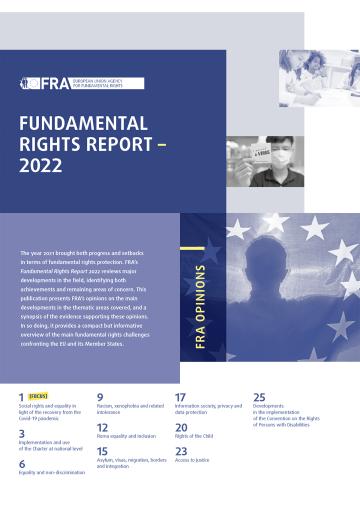
    O ano de 2021 trouxe avanços e retrocessos no âmbito da proteção dos direitos fundamentais. O Relatório sobre os Direitos Fundamentais 2022 da FRA analisa os principais desenvolvimentos neste domínio, identificando tanto as realizações quanto os problemas que persistem. A presente publicação apresenta os pareceres da FRA relacionados com os principais desenvolvimentos nas áreas temáticas versadas e uma sinopse dos factos comprovados que sustentam tais pareceres.
  • Report / Paper / Summary
    7
    July
    2021
    Italian version now available
    12 September 2022
    This report examines why victims do not report bias-motivated incidents and the barriers that they face when reporting incidents through national crime reporting systems. By mapping existing practices that have a bearing on the victim’s experiences when reporting bias-motivated violence and harassment, it aims to provide evidence to support national efforts to encourage and facilitate reporting – and ultimately assist Member States in delivering on their duties with regard to combating hate crime.
  • Report / Paper / Summary
    21
    January
    2021
    German language version now available
    26 January 2021
    As Instituições Nacionais dos Direitos Humanos (INDH) são uma parte vital do sistema de proteção dos direitos humanos à escala nacional. Ao sensibilizar, aconselhar, fiscalizar e velar pela responsabilização das autoridades, estas instituições desempenham um papel central nos grandes desafios que atualmente se levantam em matéria de direitos humanos, enfrentando quer os problemas persistentes, como a discriminação e as desigualdades, quer os novos problemas emergentes, como as implicações da inteligência artificial e da pandemia da COVID-19 em matéria dos direitos.
  • Report / Paper / Summary
    3
    September
    2020
    Summary version now available
    21 January 2021
    National Human Rights Institutions (NHRIs) are a vital part of the country-level human rights protection system. This report, published 10 years after FRA’s first in-depth study on NHRIs, looks at such bodies in the EU, as well as the Republic of North Macedonia, the Republic of Serbia, and the United Kingdom of Great Britain and Northern Ireland. It explores relevant developments, challenges to their effectiveness and ways to maximise their impact.
  • Fundamental Rights Report
    11
    June
    2020
    Now available in all 24 official EU languages
    12 August 2020
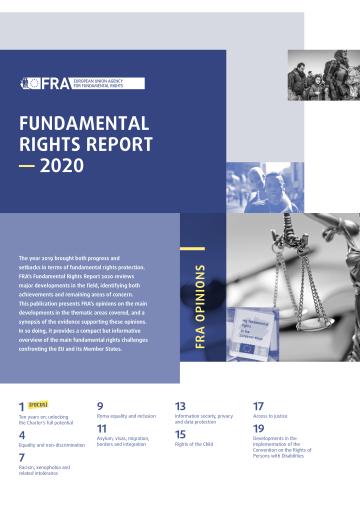
    O ano de 2019 trouxe avanços e retrocessos no âmbito
    da proteção dos direitos fundamentais. O Relatório
    sobre os Direitos Fundamentais 2020 da FRA analisa os
    principais desenvolvimentos neste domínio,
    identificando tanto as realizações quanto os problemas
    que persistem. A presente publicação apresenta os
    pareceres da FRA relacionados com os principais
    desenvolvimentos nas áreas temáticas versadas
    e uma sinopse dos factos comprovados que sustentam
    tais pareceres. Deste modo, o documento fornece uma
    panorâmica compacta, porém informativa, dos
    principais desafios em matéria de direitos
    fundamentais com que a UE e os seus Estados-
    -Membros são confrontados.
  • Periodic updates / Series
    21
    July
    2026
    This is the second bulletin in FRA’s new quarterly series monitoring the situation of migrants, asylum seekers and refugees. It covers key developments and ongoing concerns from 1 April to 30 June 2026.

    Following regular reporting on fundamental rights issues related to migration and asylum from 2015 to 2023, FRA resumed the series in 2026 under the EU's 2024 Asylum and Migration Management Regulation, ahead of the June 2026 implementation of the EU Migration and Asylum Pact. The first bulletin, published in April 2026, covered developments from 1 January 2025 to 31 March 2026.
  • In brief / Factsheet
    30
    June
    2026
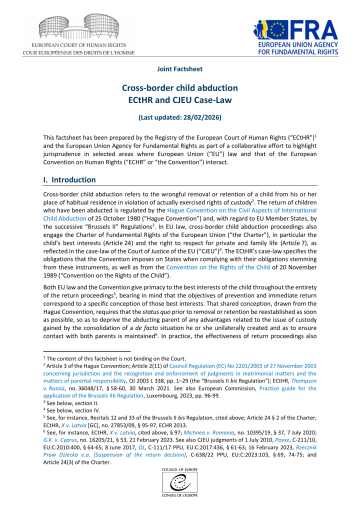
    This factsheet examines case law on cross-border child abduction, meaning the unlawful removal of a child from one EU Member State to another. Jointly published by the European Court of Human Rights and the EU Agency for Fundamental Rights, it explains how courts handle issues where EU law and human rights law overlap. It highlights key court decisions from the Court of Justice of the European Union (CJEU) and the European Court of Human Rights (ECtHR) to show how these two legal systems work together on issues of child abduction and prioritising the best interests of the child.
  • Handbook / Guide / Manual
    29
    June
    2026
    This guidance explains the role of a guardian assigned to a child during the screening and asylum procedure. It provides an overview of the different phases of the process and outlines a child’s legal rights throughout. The guidance includes topics such as lodging an application for international protection, preparing for the application interview and appealing against a negative decision. The European Union Agency for Asylum (EUAA) and the European Union Agency for Fundamental Rights (FRA) have developed a series of practical tools for guardians of unaccompanied children with international protection needs.
  • Report / Paper / Summary
    23
    June
    2026
    The publication is an excerpt from the full report: Places of care = places of safety? Violence against persons with disabilities in institutions. The report looks at the breadth and depth of violence and neglect faced by people with disabilities living in institutions. It includes key findings and calls for better protection, greater prevention of violence, and clear accountability. It urges the EU and its Member States to implement their obligations on equality and fundamental rights. It is available in English, German, Croatian, Italian, Latvian, Polish, Portuguese, Slovakian and Slovenian.