• Report / Paper / Summary
    22
    Février
    2023
    Directive 2012/29/EU represents a milestone in the development of victims’ rights. It establishes minimum standards for the rights, support and protection of victims of crime. It defines the scope of support services, guarantees the right to effective protection against secondary victimisation and comprehensively regulates the measures required for this purpose. This report covers three core components underpinning victims’ rights: support services, crime reporting, and protection from secondary and repeat victimisation. Examples highlight the relevant legal provisions in Member States and how specific rights under the Victims’ Rights Directive work in practice.
  • Leaflet / Flyer
    19
    décembre
    2022
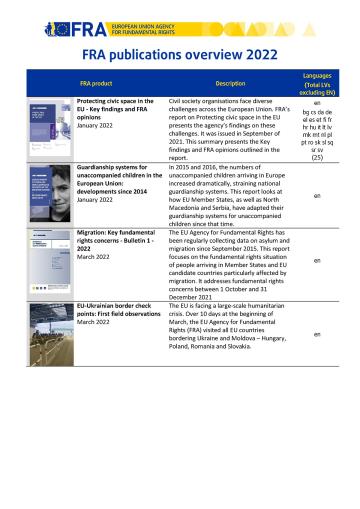
    A list of all FRA reports and translations published in 2022.
  • Periodic updates / Series
    13
    décembre
    2022
    National Human Rights Institutions (NHRIs) continue to play a key role in upholding fundamental rights. FRA keeps track of the accreditation status and the mandates of the NHRIs. In 2022, the NHRI in Cyprus was upgraded to an ‘A-status’ institution. In addition, the mandates of six NHRIs changed to include child protection or the protection of LGBTI people.
  • Vidéo
  • Report / Paper / Summary
    8
    décembre
    2022
    Artificial intelligence is everywhere and affects everyone – from deciding what content people see on their social media feeds to determining who will receive state benefits. AI technologies are typically based on algorithms that make predictions to support or even fully automate decision-making.
  • Periodic updates / Series
    24
    novembre
    2022
    The European Union Agency for Fundamental Rights (FRA) and the European Union Agency for Asylum (EUAA) joined forces to create this tool focusing on temporary protection for unaccompanied children fleeing Ukraine.
  • Report / Paper / Summary
    11
    novembre
    2022
    Europe stands at a delicate moment in its history. It is a moment of existential significance for the wellbeing and sustainability of our societies. It is emerging from the pandemic caused by the coronavirus disease, only to face a set of major overlapping challenges. These pose profound questions about the political, economic and societal future of the continent. To discuss elements of a human rights vision for the future and to identify opportunities for action, FRA brought together a group of sixty human rights leaders and experts with diverse backgrounds
    from across the continent. This report distils the meeting discussions, including analysis and ideas, and concludes with proposals for action. It does not represent the views either of individual participants or of FRA.
  • Report / Paper / Summary
    3
    novembre
    2022
    Antisemitic incidents and hate crimes violate fundamental rights, especially the right to human dignity, the right to equality of treatment and the freedom of thought, conscience and religion. This report provides an overview of available data on antisemitism as recorded by official and unofficial sources in the EU Member States and in Albania, North Macedonia and Serbia. The data provided by the countries are supplemented with information from international organisations.
  • Periodic updates / Series
    31
    octobre
    2022
    The table below gives an overview of certain key aspects in national legislation implementing the EU Temporary Protection Directive.
  • Vidéo
  • Report / Paper / Summary
    25
    octobre
    2022
    02 November 2022
    This report presents findings from FRA’s 2021 survey on Roma in Croatia, Czechia, Greece, Hungary, Italy, Portugal, Romania and Spain, as well as in North Macedonia and Serbia. The survey includes interviews with more than 8,400 Roma, collecting information on more than 20,000 individuals living in their households. By focusing on Roma, the survey provides unique data and information that are not available from European general population surveys, which do not disaggregate on grounds of ethnic origin. The findings present a bleak but familiar picture of exclusion, deprivation, discrimination and racism.

  • Periodic updates / Series
    21
    octobre
    2022
    The Russian invasion of Ukraine triggered solidarity from EU governments, local authorities and society as they welcomed more than 7 million people fleeing the aggression. The European Union’s rapid response, activating the EU Temporary Protection Directive, offered welcome relief and much-needed support to those in need. It allowed displaced persons the opportunity to quickly settle and to work, travel and access services across the EU. But other pressing human rights issues have come to the fore and remain high on the EU’s agenda, such as human trafficking, sexual and gender-based violence, hate crime and hate-fuelled disinformation.
  • Vidéo
  • Handbook / Guide / Manual
    14
    octobre
    2022
    ** As of 19 September 2024 a new version of this guidance has been issued. Please see the link below. **

    Fundamental rights monitoring at EU external borders should be systematically and regularly carried out for a range of border management activities. These include border surveillance, apprehensions at land, sea and air borders, and the operation of referral mechanisms, including in the event of mass arrivals. This general guidance provides assistance to EU Member States in setting up national independent mechanisms to monitor fundamental rights compliance at EU external borders, in line with the proposed screening regulation of 23 September 2020 by the European Commission. The EU Agency for Fundamental Rights prepared this guidance at the request of the Commission.
  • Report / Paper / Summary
    28
    septembre
    2022
    Терористичните актове представляват сериозна заплаха за живота и безопасността на хората, както и сериозно предизвикателство за сигурността за държавите. В същото време законодателството, политиките и другите мерки за борба с тероризма могат да доведат пряко или косвено до сериозни ограничения на основните права и да окажат неблагоприятно въздействие върху отделни лица, групи и обществото като цяло. В настоящото резюме са представени основните констатации на Агенцията
    на Европейския съюз за основните права (FRA) от нейния доклад относно Директива (ЕС) 2017/541 относно борбата с тероризма — основният наказателноправен инструмент на равнището на ЕС в областта на борбата с тероризма.