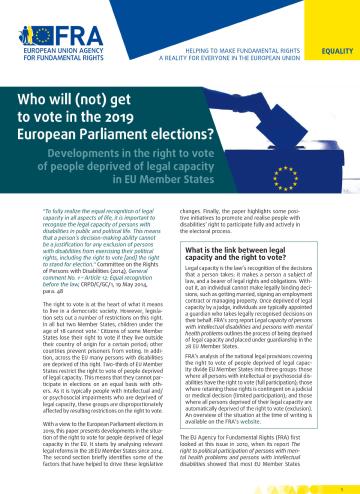
The right to vote is at the heart of what it means to live in a democratic society. However, legislation sets out a number of restrictions on this right. With a view to the European Parliament elections in 2019, this paper presents developments in the situation of the right to vote for people deprived of legal capacity in the EU.
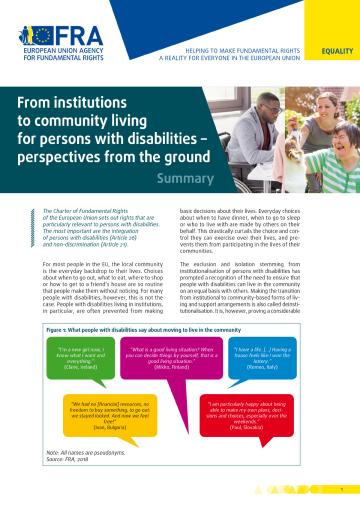
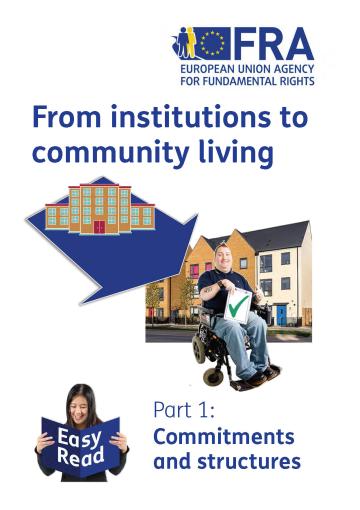
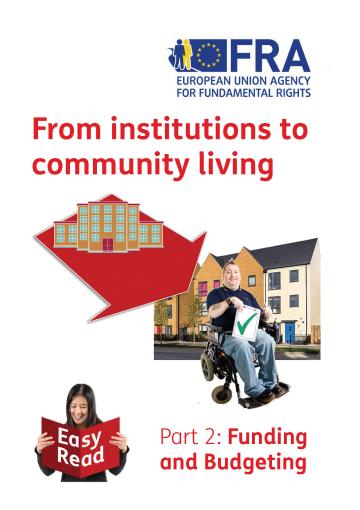
The Convention on the Rights of Persons with Disabilities commits both the EU and all of its Member States to realising the right of persons with disabilities to live independently in the community – which includes achieving deinstitutionalisation for those residing in institutional settings. But much remains to be done to make this a reality in practice. This report presents the main insights gained during fieldwork on the drivers of and barriers to deinstitutionalisation. Focusing on the local level, it gives voice to a diverse set of actors – most importantly, to people with disabilities themselves.
The European Union Agency for Fundamental Rights
(FRA) wanted to contribute to making steps to implement
deinstitutionalisation more effective, by capturing
concrete evidence of what is and what is
not working on the ground. To do this, the agency
conducted extensive fieldwork research in five EU
Member States at different stages of the deinstitutionalisation
process.
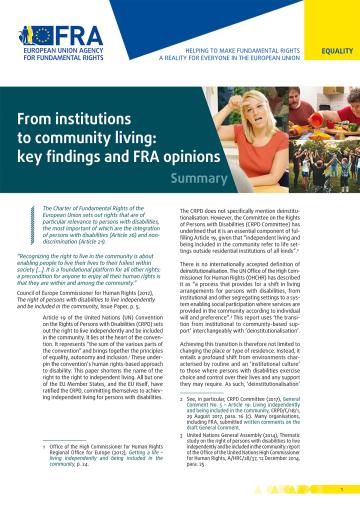
This summary report presents the key findings of
that fieldwork and the FRA opinions stemming from
them.
The year 2017 brought both progress and setbacks in terms of rights protection. The European Pillar of Social Rights marked an important move towards a more ‘social Europe’. But, as experiences with the EU Charter of Fundamental Rights underscore, agreement on a text is merely a first step. Even in its eighth year as the EU's binding bill of rights, the Charter's potential was not fully exploited, highlighting the need to more actively promote its use.
EU Member States, and the EU itself have ratified
the CRPD, committing themselves to achieving independent
living for persons with disabilities. Doing so
requires a meaningful and sustainable shift from institutional
to community-based living arrangements. This
publication summarises the findings from the three
FRA reports focusing on different aspects of deinstitutionalisation.
As organizações da sociedade civil da União Europeia desempenham um papel crucial na promoção dos direitos fundamentais, mas tornou-se mais difícil efetuar essa promoção, devido
a restrições jurídicas e práticas. Embora existam desafios em todos os Estados-Membros da UE, a sua natureza e dimensão exatas variam. De um modo geral, faltam dados e investigação
sobre esta questão ― incluindo investigação comparativa.
O relatório da FRA analisa, por conseguinte, os diferentes tipos e padrões de desafios enfrentados pelas organizações da sociedade civil que trabalham no domínio dos direitos humanos na UE. Também destaca práticas promissoras que podem contrariar esses padrões preocupantes.
Handbook / Guide / Manual
21
March
2018
New language versions: Lithuanian, Portuguese and Slovak
A legislação europeia antidiscriminação, constituída, em particular, pelas diretivas da UE em matéria
de não discriminação, pelo artigo 14.o da Convenção Europeia dos Direitos do Homem e pelo
Protocolo n.o 12 a esta convenção, proíbe a discriminação em diversos contextos e com base em
diversos motivos. O presente manual examina a legislação europeia neste domínio, tal como
decorre dessas duas fontes, remetendo indiferenciadamente para um ou outro destes sistemas
jurídicos complementares nas situações em que os mesmos se sobrepõem, ou assinalando as
diferenças onde estas existem.
This report looks at what the EU and the 28 countries have agreed to do to move people with disabilities from living in institutions to living in their local community with support.


 Report / Paper / Summary27November2025
 Handbook / Guide / Manual20March2023