eu-charter

Charte des droits fondamentaux de l'Union européenne

Article 47 - Droit à un recours effectif et à accéder à un tribunal impartial

Article 47 - Droit à un recours effectif et à accéder à un tribunal impartial

Toute personne dont les droits et libertés garantis par le droit de l'Union ont été violés a droit à un recours effectif devant un tribunal dans le respect des conditions prévues au présent article. Toute personne a droit à ce que sa cause soit entendue équitablement, publiquement et dans un délai raisonnable par un tribunal indépendant et impartial, établi préalablement par la loi. Toute personne a la possibilité de se faire conseiller, défendre et représenter. Une aide juridictionnelle est accordée à ceux qui ne disposent pas de ressources suffisantes, dans la mesure où cette aide serait nécessaire pour assurer l'effectivité de l'accès à la justice.

Explications

  • Texte:

    Le premier alinéa se fonde sur l'article 13 de la CEDH:

    `Toute personne dont les droits et libertés reconnus dans la présente Convention ont été violés, a droit à l'octroi d'un recours effectif devant une instance nationale, alors même que la violation aurait été commise par des personnes agissant dans l'exercice de leurs fonctions officielles`.

    Cependant, dans le droit de l'Union, la protection est plus étendue puisqu'elle garantit un droit à un recours effectif devant un juge. La Cour de justice a consacré ce droit dans son arrêt du 15 mai 1986 en tant que principe général du droit de l'Union (aff. 222/84, Johnston, rec. 1986, p. 1651; voir aussi les arrêts du 15 octobre 1987, aff. 222/86, Heylens, rec. 1987, p. 4097, et du 3 décembre 1992, C-97/91, Borelli, rec. 1992 , p. I-6313). Selon la Cour, ce principe général du droit de l'Union s'applique également aux États membres lorsqu'ils appliquent le droit de l'Union. L'inscription de cette jurisprudence dans la Charte n'avait pas pour objet de modifier le système de contrôle juridictionnel prévu par les traités, et notamment les règles relatives à la recevabilité des recours formés directement devant la Cour de justice de l'Union européenne. La Convention européenne a examiné le système de contrôle juridictionnel de l'Union, y compris les règles relatives à l'admissibilité, et l'a confirmé tout en en modifiant certains aspects, comme le reflètent les articles 251 à 281 du traité sur le fonctionnement de l'Union européenne, et notamment l'article 263, quatrième alinéa. L'article 47 s'applique à l'égard des institutions de l'Union et des États membres lorsqu'ils mettent en œuvre le droit de l'Union, et ce, pour tous les droits garantis par le droit de l'Union.

    Le deuxième alinéa correspond à l'article 6, paragraphe 1 de la CEDH, qui se lit ainsi:

    `Toute personne a droit à ce que sa cause soit entendue équitablement, publiquement et dans un délai raisonnable, par un tribunal indépendant et impartial, établi par la loi, qui décidera, soit des contestations sur ses droits et obligations de caractère civil, soit du bien-fondé de toute accusation en matière pénale dirigée contre elle. Le jugement doit être rendu publiquement, mais l'accès de la salle d'audience peut être interdit à la presse et au public pendant la totalité ou une partie du procès dans l'intérêt de la moralité, de l'ordre public ou de la sécurité nationale dans une société démocratique, lorsque les intérêts des mineurs ou la protection de la vie privée des parties au procès l'exigent, ou dans la mesure jugée strictement nécessaire par le tribunal, lorsque dans des circonstances spéciales la publicité serait de nature à porter atteinte aux intérêts de la justice`.

    Dans le droit de l'Union, le droit à un tribunal ne s'applique pas seulement à des contestations relatives à des droits et obligations de caractère civil. C'est l'une des conséquences du fait que l'Union est une communauté de droit, comme la Cour l'a constaté dans l'affaire 294/83, `Les Verts` contre Parlement européen (arrêt du 23 avril 1986, rec. 1986, p. 1339). Cependant, à l'exception de leur champ d'application, les garanties offertes par la CEDH s'appliquent de manière similaire dans l'Union.

    En ce qui concerne le troisième alinéa, il convient de noter que, d'après la jurisprudence de la Cour européenne des droits de l'homme, une aide juridictionnelle doit être accordée lorsque l'absence d'une telle aide rendrait inefficace la garantie d'un recours effectif (arrêt CEDH du 9.10.1979, Airey, Série A, Volume 32, p. 11). Il existe également un système d'assistance judiciaire devant la Cour de justice de l'Union européenne.

    Source:
    Journal officiel de l'Union européenne C 303/17 - 14.12.2007
    Preamble - Explanations relating to the Charter of Fundamental Rights:
    Les explications qui figurent ci-après ont été établies initialement sous la responsabilité du praesidium de la Convention qui a élaboré la Charte des droits fondamentaux de l'Union européenne. Elles ont été mises à jour sous la responsabilité du praesidium de la Convention européenne, compte tenu des adaptations apportées au texte de la Charte par ladite Convention (notamment aux articles 51 et 52) et de l'évolution du droit de l'Union. Bien que ces explications n'aient pas en soi de valeur juridique, elles constituent un outil d'interprétation précieux destiné à éclairer les dispositions de la Charte.

Références à la jurisprudence

Droit constitutionnel national

50 results found

  • Spain / Constitution of the Kingdom of Spain
    Pays:
    Spain

    Section 24 1. All persons have the right to obtain effective protection from the judges and the courts in the exercise of their rights and legitimate interests, and in no case may there be a lack of defense.2. Likewise, all have the right to the ordinary judge predetermined by law; to defense and assistance by a lawyer; to be informed of the charges brought against them; to a public trial without undue delays and with full guarantees; to the use of evidence appropriate to their defense; not to make self-incriminating statements; not to plead themselves guilty; and to be presumed innocent.The law shall specify the cases in which, for reasons of family relationship or professional secrecy, it shall not be compulsory to make statements regarding allegedly criminal offences.
    ...
    Section 54 An organic act shall regulate the institution of the Defender of the People (Defensor del Pueblo) as high commissioner of the Cortes Generales, appointed by them to defend the rights contained in this Part; for this purpose he or she may supervise the activity of the Administration and report thereon to the Cortes Generales.

    ...
    Section 117 1. Justice emanates from the people and is administered on behalf of the King by judges and magistrates members of the Judicial Power who shall be independent, shall have fixity of tenure, shall be accountable for their acts and subject only to the rule of law. 2. Judges and magistrates may only be dismissed, suspended, transferred or retired on the grounds and subject to the safeguards provided for by the law. 3. The exercise of judicial authority in any kind of action, both in ruling and having judgments executed, is vested exclusively in the courts and tribunals laid down by the law, in accordance with the rules of jurisdiction and procedure which may be established therein. 4. Judges and courts shall not exercise any powers other than those indicated in the foregoing subsection and those which are expressly allocated to them by law as a guarantee of any right.5. The principle of jurisdictional unity is the basis of the organization and operation of the courts. The law shall make provision for the exercise of military jurisdiction strictly within military framework and in cases of state of siege (martial law), in accordance with the principles of the Constitution. 6. Courts of exception are prohibited.
    ...
    Section 119 Justice shall be free when thus provided for by law, and shall in any case be so in respect of those who have insufficient means to sue in court.
    ...
    Section 120 1. Judicial proceedings shall be public, with the exceptions contemplated in the laws on procedure.2. Proceedings shall be predominantly oral, especially in criminal cases. 3. Judgments shall always specify the grounds therefore, and they shall be delivered in a public hearing.

  • Suomen perustuslaki
    Pays:
    Finland

    21 § Oikeusturva Jokaisella on oikeus saada asiansa käsitellyksi asianmukaisesti ja ilman aiheetonta viivytystä lain mukaan toimivaltaisessa tuomioistuimessa tai muussa viranomaisessa sekä oikeus saada oikeuksiaan ja velvollisuuksiaan koskeva päätös tuomioistuimen tai muun riippumattoman lainkäyttöelimen käsiteltäväksi. Käsittelyn julkisuus sekä oikeus tulla kuulluksi, saada perusteltu päätös ja hakea muutosta samoin kuin muut oikeudenmukaisen oikeudenkäynnin ja hyvän hallinnon takeet turvataan lailla.

  • The Belgian Constitution
    Pays:
    Belgium

    Article 12.The freedom of the individual is guaranteed.No one can be prosecuted except in the cases provided for by the law, and in the form prescribed by the law.(...) Article 13.No one can be separated, against his will, from the judge that the law has assigned to him. Article 14.No punishment can be introduced or administered except by virtue of the law. Article 23.Everyone has the right to lead a life in keeping with human dignity.
    To this end, the laws, federate laws and rules referred to in Article 134 guarantee
    economic, social and cultural rights, taking into account corresponding obligations, and
    determine the conditions for exercising them:(...) 2° the right to social security, to health care and to social, medical and legal aid;(...) Article 144.Disputes about civil rights belong exclusively to the competence of the courts. However, the law can empower the Council of State or federal administrative courts, in accordance with the terms it specifies, to rule on the effects that their decisions have with respect to civil law. Article 145.Disputes about political rights belong to the competence of the courts, except for the exceptions established by the law. Article 146. A court and a body capable of rendering judgment can only be established by virtue of a law. No extraordinary courts or commissions may be created, no matter under which designation. Article 148. Court hearings are public, unless such public access endangers morals or the peace; if such is the case, the Court so declares in a judgment.In cases of political or press offences, proceedings can only be conducted in camera on the basis of a unanimous vote. Article 149.Each judgment is supported by reasons. It is pronounced publicly.

  • The Constitution of the Republic of Cyprus
    Pays:
    Cyprus

    Article 30
    1. No person shall be denied access to the court assigned to him by or under this Constitution. The establishment of judicial committees or exceptional courts under any name whatsoever is prohibited.
    2. In the determination of his civil rights and obligations or of any criminal charge against him, every person is entitled to a fair and public hearing within a reasonable time by an independent, impartial and competent court established by law. Judgement shall be reasoned and pronounced in public session, but the press and the public may be excluded from all or any part of the trial upon a decision of the court where it is in the interest of the security of the Republic or the constitutional order or the public order or the public safety or the public morals or where the interests of juveniles or the protection of the private life of the parties so require or, in special circumstances where, in the opinion of the court, publicity would prejudice the interests of justice.
    3. Every person has the right -
    (a) to be informed of the reasons why he is required to appear before the court;
    (b) to present his case before the court and to have sufficient time necessary for its preparation;
    (c) to adduce or cause to be adduced his evidence and to examine witnesses according to law;
    (d) to have a lawyer of his own choice and to have free legal assistance where the interests of justice so require and as provided by law;
    (e) to have free assistance of an interpreter if he cannot understand or speak the language used in court.

  • The Constitutional Act of Denmark
    Pays:
    Denmark

    Section 61. The exercise of judicial authority shall be governed only by statute. Extraordinary courts of justice with judicial authority shall not be established.
    Section 62. The administration of justice shall always remain independent of administrative authority. Rules to this effect shall be laid down by statute.
    Section 63. Subsection 1. The courts of justice shall be empowered to decide any question relating to the scope of the executive’s authority; though any person wishing to question such authority shall not, by taking the case to the courts of justice, avoid temporary compliance with orders given by the executive authority. Subsection 2. Questions relating to the scope of the executive’s authority may by statute be referred for decision to one or more administrative courts, except that an appeal against the decision of the administrative courts shall be referred to the highest court of the Realm. Rules governing this procedure shall be laid down by statute.
    Section 64. In the performance of their duties, the judges shall be governed solely by the law. Judges shall not be dismissed except by judgement, nor shall they be transferred against their will, except in cases in which a rearrangement of the courts of justice is made. A judge who has completed his sixty-fifth year may, however, be retired, but without loss of income up to the time when he is due for retirement on account of age.
    Section 65. Subsection 1. In the administration of justice all proceedings shall to the widest possible extent be public and oral. Subsection 2. Laymen shall participate in criminal proceedings. The cases and the form in which such participation shall take place, including which cases shall be tried by jury, shall be provided for by statute.
    Section 71. Subsection 2. A person shall be deprived of his liberty only when this is warranted by law. Subsection 3. Any person who is taken into custody shall be brought before a judge within twenty-four hours. When the person taken into custody cannot be released immediately, the judge shall decide, in an order to be given as soon as possible and at the latest within three days, stating the grounds,
    whether the person taken into custody shall be committed to prison; and in cases in which he can be released on bail, the judge shall also determine the nature and amount of such bail. This provision
    may be disregarded by statute as far as Greenland is concerned, if for local considerations such departure may be deemed necessary. Subsection 4. The pronouncement of the judge may be separately appealed against at once to a higher court of justice by the person concerned. Subsection 5. No person shall be remanded in custody for an offence which can involve only punishment by fine or simple detention.

  • The Fundamental Law of Hungary
    Pays:
    Hungary

    Article XXVIII (Freedom and Responsibility) (1) Everyone shall have the right to have any charge against him or her, or his or her rights and obligations in any litigation, adjudicated within a reasonable time in a fair and public trial by an independent and impartial court established by an Act. […]
    (3) Persons subject to criminal proceedings shall have the right to defence at all stages of the procedure. Defence counsels shall not be held liable for their opinion expressed while providing legal defence. […]
    (7) Everyone shall have the right to seek legal remedy against any court, authority or other administrative decision which violates his or her rights or legitimate interests.

  • Tο Σύνταγμα της Κυπριακής Δημοκρατίας
    Pays:
    Cyprus

    ΑΡΘΡΟΝ 30
    1. Εις ουδένα δύναται ν’ απαγορευθή η προσφυγή ενώπιον του δικαστηρίου, εις ο δικαιούται να προσφύγη δυνάμει του Συντάγματος. Η σύστασις δικαστικών επιτροπών ή εκτάκτων δικαστηρίων υπό οιονδήποτε όνομα απαγορεύεται.
    2. Έκαστος, κατά την διάγνωσιν των αστικών αυτού δικαιωμάτων και υποχρεώσεων ή οιασδήποτε κατ’ αυτού ποινικής κατηγορίας, δικαιούται ανεπηρεάστου, δημοσίας ακροαματικής διαδικασίας εντός ευλόγου χρόνου, ενώπιον ανεξαρτήτου, αμερολήπτου και αρμοδίου δικαστηρίου ιδρυομένου διά νόμου.
    Αι αποφάσεις των δικαστηρίων δέον να είναι ητιολογημέναι και ν’ απαγγέλλωνται εν δημοσία συνεδριάσει, πλην όμως ο τύπος και το κοινόν δύνανται ν’ αποκλεισθώσιν εξ ολοκλήρου ή μέρους της δίκης τη αποφάσει του δικαστηρίου, οσάκις απαιτή τούτο το συμφέρον της ασφαλείας της Δημοκρατίας ή της συνταγματικής τάξεως ή της δημοσίας τάξεως ή της δημοσίας ασφαλείας ή των δημοσίων ηθών ή το συμφέρον των ανηλίκων ή η προστασία της ιδιωτικής ζωής των διαδίκων ή υπό ειδικάς συνθήκας, καθ’ ας κατά την κρίσιν του δικαστηρίου η δημοσιότης θα ηδύνατο να επηρεάσει δυσμενώς το συμφέρον της δικαιοσύνης.
    3. Έκαστος έχει το δικαίωμα:
    (α) να πληροφορηθή τους λόγους, δι’ ους καλείται να εμφανισθή ενώπιον του δικαστηρίου,
    (β) να προβάλη τους ισχυρισμούς αυτού ενώπιον του δικαστηρίου και να έχη χρόνον επαρκή διά την προπαρασκευήν τούτων,
    (γ) να προσάγη ή να προκαλή την προσαγωγήν των μέσων αποδείξεως και να εξετάζη μάρτυρας συμφώνως τω νόμω,
    (δ) να έχη συνήγορον της ιδίας αυτού εκλογής και να έχη δωρεάν νομικήν αρωγήν, οσάκις το συμφέρον της δικαιοσύνης απαιτή τούτο και όπως ο νόμος ορίζει,
    (ε) να έχει δωρεάν συμπαράστασιν διερμηνέως, εφ’ όσον δεν δύναται να κατανοή ή ομιλή την εν τω δικαστηρίω χρησιμοποιουμένην γλώσσαν.

  • Ustav Republike Hrvatske
    Pays:
    Croatia

    Članak 18.
    Jamči se pravo na žalbu protiv pojedinačnih pravnih akata donesenih u postupku prvog stupnja pred sudom ili drugim ovlaštenim tijelom.
    Pravo na žalbu može biti iznimno isključeno u slučajevima određenima zakonom ako je osigurana druga pravna zaštita.

    Članak 26.
    Svi su državljani Republike Hrvatske i stranci jednaki pred sudovima i drugim državnim i inim tijelima koja imaju javne ovlasti.

    Članak 28.
    Svatko je nedužan i nitko ga ne može smatrati krivim za kazneno djelo dok mu se pravomoćnom sudskom presudom ne utvrdi krivnja.

    Članak 29.
    Svatko ima pravo da zakonom ustanovljeni neovisni i nepristrani sud pravično i u razumnom roku odluči o njegovim pravima i obvezama, ili o sumnji ili optužbi zbog kažnjivog djela.

    U slučaju sumnje ili optužbe zbog kažnjivog djela osumnjičenik, okrivljenik ili optuženik ima pravo:
    – da u najkraćem roku bude obaviješten potanko i na jeziku koji razumije o naravi i razlozima optužbe koja se diže protiv njega i o dokazima koji ga terete,
    – da ima odgovarajuće vrijeme i mogućnost za pripremu obrane,
    – na branitelja i nesmetano uspostavljanje veze s braniteljem, i s tim pravom mora biti upoznat,
    – da se brani sam ili uz branitelja po vlastitom izboru, a ako nema dovoljno sredstava da plati branitelja, ima pravo na besplatnog branitelja pod uvjetom propisanim zakonom,
    – da mu se sudi u njegovoj nazočnosti, ukoliko je dostupan sudu,
    – da ispituje ili dade ispitati svjedoke optužbe i da zahtijeva da se osigura nazočnost i ispitivanje svjedoka obrane pod istim uvjetima kao i svjedoka optužbe,
    – na besplatnu pomoć tumača ako ne razumije ili ne govori jezik koji se upotrebljava na sudu.
    Osumnjičenik, okrivljenik i optuženik ne smije se siliti da prizna krivnju.

    Dokazi pribavljeni na nezakonit način ne mogu se uporabiti u sudskom postupku.

    Kazneni postupak može se pokrenuti samo pred sudom na zahtjev ovlaštenog tužitelja.

  • Το Σύνταγμα της Ελλάδας
    Pays:
    Greece

    Άρθρο 8 Κανένας δεν στερείται χωρίς τη θέλησή του το δικαστή που του έχει ορίσει ο νόμος. Δικαστικές επιτροπές και έκτακτα δικαστήρια, με οποιοδήποτε όνομα, δεν επιτρέπεται να συσταθούν.[...] Άρθρο 20 (1).Καθένας έχει δικαίωμα στην παροχή έννομης προστασίας από τα δικαστήρια και μπορεί να αναπτύξει σ' αυτά τις απόψεις του για τα δικαιώματα ή συμφέροντά του, όπως νόμος ορίζει. (2).Το δικαίωμα της προηγούμενης ακρόασης του ενδιαφερομένου ισχύει και για κάθε διοικητική ενέργεια ή μέτρο που λαμβάνεται σε βάρος των δικαιωμάτων ή συμφερόντων του [...].Άρθρο 87 (1).Η δικαιοσύνη απονέμεται από δικαστήρια συγκροτούμενα από τακτικούς δικαστές, που απολαμβάνουν λειτουργική προσωπική ανεξαρτησία.(2).Οι δικαστές κατά την άσκηση των καθηκόντων τους υπόκεινται μόνο στο Σύνταγμα και στους νόμους και σε καμία περίπτωση δεν υποχρεούνται να συμμορφώνονται με διατάξεις που έχουν τεθεί κατά κατάλυση του Συντάγματος.(3).Η επιθεώρηση των τακτικών δικαστών ενεργείται από δικαστές ανώτερου βαθμού καθώς και από τον Εισαγγελέα, τους Αντεισαγγελείς του Αρείου Πάγου, των δε εισαγγελέων από αρεοπαγίτες και εισαγγελείς ανώτερου βαθμού, σύμφωνα με τους ορισμούς του νόμου. [...] Άρθρο 97(1).Τα κακουργήματα και τα πολιτικά εγκλήματα δικάζονται από μικτά ορκωτά δικαστήρια που συγκροτούνται από τακτικούς δικαστές και ενόρκους, όπως νόμος ορίζει. Οι αποφάσεις των δικαστηρίων αυτών υπόκεινται στα ένδικα μέσα που ορίζει ο νόμος.(2).Κακουργήματα και πολιτικά εγκλήματα, που με συντακτικές πράξεις, ψηφίσματα και ειδικούς νόμους έχουν υπαχθεί έως την ισχύ του Συντάγματος στη δικαιοδοσία των εφετείων, εξακολουθούν να δικάζονται από αυτά, εφόσον δεν υπαχθούν με νόμο στην αρμοδιότητα των μικτών ορκωτών δικαστηρίων. Με νόμο μπορεί να υπαχθούν στη δικαιοδοσία των ίδιων εφετείων και άλλα κακουργήματα.(3).Τα εγκλήματα κάθε βαθμού που διαπράττονται δια του Τύπου υπάγονται στα τακτικά ποινικά δικαστήρια, όπως νόμος ορίζει. [...]

  • КОНСТИТУЦИЯ на Република България
    Pays:
    Bulgaria

    Чл. 30 [...] (4) Всеки има право на адвокатска защита от момента на задържането му или на привличането му като обвиняем.(5) Всеки има право да се среща насаме с лицето, което го защитава. Тайната на техните съобщения е неприкосновена. Чл. 31(1) Всеки обвинен в престъпление следва да бъде предаден на съдебната власт в законно определения срок. [...] (4) Не се допускат ограничения на правата на обвиняемия, надхвърлящи необходимото за осъществяване на правосъдието.Чл. 45. Гражданите имат право на жалби, предложения и петиции до държавните органи. Чл. 56 Всеки гражданин има право на защита, когато са нарушени или застрашени негови права или законни интереси. В държавните учреждения той може да се явява и със защитник. Чл. 117. (1) Съдебната власт защитава правата и законните интереси на гражданите, юридическите лица и държавата. [...] Чл. 120. (1) Съдилищата осъществяват контрол за законност на актове и действия на административните органи. (2) Гражданите и юридическите лица могат да обжалват всички административни актове, които ги засягат, освен изрично посочените със закон. Чл. 122(1) Гражданите и юридическите лица имат право на защита във всички стадии на процеса.(2) Редът за упражняване правото на защита се определя със закон.

Droit de l'UE

35 results found

  • Regulation (EU) 2021/784 of the European Parliament and of the Council of 29 April 2021 on addressing the dissemination of terrorist content online

    Preamble 


    (20) It should be possible for the competent authority of the Member State where the hosting service provider has its main establishment or where its legal representative resides or is established to scrutinise the removal order issued by competent authorities of another Member State to determine whether it seriously or manifestly infringes this Regulation or the fundamental rights enshrined in the Charter. Both the content provider and the hosting service provider should have the right to request such scrutiny by the competent authority in the Member State where the hosting service provider has its main establishment or where its legal representative resides or is established. Where such a request is made, that competent authority should adopt a decision on whether the removal order comprises such an infringement. Where that decision finds such an infringement, the removal order should cease to have legal effects. The scrutiny should be carried out swiftly so as to ensure that erroneously removed or disabled content is reinstated as soon as possible.


    (23) When putting in place specific measures, hosting service providers should ensure that users’ right to freedom of expression and information as well as the freedom and pluralism of the media as protected under the Charter are preserved. In addition to any requirement laid down in the law, including legislation on the protection of personal data, hosting service providers should act with due diligence and implement safeguards, where appropriate, including human oversight and verifications, to avoid any unintended or erroneous decision leading to the removal of or disabling of access to content that is not terrorist content.

    Article 1: Subject matter and scope

    1. This Regulation lays down uniform rules to address the misuse of hosting services for the dissemination to the public of terrorist content online, in particular on:

    (a) reasonable and proportionate duties of care to be applied by hosting service providers in order to address the dissemination to the public of terrorist content through their services and ensure, where necessary, the expeditious removal of or disabling of access to such content;

    (b) the measures to be put in place by Member States, in accordance with Union law and subject to suitable safeguards to protect fundamental rights, in particular the freedom of expression and information in an open and democratic society, in order to:

    (i) identify and ensure the expeditious removal of terrorist content by hosting service providers; and

    (ii) facilitate cooperation among the competent authorities of Member States, hosting service providers and, where appropriate, Europol.

    2. This Regulation applies to hosting service providers offering services in the Union, irrespective of their place of main establishment, insofar as they disseminate information to the public.

    3. Material disseminated to the public for educational, journalistic, artistic or research purposes or for the purposes of preventing or countering terrorism, including material which represents an expression of polemic or controversial views in the course of public debate, shall not be considered to be terrorist content. An assessment shall determine the true purpose of that dissemination and whether material is disseminated to the public for those purposes.

    4. This Regulation shall not have the effect of modifying the obligation to respect the rights, freedoms and principles referred to in Article 6 TEU and shall apply without prejudice to fundamental principles relating to freedom of expression and information, including freedom and pluralism of the media.

    5. This Regulation shall be without prejudice to Directives 2000/31/EC and 2010/13/EU. For audiovisual media services as defined in point (a) of Article 1(1) of Directive 2010/13/EU, Directive 2010/13/EU shall prevail.

    Article 4: Procedure for cross-borders removal orders 

    3.   The competent authority of the Member State where the hosting service provider has its main establishment or where its legal representative resides or is established may, on its own initiative, within 72 hours of receiving the copy of the removal order in accordance with paragraph 1, scrutinise the removal order to determine whether it seriously or manifestly infringes this Regulation or the fundamental rights and freedoms guaranteed by the Charter.

    Where it finds an infringement, it shall, within the same period, adopt a reasoned decision to that effect. 

  • Directive (EU) 2016/800 of the European Parliament and of the Council of 11 May 2016 on procedural safeguards for children who are suspects or accused persons in criminal proceedings

    Preamble

    (31) Member States should be able to derogate temporarily from the obligation to provide assistance by a lawyer in the pre-trial phase for compelling reasons, namely where there is an urgent need to avert serious adverse consequences for the life, liberty or physical integrity of a person, or where immediate action by the investigating authorities is imperative to prevent substantial jeopardy to criminal proceedings in relation to a serious criminal offence, inter alia, with a view to obtaining information concerning the alleged co-perpetrators of a serious criminal offence, or in order to avoid the loss of important evidence regarding a serious criminal offence. During a temporary derogation for one of those compelling reasons, the competent authorities should be able to question children without the lawyer being present, provided that they have been informed of their right to remain silent and can exercise that right, and that such questioning does not prejudice the rights of the defence, including the right not to incriminate oneself. It should be possible to carry out questioning, to the extent necessary, for the sole purpose of obtaining information that is essential to avert serious adverse consequences for the life, liberty or physical integrity of a person, or to prevent substantial jeopardy to criminal proceedings. Any abuse of this temporary derogation would, in principle, irretrievably prejudice the rights of the defence.‘
     

    (33) Confidentiality of communication between children and their lawyer is key to ensuring the effective exercise of the rights of the defence and is an essential part of the right to a fair trial. Member States should therefore respect the confidentiality of meetings and other forms of communication between the lawyer and the child in the context of the assistance by a lawyer provided for in this Directive, without derogation.

    (35) Children who are suspects or accused persons in criminal proceedings should have the right to an individual assessment to identify their specific needs in terms of protection, education, training and social integration, to determine if and to what extent they would need special measures during the criminal proceedings, the extent of their criminal responsibility and the appropriateness of a particular penalty or educative measure.

    Article 3: Definitions
    For the purposes of this Directive the following definitions apply:
    (1) ‘child’ means a person below the age of 18;
    (2) ‘holder of parental responsibility’ means any person having parental responsibility over a child;  [...]
    With regard to point (1) of the first paragraph, where it is uncertain whether a person has reached the age of 18, that person shall be presumed to be a child.


    Article 4: Right to information
    1.   Member States shall ensure that when children are made aware that they are suspects or accused persons in criminal proceedings, they are informed promptly about their rights [...].


    Article 5 - Right of the child to have the holder of parental responsibility informed
    1.   Member States shall ensure that the holder of parental responsibility is provided, as soon as possible, with the information that the child has a right to receive in accordance with Article 4.

    Article 6: Assistance by a lawyer
    2.   Member States shall ensure that children are assisted by a lawyer in accordance with this Article in order to allow them to exercise the rights of the defence effectively.


    Article 10: Limitation of deprivation of liberty
    1.   Member States shall ensure that deprivation of liberty of a child at any stage of the proceedings is limited to the shortest appropriate period of time. Due account shall be taken of the age and individual situation of the child, and of the particular circumstances of the case.
    2.   Member States shall ensure that deprivation of liberty, in particular detention, shall be imposed on children only as a measure of last resort. Member States shall ensure that any detention is based on a reasoned decision, subject to judicial review by a court. Such a decision shall also be subject to periodic review, at reasonable intervals of time, by a court, either ex officio or at the request of the child, of the child's lawyer, or of a judicial authority which is not a court. Without prejudice to judicial independence, Member States shall ensure that decisions to be taken pursuant to this paragraph are taken without undue delay. 
     

    Article 11: Alternative measures
    Member States shall ensure that, where possible, the competent authorities have recourse to measures alternative to detention (alternative measures).
     

    Article 12: Specific treatment in the case of deprivation of liberty
    1.   Member States shall ensure that children who are detained are held separately from adults, unless it is considered to be in the child's best interests not to do so.
    2.   Member States shall also ensure that children who are kept in police custody are held separately from adults, unless:
    (a) it is considered to be in the child's best interests not to do so; or
    (b) in exceptional circumstances, it is not possible in practice to do so, provided that children are held together with adults in a manner that is compatible with the child's best interests.
    3.   Without prejudice to paragraph 1, when a detained child reaches the age of 18, Member States shall provide for the possibility to continue to hold that person separately from other detained adults where warranted, taking into account the circumstances of the person concerned, provided that this is compatible with the best interests of children who are detained with that person.
    4.   Without prejudice to paragraph 1, and taking into account paragraph 3, children may be detained with young adults, unless this is contrary to the child's best interests.
    5.   When children are detained, Member States shall take appropriate measures to:
    (a) ensure and preserve their health and their physical and mental development;
    (b) ensure their right to education and training, including where the children have physical, sensory or learning disabilities;
    (c) ensure the effective and regular exercise of their right to family life;
    (d) ensure access to programmes that foster their development and their reintegration into society; and
    (e) ensure respect for their freedom of religion or belief.
    The measures taken pursuant to this paragraph shall be proportionate and appropriate to the duration of the detention.
    Points (a) and (e) of the first subparagraph shall also apply to situations of deprivation of liberty other than detention. The measures taken shall be proportionate and appropriate to such situations of deprivation of liberty.
    Points (b), (c), and (d) of the first subparagraph shall apply to situations of deprivation of liberty other than detention only to the extent that is appropriate and proportionate in the light of the nature and duration of such situations.
    6.   Member States shall endeavour to ensure that children who are deprived of liberty can meet with the holder of parental responsibility as soon as possible, where such a meeting is compatible with investigative and operational requirements. This paragraph shall be without prejudice to the nomination or designation of another appropriate adult pursuant to Article 5 or 15.
     

  • Council Regulation (EU) 2016/1103 of 24 June 2016 implementing enhanced cooperation in the area of jurisdiction, applicable law and the recognition and enforcement of decisions in matters of matrimonial property regimes

    [...]

    (73) This Regulation respects fundamental rights and observes the principles recognised in the Charter, in particular Articles 7, 9, 17, 21 and 47 concerning, respectively, respect for private and family life, the right to marry and to found a family according to national laws, property rights, the principle of non-discrimination and the right to an effective remedy and to a fair trial. This Regulation should be applied by the courts and other competent authorities of the Member States in compliance with those rights and principles.

    [...]

  • Regulation (EU) 2023/1543 of the European Parliament and of the Council of 12 July 2023 on European Production Orders and European Preservation Orders for electronic evidence in criminal proceedings and for the execution of custodial sentences

    Preamble 


    (13) The respect for private and family life and the protection of natural persons regarding the processing of personal data are fundamental rights. In accordance with Article 7 and Article 8(1) of the Charter, everyone has the right to respect for their private and family life, home and communications and to the protection of personal data concerning them.

    (46) The principle of ne bis in idem is a fundamental principle of law in the Union, as recognised by the Charter and developed by the case law of the Court of Justice of the European Union. Where the issuing authority has grounds to believe that parallel criminal proceedings could be ongoing in another Member State, it should consult the authorities of that Member State in accordance with Council Framework Decision 2009/948/JHA . In any case, a European Production Order or a European Preservation Order is not to be issued where the issuing authority has grounds to believe that this would be contrary to the ne bis in idem principle.

    Article 1: Subject matter

    1. This Regulation lays down the rules under which an authority of a Member State, in criminal proceedings, may issue a European Production Order or a European Preservation Order and thereby order a service provider offering services in the Union and established in another Member State, or, if not established, represented by a legal representative in another Member State, to produce or to preserve electronic evidence regardless of the location of the data. This Regulation is without prejudice to the powers of national authorities to address service providers established or represented on their territory for the purpose of ensuring that they comply with national measures similar to those referred to in the first subparagraph.

    2. The issuing of a European Production Order or of a European Preservation Order may also be requested by a suspect or an accused person, or by a lawyer on that person’s behalf within the framework of applicable defence rights in accordance with national criminal procedural law.

    3. This Regulation shall not have the effect of modifying the obligation to respect the fundamental rights and legal principles as enshrined in the Charter and in Article 6 TEU, and any obligations applicable to law enforcement authorities or judicial authorities in this respect shall remain unaffected. This Regulation applies without prejudice to fundamental principles, in particular the freedom of expression and information, including the freedom and pluralism of the media, respect for private and family life, the protection of personal data, as well as the right to effective judicial protection.

  • Directive (EU) 2022/2381 of the European Parliament and of the Council of 23 November 2022 on improving the gender balance among directors of listed companies and related measures

    Article 1

    Purpose

    This Directive aims to achieve a more balanced representation of women and men among the directors of listed companies by establishing effective measures that aim to accelerate progress towards gender balance, while allowing listed companies sufficient time to make the necessary arrangements for that purpose.

  • Directive (EU) 2019/1937 of the European Parliament and of the Council of 23 October 2019 on the protection of persons who report breaches of Union law

    Article 1

    Purpose

    The purpose of this Directive is to enhance the enforcement of Union law and policies in specific areas by laying down common minimum standards providing for a high level of protection of persons reporting breaches of Union law.

  • Regulation (EU) 2022/2065 of the European Parliament and of the Council of 19 October 2022 on a Single Market For Digital Services and amending Directive 2000/31/EC (Digital Services Act)

    Article 34: Risk assessment

    1. Providers of very large online platforms and of very large online search engines shall diligently identify, analyse and assess any systemic risks in the Union stemming from the design or functioning of their service and its related systems, including algorithmic systems, or from the use made of their services.

    They shall carry out the risk assessments by the date of application referred to in Article 33(6), second subparagraph, and at least once every year thereafter, and in any event prior to deploying functionalities that are likely to have a critical impact on the risks identified pursuant to this Article. This risk assessment shall be specific to their services and proportionate to the systemic risks, taking into consideration their severity and probability, and shall include the following systemic risks:

    [...]

    (b) any actual or foreseeable negative effects for the exercise of fundamental rights, in particular the fundamental rights to human dignity enshrined in Article 1 of the Charter, to respect for private and family life enshrined in Article 7 of the Charter, to the protection of personal data enshrined in Article 8 of the Charter, to freedom of expression and information, including the freedom and pluralism of the media, enshrined in Article 11 of the Charter, to non-discrimination enshrined in Article 21 of the Charter, to respect for the rights of the child enshrined in Article 24 of the Charter and to a high-level of consumer protection enshrined in Article 38 of the Charter;

  • Directive 2010/64/EU of the European Parliament and of the Council of 20 October 2010 on the right to interpretation and translation in criminal proceedings

    Preamble 

    (5) Article 6 of the European Convention for the Protection of Human Rights and Fundamental Freedoms (hereinafter the ECHR) and Article 47 of the Charter of Fundamental Rights of the European Union (hereinafter the Charter) enshrine the right to a fair trial. Article 48(2) of the Charter guarantees respect for the right of defence. This Directive respects those rights and should be implemented accordingly.

    Article 1: Subject matter and scope

    1. This Directive lays down rules concerning the right to interpretation and translation in criminal proceedings and proceedings for the execution of a European arrest warrant.

    2. The right referred to in paragraph 1 shall apply to persons from the time that they are made aware by the competent authorities of a Member State, by official notification or otherwise, that they are suspected or accused of having committed a criminal offence until the conclusion of the proceedings, which is understood to mean the final determination of the question whether they have committed the offence, including, where applicable, sentencing and the resolution of any appeal.

    3. Where the law of a Member State provides for the imposition of a sanction regarding minor offences by an authority other than a court having jurisdiction in criminal matters, and the imposition of such a sanction may be appealed to such a court, this Directive shall apply only to the proceedings before that court following such an appeal.

    4. This Directive does not affect national law concerning the presence of legal counsel during any stage of the criminal proceedings, nor does it affect national law concerning the right of access of a suspected or accused person to documents in criminal proceedings.

  • Directive 2013/48/EU of the European Parliament and of the Council of 22 October 2013 on the right of access to a lawyer in criminal proceedings and in European arrest warrant proceedings

    Preamble 

    (1) Article 47 of the Charter of Fundamental Rights of the  European Union (the Charter), Article 6 of the European  Convention for the Protection of Human Rights and  Fundamental Freedoms (the ECHR) and Article 14 of the International Covenant on Civil and Political Rights (the ICCPR) enshrine the right to a fair trial. Article 48(2) of the Charter guarantees respect for the rights of the defence.


    (12) This Directive lays down minimum rules concerning the right of access to a lawyer in criminal proceedings and in proceedings for the execution of a European arrest warrant pursuant to Council Framework Decision 2002/584/JHA of 13 June 2002 on the European arrest warrant and the surrender procedures between Member States (European arrest warrant proceedings) and the right to have a third party informed upon deprivation of liberty and to communicate with third persons and with consular authorities while deprived of liberty. In doing so, it promotes the application of the Charter, in particular Articles 4, 6, 7, 47 and 48 thereof, by building upon Articles 3, 5, 6 and 8 ECHR, as interpreted by the European Court of Human Rights, which, in its case-law, on an ongoing basis, sets standards on the right of access to a lawyer. That case-law provides, inter alia, that the fairness of proceedings requires that a suspect or accused person be able to obtain the whole range of services specifically associated with legal assistance. In that regard, the lawyers of suspects or accused persons should be able to secure without restriction, the fundamental aspects of the defence.

    (52) This Directive upholds the fundamental rights and principles recognised by the Charter, including the prohibition of torture and inhuman and degrading treatment, the right to liberty and security, respect for private and family life, the right to the integrity of the person, the rights of the child, integration of persons with disabilities, the right to an effective remedy and the right to a fair trial, the presumption of innocence and the rights of the defence. This Directive should be implemented in accordance with those rights and principles.

    Article 1: Subject matter

    This Directive lays down minimum rules concerning the rights of suspects and accused persons in criminal proceedings and of persons subject to proceedings pursuant to Framework Decision 2002/584/JHA (‘European arrest warrant proceedings’) to have access to a lawyer, to have a third party informed of the deprivation of liberty and to communicate with third persons and with consular authorities while deprived of liberty.

    Article 11: Legal aid

    This Directive is without prejudice to national law in relation to legal aid, which shall apply in accordance with the Charter and the ECHR.

     
  • Regulation (EU) 2021/693 of the European Parliament and of the Council of 28 April 2021 establishing the Justice Programme and repealing Regulation (EU) No 1382/2013

    Article 1

    Subject matter

    This Regulation establishes the Justice Programme (the ‘Programme’) for the duration of the multiannual financial framework 2021-2027, as laid down in Regulation (EU, Euratom) 2020/2093.

    It lays down the objectives of the Programme, the budget for the period 2021–2027, the forms of Union funding and the rules for providing such funding.

Droit international

0 results found

Produits

  • Opinion / Position Paper
    6
    Février
    2025
    This FRA Position Paper outlines the Agency’s position on the creation of 'return hubs' in non-EU countries for migrants who have been ordered to leave the EU. Considering the serious fundamental rights risks connected with running return hubs, this legal analysis presents the conditions that would have to be met for return hubs to respect fundamental rights and comply with EU law. These include setting up agreements with the host countries and creating independent human rights monitoring mechanisms. The position paper does not examine centres in third countries that process asylum applications.
  • Report / Paper / Summary
    28
    novembre
    2024
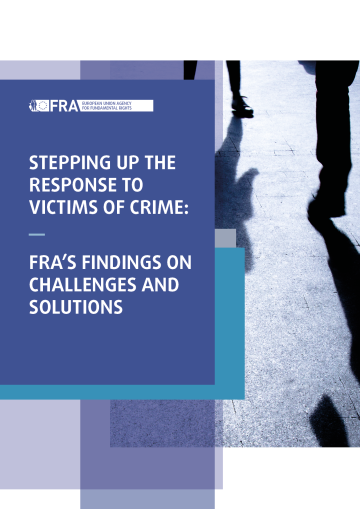
    This paper outlines key challenges and solutions when it comes to promoting and protecting victims’ rights across the EU. It draws on FRA research over the past decade. It focuses on reporting crime, protection from secondary victimisation, victim support services. The paper highlights challenges and solutions in each of these areas, drawing directly from FRA’s published work. The challenges are based on the Agency’s data gathered from large-scale quantitative surveys of victims and in-depth qualitative research, including testimonies from victims and practitioners. The solutions draw from effective practices in various EU countries that address the practical needs of victims and improve their access to rights.
    AlexLinch/iStock
  • Report / Paper / Summary
    25
    novembre
    2024
    This report presents key results of the EU gender-based violence survey based on data from all 27 Member States. The report focuses on the overall prevalence of physical violence or threats and/or sexual violence by any perpetrator, violence perpetrated by women’s intimate partners and by other people (non-partners) and women’s experiences of sexual harassment at work.
  • Handbook / Guide / Manual
    21
    novembre
    2024
    This manual is designed to be used by workplace inspection staff in the Member States. It is intended to empower them to enforce the protective standards in EU law that safeguard the rights of third-country workers, including seasonal workers, migrant workers with temporary permits and migrants in an irregular situation. Third-country workers are nationals who are not from a Member State or from Iceland, Liechtenstein, Norway or Switzerland.
  • Handbook / Guide / Manual
    19
    septembre
    2024
    This publication guides EU countries on setting up independent monitoring mechanisms to ensure fundamental rights are respected during screening and asylum border procedures. These processes at borders are for people arriving from non-EU countries. Monitoring mechanisms are meant to prevent rights violations, protect victims, and support investigations into any allegations of wrongdoing by public authorities. The guidance highlights the importance of transparency and accountability, which builds trust in public authorities. New EU regulations coming into effect in 2026 will require such monitoring systems to be in place. This updates the guidance published in 2022.
  • Report / Paper / Summary
    30
    juillet
    2024
    Fundamental rights violations on the EU’s land and sea borders often go unreported. Investigations into these violations need to be more effective. This report gathers examples of alleged rights violations of migrants and refugees between 2020 and 2023. It sets out 10 steps to promote prompt and effective national investigations into incidents of ill-treatment at borders.
  • In brief / Factsheet
    18
    juin
    2024
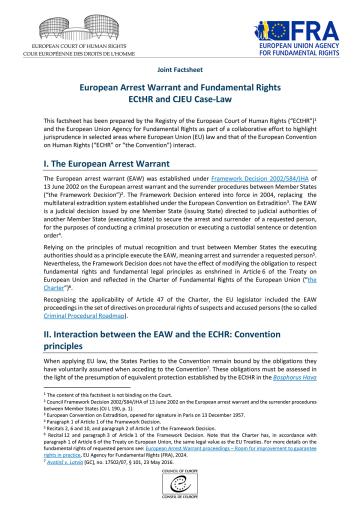
    La présente fiche thématique a été préparée par le Greffe de la Cour européenne des droits de l’homme (« Cour EDH ») et l’Agence des droits fondamentaux de l’Union européenne dans le cadre d’une collaboration visant à présenter la jurisprudence dans des domaines choisis dans lesquels le droit de l’Union européenne et de la Convention européenne des droits de l’homme (« CEDH » ou « Convention EDH ») interagissent.
  • Fundamental Rights Report
    5
    juin
    2024
    FRA’s Fundamental Rights Report 2024 analyses the year’s developments in fundamental rights. It focuses on the most pressing fundamental rights concerns facing Europe in 2023: the cost-of-living crisis, rights concerns at the EU’s external borders and migration, and threats to democracy. Re-structured, this year’s new approach is a shorter and sharper analysis. It also presents FRA’s opinions on these developments, including a summary of the evidence supporting these opinions.
  • Fundamental Rights Report
    5
    juin
    2024
    L’année 2023 a été marquée à la fois par des avancées et des reculs en matière de protection des droits fondamentaux. Le Rapport sur les droits fondamentaux 2024 de l’Agence des droits fondamentaux de l’Union européenne (FRA) examine des évolutions dans ce domaine, en recensant les progrès accomplis et les sujets de préoccupation persistants. La présente publication expose les avis de la FRA sur les principales évolutions dans les domaines thématiques couverts ainsi qu’un résumé des éléments factuels qui étayent ces avis. Elle fournit ainsi une vue d’ensemble concise mais instructive des principaux défis en matière de droits fondamentaux auxquels l’Union européenne (UE) et ses États membres doivent faire face.