Asylum

Protection des enfants

    Produits

    Publications and Data

    Displaying results 31 - 40 of 46
    Report / Paper / Summary
    20
    novembre
    2017
    International treaties, the Charter of Fundamental Rights of the European Union, European Union (EU) secondary law and national legislation provide a number of rights to citizens. The maps and tables presented show the various patterns concerning age requirements for children to acquire rights in the EU. They also identify inconsistencies, protection gaps and restrictions deriving from different age thresholds. The reference period was until April 2016. Any legislative developments since then have been included whenever relevant or if known.
    Report / Paper / Summary
    22
    juin
    2017
    Up to one third of migrants arriving in the European Union since the summer of 2015 have been children. The current emphasis on speedier asylum processing and making returns more effective may trigger increased use of immigration detention, possibly also affecting children. The detention of children implicates various fundamental rights and will only be in line with EU law if limited to exceptional cases. This report aims to support practitioners in implementing relevant polices in line with applicable law by outlining available safeguards against unlawful and arbitrary detention and highlighting promising practices.
    Report / Paper / Summary
    19
    mai
    2017
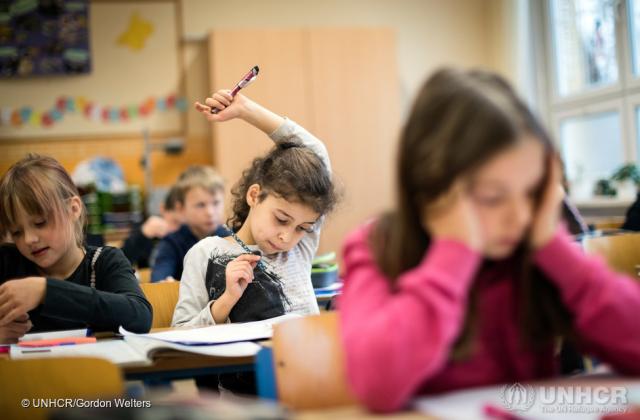
    This report assesses asylum seekers’ and refugees’ opportunities to access early
    childhood education and primary, secondary and tertiary education and training.
    It identifies measures available for their support, as well as possible areas for
    improvement.
    Opinion / Position Paper
    25
    janvier
    2017
    The European Parliament asked the Agency to provide its Opinion on the fundamental rights impact of the proposed revision of the Eurodac Regulation on children.
    Report / Paper / Summary
    20
    décembre
    2016
    This focus section outlines the specific protection needs of separated children, and highlights current responses and promising practices among EU Member States.
    Opinion / Position Paper
    8
    décembre
    2016
    This opinion analyses the effects on children of the proposed recast Dublin Regulation. It covers child-specific rules as well as provisions relating to all asylum applicants that significantly affect children.
    Opinion / Position Paper
    29
    novembre
    2016
    Without being exhaustive, this opinion discusses selected topics which touch certain Charter rights, identifying the challenges and describing measures that could be taken to mitigate the risk of actions, which are not compliant with the Charter. It does not focus exclusively on risks arising in direct relation to the involvement of EU actors on the ground, but also takes into account that the hotspot approach entails a certain share of responsibility of the EU for the situation in the hotspots overall.
    Handbook / Guide / Manual
    20
    novembre
    2015
    Les enfants sont des titulaires de droits à part entière. Ils sont bénéficiaires de tous les droits
    fondamentaux et de l’homme, et sont sujets de réglementations particulières compte tenu de leurs
    caractéristiques spécifiques. Ce manuel a pour but de montrer comment le droit et la jurisprudence
    européens s’adaptent aux intérêts et besoins particuliers des enfants.
    Report / Paper / Summary
    16
    octobre
    2015
    This report explores the key features of guardianship systems put in place to cater for the needs of all children in need of protection, including child victims and those at risk of becoming victims of trafficking in human beings or of other forms of exploitation. The research covers four specific areas, namely the type of guardianship systems in place, the profile of appointed guardians, the appointment procedures, and the tasks of the guardians.

    Handbook / Guide / Manual
    30
    juin
    2014
    Le présent manuel a pour but de renforcer la protection des enfants en aidant les
    autorités nationales et les autres parties prenantes dans toute l’UE à développer leurs
    régimes de tutelle actuels. Il vise à clarifier le rôle des tuteurs, ceux-ci constituant une
    composante essentielle d’un système intégré de protection de l’enfance.