The Employers Sanctions Directive was primarily enacted to dissuade employers from recruiting migrants in an irregular situation, but it also contains provisions to protect workers. It facilitates access to justice for exploited workers and sets out workers’ rights to claim back payment of outstanding wages. The directive also contains provisions to enhance the effectiveness of labour inspections. This report describes how the 25 Member States bound by the directive have been implementing its protective provisions, focusing on the impact these provisions have on migrant workers in an irregular situation who are victims of exploitation and other labour
law violations.
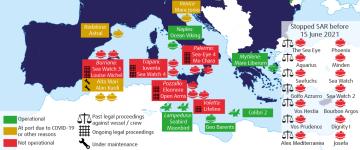
The International Organization for Migration estimates that about 813 people died or went missing crossing the Mediterranean Sea to reach Europe to escape war, persecution or to pursue a better life in 2021, up to 15 June. This is an average of almost five people per day. The EU Agency for Fundamental Rights (FRA) collects data on NGO ships involved in search and rescue in the Mediterranean, legal proceedings against them, as well as difficulties in disembarking migrants in safe ports.
This Coronavirus Bulletin focuses on equitable access to vaccines. It outlines the situation in the 27 EU Member States from 1 March to 30 April 2021. The bulletin looks at two main areas: planning and prioritisation in deploying Covid-19 vaccinations and their rollout in the countries. It covers information and communication campaigns, as well as (pre)registration channels for and the administration of vaccinations.
Il 2020 è stato caratterizzato sia da progressi
sia da battute d’arresto in termini di tutela dei
diritti fondamentali. La Relazione sui diritti
fondamentali 2021 dell’Agenzia dell’Unione
europea per i diritti fondamentali (FRA) fa il punto
della situazione sui principali sviluppi in materia,
individuando i risultati ottenuti e i settori che destano
ancora preoccupazione.
Το 2020 σημειώθηκε πρόοδος αλλά και
οπισθοδρόμηση στην προστασία των θεμελιωδών
δικαιωμάτων. Στην Έκθεση για τα Θεμελιώδη
Δικαιώματα 2021 του FRA εξετάζονται οι
σημαντικότερες εξελίξεις στον τομέα και
προσδιορίζονται τόσο τα επιτεύγματα, όσο και
τα ζητήματα που εξακολουθούν να προκαλούν
ανησυχία.
The year 2020 brought both progress and setbacks in terms of fundamental rights protection. FRA’s Fundamental Rights Report 2021 reviews major developments in the field, identifying both achievements and remaining areas of concern. This publication presents FRA’s opinions on the main developments in the thematic areas covered, and a synopsis of the evidence supporting these opinions.
FRA’s Fundamental Rights Report 2021 reviews major developments in the field in 2020, identifying both achievements and areas of concern. It also presents FRA’s opinions on these developments, including a synopsis of the evidence supporting these opinions. This year’s focus chapter explores the impact of the COVID-19 pandemic on fundamental rights. The remaining chapters cover: the EU Charter of Fundamental Rights; equality and non-discrimination; racism, xenophobia and related intolerance; Roma equality and inclusion; asylum, borders and migration; information society, privacy and data protection; rights of the child; access to justice; and the implementation of the Convention on the Rights of Persons with Disabilities.
This focus looks at COVID-19’s impact on fundamental rights. It underscores that a human rights-based approach to tackling the pandemic requires balanced measures that are based on law, necessary, temporary and proportional. It also requires addressing the pandemic’s socio-economic impact, protecting the vulnerable and fighting racism.
This paper presents statistical survey data for the EU on how often people are stopped by the police, in what kind of situations they are stopped, the action taken by the police during stops, and views on whether or not the police acted respectfully.
This opinion illustrates the extent and nature of lived experiences of inequality and discrimination across the EU. It does so with reference to the grounds of discrimination and areas of life covered by the racial and employment equality directives, as well as in relation to the grounds and areas covered by the proposed Equal Treatment Directive.
This report looks at the practical implementation of the presumption of innocence in criminal proceedings, and related rights, in 9 EU Member States (Austria, Belgium, Bulgaria, Cyprus, Germany, Italy, Lithuania, Poland and Portugal). Article 48 of the EU Charter of Fundamental Rights guarantees the presumption of innocence – but, as FRA’s research underscores, it can be undermined in many ways.
FRA Director Michael O'Flaherty, in his latest vlog, reflects on the migration situation at the EU’s external borders. He highlights the need for sustained joined-up efforts from all relevant bodies, including civil society, to protect the wellbeing and human rights of migrants. He underlines the importance of working with local communities as we receive migrants into our communities. He also points to room for improvement is our treatment of unaccompanied children.
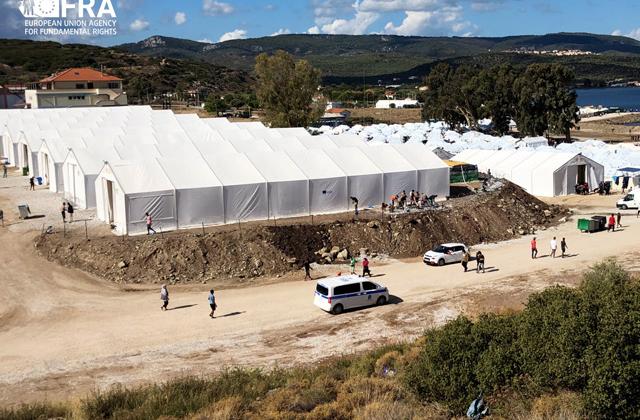
This note outlines how to help ensure a dignified stay for third-country nationals who are apprehended or intercepted at external borders. Specifically, FRA identifies twelve points for protection-sensitive and fundamental rights-compliant planning and design of initial-reception facilities at such borders. These are based on the agency’s work at external borders, including data collection and research activities.
It’s said you have the right to have fundamental human rights. FRA’s Gabriel Toggenburg explains his firm belief in the EU justice system to protect those basic freedoms. For Gabriel, a person’s identity does not necessarily come from their nationality. He tells how being born in Germany with family roots and connections in Italy, France, the UK, Switzerland and Russia shaped those views.
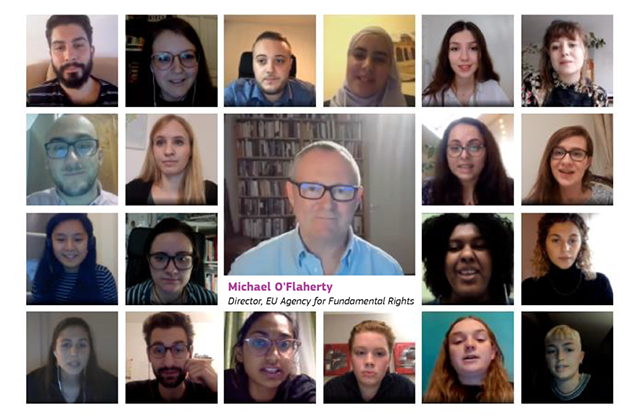
On 23 February 2021, FRA’s Director, Michael O’Flaherty, listened to fundamental rights concerns and discussed ways to solve them. The second Fundamental Rights Dialogue invited young people to participate in shaping our societies, placing human rights centre stage.
This is the second main report from FRA’s Fundamental Rights Survey, which collected data from 35,000 people on a range of issues. This report focuses on respondents’ experiences as victims of selected types of crime, including violence, harassment, and property crime. The report also examines how often these crimes are reported to the police, and presents further details relating to harassment and violence, such as the perpetrators and where the incidents took place.
An equal society is a better society for everyone. FRA’s Ursula Till-Tentschert warns against sidelining women — once empowered, there is nothing they cannot do. Ursula remembers the injustice of having to sew at school while her brothers carved models from wood. It is only a short step from classroom discrimination to outright prejudice. She celebrates the EU laws that protect us. But she says they will only truly work if we also smash the invisible social barriers to empowerment.
FRA’s report on artificial intelligence and fundamental rights presents concrete examples of how companies and public administrations in the EU are using, or trying to use, AI. This summary presents the main insights from the report. These can inform EU and national policymaking efforts to regulate the use of AI tools in compliance with human and fundamental rights.
As a parent, you realise children are the future. FRA’s Nicole Romain shares the anxiety she has felt as the mother of a mixed race family living in predominantly white countries. She explains how the Fundamental Rights Charter delivers hope for an inclusive Europe where we all respect and celebrate our differences.