eu-charter

Charte des droits fondamentaux de l'Union européenne

Article 28 - Droit de négociation et d'actions collectives

Article 28 - Droit de négociation et d'actions collectives

Les travailleurs et les employeurs, ou leurs organisations respectives, ont, conformément au droit de l'Union et aux législations et pratiques nationales, le droit de négocier et de conclure des conventions collectives aux niveaux appropriés et de recourir, en cas de conflits d'intérêts, à des actions collectives pour la défense de leurs intérêts, y compris la grève.

Explications

  • Texte:

    Cet article se fonde sur l'article 6 de la Charte sociale européenne, ainsi que sur la Charte communautaire des droits sociaux fondamentaux des travailleurs (points 12 à 14). Le droit à l'action collective a été reconnu par la Cour européenne des droits de l'homme comme l'un des éléments du droit syndical posé par l'article 11 de la CEDH. En ce qui concerne les niveaux appropriés auxquels peut avoir lieu la négociation collective, voir les explications données pour l'article précédent. Les modalités et limites de l'exercice des actions collectives, parmi lesquelles la grève, relèvent des législations et des pratiques nationales, y compris la question de savoir si elles peuvent être menées de façon parallèle dans plusieurs États membres.

    Source:
    Journal officiel de l'Union européenne C 303/17 - 14.12.2007
    Preamble - Explanations relating to the Charter of Fundamental Rights:
    Les explications qui figurent ci-après ont été établies initialement sous la responsabilité du praesidium de la Convention qui a élaboré la Charte des droits fondamentaux de l'Union européenne. Elles ont été mises à jour sous la responsabilité du praesidium de la Convention européenne, compte tenu des adaptations apportées au texte de la Charte par ladite Convention (notamment aux articles 51 et 52) et de l'évolution du droit de l'Union. Bien que ces explications n'aient pas en soi de valeur juridique, elles constituent un outil d'interprétation précieux destiné à éclairer les dispositions de la Charte.

Références à la jurisprudence

Droit constitutionnel national

57 results found

  • Costituzione della Repubblica Italiana
    Pays:
    Italy

    Art. 39. L'organizzazione sindacale è libera.Ai sindacati non può essere imposto altro obbligo se non la loro registrazione presso uffici locali o centrali, secondo le norme di legge.E' condizione per la registrazione che gli statuti dei sindacati sanciscano un ordinamento interno a base democratica.I sindacati registrati hanno personalità giuridica. Possono, rappresentati unitariamente in proporzione dei loro iscritti, stipulare contratti collettivi di lavoro con efficacia obbligatoria per tutti gli appartenenti alle categorie alle quali il contratto si riferisce. Art. 40. Il diritto di sciopero si esercita nell'ambito delle leggi che lo regolano.

  • Czechia / Charter of Fundamental Rights and Freedoms
    Pays:
    Czechia

    Article 27 (1) Everyone has the right to associate freely with others for the protection of her economic and social interests. (2) Trade unions shall be established independently of the state. No limits may be placed upon the number of trade union organizations, nor may any of them be given preferential treatment in a particular enterprise or branch of industry. (3) The activities of trade unions and the formation and activities of similar associations for the protection of economic and social interests may be limited by law in the case of measures necessary in a democratic society for the protection of the security of the State, public order, or the rights and freedoms of others. (4) The right to strike is guaranteed under the conditions provided for by law; this right does not appertain to judges, prosecutors, or members of the armed forces or security corps. Article 44 Restrictions may be placed upon the exercise of the right of enterprise and of other economic activity, as well as of the right enumerated in Article 20 para. 2, by judges and prosecutors; by employees in state administration and in territorial self-government, holding the positions specified therein as well as upon their exercise of the right enumerated in Article 27 para. 4; by members of security corps and members of the armed forces, as well as, insofar as such is related to the performance of their duties, upon their exercise of the rights listed in Articles 18, 19, and 27 paras. 1 to 3. A law may place restrictions upon the exercise of the right to strike by persons who engage in professions essential for the protection of life and health.

  • De Belgische Grondwet
    Pays:
    Belgium

    Artikel 23 Ieder heeft het recht een menswaardig leven te leiden. Daartoe waarborgen de wet, het decreet of de in artikel 134 bedoelde regel, rekening houdend met de overeenkomstige plichten, de economische, sociale en culturele rechten, waarvan ze de voorwaarden voor de uitoefening bepalen. Die rechten omvatten inzonderheid: 1° het recht op arbeid en op de vrije keuze van beroepsarbeid in het raam van een algemeen werkgelegenheidsbeleid dat onder meer gericht is op het waarborgen van een zo hoog en stabiel mogelijk werkgelegenheidspeil, het recht op billijke arbeidsvoorwaarden en een billijke beloning, alsmede het recht op informatie, overleg en collectief onderhandelen;(...)

  • Eesti Vabariigi Põhiseadus
    Pays:
    Estonia

    § 29. Töötajate ja tööandjate ühingutesse ja liitudesse kuulumine on vaba. Töötajate ja tööandjate ühingud ja liidud võivad oma õiguste ja seaduslike huvide eest seista vahenditega, mida seadus ei keela. Streigiõiguse kasutamise tingimused ja korra sätestab seadus. Töövaidluste lahendamise korra sätestab seadus.

  • Employment and Industrial Relations Act, Cap. 452 of the Laws of Malta, 2002
    Pays:
    Malta


  • European Convention on Human Rights - Article 11
    Pays:
    Austria

    Article 11

    1 Everyone has the right to freedom of peaceful assembly and to freedom of association with others, including the right to form and to join trade unions for the protection of his interests.

    2 No restrictions shall be placed on the exercise of these rights other than such as are prescribed by law and are necessary in a democratic society in the interests of national security or public safety, for the prevention of disorder or crime, for the protection of health or morals or for the protection of the rights and freedoms of others. This article shall not prevent the imposition of lawful restrictions on the exercise of these rights by members of the armed forces, of the police or of the administration of the State.

  • Grundgesetz für die Bundesrepublik Deutschland
    Pays:
    Germany

    Artikel 9 (3) Das Recht, zur Wahrung und Förderung der Arbeits- und Wirtschaftsbedingungen Vereinigungen zu bilden, ist für jedermann und für alle Berufe gewährleistet. Abreden, die dieses Recht einschränken oder zu behindern suchen, sind nichtig, hierauf gerichtete Maßnahmen sind rechtswidrig. Maßnahmen nach den Artikeln 12a, 35 Abs. 2 und 3, Artikel 87a Abs. 4 und Artikel 91 dürfen sich nicht gegen Arbeitskämpfe richten, die zur Wahrung und Förderung der Arbeits- und Wirtschaftsbedingungen von Vereinigungen im Sinne des Satzes 1 geführt werden.

  • Industrial Relations Act, 1990
    Pays:
    Ireland

    An act to make further and better provision for promoting harmonious relations between workers and employers, and to amend the law relating to trade unions and for these and other purposes to amend the Industrial Relations Acts, 1946 to 1976, and the Trade Union Acts, 1871 to 1982.

  • Kollektiivse töötüli lahendamise seadus
    Pays:
    Estonia

     § 1. Seaduse ülesanne. Käesolev seadus reguleerib kollektiivse töötüli lahendamise ning streigi ja töösulu väljakuulutamise ning korraldamise korda.

  • Konstytucja Rzeczypospolitej Polskiej
    Pays:
    Poland

    Art. 20Społeczna gospodarka rynkowa oparta na wolności działalności gospodarczej, własności prywatnej oraz solidarności, dialogu i współpracy partnerów społecznych stanowi podstawę ustroju gospodarczego Rzeczypospolitej Polskiej. Art. 591. Zapewnia się wolność zrzeszania się w związkach zawodowych, organizacjach społeczno-zawodowych rolników oraz w organizacjach pracodawców.2. Związki zawodowe oraz pracodawcy i ich organizacje mają prawo do rokowań, w szczególności w celu rozwiązywania sporów zbiorowych, oraz do zawierania układów zbiorowych pracy i innych porozumień.3. Związkom zawodowym przysługuje prawo do organizowania strajków pracowniczych i innych form protestu w granicach określonych w ustawie. Ze względu na dobro publiczne ustawa może ograniczyć prowadzenie strajku lub zakazać go w odniesieniu do określonych kategorii pracowników lub w określonych dziedzinach.4. Zakres wolności zrzeszania się w związkach zawodowych i organizacjach pracodawców oraz innych wolności związkowych może podlegać tylko takim ograniczeniom ustawowym, jakie są dopuszczalne przez wiążące Rzeczpospolitą Polską umowy międzynarodowe.

  • Konvention zum Schutze der Menschenrechte und Grundfreiheiten
    Pays:
    Austria

    Artikel 11 (1) Alle Menschen haben das Recht, sich friedlich zu versammeln und sich frei mit anderen zusammenzuschließen, einschließlich des Rechts, zum Schutze ihrer Interessen Gewerkschaften zu bilden und diesen beizutreten.

  • La Constitution Belge
    Pays:
    Belgium

    Article 23Chacun a le droit de mener une vie conforme à la dignité humaine. A cette fin, la loi, le décret ou la règle visée à l'article 134 garantissent, en tenant compte des obligations correspondantes, les droits économiques, sociaux et culturels, et déterminent les conditions de leur exercice. Ces droits comprennent notamment: 1. le droit au travail et au libre choix d'une activité professionnelle dans le cadre d'une politique générale de l'emploi, visant entre autres à assurer un niveau d'emploi aussi stable et élevé que possible, le droit à des conditions de travail et à une rémunération équitables, ainsi que le droit d'information, de consultation et de négociation collective; (...)

  • Labour Code
    Pays:
    Bulgaria

     Article 1(3) This Code shall aim to ensure the freedom and protection of labour, equitable and dignified working conditions, as well as the conducting of social dialogue between the State, the employees, the employers and their organizations, for the purposes of settlement of labour relations and other immediately related relations.

  • Labour Law
    Pays:
    Latvia

    Section 17. Content and Form of Collective Agreements(1) Parties to a collective agreement shall reach agreement on the provisions regulating the content of employment legal relationships, in particular the organisation of work remuneration and labour protection, establishment and termination of employment legal relationships, improvement of qualifications, work procedures, social security of employees and other issues related to employment legal relationships, and shall determine mutual rights and duties.(2) Without special arrangements, parties to a collective agreement shall:1) during the period of the existence of the collective agreement refrain from any measures which are directed at unilateral amendments to its provisions unless provided otherwise by regulatory enactments or by the collective agreement; and2) ensure that the provisions of the collective agreement are complied with and fulfilled both by the employer and the employees.(3) A collective agreement shall be entered into in writing.

  • Latvijas Republikas Satversme
    Pays:
    Latvia

    108. Strādājošajiem ir tiesības uz koplīgumu, kā arī tiesības streikot. Valsts aizsargā arodbiedrību brīvību.

  • Latvijas Republikas Satversme
    Pays:
    Latvia

    108. Strādājošajiem ir tiesības uz koplīgumu, kā arī tiesības streikot. Valsts aizsargā arodbiedrību brīvību.

  • Law on Trade Unions
    Pays:
    Latvia

      Section 1. Concept of Trade UnionsIn accordance with the Declaration on the Restoration of the Independence of the Republic of Latvia and the laws of Latvia, the inhabitants of the Republic have the right to form trade unions freely.Trade unions of the Republic of Latvia are independent public organisations, which express, represent and protect labour and other social and economic rights and interests of their members in accordance with the Law of the Republic of Latvia On Trade Unions, other current legislation of the Republic of Latvia, and the by-laws of trade unions of the Republic of Latvia, as well as observing the principles and norms specified in the Universal Declaration of Human Rights and other international covenants and conventions.Section 2. Freedom to Form Trade UnionsThe inhabitants of the Republic of Latvia who work or study have the right to form trade unions. Trade unions may be formed following the professional, sectoral, territorial or other principles. Employers may form their own trade unions. The by-laws approved by the trade unions and this Law shall determine and regulate the form of operation of the trade unions, the organisational structure and procedures for the establishment thereof.Members of a trade union shall take a decision regarding the termination of activities of trade unions or the integration thereof into territorial, sectoral or other unions following the procedures specified in the by-laws. 

  • Lietuvos Respublikos Konstitucija
    Pays:
    Lithuania

    50 straipsnis. Profesinės sąjungos kuriasi laisvai ir veikia savarankiškai. Jos gina darbuotojų profesines, ekonomines bei socialines teises bei interesus. Visos profesinės sąjungos turi lygias teises. 51 straipsnis. Darbuotojai, gindami savo ekonominius ir socialinius interesus, turi teisę streikuoti. Šios teisės apribojimus, įgyvendinimo sąlygas ir tvarką nustato įstatymas.

  • Luxembourg / Constitution du Grand-Duché de Luxembourg
    Pays:
    Luxembourg

    Art. 28. Les libertés syndicales sont garanties. 

    La loi organise l’exercice du droit de grève.

  • Magyarország Alaptörvénye
    Pays:
    Hungary

    XVII. cikk (SZABADSÁG ÉS FELELŐSSÉG) (1) A munkavállalók és a munkaadók – a munkahelyek biztosítására, a nemzetgazdaság fenntarthatóságára és más közösségi célokra is figyelemmel – együttműködnek egymással.
    (2) Törvényben meghatározottak szerint a munkavállalóknak, a munkaadóknak, valamint szervezeteiknek joguk van ahhoz, hogy egymással tárgyalást folytassanak, annak alapján kollektív szerződést kössenek, érdekeik védelmében együttesen fellépjenek, amely magában foglalja a munkavállalók munkabeszüntetéshez való jogát. […]

Droit de l'UE

5 results found

  • Community Charter of the Fundamental Social Rights of Workers (not in force)

    14. The internal legal order of the Member States shall determine under which conditions and to what extent the rights provided for in Articles 11 to 13 apply to the armed forces, the police and the civil service.

  • Community Charter of the Fundamental Social Rights of Workers (not in force)

    13. The right to resort to collective action in the event of a conflict of interests shall include the right to strike, subject to the obligations arising under national regulations arid collective agreements.
    In order to facilitate the settlement of industrial disputes the establishment and utilization at the appropriate levels of conciliation, mediation and arbitration procedures sliould be encouraged in accordance with national practice.

  • Community Charter of the Fundamental Social Rights of Workers (not in force)

    12. Employers or employers' organizations, on the one hand, and workers' organizations, on the other, shall have the right to negotiate and conclude collective agreements under the conditions laid down by national legislation and practice. The dialogue between the two sides of industry at
    European level which must be developed, may, if the parties deem it desirable, result in contractual relations in particular at inter-occupational and sectoral level.

  • Directive (EU) 2022/2041 of the European Parliament and of the Council of 19 October 2022 on adequate minimum wages in the European Union

    [...]

    (3) Article 31 of the Charter of Fundamental Rights of the European Union (4) (the ‘Charter’) provides for the right of every worker to working conditions which respect his or her health, safety and dignity. Article 27 of the Charter provides for the right of workers to information and consultation. Article 28 of the Charter provides for the right of workers and employers, or their respective organisations, in accordance with Union law and national laws and practices, to negotiate and conclude collective agreements at the appropriate levels. Article 23 of the Charter provides for the right to equality between women and men in all areas, including employment, work and pay.

    [...]

  • Directive 2014/36/EU of the European Parliament and of the Council of 26 February 2014 on the conditions of entry and stay of third-country nationals for the purpose of employment as seasonal workers

    Preamble

    ‘(46) Third-country national seasonal workers should be granted equal treatment in respect of those branches of social security listed in Article 3 of Regulation (EC) No 883/2004 of the European Parliament and of the Council (13). This Directive does not harmonise the social security legislation of Member States and does not cover social assistance. It is limited to applying the principle of equal treatment in the field of social security to the persons falling within its scope. This Directive should not confer more rights than those already provided in existing Union legislation in the field of social security for third-country nationals who have cross-border interests between Member States.
    Due to the temporary nature of the stay of seasonal workers and without prejudice to Regulation (EU) No 1231/2010 of the European Parliament and of the Council (14), Member States should be able to exclude family benefits and unemployment benefits from equal treatment between seasonal workers and their own nationals and should be able to limit the application of equal treatment in relation to education and vocational training, as well as tax benefits.
    This Directive does not provide for family reunification. Furthermore, this Directive does not grant rights in relation to situations which lie outside the scope of Union law such as, for example, situations where family members reside in a third country. That should not, however, affect the right of survivors who derive rights from the seasonal worker to receive survivor’s pensions when residing in a third country. This should be without prejudice to the non-discriminatory application by Member States of national law providing for de minimis rules on contributions to pension systems. Mechanisms should be in place in order to ensure effective social security coverage during the stay and the exporting of acquired rights of the seasonal workers, where applicable.
    (47) Union law does not limit the power of the Member States to organise their social security schemes. In the absence of harmonisation at Union level, it is for each Member State to lay down the conditions under which social security benefits are granted, as well as the amount of such benefits and the period for which they are granted. However, when exercising that power, Member States should comply with Union law.‘

    (52) This Directive respects the fundamental rights and observes the principles recognised by the Charter of Fundamental Rights of the European Union, in particular, Articles 7, 15(3), 17, 27, 28, 31 and 33(2) thereof, in accordance with Article 6 TEU

    Article 23 - Right to equal treatment

    ‘1. Seasonal workers shall be entitled to equal treatment with nationals of the host Member State at least with regard to:
    (a) terms of employment, including the minimum working age, and working conditions, including pay and dismissal, working hours, leave and holidays, as well as health and safety requirements at the workplace;
    (b) the right to strike and take industrial action, in accordance with the host Member State’s national law and practice, and freedom of association and affiliation and membership of an organisation representing workers or of any organisation whose members are engaged in a specific occupation, including the rights and benefits conferred by such organisations, including the right to negotiate and conclude collective agreements, without prejudice to the national provisions on public policy and public security;
    (c) back payments to be made by the employers, concerning any outstanding remuneration to the third-country national;
    (d) branches of social security, as defined in Article 3 of Regulation (EC) No 883/2004;
    (e) access to goods and services and the supply of goods and services made available to the public, except housing, without prejudice to the freedom of contract in accordance with Union and national law;
    (f) advice services on seasonal work afforded by employment offices;
    (g) education and vocational training;
    (h) recognition of diplomas, certificates and other professional qualifications in accordance with the relevant national procedures;
    (i) tax benefits, in so far as the seasonal worker is deemed to be resident for tax purposes in the Member State concerned.
    Seasonal workers moving to a third country, or the survivors of such seasonal workers residing in a third-country deriving rights from the seasonal worker, shall receive statutory pensions based on the seasonal worker’s previous employment and acquired in accordance with the legislation set out in Article 3 of Regulation (EC) No 883/2004, under the same conditions and at the same rates as the nationals of the Member States concerned when they move to a third country.
    2. Member States may restrict equal treatment:
    (i) under point (d) of the first subparagraph of paragraph 1 by excluding family benefits and unemployment benefits, without prejudice to Regulation (EU) No 1231/2010;
    (ii) under point (g) of the first subparagraph of paragraph 1 by limiting its application to education and vocational training which is directly linked to the specific employment activity and by excluding study and maintenance grants and loans or other grants and loans;
    (iii) under point (i) of the first subparagraph of paragraph 1 with respect to tax benefits by limiting its application to cases where the registered or usual place of residence of the family members of the seasonal worker for whom he/she claims benefits, lies in the territory of the Member State concerned.
    3. The right to equal treatment provided for in paragraph 1 shall be without prejudice to the right of the Member State to withdraw or to refuse to extend or renew the authorisation for the purpose of seasonal work in accordance with Articles 9 and 15.‘

Droit international

1 results found

  • R204 - Transition from the Informal to the Formal Economy Recommendation, 2015 (No. 204)

    VII. Freedom of association, social dialogue and role of employers’ and workers’ organizations
    ‘31. Members should ensure that those in the informal economy enjoy freedom of association and the right to collective bargaining, including the right to establish and, subject to the rules of the organization concerned, to join organizations, federations and confederations of their own choosing
    32. Members should create an enabling environment for employers and workers to exercise their right to organize and to bargain collectively and to participate in social dialogue in the transition to the formal economy
    33. Employers’ and workers’ organizations should, where appropriate, extend membership and services to workers and economic units in the informal economy
    34. In designing, implementing and evaluating policies and programmes of relevance to the informal economy, including its formalization, Members should consult with and promote active participation of the most representative employers’ and workers’ organizations, which should include in their rank, according to national practice, representatives of membership-based representative organizations of workers and economic units in the informal economy
    35. Members and employers’ and workers’ organizations may seek the assistance of the International Labour Office to strengthen the capacity of the representative employers’ and workers’ organizations and, where they exist, representative organizations of those in the informal economy, to assist workers and economic units in the informal economy, with a view to facilitating the transition to the formal economy‘

Produits

  • Handbook / Guide / Manual
    23
    octobre
    2018
    En tant que catalogue très moderne des droits de l’homme, la Charte inclut de nombreux
    droits absents des déclarations de droits établies de longue date, et sa lecture
    suscite une impression très favorable. Les personnes qui connaissent les grands
    principes du droit de l’UE sont en général capables de réciter rapidement que la Charte
    est toujours contraignante pour l’UE, et l’est pour les États membres uniquement
    « lorsqu’ils mettent en oeuvre le droit de l’Union ». Mais que signifie cette expression
    souvent citée de l’article 51 de la Charte ?
  • Report / Paper / Summary
    4
    décembre
    2025
    Artificial Intelligence comes with both benefits and risks. Safe AI use that accounts for fundamental rights is thus crucial. While the 2024 EU AI Act was a milestone in this regard, its broad definitions regarding AI systems and high-risk AI could introduce loopholes for fundamental rights compliance. This report offers an empirical basis for much-needed practical guidance on the Act’s implementation. Based on interviews with AI developers, sellers, and users, FRA addresses challenges of its use in critical domains, like asylum, education, and employment. Our findings help guide next steps in realising the AI Act’s potential to ensure responsible innovation.
  • Fundamental Rights Report
    5
    juin
    2024
    FRA’s Fundamental Rights Report 2024 analyses the year’s developments in fundamental rights. It focuses on the most pressing fundamental rights concerns facing Europe in 2023: the cost-of-living crisis, rights concerns at the EU’s external borders and migration, and threats to democracy. Re-structured, this year’s new approach is a shorter and sharper analysis. It also presents FRA’s opinions on these developments, including a summary of the evidence supporting these opinions.
  • Country sheets
    22
    mars
    2019
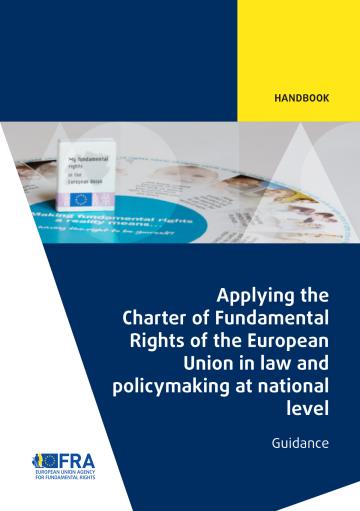
    Les États membres sont explicitement tenus de promouvoir l’application de la Charte. Ces fiches pays soutiennent cet effort en fournissant des exemples de l’utilisation de la Charte et en expliquant comment elle apporte une valeur ajoutée.