eu-charter

Charte des droits fondamentaux de l'Union européenne

Article 34 - Sécurité sociale et aide sociale

Article 34 - Sécurité sociale et aide sociale

1. L'Union reconnaît et respecte le droit d'accès aux prestations de sécurité sociale et aux services sociaux assurant une protection dans des cas tels que la maternité, la maladie, les accidents du travail, la dépendance ou la vieillesse, ainsi qu'en cas de perte d'emploi, selon les règles établies par le droit de l'Union et les législations et pratiques nationales.
2. Toute personne qui réside et se déplace légalement à l'intérieur de l'Union a droit aux prestations de sécurité sociale et aux avantages sociaux, conformément au droit de l'Union et aux législations et pratiques nationales.
3. Afin de lutter contre l'exclusion sociale et la pauvreté, l'Union reconnaît et respecte le droit à une aide sociale et à une aide au logement destinées à assurer une existence digne à tous ceux qui ne disposent pas de ressources suffisantes, selon les règles établies par le droit de l'Union et les législations et pratiques nationales.

Explications

  • Texte:

    Le principe énoncé au paragraphe 1 de l'article 34 est fondé sur les articles 153 et 156 du traité sur le fonctionnement de l'Union européenne, ainsi que sur l'article 12 de la Charte sociale européenne et sur le point 10 de la Charte communautaire des droits des travailleurs. Il doit être respecté par l'Union lorsqu'elle met en œuvre les compétences que lui confèrent les articles 153 et 156 du traité sur le fonctionnement de l'Union européenne. La référence à des services sociaux vise les cas dans lesquels de tels services ont été instaurés pour assurer certaines prestations, mais n'implique aucunement que de tels services doivent être créés quand il n'en existe pas. L'expression `maternité` doit être entendue dans le même sens que dans l'article précédent.
    Le paragraphe 2 se fonde sur les articles 12, paragraphes 4, et 13, paragraphe 4, de la Charte sociale européenne, ainsi que sur le point 2 de la Charte communautaire des droit sociaux fondamentaux des travailleurs et reflète les règles qui découlent du règlement (CEE) no 1408/71 et du règlement (CEE) no 1612/68.

    Le paragraphe 3 s'inspire de l'article 13 de la Charte sociale européenne et des articles 30 et 31 de la Charte sociale révisée, ainsi que du point 10 de la Charte communautaire. Il doit être respecté par l'Union dans le cadre des politiques fondées sur l'article 153 du traité sur le fonctionnement de l'Union européenne.

    Source:
    Journal officiel de l'Union européenne C 303/17 - 14.12.2007
    Preamble - Explanations relating to the Charter of Fundamental Rights:
    Les explications qui figurent ci-après ont été établies initialement sous la responsabilité du praesidium de la Convention qui a élaboré la Charte des droits fondamentaux de l'Union européenne. Elles ont été mises à jour sous la responsabilité du praesidium de la Convention européenne, compte tenu des adaptations apportées au texte de la Charte par ladite Convention (notamment aux articles 51 et 52) et de l'évolution du droit de l'Union. Bien que ces explications n'aient pas en soi de valeur juridique, elles constituent un outil d'interprétation précieux destiné à éclairer les dispositions de la Charte.

Références à la jurisprudence

  • Y.A.C. vs the Director of the Social Assistance Directorate – L. (Дирекция „Социално подпомагане” – Л.)
    Decision date:
  • Aliny Wojciechowski v Office national des pensions (ONP)
    Decision date:
  • Servet Kamberaj v Istituto per l’Edilizia Sociale della Provincia autonoma di Bolzano (IPES), Giunta della Provincia autonoma di Bolzano, Provincia Autonoma di Bolzano
    Decision date:
  • Servet Kamberaj v Istituto per l’Edilizia Sociale della Provincia autonoma di Bolzano (IPES), Giunta della Provincia autonoma di Bolzano, Provincia Autonoma di Bolzano
    Decision date:
  • Land Hessen v Florence Feyerbacher
    Decision date:
  • Office national de l’emploi v Marie-Rose Melchior
    Decision date:
  • Adzo Domenyo Alokpa, Jarel Moudoulou, Eja Moudoulou v Ministre du Travail, de l’Emploi et de l’Immigration
    Decision date:
  • European Court of Auditors v Karel Pinxten
    Decision date:
  • Istituto nazionale della previdenza sociale (INPS) v V. M
    Decision date:
  • Istituto nazionale della previdenza sociale (INPS) v V. M
    Decision date:

Droit constitutionnel national

45 results found

  • Eesti Vabariigi Põhiseadus
    Pays:
    Estonia

    § 28. (...) Eesti kodanikul on õigus riigi abile vanaduse, töövõimetuse, toitjakaotuse ja puuduse korral. Abi liigid, ulatuse ning saamise tingimused ja korra sätestab seadus. Kui seadus ei sätesta teisiti, siis on see õigus võrdselt Eesti kodanikuga ka Eestis viibival välisriigi kodanikul ja kodakondsuseta isikul. Riik soodustab vabatahtlikku ja omavalitsuse hoolekannet. Lasterikkad pered ja puuetega inimesed on riigi ja kohalike omavalitsuste erilise hoole all.

  • Konstytucja Rzeczypospolitej Polskiej
    Pays:
    Poland

    Art. 67.1. Obywatel ma prawo do zabezpieczenia społecznego w razie niezdolności do pracy ze względu na chorobę lub inwalidztwo oraz po osiągnięciu wieku emerytalnego. Zakres i formy zabezpieczenia społecznego określa ustawa.2. Obywatel pozostający bez pracy nie z własnej woli i nie mający innych środków utrzymania ma prawo do zabezpieczenia społecznego, którego zakres i formy określa ustawa.Art. 68.1. Każdy ma prawo do ochrony zdrowia.2. Obywatelom, niezależnie od ich sytuacji materialnej, władze publiczne zapewniają równy dostęp do świadczeń opieki zdrowotnej finansowanej ze środków publicznych. Warunki i zakres udzielania świadczeń określa ustawa. (...)Art. 71.1. Państwo w swojej polityce społecznej i gospodarczej uwzględnia dobro rodziny. Rodziny znajdujące się w trudnej sytuacji materialnej i społecznej, zwłaszcza wielodzietne i niepełne, mają prawo do szczególnej pomocy ze strony władz publicznych. (...)Art. 75.1. Władze publiczne prowadzą politykę sprzyjającą zaspokojeniu potrzeb mieszkaniowych obywateli, w szczególności przeciwdziałają bezdomności, wspierają rozwój budownictwa socjalnego oraz popierają działania obywateli zmierzające do uzyskania własnego mieszkania.2. Ochronę praw lokatorów określa ustawa.

  • La Constitution Belge
    Pays:
    Belgium

     Article 23Chacun a le droit de mener une vie conforme à la dignité humaine.A cette fin, la loi, le décret ou la règle visée à l'article 134 garantissent, en tenant compte des obligations correspondantes, les droits économiques, sociaux et culturels, et déterminent les conditions de leur exercice.Ces droits comprennent notamment: (...) 2°le droit à la sécurité sociale, à la protection de la santé et à l'aide sociale, médicale et juridique; 3° le droit à un logement décent;(...)

  • Latvijas Republikas Satversme
    Pays:
    Latvia

    109. Ikvienam ir tiesības uz sociālo nodrošinājumu vecuma, darbnespējas, bezdarba un citos likumā noteiktajos gadījumos.111. Valsts aizsargā cilvēku veselību un garantē ikvienam medicīniskās palīdzības minimumu.

  • Lietuvos Respublikos Konstitucija
    Pays:
    Lithuania

    48 straipsnis. Kiekvienas žmogus gali laisvai pasirinkti darbą bei verslą ir turi teisę turėti tinkamas, saugias ir sveikas darbo sąlygas, gauti teisingą apmokėjimą už darbą ir socialinę apsaugą nedarbo atveju. 52 straipsnis. Valstybė laiduoja piliečių teisę gauti senatvės ir invalidumo pensijas, socialinę paramą nedarbo, ligos, našlystės, maitintojo netekimo ir kitais įstatymų numatytais atvejais.

  • Luxembourg / Constitution du Grand-Duché de Luxembourg
    Pays:
    Luxembourg

    Art. 34. La sécurité sociale, la protection de la santé et les droits des travailleurs sont réglés par la loi quant à leurs principes.

    ...

    Art. 40 L’État veille à ce que toute personne puisse vivre dignement et disposer d’un logement approprié.

  • Magyarország Alaptörvénye
    Pays:
    Hungary

    XIX. cikk (SZABADSÁG ÉS FELELŐSSÉG) (1) Magyarország arra törekszik, hogy minden állampolgárának szociális biztonságot nyújtson. Anyaság, betegség, rokkantság, fogyatékosság, özvegység, árvaság és önhibáján kívül bekövetkezett munkanélküliség esetén minden magyar állampolgár törvényben meghatározott támogatásra jogosult.
    (2) Magyarország a szociális biztonságot az (1) bekezdés szerinti és más rászorulók esetében a szociális intézmények és intézkedések rendszerével valósítja meg.
    (3) Törvény a szociális intézkedések jellegét és mértékét a szociális intézkedést igénybe vevő személynek a közösség számára hasznos tevékenységéhez igazodóan is megállapíthatja.
    (4) Magyarország az időskori megélhetés biztosítását a társadalmi szolidaritáson alapuló egységes állami nyugdíjrendszer fenntartásával és önkéntesen létrehozott társadalmi intézmények működésének lehetővé tételével segíti elő. Törvény az állami nyugdíjra való jogosultság feltételeit a nők fokozott védelmének követelményére tekintettel is megállapíthatja.

    XXII. cikk (SZABADSÁG ÉS FELELŐSSÉG) (1) Magyarország törekszik arra, hogy az emberhez méltó lakhatás feltételeit és a közszolgáltatásokhoz való hozzáférést mindenki számára biztosítsa.
    (2) Az emberhez méltó lakhatás feltételeinek a megteremtését az állam és a helyi önkormányzatok azzal is segítik, hogy törekszenek valamennyi hajlék nélkül élő személy számára szállást biztosítani.
    (3) Törvény vagy helyi önkormányzat rendelete a közrend, a közbiztonság, a közegészség és a kulturális értékek védelme érdekében, a közterület meghatározott részére vonatkozóan jogellenessé minősítheti az életvitelszerűen megvalósuló közterületi tartózkodást.

  • Netherlands / Constitution of the Kingdom of the Netherlands
    Pays:
    Netherlands

    Article 20 1. It shall be the concern of the authorities to secure the means of subsistence of the population and to achieve the distribution of wealth. 2. Rules concerning entitlement to social security shall be laid down by Act of Parliament. 3. Dutch nationals resident in the Netherlands who are unable to provide for themselves shall have a right, to be regulated by Act of Parliament, to aid from the authorities.

  • Portugal / Constitution of the Portuguese Republic
    Pays:
    Portugal

     Article 63 (Social security and solidarity) (1) Everyone shall have the right to social security. (2) The state shall be charged with organising, coordinating and subsidising a unified and decentralised social security system, with the participation of the trade unions, other organisations that represent workers and associations that represent any other beneficiaries. (3) The social security system shall protect citizens in illness and old age and when they are disabled, widowed or orphaned, as well as when they are unemployed or in any other situation that entails a lack of or reduction in means of subsistence or ability to work. (4) All periods of work shall, as laid down by law, contribute to the calculation of old age and disability pensions, regardless of the sector of activity in which they were performed. (5). With a view to the pursuit of the social solidarity objectives (...) the state shall, as laid down by law, support and inspect the activities and operation of private charitable institutions and other non-profit institutions that are recognised to be in the public interest.

  • Preamble to the Constitution of 27 October 1946
    Pays:
    France

    § 11.It shall guarantee to all, notably to children, mothers and elderly workers, protection of their health, material security, rest and leisure. All people who, by virtue of their age, physical or mental condition, or economic situation, are incapable of working, shall have to the right to receive suitable means of existence from society.

  • Préambule de la Constitution du 27 Octobre 1946
    Pays:
    France

    § 11. Elle garantit à tous, notamment à l'enfant, à la mère et aux vieux travailleurs, la protection de la santé, la sécurité matérielle, le repos et les loisirs. Tout être humain qui, en raison de son âge, de son état physique ou mental, de la situation économique, se trouve dans l'incapacité de travailler a le droit d'obtenir de la collectivité des moyens convenables d'existence.

  • Romania / Constitution of Romania
    Pays:
    Romania

    Article 47(1) The State shall be bound to take measures of economic development and social protection, of a nature to ensure a decent living standard for its citizens. (2) Citizens have the right to pensions, paid maternity leave, medical care in public health centres, unemployment benefits, and other forms of public or private social securities, as stipulated by the law. Citizens have the right to social assistance, according to the law.

  • Slovakia / Constitution of the Slovak Republic
    Pays:
    Slovakia

    Article 39 (1) Citizens have the right to adequate material provision in old age, in the event of work disability, as well as after losing their provider. (2) Everyone who is in material need is entitled to assistance necessary to ensure basic living conditions. (3) Details concerning rights listed in paragraphs 1 and 2 shall be laid down by law.

    Article 41 (...) (2) 2) Special care, protection in labor relations, and adequate working conditions are guaranteed to a woman during the period of pregnancy. (...)

  • Slovenia / Constitution of the Republic of Slovenia
    Pays:
    Slovenia

    Article 50* (Right to Social Security)Citizens have the right to social security, including the right to a pension, under conditions provided by law.The state shall regulate compulsory health, pension, disability and other social insurance, and shall ensure its proper functioning.Special protection in accordance with the law shall be guaranteed to war veterans and victims of war.* As amended by the Constitutional Act Amending Article 50 of the Constitution of the Republic of Slovenia, 15 June 2004 (Official Gazette of the Republic of Slovenia, No. 69/04).

  • Social Welfare Act 2007
    Pays:
    Ireland


  • Spain / Constitution of the Kingdom of Spain
    Pays:
    Spain

    Article 41 The public authorities shall maintain a public Social Security system for all citizens guaranteeing adequate social assistance and benefits in situations of hardship, especially in case of unemployment. Supplementary assistance and benefits shall be optional.

    Article 47 All Spaniards have the right to enjoy decent and adequate housing. The public authorities shall promote the necessary conditions and establish appropriate standards in order to make this right effective, regulating land use in accordance with the general interest in order to prevent speculation. The community shall have a share in the benefits accruing from the town-planning policies of public bodies.

  • Suomen perustuslaki
    Pays:
    Finland

    19 § Oikeus sosiaaliturvaan Jokaisella, joka ei kykene hankkimaan ihmisarvoisen elämän edellyttämää turvaa, on oikeus välttämättömään toimeentuloon ja huolenpitoon. Lailla taataan jokaiselle oikeus perustoimeentulon turvaan työttömyyden, sairauden, työkyvyttömyyden ja vanhuuden aikana sekä lapsen syntymän ja huoltajan menetyksen perusteella. Julkisen vallan on turvattava, sen mukaan kuin lailla tarkemmin säädetään, jokaiselle riittävät sosiaali- ja terveyspalvelut ja edistettävä väestön terveyttä. Julkisen vallan on myös tuettava perheen ja muiden lapsen huolenpidosta vastaavien mahdollisuuksia turvata lapsen hyvinvointi ja yksilöllinen kasvu. Julkisen vallan tehtävänä on edistää jokaisen oikeutta asuntoon ja tukea asumisen omatoimista järjestämistä.

  • The Belgian Constitution
    Pays:
    Belgium

    Article 23. Everyone has the right to lead a life in keeping with human dignity.
    To this end, the laws, federate laws and rules referred to in Article 134 guarantee
    economic, social and cultural rights, taking into account corresponding obligations, and
    determine the conditions for exercising them.
    These rights include among others: (...)2. the right to social security, to health care and to social, medical, and legal aid; 3. the right to have decent accommodation;(...)

  • The Constitution of the Republic of Cyprus
    Pays:
    Cyprus

    Article 9
    Every person has the right to a decent existence and to social security. A law shall provide for the protection of the workers, assistance to the poor and for a system of social insurance.

  • The Constitutional Act of Denmark
    Pays:
    Denmark

    Section 75. Subsection 2. Any person unable to support himself or his family shall, when no other person is responsible for his or their maintenance, be entitled to receive public assistance, provided that he shall comply with the obligations imposed by statute in such respect.

Droit de l'UE

14 results found

  • Council Directive 79/7/EEC of 19 December 1978 on the progressive implementation of the principle of equal treatment for men and women in matters of social security

    Article 1

    The purpose of this Directive is the progressive implementation, in the field of social security and other elements of social protection provided for in Article 3, of the principle of equal treatment for men and women in matters of social security, hereinafter referred to as ‘the principle of equal treatment’.

    Article 4

    1.   The principle of equal treatment means that there shall be no discrimination whatsoever on ground of sex either directly, or indirectly by reference in particular to marital or family status, in particular as concerns:

    — the scope of the schemes and the conditions of access thereto,

    — the obligation to contribute and the calculation of contributions,

    — the calculation of benefits including increases due in respect of a spouse and for dependants and the conditions governing the duration and retention of entitlement to benefits.

    2.   The principle of equal treatment shall be without prejudice to the provisions relating to the protection of women on the grounds of maternity.

    Article 6

    Member States shall introduce into their national legal systems such measures as are necessary to enable all persons who consider themselves wronged by failure to apply the principle of equal treatment to pursue their claims by judicial process, possibly after recourse to other competent authorities.

  • Directive 2011/95 - Standards for the qualification of third-country nationals or stateless persons as beneficiaries of international protection, for a uniform status for refugees or for persons eligible for subsidiary protection, and for the content of t

    Preamble 

    (10) This Directive respects the fundamental rights and observes the principles recognised in particular by the Charter of Fundamental Rights of the European Union. In particular this Directive seeks to ensure full respect for human dignity and the right to asylum of applicants for asylum and their accompanying family members.

    (16) This Directive respects the fundamental rights and observes the principles recognised in particular by the Charter of Fundamental Rights of the European Union.  In particular this Directive seeks to ensure full respect for  human dignity and the right to asylum of applicants for  asylum and their accompanying family members and to  promote the application of Articles 1, 7, 11, 14, 15, 16, 
    18, 21, 24, 34 and 35 of that Charter, and should  therefore be implemented accordingly.


    (34) With regard to social assistance and health care, the modalities and detail of the provision of core benefits to beneficiaries of subsidiary protection status should be determined by national law. The possibility of limiting the benefits for beneficiaries of subsidiary protection status to core benefits is to be understood in the sense that this notion covers at least minimum income support, assistance in case of illness, pregnancy and parental assistance, in so far as they are granted to nationals according to the legislation of the Member State concerned.

    (35) Access to health care, including both physical and mental health care, should be ensured to beneficiaries of refugee or subsidiary protection status.

    Article 2: Definitions
    For the purposes of this Directive the following definitions shall apply:
    (a) ‘international protection’ means refugee status and subsidiary protection status as defined in points (e) and (g);
    (d) ‘refugee’ means a third-country national who, owing to a well-founded fear of being persecuted for reasons of race, religion, nationality, political opinion or membership of a particular social group, is outside the country of nationality and is unable or, owing to such fear, is unwilling to avail himself or herself of the protection of that country, or a stateless person, who, being outside of the country of former habitual residence for the same reasons as mentioned above, is unable or, owing to such fear, unwilling to return to it, and to whom Article 12 does not apply; [...]
    (e) ‘refugee status’ means the recognition by a Member State of a third-country national or a stateless person as a refugee;
    (f) ‘person eligible for subsidiary protection’ means a third-country national or a stateless person who does not qualify as a refugee but in respect of whom substantial grounds have been shown for believing that the person concerned, if returned to his or her country of origin, or in the case of a stateless person, to his or her country of former habitual residence, would face a real risk of suffering serious harm as defined in Article 15, and to whom Article 17(1) and (2) does not apply, and is unable, or, owing to such risk, unwilling to avail himself or herself of the protection of that country;
    (g) ‘subsidiary protection status’ means the recognition by a Member State of a third-country national or a stateless person as a person eligible for subsidiary protection; [...]

    Article 13: Granting of refugee status
    Member States shall grant refugee status to a third-country national or a stateless person who qualifies as a refugee in accordance with Chapters II and III.‘

    Article 18: Granting of subsidiary protection status
    Member States shall grant subsidiary protection status to a third-country national or a stateless person eligible for subsidiary protection in accordance with Chapters II and V.‘

    Article 21: Protection from refoulement

    1.   Member States shall respect the principle of non-refoulement in accordance with their international obligations.

    2.   Where not prohibited by the international obligations mentioned in paragraph 1, Member States may refoule a refugee, whether formally recognised or not, when:

    (a) there are reasonable grounds for considering him or her as a danger to the security of the Member State in which he or she is present; or

    (b) he or she, having been convicted by a final judgement of a particularly serious crime, constitutes a danger to the community of that Member State.

    3.   Member States may revoke, end or refuse to renew or to grant the residence permit of (or to) a refugee to whom paragraph 2 applies.

    Article 22: Information

    Member States shall provide persons recognised as being in need of international protection, as soon as possible after the respective protection status has been granted, with access to information, in a language likely to be understood by them, on the rights and obligations relating to that status.

    Article 23: Maintaining family unity

    1.   Member States shall ensure that family unity can be maintained.

    2.   Member States shall ensure that family members of the beneficiary of refugee or subsidiary protection status, who do not individually qualify for such status, are entitled to claim the benefits referred to in Articles 24 to 34, in accordance with national procedures and as far as it is compatible with the personal legal status of the family member.

    In so far as the family members of beneficiaries of subsidiary protection status are concerned, Member States may define the conditions applicable to such benefits.

    In these cases, Member States shall ensure that any benefits provided guarantee an adequate standard of living.

    3.   Paragraphs 1 and 2 are not applicable where the family member is or would be excluded from refugee or subsidiary protection status pursuant to Chapters III and V.

    4.   Notwithstanding paragraphs 1 and 2, Member States may refuse, reduce or withdraw the benefits referred therein for reasons of national security or public order.

    5.   Member States may decide that this Article also applies to other close relatives who lived together as part of the family at the time of leaving the country of origin, and who were wholly or mainly dependent on the beneficiary of refugee or subsidiary protection status at that time.

    Article 26: Access to employment

    1.   Member States shall authorise beneficiaries of refugee status to engage in employed or self-employed activities subject to rules generally applicable to the profession and to the public service, immediately after the refugee status has been granted.

    2.   Member States shall ensure that activities such as employment-related education opportunities for adults, vocational training and practical workplace experience are offered to beneficiaries of refugee status, under equivalent conditions as nationals.

    3.   Member States shall authorise beneficiaries of subsidiary protection status to engage in employed or self-employed activities subject to rules generally applicable to the profession and to the public service immediately after the subsidiary protection status has been granted. The situation of the labour market in the Member States may be taken into account, including for possible prioritisation of access to employment for a limited period of time to be determined in accordance with national law. Member States shall ensure that the beneficiary of subsidiary protection status has access to a post for which the beneficiary has received an offer in accordance with national rules on prioritisation in the labour market.

    4.   Member States shall ensure that beneficiaries of subsidiary protection status have access to activities such as employment-related education opportunities for adults, vocational training and practical workplace experience, under conditions to be decided by the Member States.

    5.   The law in force in the Member States applicable to remuneration, access to social security systems relating to employed or self-employed activities and other conditions of employment shall apply.

    Article 27: Access to education

    1.   Member States shall grant full access to the education system to all minors granted refugee or subsidiary protection status, under the same conditions as nationals.

    2.   Member States shall allow adults granted refugee or subsidiary protection status access to the general education system, further training or retraining, under the same conditions as third country nationals legally resident.

    3.   Member States shall ensure equal treatment between beneficiaries of refugee or subsidiary protection status and nationals in the context of the existing recognition procedures for foreign diplomas, certificates and other evidence of formal qualifications.

    Article 28: Social welfare

    1.   Member States shall ensure that beneficiaries of refugee or subsidiary protection status receive, in the Member State that has granted such statuses, the necessary social assistance, as provided to nationals of that Member State.

    2.   By exception to the general rule laid down in paragraph 1, Member States may limit social assistance granted to beneficiaries of subsidiary protection status to core benefits which will then be provided at the same levels and under the same eligibility conditions as nationals.

    Article 29: Health care

    1.   Member States shall ensure that beneficiaries of refugee or subsidiary protection status have access to health care under the same eligibility conditions as nationals of the Member State that has granted such statuses.

    2.   By exception to the general rule laid down in paragraph 1, Member States may limit health care granted to beneficiaries of subsidiary protection to core benefits which will then be provided at the same levels and under the same eligibility conditions as nationals.

    3.   Member States shall provide, under the same eligibility conditions as nationals of the Member State that has granted the status, adequate health care to beneficiaries of refugee or subsidiary protection status who have special needs, such as pregnant women, disabled people, persons who have undergone torture, rape or other serious forms of psychological, physical or sexual violence or minors who have been victims of any form of abuse, neglect, exploitation, torture, cruel, inhuman and degrading treatment or who have suffered from armed conflict.

  • Community Charter of the Fundamental Social Rights of Workers (not in force)

    Social protection
    According to the arrangements applying in each country:
    10. Every worker of the European Community shall
    have a right to adequate social protection and shall, whatever his status and whatever the size of the undertaking in
    which he is employed, enjoy an adequate level of social
    security benefits.
    Persons who have been unable either to enter or
    re-enter the labour market and have no means of subsistence must be able to receive sufficient resources and
    social assistance in keeping with their particular situation.
     

  • Treaty on the Functioning of the European Union

    Article 153

    (ex Article 137 TEC)

    1. With a view to achieving the objectives of Article 151, the Union shall support and complement the activities of the Member States in the following fields:

    (a) improvement in particular of the working environment to protect workers' health and safety;

    (b) working conditions;

    (c) social security and social protection of workers;

    (d) protection of workers where their employment contract is terminated;

    (e) the information and consultation of workers;

    (f) representation and collective defence of the interests of workers and employers, including co-determination, subject to paragraph 5;

    (g) conditions of employment for third-country nationals legally residing in Union territory;

    (h) the integration of persons excluded from the labour market, without prejudice to Article 166;

    (i) equality between men and women with regard to labour market opportunities and treatment at work;

    (j) the combating of social exclusion;

  • Community Charter of the Fundamental Social Rights of Workers (not in force)

    2. The right to freedom of movement shall enable any worker to engage in any occupation or profession in the Community in accordance with the principles of equal treatment as regards access to employment, working conditions and social protection in the host country.

  • Council Regulation (EC) No 1408/71 of 14 June 1971 on the application of social security schemes to employed persons, to self-employed persons and to members of their families moving within the Community (8) (9) (10) (11)

    .

  • Regulation (EU) No 492/2011 of the European Parliament and of the Council of 5 April 2011 on freedom of movement for workers within the Union (codification)

    .

  • Community Charter of the Fundamental Social Rights of Workers (not in force)

    Social protection
    According to the arrangements applying in each country:
    10. Every worker of the European Community shall have a right to adequate social protection and shall, whatever his status and whatever the size of the undertaking in which he is employed, enjoy an adequate level of social security benefits.
    Persons who have been unable either to enter or re-enter the labour market and have no means of subsistence must be able to receive sufficient resources and social assistance in keeping with their particular situation.

  • Treaty on the Functioning of the European Union

    Article 156

    (ex Article 140 TEC)

    With a view to achieving the objectives of Article 151 and without prejudice to the other provisions of the Treaties, the Commission shall encourage cooperation between the Member States and facilitate the coordination of their action in all social policy fields under this Chapter, particularly in matters relating to:

    - employment,

    - labour law and working conditions,

    - basic and advanced vocational training,

    - social security,

    - prevention of occupational accidents and diseases,

    - occupational hygiene,

    - the right of association and collective bargaining between employers and workers.

    To this end, the Commission shall act in close contact with Member States by making studies, delivering opinions and arranging consultations both on problems arising at national level and on those of concern to international organisations, in particular initiatives aiming at the establishment of guidelines and indicators, the organisation of exchange of best practice, and the preparation of the necessary elements for periodic monitoring and evaluation. The European Parliament shall be kept fully informed.

    Before delivering the opinions provided for in this Article, the Commission shall consult the Economic and Social Committee.

  • Treaty on the Functioning of the European Union

    Article 153

    (ex Article 137 TEC)

    1. With a view to achieving the objectives of Article 151, the Union shall support and complement the activities of the Member States in the following fields:

    (a) improvement in particular of the working environment to protect workers' health and safety;

    (b) working conditions;

    (c) social security and social protection of workers;

    (d) protection of workers where their employment contract is terminated;

    (e) the information and consultation of workers;

    (f) representation and collective defence of the interests of workers and employers, including co-determination, subject to paragraph 5;

    (g) conditions of employment for third-country nationals legally residing in Union territory;

    (h) the integration of persons excluded from the labour market, without prejudice to Article 166;

    (i) equality between men and women with regard to labour market opportunities and treatment at work;

    (j) the combating of social exclusion;

    (k) the modernisation of social protection systems without prejudice to point (c).

    2. To this end, the European Parliament and the Council:

    (a) may adopt measures designed to encourage cooperation between Member States through initiatives aimed at improving knowledge, developing exchanges of information and best practices, promoting innovative approaches and evaluating experiences, excluding any harmonisation of the laws and regulations of the Member States;

    (b) may adopt, in the fields referred to in paragraph 1(a) to (i), by means of directives, minimum requirements for gradual implementation, having regard to the conditions and technical rules obtaining in each of the Member States. Such directives shall avoid imposing administrative, financial and legal constraints in a way which would hold back the creation and development of small and medium-sized undertakings.

    The European Parliament and the Council shall act in accordance with the ordinary legislative procedure after consulting the Economic and Social Committee and the Committee of the Regions.

    In the fields referred to in paragraph 1(c), (d), (f) and (g), the Council shall act unanimously, in accordance with a special legislative procedure, after consulting the European Parliament and the said Committees.

    The Council, acting unanimously on a proposal from the Commission, after consulting the European Parliament, may decide to render the ordinary legislative procedure applicable to paragraph 1(d), (f) and (g).

    3. A Member State may entrust management and labour, at their joint request, with the implementation of directives adopted pursuant to paragraph 2, or, where appropriate, with the implementation of a Council decision adopted in accordance with Article 155.

    In this case, it shall ensure that, no later than the date on which a directive or a decision must be transposed or implemented, management and labour have introduced the necessary measures by agreement, the Member State concerned being required to take any necessary measure enabling it at any time to be in a position to guarantee the results imposed by that directive or that decision.

    4. The provisions adopted pursuant to this Article:

    - shall not affect the right of Member States to define the fundamental principles of their social security systems and must not significantly affect the financial equilibrium thereof,

    - shall not prevent any Member State from maintaining or introducing more stringent protective measures compatible with the Treaties.

    5. The provisions of this Article shall not apply to pay, the right of association, the right to strike or the right to impose lock-outs.

Droit international

5 results found

  • Committee on Economic, Social and Cultural Rights General comment No. 20 (2009) Non-discrimination in economic, social and cultural rights (art. 2, para. 2, of the International Covenant on Economic, Social and Cultural Rights)

    Marital and family status
    ‘31. Marital and family status may differ between individuals because, inter alia, they are married or unmarried, married under a particular legal regime, in a de facto relationship or one not recognized by law, divorced or widowed, live in an extended family or kinship group or have differing kinds of responsibility for children and dependants or a particular number of children. Differential treatment in access to social security benefits on the basis of whether an individual is married must be justified on reasonable and objective criteria. In certain cases, discrimination can also occur when an individual is unable to exercise a right protected by the Covenant because of his or her family status or can only do so with spousal consent or a relative’s concurrence or guarantee.‘

  • Committee on Economic, Social and Cultural Rights, General comment No. 19 (2007) - The right to social security (art. 9)
  • Committee on the Elimination of Discrimination against Women, General recommendation No. 34 (2016) on the rights of rural women

    ‘17. States parties should promote inclusive and sustainable economic development which enables rural women to enjoy their rights, and: [...] (c) Ensure that they are able to effectively and directly benefit from economic and social programmes by involving them in the design and development of all relevant plans and strategies, such as those related to health, education, employment, social security, etc.‘
    ‘40. Article 14, paragraph 2(c) requires States parties to ensure that rural women benefit directly from social security. However, a majority of rural women have limited opportunities in the formal labour market, and are more likely to be engaged in activities not regulated by labour codes and social security legislation linked with formal employment. They are therefore exposed to increased risks and need measures of social protection taking their situation into account.
    41. In order to eliminate discrimination against rural women in economic and social life, States parties should:
    (a) Ensure that rural women engaged in unpaid work and/or in the informal sector have access to non-contributory social protection in line with GR 16 (1991) on unpaid women workers in rural and urban family enterprises, and that those employed in the formal sector have access to contributory social security benefits in their own right, irrespective of their marital status;
    (b) Adopt gender-responsive social protection floors to ensure that all rural women have access to essential health care, childcare facilities and income security, in line with article 14, paragraph 2 (b) and (h) and ILO Recommendation No. 202 (2012) on social protection floors.‘

  • Committee on the Protection of the Rights of All Migrant Workers and Members of Their Families, General comment No. 2 on the rights of migrant workers in an irregular situation and members of their families

    2. Right to social security
    ‘67. With respect to social security, article 27, paragraph 1, of the Convention provides that all migrant workers and members of their families shall have the right to the same treatment granted to nationals of the State of employment, insofar as they fulfil the requirements provided for by the applicable legislation of that State and the applicable bilateral and multilateral treaties. When a State party enacts legislation providing for the payment of a social benefit, whether conditional or not on the prior payment of contributions, and if the migrant worker concerned fulfils the requirements provided for in such legislation, it cannot arbitrarily exclude him or her from that benefit or limit his or her access to such benefit, as the prohibition of discrimination applies to the right to social security. Accordingly, any distinction based on nationality or migration status must be prescribed by law, pursue a legitimate aim under the Convention, be necessary in the specific circumstances, and be proportionate to the legitimate aim pursued. While States parties enjoy a certain margin of discretion in assessing whether and to what extent differences in otherwise similar situations justify different treatment, they must explain how such different treatment, based exclusively on nationality or migration status, is compatible with articles 7 and 27. [...]‘

  • ILO R202 - Social Protection Floors Recommendation, 2012 (No. 202)

    ‘4. Members should, in accordance with national circumstances, establish as quickly as possible and maintain their social protection floors comprising basic social security guarantees. The guarantees should ensure at a minimum that, over the life cycle, all in need have access to essential health care and to basic income security which together secure effective access to goods and services defined as necessary at the national level.
    5. The social protection floors referred to in Paragraph 4 should comprise at least the following basic social security guarantees:
    (a) access to a nationally defined set of goods and services, constituting essential health care, including maternity care, that meets the criteria of availability, accessibility, acceptability and quality;
    (b) basic income security for children, at least at a nationally defined minimum level, providing access to nutrition, education, care and any other necessary goods and services;
    (c) basic income security, at least at a nationally defined minimum level, for persons in active age who are unable to earn sufficient income, in particular in cases of sickness, unemployment, maternity and disability; and
    (d) basic income security, at least at a nationally defined minimum level, for older persons.
    6. Subject to their existing international obligations, Members should provide the basic social security guarantees referred to in this Recommendation to at least all residents and children, as defined in national laws and regulations.
    7. Basic social security guarantees should be established by law. National laws and regulations should specify the range, qualifying conditions and levels of the benefits giving effect to these guarantees. Impartial, transparent, effective, simple, rapid, accessible and inexpensive complaint and appeal procedures should also be specified. Access to complaint and appeal procedures should be free of charge to the applicant. Systems should be in place that enhance compliance with national legal frameworks.
    8. When defining the basic social security guarantees, Members should give due consideration to the following:
    (a) persons in need of health care should not face hardship and an increased risk of poverty due to the financial consequences of accessing essential health care. Free prenatal and postnatal medical care for the most vulnerable should also be considered;
    (b) basic income security should allow life in dignity. Nationally defined minimum levels of income may correspond to the monetary value of a set of necessary goods and services, national poverty lines, income thresholds for social assistance or other comparable thresholds established by national law or practice, and may take into account regional differences;
    (c) the levels of basic social security guarantees should be regularly reviewed through a transparent procedure that is established by national laws, regulations or practice, as appropriate; and
    (d) in regard to the establishment and review of the levels of these guarantees, tripartite participation with representative organizations of employers and workers, as well as consultation with other relevant and representative organizations of persons concerned, should be ensured. [...]‘

Produits

  • Periodic updates / Series
    29
    septembre
    2023
    Russia’s invasion of Ukraine posed new challenges for the EU. Millions were forced to flee the war. As a result of the scale of people’s displacement, the EU activated for the first time the Temporary Protection Directive (TPD). More than 1.3 million children sought international protection in the EU. This bulletin explores the respect, protection and fulfilment of the fundamental rights of displaced children and ways to safeguard their rights. The third in a series, this bulletin builds on the evidence in FRA’s Bulletin #1 and #2 on the experiences of displaced people seeking safety in the EU.
  • Report / Paper / Summary
    13
    septembre
    2023
    Europe’s ageing population is ever-increasing, and our societies are becoming more digitalised. Many public services are now available online, with many more services in the process of being digitalised. But the digitalisation of public services poses a risk of exclusion for older persons. In this new report, FRA explores the impact of digitalisation on the fundamental rights of older persons. The report maps the current legislation, policies and practices fostering digital inclusion. It provides an overview of the laws at the national level that provide for equal access to public services, both online and offline. The findings show how Member States safeguard older person’s rights to access services undergoing digitalisation. It outlines how Member States can support digital skills and ensure older people can fully participate in public life.

  • Report / Paper / Summary
    6
    septembre
    2023
    Integration and social inclusion are important aspects of EU migration and asylum policy. The fundamental rights of long-term residents in the EU are explored through this report, focussing on the Long-Term Residence Directive. EU long-term resident status includes rights to move and reside in other EU Member States. This report examines the reasons behind the low uptake of EU long-term resident permits, despite them typically giving more rights than national long-term resident permits.
  • Fundamental Rights Report
    8
    juin
    2023
    L’année 2022 a été marquée à la fois par des avancées et des reculs en matière de protection des droits fondamentaux. Le Rapport sur les droits fondamentaux 2023 de l’Agence des droits fondamentaux de l’Union européenne (FRA) examine les principales évolutions dans ce domaine, en recensant les progrès accomplis et les sujets de préoccupation persistants. La présente publication expose les avis de la FRA sur les principales évolutions dans les domaines thématiques couverts ainsi qu’un résumé des éléments factuels qui étayent ces avis.
  • Fundamental Rights Report
    8
    juin
    2023
    FRA’s Fundamental Rights Report 2023 reviews major developments in the field in 2022, identifying both achievements and areas of concern. It also presents FRA’s opinions on these developments, including a synopsis of the evidence supporting these opinions.
  • Fundamental Rights Report
    8
    juin
    2023
    La guerre d'agression non provoquée de la Russie contre l'Ukraine a entraîné des déplacements massifs de personnes à l'intérieur et à l'extérieur du pays. L'Union européenne (UE) a rapidement activé sa directive relative à la protection
    temporaire pour la première fois depuis son adoption en 2001. Cela a donné à près de 4 millions de personnes le droit à un séjour régulier et à un accès au travail, au logement, à l'assistance juridique, à l'éducation et aux soins de santé.
  • Report / Paper / Summary
    2
    Février
    2023
    Many cities throughout the European Union hosted people fleeing Russia’s war of aggression against Ukraine. The EU currently faces the largest displacement of people in Europe since World War II. Since February 2022, over seven million people came to the EU. The arrival of such large numbers of people thrust cities and local governments to the forefront of the EU and its Member States’ relief work. This short publication provides a snapshot of cities’ initiatives to address this humanitarian crisis.
  • Periodic updates / Series
    21
    octobre
    2022
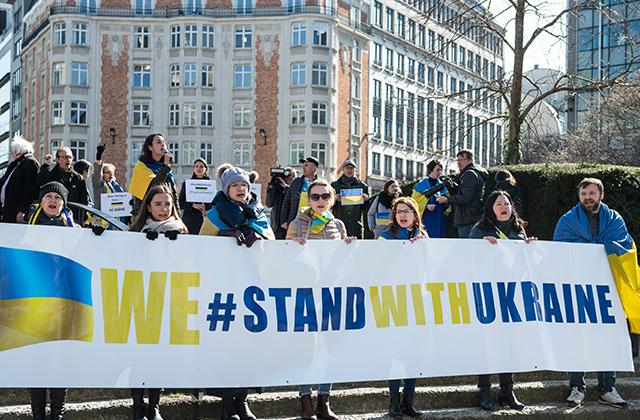
    The Russian invasion of Ukraine triggered solidarity from EU governments, local authorities and society as they welcomed more than 7 million people fleeing the aggression. The European Union’s rapid response, activating the EU Temporary Protection Directive, offered welcome relief and much-needed support to those in need. It allowed displaced persons the opportunity to quickly settle and to work, travel and access services across the EU. But other pressing human rights issues have come to the fore and remain high on the EU’s agenda, such as human trafficking, sexual and gender-based violence, hate crime and hate-fuelled disinformation.
  • Fundamental Rights Report
    8
    juin
    2022
    FRA’s Fundamental Rights Report 2022 reviews major developments in the field in 2021, identifying both achievements and areas of concern. It also presents FRA’s opinions on these developments, including a synopsis of the evidence supporting these opinions.
  • Fundamental Rights Report
    8
    juin
    2022
    Le présent focus s’intéresse à l’impact de la pandémie sur les droits sociaux. Il examine les mesures des plans nationaux de relance et de résilience qui visent les vulnérabilités sociales de divers groupes de population dans l’UE, notamment les femmes, les enfants et les jeunes en situation de vulnérabilité, les personnes handicapées, les personnes âgées, les Roms et les personnes dont les conditions de travail sont précaires.