As Instituições Nacionais dos Direitos Humanos (INDH) são uma parte vital do sistema de proteção dos direitos humanos à escala nacional. Ao sensibilizar, aconselhar, fiscalizar e velar pela responsabilização das autoridades, estas instituições desempenham um papel central nos grandes desafios que atualmente se levantam em matéria de direitos humanos, enfrentando quer os problemas persistentes, como a discriminação e as desigualdades, quer os novos problemas emergentes, como as implicações da inteligência artificial e da pandemia da COVID-19 em matéria dos direitos.
Instituțiile naționale pentru apărarea drepturilor omului (INDO) reprezintă o parte vitală a sistemului de protecție a drepturilor omului existent la nivelul unei țări. Prin eforturile lor de sensibilizare, consiliere, monitorizare și responsabilizare a autorităților, aceste instituții au un rol central în depășirea marilor provocări legate de drepturile omului din zilele noastre, abordând atât preocupări persistente, precum cele referitoare la discriminare și inegalitate, cât și chestiuni noi, cum ar fi implicațiile inteligenței artificiale și ale pandemiei de COVID-19 asupra acestor drepturi.
Národné inštitúcie pre ľudské práva (NHRI) sú nevyhnutnou súčasťou systému ochrany ľudských práv na vnútroštátnej úrovni. Zvyšovaním informovanosti, poskytovaním poradenstva, monitorovaním a vyvodzovaním zodpovednosti voči príslušným orgánom zohrávajú kľúčovú úlohu zvládaní súčasných veľkých výziev v oblasti ľudských práv. Zaoberajú sa pretrvávajúcimi problémami, ako je diskriminácia či nerovnosť, ako aj novými otázkami, napríklad vplyvom umelej inteligencie a pandémie COVID-19 na práva.
De nationella människorättsinstitutionerna är en viktig del av ländernas system för att skydda de mänskliga rättigheterna. Genom att bidra till en ökad medvetenhet, och genom att ge råd, övervaka och ställa myndigheter till svars, spelar de en central roll i hanteringen av vår tids stora människorättsutmaningar. De arbetar både med ständigt aktuella problem som diskriminering och ojämlikhet och med nya frågor som hur våra rättigheter påverkas av artificiell intelligens eller covid-19-pandemin.
Националните институции по правата на човека (НИПЧ) са жизнено важна част от
системата за защита на правата на човека на национално равнище. Тези институции
работят за повишаване на осведомеността, предоставят съвети, осъществяват
наблюдение и държат отговорни съответните органи, с което изпълняват централна
роля в усилията за преодоляване на най-значимите съвременни предизвикателства
в областта на правата на човека. Те предприемат действия във връзка както
с традиционни проблеми като дискриминацията и неравенството, така и с нови
въпроси като въздействието в областта на правата, произтичащо от изкуствения
интелект и от пандемията от COVID-19.
De nationale menneskerettighedsinstitutioner er en afgørende del af systemet til beskyttelse af menneskerettigheder på nationalt plan. Ved at skabe større bevidsthed, yde rådgivning, overvåge og stille myndighederne til ansvar har de en central rolle med hensyn til at navigere mellem nutidens store menneskerettighedsudfordringer — og tackle både vedvarende problemstillinger som diskrimination og ulighed og nye spørgsmål som f.eks. konsekvenserne af kunstig intelligens og covid-19-pandemien for rettighederne.
Nationale Menschenrechtsinstitutionen (NMRI) sind ein wichtiger Bestandteil des Systems zum Schutz der Menschenrechte auf nationaler Ebene. Sie tragen zur Bewusstseinsbildung bei, bieten Beratung, beobachten Behörden und ziehen sie zur Rechenschaft. Somit haben sie eine zentrale Rolle bei der Bewältigung der großen Herausforderungen unserer Zeit im Bereich der Menschenrechte inne, denn sie nehmen dauerhafte Probleme wie Diskriminierung und Ungleichbehandlung ebenso in Angriff wie neu auftauchende Fragen, etwa die Folgen der künstlichen Intelligenz und der COVID-19-Pandemie für die Grundrechte.
Οι εθνικοί οργανισμοί για τα ανθρώπινα δικαιώματα (ΕΟΑΔ) αποτελούν καίριας σημασίας στοιχείο του συστήματος προστασίας των ανθρωπίνων δικαιωμάτων σε επίπεδο χωρών. Μέσω της ευαισθητοποίησης, της παροχής συμβουλών, της παρακολούθησης και της εξασφάλισης λογοδοσίας των αρχών, διαδραματίζουν κεντρικό ρόλο στην αντιμετώπιση των μεγάλων σύγχρονων προκλήσεων στον τομέα των ανθρωπίνων δικαιωμάτων —τόσο σε ό,τι αφορά τα ζητήματα που προκαλούν επίμονες ανησυχίες, όπως οι διακρίσεις και η ανισότητα, όσο και σε ό,τι αφορά καινοφανή ζητήματα, όπως οι επιπτώσεις της τεχνητής νοημοσύνης και της πανδημίας COVID-19 στα ανθρώπινα δικαιώματα.
National Human Rights Institutions (NHRIs) are a vital part of the country-level human rights protection system. By raising awareness, providing advice, monitoring and holding authorities to account, they have a central role in navigating the great human rights challenges of our day – tackling both persistent concerns like discrimination and inequality, and novel issues such as the rights implications of artificial intelligence and of the COVID-19 pandemic.
Las instituciones nacionales de derechos humanos (INDH) constituyen una parte esencial del sistema de protección de los derechos humanos en cada país. Con su trabajo de sensibilización, asesoramiento, supervisión y exigencia de rendición de
cuentas a las autoridades, estas instituciones desempeñan un papel fundamental a la hora de abordar los grandes retos actuales en materia de derechos humanos, al ocuparse tanto de problemáticas recurrentes, tales como la discriminación y la
desigualdad, como de problemas de reciente aparición como las implicaciones desde el punto de vista de los derechos de la inteligencia artificial y de la pandemia de la COVID-19.
Inimõigustega tegelevad riiklikud asutused on oluline osa inimõiguste kaitse süsteemist riigi tasandil. Teadlikkuse suurendajate, nõustajate ning ametiasutuste jälgijate ja vastutusele võtjatena on neil keskne roll tänapäeva suurte inimõigusprobleemide lahendamisel ning nad tegelevad nii alaliste probleemidega, nagu diskrimineerimine ja ebavõrdsus, kui ka uute küsimustega, nagu COVID-19 pandeemia ja tehisintellekti mõju inimõigustele.
Kansalliset ihmisoikeusinstituutiot ovat olennainen osa eri maiden ihmisoikeuksien suojelujärjestelmää. Instituutiot lisäävät tietoisuutta ihmisoikeuksista, antavat neuvontaa, seuraavat viranomaisten toimintaa ja saattavat niitä vastuuseen. Näin niillä on keskeinen rooli tämän päivän suurten ihmisoikeushaasteiden parissa luovimisessa. Ne puuttuvat sekä syrjinnän ja epätasa-arvon kaltaisiin jatkuviin huoliin että uusiin kysymyksiin, joita ovat muun muassa tekoälyn ja covid-19- pandemian vaikutukset ihmisoikeuksiin.
Les institutions nationales des droits de l’homme (INDH) constituent un élément essentiel du système de protection des droits de l’homme dans chaque pays. En sensibilisant le public, en fournissant des conseils, en assurant une surveillance et en demandant des comptes aux autorités, elles jouent un rôle central dans la gestion des graves risques pesant sur les droits de l’homme à notre époque, affrontant à la fois les préoccupations persistantes, telles que la discrimination et les inégalités, et les nouvelles questions, telles que les répercussions sur les droits de l’intelligence artificielle et de la pandémie de COVID-19.
Nacionalne institucije za ljudska prava ključan su dio sustava za zaštitu ljudskih prava na razini pojedine zemlje. Time što osvještavaju, pružaju savjete, nadziru tijela i pozivaju ih na odgovornost, te institucije imaju središnju ulogu u hvatanju u koštac s velikim poteškoćama u području ljudskih prava u današnje doba, nastojeći pronaći rješenje za trajne probleme kao što su diskriminacija i nejednakost, ali i baveći se novim pitanjima kao što je utjecaj umjetne inteligencije i pandemije bolesti COVID-19 na ljudska prava.
A nemzeti emberi jogi intézmények (NHRI-k) az országos szintű emberijog-védelmi rendszer alapvető részét képezik. Figyelemfelkeltő tevékenységek, tanácsadás, nyomon követés és a hatóságok elszámoltatása révén központi szerepet töltenek be a napjaink jelentős emberi jogi kihívásai közötti eligazodásban – egyrészt kezelik a hátrányos megkülönböztetéshez és az egyenlőtlenséghez hasonló, tartósan fennálló aggályokat, másrészt a mesterséges intelligencia és a Covid19-világjárvány jogi vonatkozásaihoz hasonló, újszerű kérdéseket.
Le istituzioni nazionali per i diritti umani (NHRI) sono una parte vitale del sistema di protezione dei diritti umani a livello nazionale. Aumentando la consapevolezza, fornendo consigli, monitorando e tenendo conto delle autorità, le NHRI hanno un ruolo centrale nell'affrontare le grandi sfide attuali dei diritti umani. Tra i diversi problemi che tali istituzioni affrontano, vi sono quelli inerenti alla persistente discriminazione e disuguaglianza, e quelli relativi alle implicazioni sui diritti dell'intelligenza artificiale ed alla pandemia COVID-19.
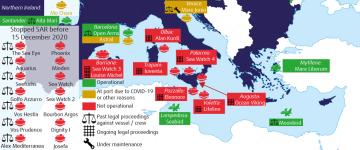
In 2020 (until 15 December), the International Organization for Migration estimated that about 1,054 people have died or gone missing while crossing the Mediterranean Sea to reach Europe to escape war or persecution or to pursue a better life. This is an average of almost three people per day. In the past years, a significant number of migrants in distress at sea have been rescued by civil society vessels deployed with a humanitarian mandate to reduce fatalities and bring rescued migrants to safety. Since 2018, however, national authorities initiated some 50 administrative and criminal proceedings against crew members or vessels, also seizing the latter. In some cases, rescue vessels were blocked in harbours due to flag issues or the inability to meet maritime safety-related and other technical requirements.
The EU is founded on the values of democracy, rule of law and respect for human rights. Yet these values, and discussions on fundamental rights at the EU and Member State level, can seem remote in people’s daily lives. With this in mind, FRA explored what people understand, know and experience with respect to their fundamental rights in practice. The resulting data provide comprehensive and comparable evidence on these aspects.
Artificial intelligence is here. It’s not going away. It can be a force for good, but it needs to be watched so carefully in terms of respect for our human fundamental rights. The EU Fundamental Rights Agency is deeply committed to this work.Our ambition is not just to ensure that AI respects our rights, but also that it protects and promotes them.
This year, the COVID-19 pandemic leaves a lasting mark on society worldwide. It affected everyone but some people more than others. As we look ahead, on Human Rights Day, on 10 December, we need to make the new normal a better normal. In his video message, FRA Director Michael O’Flaherty underlines the need to stand up for human rights to make 2021 a better year. This means ensuring we respect and take into account everybody's human rights.